Is Blinkit The Next Zepto, That Should Be Fined For Flouting Pricing Rules And Using Dark Pattern Practices?

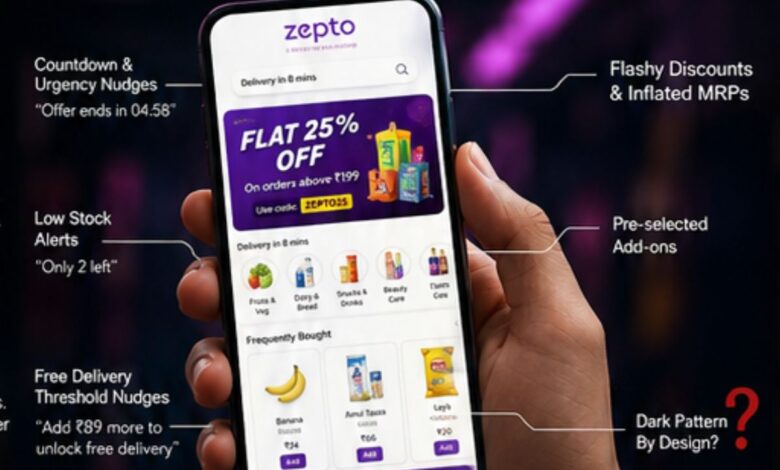
India’s quick-commerce sector has grown into a multi-billion-rupee convenience machine, promising 10-minute delivery of everything from groceries to cigarettes. Yet beneath the polished apps and flashy marketing lies a recurring pattern of pricing opacity that regulators have already begun to punish. In late 2025, the Central Consumer Protection Authority (CCPA) imposed a ₹7 lakh penalty on Zepto Marketplace for drip pricing and basket sneaking—practices that systematically pushed the final payable amount above the Maximum Retail Price (MRP) displayed to consumers.
The same structural issues appear on competing platforms, including Blinkit. When a pack of classic cigarettes is listed at its MRP of ₹480 and the checkout then layers on handling fees, late-night surcharges, convenience fees and other charges, the consumer is no longer paying the legally declared maximum price for the packaged commodity. This is not a minor interface quirk. It is a calculated design choice that exploits information asymmetry, and it demands the same regulatory scrutiny that Zepto received.
The Zepto Precedent: How CCPA Linked Interface Design to MRP Violations
In December 2025 the CCPA issued a detailed final order against Zepto after a suo motu examination of its checkout flows. Investigators found that the platform displayed a product price at the selection stage, only to introduce mandatory handling charges and a pre-ticked Zepto Pass membership fee once the user reached the cart or payment page. In one documented example, an item shown at ₹170 became ₹177.40 after the additional charges appeared. The Authority classified this as drip pricing—the progressive revelation of price elements that were not disclosed upfront—and basket sneaking, the automatic addition of a paid membership without explicit, affirmative consent.
Crucially, the CCPA did not stop at the Guidelines for Prevention and Regulation of Dark Patterns, 2023. It connected the interface practices directly to the Legal Metrology (Packaged Commodities) Rules, 2011. Rule 2(m) defines MRP as “the maximum price at which a packaged commodity may be sold to the consumer, inclusive of all taxes.” Rule 18(2) prohibits sale above that declared MRP.
The Authority held that once mandatory platform charges pushed the final amount above the displayed MRP, the consumer was effectively forced to pay more than the statutory ceiling. The order rejected Zepto’s defence that separating product price from service fees was necessary to avoid listing items above MRP. CCPA ruled that attracting consumers with a lower initial price and then adding unavoidable charges at checkout amounts to “indirectly bypassing the statutory prohibition on selling above the MRP.”

The regulator further found interface interference: payment options linked to the higher-fee path were visually highlighted in red while alternatives appeared in neutral colours, creating a behavioural nudge. Consent obtained through such design was deemed invalid. Zepto’s earlier self-audit declaration claiming a clean platform was dismissed as irrelevant in the face of regulatory findings. Post-scrutiny corrective changes—removal of the auto-added Pass and clearer fee displays—were acknowledged but held insufficient to erase liability for past conduct. The platform was directed to stop the practices, disclose all charges upfront, conduct regular public self-audits, and pay the penalty.
This order marks a decisive shift. Dark patterns are no longer treated as mere UX annoyances; when they inflate the final price beyond MRP, they become statutory pricing violations. The protective value of voluntary self-declarations has been sharply reduced. Regulator-led scrutiny now determines compliance.
The Same Playbook on Blinkit
Consumers ordering on Blinkit encounter a strikingly similar sequence. A product is presented at its MRP—₹480 for a standard pack of cigarettes, for example. At the moment of selection the price appears clean and final. Only after the item enters the cart, and especially at the checkout or payment confirmation stage, do additional line items materialise: handling fees, late-night convenience fees, small-cart charges, or surge-related surcharges. Reports from 2025 and 2026 document these exact categories on Blinkit.
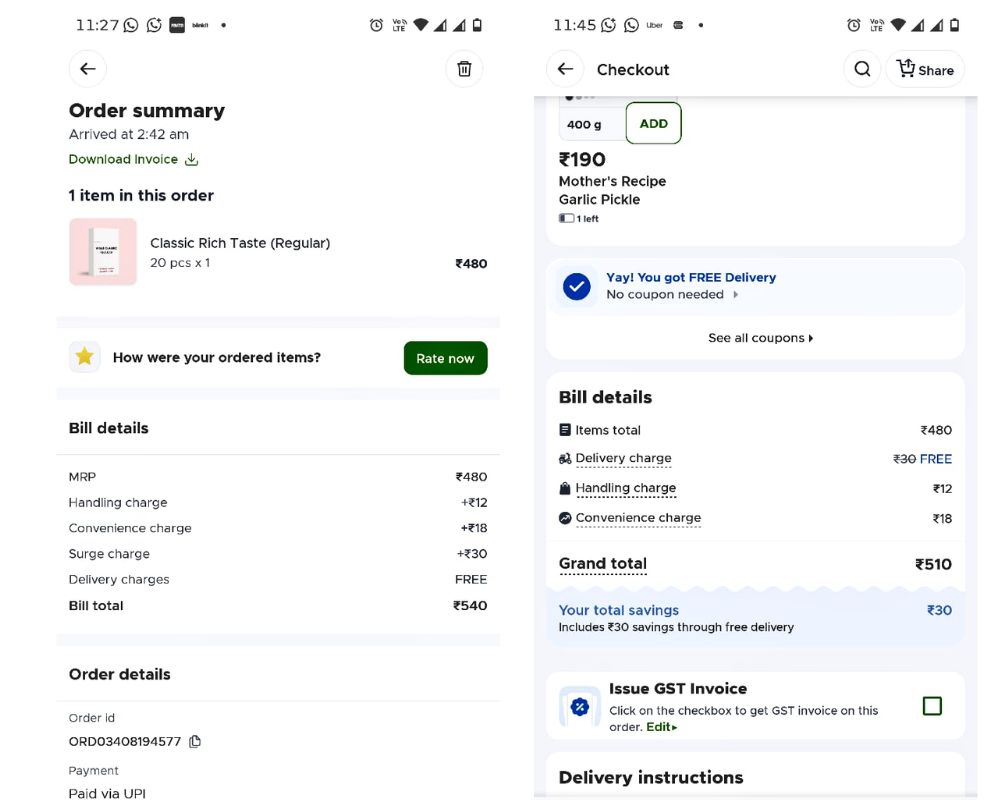
These are not optional tips or genuine third-party taxes. They are platform-imposed, often non-waivable costs that appear only after the consumer has invested time and cognitive effort in building the order. The initial price signal is therefore incomplete and misleading. Under the CCPA’s reasoning in the Zepto case, the final payable amount exceeds the declared MRP of the packaged commodity. The consumer who relied on the MRP display is left paying more.
Blinkit’s ownership by Eternal (formerly Zomato) and its dominant market position do not create a regulatory exemption. The Dark Patterns Guidelines apply uniformly to marketplace e-commerce entities. “Necessary fees” such as delivery may be exempt from basket-sneaking classification, if, they are explicitly disclosed at the time of purchase. Delayed or progressive disclosure converts them into drip pricing. Visual hierarchy, pre-selected options, or friction designed to discourage fee removal further aggravate the violation. The Guidelines list thirteen prohibited patterns; drip pricing and basket sneaking sit near the top.
Industry data reinforces the systemic nature of the problem. Studies in 2026 estimated that dark patterns cost Indian online shoppers ₹25,000–28,000 crore annually, with drip pricing and hidden charges experienced by a majority of users. Quick-commerce platforms, after years of subsidised delivery to acquire users, shifted toward monetising through layered fees precisely when regulatory attention intensified. Blinkit has publicly emphasised unit economics and avoided pure zero-fee models; the practical result for the consumer is a growing gap between the MRP advertised and the amount debited.
Why Large Platforms Persist in These Practices?
The commercial logic is straightforward. Displaying the pure MRP maximises conversion at the product-listing stage. Revealing the true all-in cost only after the consumer has added items, selected a delivery slot, and invested decision energy raises the psychological cost of abandoning the cart. Behavioural data shows that users are more likely to complete payment once they have progressed far into the funnel. The platform captures the difference between the advertised price and the final amount as margin, while the consumer absorbs the opacity.
This model is particularly potent for low-involvement, high-frequency purchases such as cigarettes, snacks or daily essentials. The absolute rupee amounts of individual fees may appear small—₹5 here, ₹10 there—but they compound across millions of orders. For the user who orders late at night or places a small basket, the surcharge becomes a reliable revenue stream. The Legal framework was designed precisely to prevent such erosion of the MRP’s protective function. When platforms treat the MRP as a starting point rather than a ceiling, they invert the statute’s purpose.
Defences that “sellers set the MRP and platforms only charge for logistics” have already been rejected by the CCPA. The Authority held that the entity controlling the interface, price display and transaction flow bears responsibility for transparency, regardless of internal fund allocation between marketplace and sellers. The same logic applies to Blinkit. Whether the handling fee is labelled a logistics cost or a platform service is secondary to the question of when and how clearly it is disclosed, and whether the final amount stays within the MRP bound for the packaged good.
The Case for Immediate Scrutiny of Blinkit
Zepto’s penalty and subsequent app overhaul demonstrate that regulatory pressure works. After the order, Zepto moved charges to the cart page, removed default membership additions, and improved disclosure. Other platforms have made selective adjustments under the same threat. Yet the absence of a parallel public investigation or penalty against Blinkit creates an uneven playing field and leaves consumers exposed to identical harms.
The CCPA’s own advisory of June 2025 directed e-commerce platforms to conduct self-audits for dark patterns and to create a fair digital ecosystem. Self-audits that claim cleanliness while checkout flows continue to layer fees after the MRP display are precisely the kind of declaration the Authority has already discounted. Consistency in enforcement requires that the same methodology applied to Zepto—suo motu monitoring, reality testing of checkout sequences, examination of whether final payable exceeds displayed MRP, and assessment of consent validity—be applied to Blinkit and every other major quick-commerce operator.
Consumers who encounter a ₹480 MRP cigarette pack transforming into a higher final bill at checkout have a clear remedy pathway: file complaints under the Consumer Protection Act, 2019, and the Dark Patterns Guidelines. More importantly, the regulator should treat the pattern as systemic rather than platform-specific. The Legal Metrology Rules exist to give consumers a reliable price signal. When that signal is systematically undermined by design, the law is being flouted, regardless of the brand name on the app.
Broader Implications for Consumer Trust and Market Integrity
The quick-commerce model thrives on speed and convenience. Those advantages are real. They do not justify eroding the foundational price transparency that Indian consumer law has long protected. MRP was never intended as a marketing teaser; it is a statutory ceiling. Dark-pattern guidelines were issued to stop precisely the progressive revelation of costs and the engineering of consent. When large, well-capitalised platforms continue to deploy these techniques after a peer has been penalised and ordered to reform, the message is that scale confers temporary immunity.
The platform possesses complete knowledge of the fee structure at every stage; the consumer discovers it only after commitment. That asymmetry is the definition of an unfair trade practice under the Consumer Protection Act. The CCPA’s Zepto order closed the loophole that platforms had relied upon—claiming service fees sit outside MRP. The same reasoning must now be applied uniformly. Anything less invites a race to the bottom in which every competitor layers more opaque charges, and the consumer ultimately pays for the opacity.
Blinkit’s reported fee architecture, which includes handling charges, late-night convenience fees, small-cart penalties, mirrors the practices that triggered Zepto’s penalty. The absence of an equivalent public finding does not prove compliance; it highlights an enforcement gap. Regulators, consumer groups and the platforms themselves should treat that gap as urgent. Upfront, all-inclusive disclosure of every rupee that will leave the consumer’s account is not a design preference. It is the minimum required by both the Dark Patterns Guidelines and the Legal Metrology framework. Until that standard is met across the board, claims of consumer-centric innovation remain incomplete.
The ₹480 cigarette pack that becomes more expensive at the final screen is not an isolated anecdote. It is a symptom of an industry still testing how far pricing opacity can be pushed before the next penalty lands. The Zepto order has already drawn the line. Consistency demands that Blinkit, and every platform employing the same techniques, be held to it.