DHFL Probe Takes A New Turn As CBI Alleges ₹1 Crore Bribe. Arrests SFIO Deputy Director, Advocate
A CBI investigation into an alleged ₹1 crore bribe has put an SFIO deputy director under scrutiny in a case linked to DHFL. The arrests raise fresh questions as investigators continue probing one of India's biggest alleged bank frauds.


The Central Bureau of Investigation (CBI) has arrested Indian Revenue Service (IRS) officer Harish Kumar Tanwar, a deputy director at the Serious Fraud Investigation Office (SFIO), along with Delhi-based advocate Bharat Sharma and Sharma’s relative Aryan Sharma, in an alleged ₹1 crore bribery case linked to the investigation into Dewan Housing Finance Corporation Limited (DHFL).
According to reports, the CBI alleges that Tanwar, who was posted at the SFIO’s Chennai office, demanded money in exchange for providing favourable treatment to a person connected with an ongoing DHFL-related investigation. The alleged demand was accompanied by threats of arrest and prosecution if the money was not paid, according to the complaint described in the reports.
The case came to light after a complaint was submitted to the CBI on October 12. Investigators subsequently verified the allegations and laid a trap operation, during which ₹20 lakh was allegedly handed over as part-payment of the larger amount.
The CBI arrested the three accused and conducted searches at premises linked to Tanwar and Sharma. The agency reportedly recovered material connected with the investigation.
The case has since moved to the courts. In a report published on October 18, said the Rouse Avenue Court had remanded Tanwar to three days of CBI custody to allow investigators to question him about the alleged arrangement and identify other possible participants. The court also extended Bharat Sharma’s CBI custody by one day, while Aryan Sharma had earlier been sent to judicial custody for 14 days.
The arrests have brought renewed attention to the investigation being handled by the SFIO, the government agency responsible for investigating serious corporate fraud. However, the alleged bribery case remains separate from the underlying DHFL fraud proceedings. The allegations against the accused have yet to be established in court.
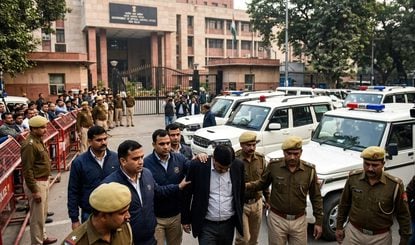
Complainant Alleges Threats Of Arrest As CBI Traces Bribe Demand
The complaint that triggered the CBI action was filed by Gopal Shivram Dalvi on October 12. Dalvi alleged that Tanwar, Bharat Sharma and others demanded ₹1 crore in exchange for favourable treatment in the SFIO’s investigation connected with DHFL. The complaint also alleged that he was threatened with arrest and prosecution.
The CBI reportedly verified the allegations on October 12 and 13 in the presence of independent witnesses. According to the agency’s account, the verification indicated that a bribe had allegedly been demanded by Tanwar and Sharma.
The alleged amount was reportedly negotiated down from an initial demand of ₹10 crore to ₹1 crore, according to the subsequent court-reporting coverage published. The agreed advance was reportedly ₹25 lakh, although the amount allegedly handed over during the operation was ₹20 lakh.
The CBI then registered a case and conducted the trap operation. According to one report, Sharma allegedly agreed to receive the money on Tanwar’s behalf. Aryan Sharma was also arrested in connection with the alleged transaction.
The CBI has invoked provisions of the Prevention of Corruption Act, 1988, as amended, along with provisions of the Bharatiya Nyaya Sanhita relating to criminal conspiracy. The investigation remains ongoing, with the agency seeking to establish how the alleged demand was coordinated and whether other individuals were involved.
The case now places the alleged bribery arrangement before the courts while investigators continue to examine the circumstances surrounding the demand and payment.
Who Is Harish Kumar Tanwar and What Was His Role In the DHFL Probe?
Harish Kumar Tanwar is a 2017-batch Indian Revenue Service (IRS) officer belonging to the Income Tax cadre. At the time of his arrest, he was posted as a Deputy Director at the Serious Fraud Investigation Office (SFIO) in Chennai and was the investigating officer in the DHFL-related case, according to India Today.
The SFIO operates under the Ministry of Corporate Affairs and investigates serious corporate fraud. Its investigations can involve financial transactions, company records, accounting practices and the movement of funds across related entities. The government ordered an SFIO investigation into DHFL and five other companies in November 2019 following scrutiny of the company’s financial affairs by the Registrar of Companies.
The CBI’s bribery case has also brought a senior IRS officer posted at the SFIO under scrutiny.
How The DHFL Investigation Began
The investigation into Dewan Housing Finance Corporation Limited (DHFL) gathered momentum in 2019, when questions emerged over the company’s borrowings, financial transactions and the alleged diversion of funds. The Registrar of Companies examined DHFL’s financial affairs and submitted a report to the Ministry of Corporate Affairs. The government subsequently ordered an investigation by the SFIO into DHFL and five other companies, including entities named Immediate Real Estate, Tenancity Real Estate, RKW Developers, Darshan Developers and Rajen Skycrapers.
The DHFL matter also came under investigation by the CBI and the Enforcement Directorate. The CBI’s case focused on alleged cheating and diversion of funds borrowed from a consortium of 17 banks led by Union Bank of India. The ED pursued the alleged proceeds of crime and the movement of money and assets linked to the suspected diversion.
The scale of the allegations was substantial. In its case, the CBI alleged that the lenders had been cheated of approximately ₹34,615 crore through misrepresentation, concealment of facts, criminal breach of trust and the diversion of funds. The figure represents the alleged loss in the bank consortium case, not a final judicial finding that the entire amount was fraudulently diverted.
In October 2022, the CBI filed a chargesheet naming 18 individuals and 57 companies or entities. The chargesheet alleged that DHFL funds had been diverted through a network of shell companies and fictitious retail loan accounts. The court subsequently took cognisance of the chargesheet and summoned the accused named in the case.
How The Alleged DHFL Fraud Worked
The CBI’s case against DHFL centres on allegations that funds borrowed from a consortium of 17 banks were diverted through shell companies and concealed using fictitious retail loan accounts. The lenders had sanctioned credit facilities aggregating ₹42,871.42 crore to the company, while the alleged wrongful loss to the consortium was estimated at approximately ₹34,615 crore.
According to the prosecution’s account, one mechanism involved 87 shell companies that allegedly received ₹11,765.11 crore between 2007 and 2017. The transactions were allegedly recorded in DHFL’s accounting system as loans to retail homebuyers, masking the movement of money to the companies.
Investigators also alleged that DHFL used a fictitious branch identified as “Bandra Branch-001”. The branch allegedly existed in the company’s accounting system but not as a functioning physical branch. Fake home-loan accounts were reportedly generated through the company’s software, while a separate set of records, referred to as the “Bandra Book”, allegedly tracked transactions that were not properly reflected in the company’s regular accounts.
The CBI’s case names DHFL’s former promoters Kapil Wadhawan and Dheeraj Wadhawan among those accused of conspiring to divert funds. The allegations include the use of shell entities, falsification of company records and the extension of loans without adequate documentation or security. The accused are entitled to the presumption of innocence unless the charges are proved in court.
The scale and complexity of the alleged transactions have resulted in multiple proceedings involving different sets of loans and entities. Figures cited in the cases can therefore vary depending on which transactions are included; they should not automatically be treated as separate losses or added together.
ED Freezes ₹51.75 Crore as DHFL Money-Laundering Probe Continues
The Enforcement Directorate (ED) froze approximately ₹51.75 crore in a bank account linked to UAE-based Al Jalore Trading FZE in August 2026, as part of its ongoing money-laundering investigation into the alleged DHFL loan fraud. The agency said the amount, equivalent to around US$5.41 million, represented proceeds of crime.
The action followed searches conducted on August 19, 2026, and an investigation into the sale of Hurtmore House, a property in the United Kingdom held in the name of Vanita Wadhawan, wife of former DHFL promoter Kapil Wadhawan.
According to the ED, the property was involved in a series of transactions that allegedly created a fictitious liability in Vanita Wadhawan’s name. A purported loan agreement was reportedly executed between her and Al Jalore Trading FZE, following which the property was mortgaged.
The agency alleged that when Hurtmore House was sold in 2026, the proceeds were transferred to Al Jalore Trading FZE’s Indian bank account rather than being received by Vanita Wadhawan, the property’s registered owner. The ED suspects that the arrangement was used to facilitate the settlement of a liability in India arising from the alleged DHFL fraud.
During the searches, investigators examined the company’s bank account and froze the funds under the Prevention of Money Laundering Act. Documents and records relating to the transactions and assets were also seized or impounded.
The action is part of the ED’s separate money-laundering investigation, which originated from the CBI’s case following a complaint by Union Bank of India on behalf of the consortium of lenders. The latest freeze represents an additional step in tracing assets allegedly connected to the fraud. The ED said further investigation was underway.
DHFL Fund-Diversion Case Moves Forward In Court
The legal proceedings linked to DHFL have continued alongside the investigation into alleged money laundering and asset transfers.
In July 2026, a special CBI court ordered charges to be framed against Kapil Wadhawan, Dheeraj Wadhawan and others in a separate case involving alleged fund diversion of ₹32,930 crore. The court held that the material on record raised “grave suspicion” of a conspiracy and directed that the accused face charges relating to criminal conspiracy, cheating, forgery and falsification of accounts.
The CBI’s bribery case has introduced a separate set of allegations into an investigation that has already involved multiple agencies, corporate records and court proceedings.