India’s top oil firm IOC will give Rs 50.22 crore towards funding the ambitious trans-continental relocation of Cheetahs from Africa to India, the company said on Tuesday.
Indian Oil Corporation (IOC) has signed a memorandum of understanding with the National Tiger Conservation Authority (NTCA) for meeting two-thirds of the Rs 75 crore project cost.
“Under the aegis of the NTCA and powered by IOC, the ambitious Cheetah Reintroduction Project is set to welcome the first Cheetahs on Indian soil after over seven decades on September 17, 2022,” the company said in a statement.
IOC is the first and only corporate to come forward to support ‘Project Cheetah’ through CSR.
Under this project, a source population of 15-20 Cheetahs will be flown in from Namibia and South Africa and will be introduced at Kuno National Park, Madhya Pradesh.
IOC will be contributing Rs 50.22 crore over five years for cheetah reintroduction as well as its habitat management and protection, ecology development, staff training and veterinary healthcare.
The cheetah population in India dwindled during the 19th century, largely because of bounty hunting by local kings and ruling British officials. The last three Asiatic cheetahs were hunted down in 1948 and the cheetah was declared extinct in the country in 1952.
The subspecies of cheetah which got extinct in India was Asiatic Cheetah (Acinonyx jubatus venaticus) and the subspecies being introduced in the country is the African Cheetah (Acinonyx jubatus jubatus). Research has shown that the genes of these two subspecies are the same.
On August 2, IOC said it had signed an MoU with NTCA for the transcontinental relocation of Cheetah in its historical range in India.
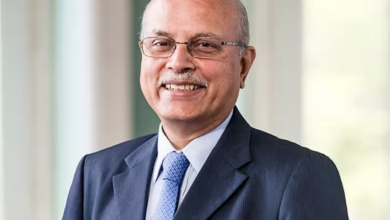
The MoU was signed by S M Vaidya, Chairman, IOC and S P Yadav, Addl. Director General (Project Tiger) and Member Secretary (NTCA).
Reflecting IOC’s commitment to supporting this ambitious ecological project steadfastly, Vaidya said the Cheetah Introduction Project is in sync with the company’s priority of conserving India’s natural habitat and heritage.
“Our mascot, the now famous Indian Oil Rhino, stands firm as a testimony to that commitment,” he said.
India’s Economy Grew 7.8% But Can One Number Really Capture The Economy Of 1.4 Billion People? What Exactly Is India Measuring And Why The Number Deserves A Closer Look
1 day ago
Shailesh Haribhakti Ranks No.1 In Terms Of Past Dark Anecdotes In The Entire Network Of Ankiti Bose
1 day ago
Delhi HC Dismisses Nitin Naresh PIL: When Police Denials Clash With Media Reports, Who Will Answer For The Truth?
1 day ago
Where The Money Went Is One Question. Who Was Around It Is Another: Robin Raina, Ankiti Bose, Krishan Rattan, Vikas Garg And The Ebix-Mahadev Trail
2 days ago
UPI’s Free Ride Is Ending But The Bigger Story May Be India’s Search For Fiscal Room. Are India’s Banks Strong Enough For The Kind Of Shocks India May Have To Absorb Next?
2 days ago
ED & CBI Must Investigate Ankiti Bose & Krishan Rattan In Mahadev Betting App Scam
2 days ago
Ankiti Bose: From Startup Star to the Face of Zilingo’s Collapse
2 days ago
Trump’s Russian Oil Tariff Threatens India Even As The World Runs Out Of Predictable Oil. Iran And The Middle East Are Rewriting The Global Energy Map, But The Bigger Battle Is Over Who Controls The Next Barrel
2 days ago
Ankiti Bose & Krishan Rattan Are Surrounded By The Network Of People With Dark History & Compromised Historical Anecdotes
2 days ago
Why Ankiti Bose & Krishan Rattan Are Surrounded by a Network of People Whose Histories Demand Scrutiny
With Product You Purchase
Subscribe to our mailing list to get the new updates!









India’s top oil firm IOC will give Rs 50.22 crore towards funding the ambitious trans-continental relocation of Cheetahs from Africa to India, the company said on Tuesday.
Indian Oil Corporation (IOC) has signed a memorandum of understanding with the National Tiger Conservation Authority (NTCA) for meeting two-thirds of the Rs 75 crore project cost.
“Under the aegis of the NTCA and powered by IOC, the ambitious Cheetah Reintroduction Project is set to welcome the first Cheetahs on Indian soil after over seven decades on September 17, 2022,” the company said in a statement.
IOC is the first and only corporate to come forward to support ‘Project Cheetah’ through CSR.
Under this project, a source population of 15-20 Cheetahs will be flown in from Namibia and South Africa and will be introduced at Kuno National Park, Madhya Pradesh.
IOC will be contributing Rs 50.22 crore over five years for cheetah reintroduction as well as its habitat management and protection, ecology development, staff training and veterinary healthcare.
The cheetah population in India dwindled during the 19th century, largely because of bounty hunting by local kings and ruling British officials. The last three Asiatic cheetahs were hunted down in 1948 and the cheetah was declared extinct in the country in 1952.
The subspecies of cheetah which got extinct in India was Asiatic Cheetah (Acinonyx jubatus venaticus) and the subspecies being introduced in the country is the African Cheetah (Acinonyx jubatus jubatus). Research has shown that the genes of these two subspecies are the same.
On August 2, IOC said it had signed an MoU with NTCA for the transcontinental relocation of Cheetah in its historical range in India.
The MoU was signed by S M Vaidya, Chairman, IOC and S P Yadav, Addl. Director General (Project Tiger) and Member Secretary (NTCA).
Reflecting IOC’s commitment to supporting this ambitious ecological project steadfastly, Vaidya said the Cheetah Introduction Project is in sync with the company’s priority of conserving India’s natural habitat and heritage.
“Our mascot, the now famous Indian Oil Rhino, stands firm as a testimony to that commitment,” he said.