Kapil and Dheeraj Wadhwan: The Housing-Finance Empire, the Phantom Branch, and a Trial That Still Cannot Finish

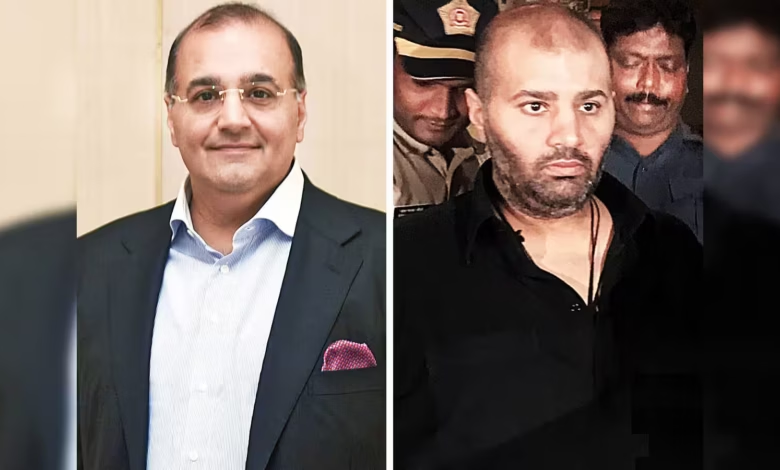
They sold the romance of a home loan. Investigators later described a ledger that could invent a home loan that never existed. That is the ugly distance between the public face of Dewan Housing Finance Limited and the case files now sitting on CBI, ED, SEBI and NCLT tables against Kapil and Dheeraj Wadhwan.
Not a rumour mill. Not a television shout. A paper trail so fat that the Supreme Court itself said a day-to-day trial might not finish in two to three years. Four lakh pages. Seven hundred and thirty-six witnesses. One hundred and ten accused. Seventeen trunks of documents the prosecution did not even rely on. More than two terabytes of digital data. And still, as of today, no criminal court has convicted Kapil Wadhawan or Dheeraj Wadhawan.
That last sentence is not mercy. It is an indictment of the system that allowed an alleged multi-decade siphon to become a litigation industry.
The men, the company, the collapse
Kapil Wadhawan was Chairman and Managing Director of DHFL. Dheeraj Wadhawan was a director. For years the firm was marketed as a mass-housing lender, a retail machine that turned bank money into home loans for ordinary borrowers. In November 2019 the Reserve Bank of India superseded the board after defaults. In 2021 the company was resolved under the Insolvency and Bankruptcy Code and acquired by the Piramal Group for a consideration of ₹34,250 crore, with creditors and depositors recovering about ₹38,000 crore in the aggregate — roughly 46 per cent for most creditors, far less for many depositors. About 70,000 creditors ate the haircut. The promoters ate the exit.
On 1 April 2025 the Supreme Court confirmed the resolution plan and dismissed challenges by the erstwhile promoters. The corporate shell got IBC protection. The men who ran it did not. Section 32A of the Code can wash the company. It does not wash the alleged authors of the books.
On 14 August 2025, NCLT Mumbai went further against Kapil personally. On a Union Bank of India petition under Section 123 of the IBC, the bench of Lakshmi Gurung and Hariharan Neelakanta Iyer declared him bankrupt. After adjusting recoveries from the DHFL resolution, the unpaid personal-guarantee liability was quantified at ₹4,545.96 crore. His estate was ordered to vest in bankruptcy trustee Sanjay Kumar Mishra. The man who once sat atop a listed housing-finance giant was, in the civil law of insolvency, a bankrupt personal guarantor.
That is not a morality play. It is a balance-sheet verdict on a guarantee he signed.
What the CBI put on paper
The Central Bureau of Investigation’s FIR of 20 June 2022, on a complaint by Union Bank of India for a consortium of 17 banks, is the spine of the criminal case against Kapil and Dheeraj Wadhwan. The alleged offences include criminal conspiracy, criminal breach of trust, cheating and falsification of accounts under the IPC, and provisions of the Prevention of Corruption Act.
The numbers in official papers do not always wear the same suit, and that sloppiness itself tells you how large the alleged wreck is:
- Consortium facilities often cited as ₹42,871.42 crore in CBI/ED FIR language.
- Court reporting of the same matter also records sanctioned loans of about ₹57,242 crore to ₹57,252 crore.
- Alleged wrongful loss to lenders: about ₹34,615 crore in most CBI/ED statements; ₹34,614.88 crore in later charge-framing coverage; ₹34,926.77 crore in one detailed court report.
Pick the conservative official figure and you are still staring at a ₹34,615-crore hole alleged against a consortium of public-sector and other banks. That is not a rounding error. That is a mid-sized state budget dressed up as a housing book.
The method alleged by CBI is almost literary in its cynicism.
Investigators say Kapil and Dheeraj Wadhwan, with others, routed DHFL money through 87 shell companies opened in the names of employees, friends and associates. Those entities, the agency says, took funds without proper documentation. On the books, the same money was dressed as loans to 2,60,315 fictitious retail borrowers. To make the costume fit, DHFL’s system allegedly grew a branch that did not exist: “Bandra branch-001.” Not a building. Not a manager’s cabin. A code in software. A ghost counter in Bandra through which real bank money could walk out wearing a home-loan name.
CBI’s chargesheet language has put the disbursal to those 87 entities in the region of ₹11,675 crore to ₹11,765 crore between 2007 and 2017. Later court reporting on charge-framing used ₹11,765.11 crore. The prosecution case is that dummy borrower data was generated by software that lifted names and addresses from existing files — a factory for imaginary home-buyers.
If even half of that architecture is proved at trial, it is not “aggressive lending.” It is book-cooking with a pincode.
CBI also alleged that diverted money paid for a collector’s life: chargesheet reporting in 2022 spoke of 24 paintings worth about ₹63 crore. The Enforcement Directorate later attached a smaller, separately valued basket of art and objects. Different valuations, same accusation: bank-funded taste.
SEBI’s parallel finding: “egregiously fraudulent”
Criminal law still waits. The market regulator did not.
In August 2025, SEBI’s whole-time member order described an “egregiously fraudulent scheme” running from 2006. It held that DHFL diverted funds to promoter-linked “Bandra Book Entities.” Outstanding loans to those entities as of March 2019 were put at about ₹14,040 crore. SEBI said ₹5,662.44 crore went to 39 such entities, of which 40 per cent was then moved into 48 other promoter-connected companies. It said the firm booked fake interest income even without genuine repayments, inflating profits and misleading the market.
SEBI identified Kapil and Dheeraj as the principal orchestrators. It barred them from the securities market for five years, barred them from key positions in listed companies for the same period, and fined them ₹27 crore each. Total penalties on the noticees: about ₹120 crore. Rakesh Wadhawan and Sarang Wadhawan, who sat on the DHFL board, drew four-year restraints and ₹20.75 crore each. Former CEO Harshil Mehta and former CFO Santosh Sharma drew three-year bars and fines of ₹11.75 crore and ₹12.75 crore.
A SEBI order is not a sessions-court conviction. It is still a formal finding by the capital-market regulator that the Bandra Book was not a clerical accident. As of 29 September 2026, SEBI’s recovery machinery was still moving against Dheeraj Wadhawan as a defaulter in DHFL scrip-trading proceedings under Recovery Certificate No. 9214 of 2026. The file has not gone to sleep.
Yes Bank: the other door through which money allegedly walked
The consortium case is not the only door.
ED and CBI have long alleged a quid pro quo with former Yes Bank MD and CEO Rana Kapoor. The prosecution story is blunt: between April and June 2018, Yes Bank put about ₹3,700 crore into DHFL short-term debentures. DHFL, in the ED’s telling, then pushed ₹600 crore to DOIT Urban Ventures Pvt Ltd, an entity linked to Kapoor’s family, against properties the agency valued at only ₹39.66 crore. ED has spoken of proceeds of crime in that stream in the region of ₹5,050 crore.
Kapil and Dheeraj were arrested in April 2020 in the Yes Bank-linked matters. The Supreme Court’s December 2025 bail order recorded defence submissions that about 11 cases stood registered, with custody from April 2020, and that bail had already been granted in the other matters — including the CBI Yes Bank special case and the ED Yes Bank special case. The company itself later walked out of some PMLA prosecution because IBC Section 32A protects a resolved corporate debtor. The former directors were told, in so many words, that the shield is not theirs.
So the pattern is not one FIR and a bad year. It is a cluster: bank consortium, market regulator, anti-money-laundering unit, insolvency court, personal bankruptcy. Different statutes. Same surnames.
The luxury inventory the ED put under lock
If the CBI case is about how the money left the banks, the ED case is about where it allegedly sat down.
In October 2023 the Directorate provisionally attached assets it valued at ₹70.39 crore in the names of Kapil and Dheeraj in the DHFL–Union Bank matter:
- paintings and sculpture: ₹28.58 crore
- watches: ₹5 crore
- diamond jewellery: ₹10.71 crore
- 20 per cent stake in a helicopter: ₹9 crore
- two flats in Bandra: ₹17.10 crore
ED then said total attachment in that case stood at about ₹2,095.94 crore.
In September 2025 it attached another layer: 154 flats in Kurla and receivables against 20 more flats, valued at about ₹185.84–186 crore. Agency statements put the running total of that attachment track at roughly ₹256 crore. Homes for the market on one side of the brochure. Homes under attachment on the other.
Then came August 2026, six years after the first arrests, and the file still grew a new limb.
ED’s Headquarters Investigation Unit searched on 19 August 2026. The press note of 28 August said Hurtmore House in the United Kingdom, held in the name of Vanita Wadhawan, wife of Kapil Wadhawan, was disposed of through what the agency called a fictitious liability created in her name. A purported loan agreement with UAE-based Al Jalore Trading FZE, a mortgage over the house, a sale in 2026, and sale proceeds directed not to the registered owner but into Al Jalore’s Indian bank account. ED froze about US$5.41 million — ₹51.75 crore — as alleged proceeds of crime under Section 17(1A) of the PMLA.
Read that slowly. A housing-finance collapse in India. A house in Britain. A free-zone company in the UAE. An account in India. A freeze in 2026. If this is what “finished investigation” looks like, the word finished has been ill-used.
Courts have already used ugly words. They have not used the word “guilty.”
In August 2025, Justice Ravinder Dudeja of the Delhi High Court refused regular bail in a 27-page order and wrote that the court could not release a person who was “prima facie the mastermind of a deep-rooted financial fraud, especially when the trial is at a nascent stage.” That is a High Court speaking, not a columnist. It is still a prima facie line, not a conviction.
The same season, the Supreme Court cancelled Dheeraj Wadhawan’s medical bail and ordered him back. The custody story of Kapil and Dheeraj Wadhwan is a bounce: arrest, statutory bail, cancellation, medical bail, cancellation, then regular bail. Not the biography of men the State forgot. The biography of men the process cannot finish.
On 11 December 2025, Justices J.K. Maheshwari and Vijay Bishnoi granted regular bail in the CBI consortium case. They did not bless the defence. They looked at the mountain of paper and said even a day-to-day trial might not end in two or three years. They said prolonged pre-trial jail cannot become the sentence. They imposed a leash: ₹10 lakh personal bond each with two sureties, monthly police reporting, passport surrender within two days, no exit from India without High Court permission, no touching witnesses, no casual adjournments. Breach itself is a ground to cancel.
Bail is not honour. It is the Constitution admitting that the republic cannot try a four-lakh-page case at the speed the allegation deserves.
In late July / early August 2026 — reported as an order of Special Judge Sanjeev Kumar Malhotra — a CBI court directed framing of charges against the brothers and others in a ₹32,930-crore fund-diversion prosecution arising from the same bank-consortium story. The judge held that the material raised “grave suspicion” of conspiracy. Charges under conspiracy, cheating, forgery and falsification of accounts were to be framed.
Grave suspicion is the door to trial. It is not the verdict. Anyone who treats charge-framing as a hanging is doing the accused a favour and the public a fraud. But anyone who treats “not convicted yet” as “nothing happened” is doing the banks a fraud.
A separate PMAY-linked CBI inquiry into dummy housing-loan accounts was reported closed in January 2025 after the agency could not establish criminal conspiracy in that specific file. That closure is real. It is also not a cleansing certificate for the consortium fraud, the SEBI Bandra Book finding, the PMLA attachments, or the personal bankruptcy. Different files. Different conclusions. The main wreck remains in court.
The bitter arithmetic
Put the verified public record on one page and stop flinching.
| What the record says | Figure / fact | Status |
|---|---|---|
| Alleged lender loss (CBI/ED mainstream figure) | ~₹34,615 crore | Allegation |
| Facilities cited in FIR language | ₹42,871.42 crore | Allegation |
| Sanctioned-loan figure in court reporting | ~₹57,242–57,252 crore | Allegation |
| Shell companies in CBI narrative | 87 | Allegation |
| Fictitious retail borrowers alleged | 2,60,315 | Allegation |
| Disbursals to shells (chargesheet range) | ~₹11,675–11,765 crore | Allegation |
| SEBI outstanding to Bandra Book Entities (Mar 2019) | ~₹14,040 crore | Regulatory finding |
| SEBI penalty on Kapil / Dheeraj | ₹27 crore each | Regulatory order |
| Piramal resolution consideration | ₹34,250 crore | Completed 2021 |
| Creditor recovery in resolution | ~₹38,000 crore aggregate; ~46% for most creditors | Completed |
| Kapil personal bankruptcy debt | ₹4,545.96 crore | NCLT order, 14 Aug 2025 |
| ED freeze on Al Jalore account (Aug 2026) | ₹51.75 crore | Provisional PMLA action |
| CBI chargesheet bulk | ~4 lakh pages, 736 witnesses, 110 accused | Court record |
| Criminal conviction of either brother in these frauds | None | Fact as on 30 Sep 2026 |
The public paid twice. First when banks — many of them public-sector banks handling public deposits — booked the alleged loss. Then when the insolvency process returned only a slice. The men named as promoters moved from boardrooms to bail bonds to bankruptcy trustees, while the trial calendar negotiated with trunks of paper.
That is the pinch. Not poetry. Arithmetic.
Who failed besides the accused?
Attack the accused on the record. Then attack the State on the same record.
Cobrapost put diversion allegations in the public domain in January 2019. DHFL denied them. RBI took the board in November 2019. Arrests in the Yes Bank cluster came in April 2020. The big consortium FIR came in June 2022 — years after the default, years after the forensic gossip, years after the company had already been put on the IBC slab. Grant Thornton forensic work and bank complaints did not arrive from Mars. They sat in files while the clock ran.
Then the prosecution built a case so obese it became its own alibi. Four lakh pages is not automatically a sign of rigour. It can also be a sign of an investigation that photocopied the universe instead of choosing the twenty documents that would prove a branch that never existed. If “Bandra-001” is a software ghost, a competent trial should be able to show the code, the maker, the authorisation, the money trail, and the beneficiary. That is how fraud cases are supposed to die or live. Not by storing 17 extra trunks “in case we need them later.”
ED is still finding UK houses in 2026. That can mean diligence. It can also mean the first five years did not map the overseas layer with enough violence. SEBI could describe a scheme “since 2006” in 2025. Criminal courts were still arguing bail in 2025. Charge-framing in a related diversion case arrived in 2026. The alleged crime window starts in the mid-2000s. The trial has not started in any sense that a depositor would recognise as justice.
Kapil and Dheeraj Wadhwan are entitled to every presumption the Constitution gives an undertrial. Banks and depositors are entitled to a State that can finish a case it already calls one of the largest bank frauds in the country. Both sentences can be true. Only one of them is being treated as urgent.
What “speedy trial” must mean here
The Supreme Court was right on liberty and late on consequence. Bail with a passport on the trial court table is not a scandal if the alternative is jail without a trial. The scandal is that a documentary case — the Court’s own description in surrounding reportage — still needs 736 mouths to narrate what a server and a bank statement should already scream.
What should happen now is not another press conference.
- Frame charges in every live CBI file within a fixed outer limit and stop treating “nascent stage” as a lifestyle. The Malhotra court has already spoken of grave suspicion in the diversion case. Convert suspicion into issues for trial, then try them.
- Split the trial. Promoters and the core Bandra Book evidence in one court, on a day-to-day roster. Shell-company residual accused in another. The 110-accused circus is how rich defendants outlive poor complainants.
- Make the digital record the first witness. If dummy-loan software existed, produce the image, the logs, the maker’s statement, the reconciliation that stuffed a virtual branch into the trial balance. Stop threatening the calendar with 736 names.
- ED must finish the overseas map. Hurtmore House and Al Jalore arrived in 2026. Letters rogatory, UK land records, UAE company filings and Indian account KYC should already have been a closed chapter, not a fresh press release.
- Personal insolvency must not become a parking lot. Kapil Wadhawan is a declared bankrupt on a ₹4,545.96-crore guarantee residue. The trustee’s work and the criminal attachment should talk to each other, or public money will be chased in two buildings that do not share a corridor.
- No more medical-bail theatre without contemporaneous AIIMS-level records on the judicial file. Courts have already burnt time on this. Dheeraj’s health, if genuine, is a custody-condition problem, not a case-disposal strategy.
- Parliament and the financial regulator should explain how an NBFC could run a non-existent branch code for years while banks kept refinancing the story. The accused did not operate in a jungle. They operated in a licensed, rated, audited company.
Harshness is cheap if it only abuses two surnames. Harshness is useful if it also names the delay.
The only honest last line
Kapil and Dheeraj Wadhwan stand at the centre of one of the ugliest alleged bank-and-market frauds of the last decade: a housing lender accused of inventing borrowers, a phantom Bandra branch, promoter-linked shells, a Yes Bank overlay, regulator findings of a fraudulent scheme from 2006, a bankrupt personal guarantor, paintings and flats under attachment, and a British house whose sale proceeds the ED froze in an Emirati firm’s Indian account in 2026. That is the public record of allegations, attachments, regulatory penalties and insolvency orders.
It is also the public record of a criminal justice system that has not, to this date, written the word convicted against either man in these matters.
Allegations this large deserve a trial that hurts. Delay this long deserves the same.
Disclaimer
This article is an investigative opinion based on publicly reported FIRs, chargesheets, SEBI orders, ED press notes, NCLT/Supreme Court orders and contemporaneous news records available as of 30 September 2026.
All criminal accusations against Kapil Wadhawan and Dheeraj Wadhawan remain allegations until proved beyond reasonable doubt. Observations such as “prima facie mastermind” or “grave suspicion” are judicial or regulatory remarks at interlocutory or charge-framing stages. They are not findings of guilt.
No court of law has convicted Kapil Wadhawan or Dheeraj Wadhawan in the DHFL bank-fraud, Yes Bank-linked, or related PMLA prosecutions as on the date of this publication. They are entitled to the presumption of innocence. SEBI’s 2025 directions and penalties are regulatory determinations, subject to the appellate process provided by law. ED attachments and freezes are provisional coercive measures under the PMLA, not confiscation after trial. The NCLT bankruptcy declaration against Kapil Wadhawan is an insolvency order on a personal guarantee, not a criminal sentence.
Family members named only as recorded owners or counterparties in agency notes are not, by that mention alone, convicted of any offence.
Nothing in this article should be read as a finding that the accused are guilty, or as a substitute for the trial that India still owes both the accused and the public.