The ₹200-Crore CSR Cash-Back Machine: ED’s Probe Raises Explosive Questions About Charities, PSUs, Middlemen and a “Doctor” Who Was Allegedly Never a Doctor
How an instrument meant for hospitals, healthcare and public welfare allegedly became a sophisticated route for recycling corporate money into unaccounted cash

Corporate Social Responsibility was never designed to be a money-back scheme.
It was never meant to be a commission market.
It was never intended to become a private cash-conversion counter where a company could allegedly send money out in the name of social welfare and receive a substantial part of it back in cash.
And yet, that is precisely the deeply disturbing picture emerging from a Directorate of Enforcement investigation into an alleged bogus CSR donation racket involving approximately ₹200 crore, a network of charitable trusts, CSR agents, middlemen, equipment suppliers and shell entities, and donations reportedly originating from at least 40 public sector undertakings and public sector banks.
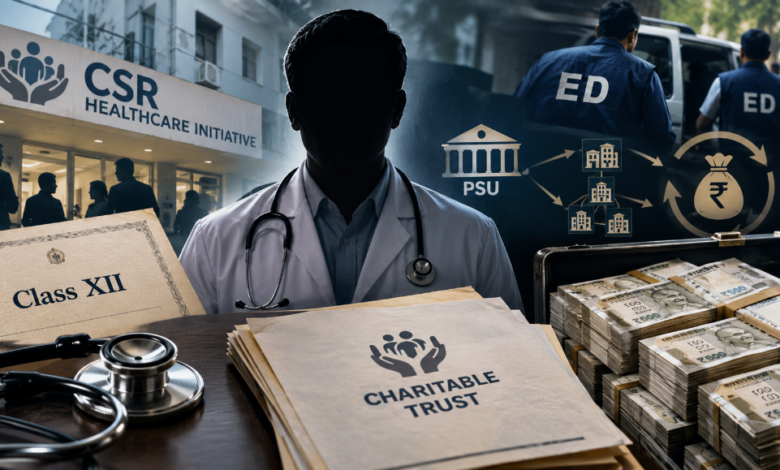
The case becomes even more extraordinary because the ED says the individual at the centre of the investigation, Dharmendra Kumar Chandradev Singh, had allegedly studied only up to Class XII, possessed no recognised medical qualification or registration with a Medical Council, yet allegedly presented himself as a doctor and used the title “Doctor” for nearly three decades.
That is not merely a strange anecdote.
According to the ED, the alleged credibility attached to that identity was used to establish and operate a network of charitable trusts and healthcare-focused entities through which substantial CSR money was mobilised from PSUs and private corporations.
The result, if the agency’s allegations are ultimately established in court, would amount to something considerably more serious than a routine CSR compliance violation.
It would mean that a statutory social-welfare mechanism was allegedly exploited as a financial recycling architecture.
Eight locations. Four regions. ₹21 lakh seized. ₹200 crore under the microscope.
On 1 October 2026, the ED’s Mumbai Zonal Office-I conducted searches at eight locations across Maharashtra, West Bengal, Gujarat and Delhi-NCR under the Prevention of Money Laundering Act, 2002. The agency says it seized approximately ₹21 lakh in cash, along with incriminating documents and digital devices.
The locations reportedly included five in Maharashtra and one each in West Bengal, Gujarat and Delhi-NCR. The premises searched were connected to market operators, trustees and intermediaries allegedly involved in the collection and movement of CSR funds.
But the eye-catching figure is not ₹21 lakh.
It is ₹200 crore.
The ED says approximately ₹200 crore in CSR funds were routed through the mechanism under investigation and describes the arrangement as a conduit for converting accounted funds into unaccounted cash.
That distinction matters.
₹21 lakh is the cash seized during one set of searches.
₹200 crore is the approximate value of CSR funds the ED says moved through the alleged mechanism.
They are not the same number, and treating the cash seizure as the size of the alleged racket would grossly understate what investigators are actually examining.
The alleged model: donate on paper, recycle in practice
The most disturbing part of the investigation is the alleged mechanism itself.
According to the ED, healthcare institutions seeking expensive medical equipment were allegedly linked with public representatives in the concerned areas. Those representatives or their staff then allegedly recommended that CSR funding for such projects be routed through trusts operated by Singh. PSUs allegedly released CSR donations substantially on the strength of such recommendations.
On paper, it sounds respectable.
Hospitals need equipment.
A public representative recommends a project.
A company provides CSR funding.
A charitable trust implements the programme.
Everybody gets a photograph.
Everyone gets a file.
Someone gets a ribbon-cutting ceremony.
The public sees charity.
But according to the ED’s allegations, behind that polished chain was something altogether different.
The agency says several projects were only partially executed or not executed in proportion to the funds received. Vendor invoices were allegedly inflated. Excess funds were allegedly routed through bogus or shell entities. Intermediaries allegedly received kickbacks and commissions for facilitating CSR funding.
That is where the alleged scheme stops looking like philanthropy and starts looking like financial engineering.
The charity appears to have been the front.
The paperwork appears to have been the camouflage.
The shell entities allegedly became the plumbing.
And cash allegedly became the destination.
The “cash-back” allegation is the most explosive element
The ED’s allegation concerning private-sector donors is particularly damning.
The agency says CSR contributions from private entities were substantially returned in cash to the contributors after deduction of a small commission.
Read that allegation carefully.
A company is supposed to spend money on an approved CSR activity.
Instead, according to the agency, money allegedly moves to a trust.
The trust allegedly deducts a commission.
The balance allegedly returns to the company in cash.
In effect, the alleged system would turn CSR into a formalised cash-back arrangement.
The company gets a CSR transaction on paper.
The recipient trust gets the fee.
The intermediaries allegedly get their cut.
The money allegedly comes back.
And the social project — the very reason CSR exists — risks becoming the least important participant in the transaction.
That is precisely why this investigation deserves far more than another cycle of raid photographs and press-release headlines.
It requires reconstruction of the entire financial chain.
And then came the shell-company layer
According to the ED, CSR agents and intermediaries channelled funds into the trusts, after which money was allegedly routed through shell entities controlled by market operators. The agency says many of these entities have also been flagged in multiple GST fraud investigations.
That statement opens another enormous line of investigation.
Who were these entities?
Who were their directors and beneficial owners?
Who issued the invoices?
What equipment was allegedly purchased?
Which vendors supplied it?
At what price?
What did the hospitals actually receive?
When was it installed?
Was it ever installed?
What happened to the funds after the vendor was paid?
How much was withdrawn in cash?
Who authorised the withdrawals?
Which accounts received the transfers?
Who introduced the CSR donors to the trusts?
And, most importantly, who ultimately benefited?
A shell-company chain is not a magic trick.
Every transfer leaves a footprint somewhere — bank statements, ledgers, tax filings, invoices, GST returns, accounting entries, digital communications and corporate records.
If the alleged ₹200-crore trail is real, the forensic question is not whether a trail exists.
It is how far that trail can be followed.
At least 40 PSUs and public sector banks: this is where the scandal gets systemic
The ED says that at least 40 PSUs and public sector banks across the country provided CSR donations to trusts operated by the accused.
That figure transforms the issue.
A single questionable donation can be dismissed as poor due diligence.
Two can be negligence.
A repeated pattern involving dozens of government-owned organisations raises the far more uncomfortable possibility of a systemic control failure.
The key question is no longer merely:
Who received the money?
It is:
Why did so many institutions believe the recipient was legitimate?
And the next question is even more uncomfortable:
What verification was actually performed before public-sector CSR money was transferred?
The latest reporting on 7 October 2026, citing the ED’s investigation, has also described a bribery angle involving senior executives of at least 40 PSUs and government banks, with the agency examining transaction details linked to PSU executives and corporate hospitals.
That reporting should be treated as an investigative development, not as a final judicial finding.
But if the alleged bribery trail is corroborated, this case would move far beyond the conduct of a charitable trust network.
It would raise questions about the conduct of decision-makers inside donor institutions themselves.
And that is precisely where the investigation cannot afford to become timid.
The law already contains safeguards. So how did this allegedly happen?
India’s CSR regime is not an unregulated free-for-all.
Section 135 of the Companies Act, 2013 applies CSR obligations to qualifying companies and requires the Board to ensure that prescribed CSR expenditure is undertaken under the statutory framework. The law provides for a minimum CSR expenditure linked to average net profits for qualifying companies.
The CSR rules also contain important controls concerning implementation agencies.
Since 1 April 2021, eligible implementing agencies are required to register through Form CSR-1 with the Central Government. The rules also prescribe eligibility requirements and, in relevant cases, an established track record of at least three years in undertaking similar activities. Most importantly, the rules state that the Board must satisfy itself that funds disbursed have been utilised for the approved purposes and manner, while the CFO or responsible financial-management officer must certify the position.
So the allegation raises a devastating governance question:
If these safeguards were followed, how could projects allegedly remain incomplete, bills allegedly be inflated, excess funds allegedly move through shell entities and substantial amounts allegedly return to private donors in cash?
There are only a few broad possibilities.
The controls may have been inadequate.
The controls may have been circumvented.
The information supplied to the companies may have been misleading.
Or some combination of all three.
The investigation must determine which.
The numbers put the alleged racket into national perspective
India’s CSR ecosystem is enormous.
Data compiled from the National CSR Portal show reported CSR expenditure of approximately ₹40,794 crore in FY 2024-25, across 29,546 companies and 72,233 projects.
Against that backdrop, the ED’s approximate ₹200-crore figure is significant even as a scale indicator.
₹200 crore is roughly 0.5% of one year’s reported national CSR expenditure.
That does not mean the alleged ₹200 crore was generated in FY 2024-25, nor does it mean the figures are directly comparable; the ED’s investigation may cover multiple years and describes funds routed through a mechanism rather than a one-year CSR-spend number.
But the comparison demonstrates the scale.
This is not an allegation about a missing cheque.
It is an allegation involving money measured in hundreds of crores.
Health and medical equipment: perhaps the cruelest part of the allegation
The alleged use of healthcare as the narrative vehicle makes the story particularly bitter.
Medical equipment is not decorative.
An MRI machine, CT scanner, ventilator, dialysis equipment, surgical equipment or diagnostic technology can directly determine whether a patient receives timely treatment.
When a healthcare project is presented as a CSR initiative, corporations and the public are entitled to assume that the stated need is real, the expenditure is genuine and the promised equipment or service will actually reach patients.
If money intended for those purposes is instead allegedly recycled into cash, inflated bills or shell entities, the harm is not merely financial.
It is social.
Every rupee diverted from a legitimate medical project represents a rupee that did not produce the healthcare outcome promised to the donor and, ultimately, to the public.
The irony is brutal:
The stronger the emotional credibility of the “help hospitals” story, the easier it may become to sell the alleged financial arrangement.
A “Doctor” without a recognised medical qualification?
The ED’s account also puts an extraordinary credential-related allegation at the centre of the case.
According to the agency, Singh had studied only up to Class XII and did not possess a recognised medical qualification or registration with a Medical Council, yet allegedly represented himself as a doctor for nearly three decades.
The ED says he then leveraged the credibility associated with the title to establish and operate charitable trusts and healthcare-focused entities.
That allegation deserves forensic examination independent of the money trail.
When exactly was the title “Doctor” used?
On which trust documents?
On which letters?
On which proposals?
On websites?
On brochures?
On CSR pitches?
On correspondence with hospitals?
On recommendations?
On agreements?
On public events?
On bank documents?
On government or quasi-government communications?
If investigators establish that an unrecognised medical identity was repeatedly used as a credibility enhancer while approaching institutions for funds, that would raise a profound question about how easily titles, credentials and institutional appearances can create false legitimacy.
But again, this remains an allegation until proven.
The public representative angle needs daylight, not whispers
The ED says hospitals or healthcare institutions citing a lack of funds for medical equipment were connected with public representatives of the relevant area, who then issued recommendations for funding through the trusts operated by Singh. The agency says PSUs made donations primarily on the strength of those recommendations or those of the representatives’ staff.
This is potentially one of the most sensitive areas of the entire investigation.
A recommendation is not proof of wrongdoing.
A public representative recommending a healthcare project is not, by itself, suspicious.
But once a recommendation becomes the gateway for releasing large public-sector CSR sums to a particular trust, the provenance and independence of that recommendation become highly material.
Investigators should therefore establish:
Who requested the recommendation?
Who drafted it?
Who prepared the project report?
Who selected the trust?
Why that trust?
What due diligence was undertaken?
Which hospital actually needed the equipment?
Was a competitive process undertaken?
Who nominated the vendor?
Who verified delivery?
Who certified utilisation?
Who authorised the final payment?
And, above all:
Did the person making the recommendation know anything about the alleged financial recycling mechanism?
These are investigative questions, not accusations.
They must nevertheless be answered.
The Bombay High Court trail deserves careful scrutiny too
A publicly accessible Bombay High Court record names Dharmendra Kumar Chandradev Singh as petitioner in Writ Petition No. 3891 of 2026. The order records his claim that he was detained at a Deputy Commissioner of Police’s office on 10 July 2026 and that a subsequent search of his office/residence continued through the night, during which he alleged nearly 220 items were seized. The court directed the prosecution to take instructions on those averments and expressly cautioned that the observations were made before the prosecution had been heard.
That judicial record does not establish misconduct by the police or wrongdoing by Singh.
It does, however, demonstrate that the individual at the centre of the present investigation had already been involved in criminal proceedings and litigation before the October searches became public.
Separately, a court-record database shows a bail proceeding involving D.C.B. CID Unit-I versus Dharmendra Kumar Chandradev Singh, registered as Bail Application No. 1134/2026, which was disposed of on 24 August 2026. The database makes the existence and disposal of the bail proceeding clear, although the full text of the final bail order was not available through the public interface reviewed for this article.
That is precisely why responsible reporting must distinguish between a case being investigated, a bail proceeding, an allegation, a charge and a conviction.
They are not interchangeable.
The real scandal may be bigger than the person named in the press release
The temptation in cases like this is to build the entire story around one alleged mastermind.
That would be a mistake.
A ₹200-crore financial system does not move because one person waves a cheque.
It requires introductions.
It requires donors.
It requires recipient entities.
It requires bank accounts.
It requires accounting.
It requires invoices.
It requires vendors.
It requires project reports.
It requires recommendation letters.
It requires compliance paperwork.
It requires people who ask questions — and people who do not.
It requires approvals.
It requires execution certificates.
It requires accountants.
It requires auditors or financial reviewers somewhere in the chain.
And, if the ED’s bribery and cash-return allegations are eventually substantiated, it would require willing participants at multiple points in the ecosystem.
That is why an investigation that stops at the trust offices would answer only half the question.
The other half lives inside the donor institutions, vendors, bank accounts, intermediaries and ultimate beneficiaries.
Every one of the 40 institutions should face forensic scrutiny
The ED should now undertake a transaction-level audit of every identified PSU and public-sector bank donor connected with the trusts.
Every CSR approval.
Every Board and CSR Committee minute.
Every project proposal.
Every recommendation letter.
Every implementing-agency registration.
Every CSR-1 record.
Every trust’s 12A/12AB and 80G status, wherever applicable.
Every bank transaction.
Every vendor invoice.
Every purchase order.
Every delivery challan.
Every installation certificate.
Every utilisation certificate.
Every project completion report.
Every photograph submitted as proof.
Every email and messaging trail recovered lawfully.
Every intermediary fee.
Every cash withdrawal.
Every director and beneficial owner of the recipient and vendor entities.
And then the most important forensic exercise of all:
follow the money after it left the trust.
Because in a case of alleged money laundering, the critical question is not merely who received the first payment.
The critical question is where the money went next.
The companies cannot hide behind paperwork forever
Corporate India spends tens of thousands of crores on CSR every year.
For FY 2024-25 alone, reported CSR spending reached about ₹40,794 crore.
That is a gigantic pool of money moving in the name of social development.
But a certificate saying “project completed” is not a project.
A photograph of a hospital is not proof that a machine was purchased.
A purchase invoice is not proof that the equipment was delivered.
A recommendation letter is not proof that a beneficiary was genuine.
And an accounting entry is certainly not proof of social impact.
The alleged CSR racket exposes an uncomfortable truth about every compliance-heavy financial system:
When verification becomes paperwork instead of verification, paperwork itself can become camouflage.
MCA, regulators and boards must ask harder questions
The Ministry of Corporate Affairs should examine whether the current CSR compliance architecture is sufficiently resistant to circular transactions, related-party structures, recycled donations and beneficiary-controlled intermediaries.
Companies should be pushed toward stronger independent verification of large healthcare and equipment-related CSR projects.
Large projects should be subjected to meaningful physical verification and outcome verification, not merely document-based confirmation.
Where a trust receives substantial funds from multiple PSUs and public-sector banks, the concentration risk should trigger automatic enhanced due diligence.
Where a recipient is repeatedly recommended by public representatives, the governance process should be transparent enough to establish why that recipient was selected.
Where vendors are repeatedly used across multiple CSR projects, their ownership, invoicing patterns and related-party connections should be examined.
And where money allegedly returns to donors in cash, regulators should examine not merely the recipient trust but the donor’s internal approval chain.
Because a recipient cannot “return” money that a donor is unwilling to receive.
If that allegation is proved, the money does not travel in one direction.
It travels in a circle.
This is where enforcement must become faster and sharper
The ED has taken the first visible step: searches, seizure of cash, documents and digital devices, and expansion of the money-laundering probe.
But a search is not justice.
A seizure is not a conviction.
A press release is not a charge-sheet.
And a charge-sheet is not a final verdict.
The enforcement agencies must now do the difficult part.
They must identify every participant.
They must establish the actual money trail.
They must distinguish genuine recipients from facilitators.
They must identify ultimate beneficiaries.
They must establish whether any corporate officials, intermediaries, vendors or public-facing recommenders knowingly participated.
They must identify assets acquired from alleged proceeds, wherever legally sustainable.
They must examine the GST dimension.
They must coordinate across jurisdictions.
And they must move the prosecutorial process with the urgency appropriate to a case of this scale.
The public has seen far too many financial investigations become lengthy dramas where raids make headlines on Day One and trial dates disappear into the calendar.
That cannot be the fate of this case.
The ₹200 crore question cannot be buried under ₹21 lakh
Perhaps the most important point is also the simplest.
The ₹21 lakh seizure is a headline number.
The ₹200 crore routing allegation is the real story.
The cash may be sitting in bags.
But the larger story is likely sitting in bank accounts, corporate ledgers, invoices, trust records, digital communications and project files.
The visible money is only what investigators found at the searched premises.
The invisible money is what investigators must reconstruct.
And somewhere within that invisible trail lies the answer to the biggest question facing the authorities:
Was India’s CSR machinery allegedly used not to deliver social good, but to create a respectable-looking route from accounted corporate money to unaccounted cash?
The ED says its preliminary investigation indicates exactly that.
If those allegations survive forensic scrutiny and judicial testing, this will not simply be a story about one alleged bogus charity network.
It will be a warning about what happens when charity becomes an industry, recommendations become gateways, compliance becomes paperwork and public money becomes somebody else’s private cash-flow strategy.
CSR was created to make companies socially responsible.
It was not created to make accounting entries look socially responsible.
And if the allegations in this case are proven, the most bitter irony would be that the money allegedly meant for society did not disappear because India lacked a CSR law.
It disappeared because people may allegedly have learned how to game the system.
That is why the response cannot stop at raids.
It must end with identification, prosecution, recovery, accountability and conviction wherever guilt is legally established.
Anything less would leave the country with the worst possible message:
That even a ₹200-crore alleged CSR money trail can produce headlines faster than it produces consequences.
EDITORIAL DEMAND
The Union Government, Ministry of Corporate Affairs, Enforcement Directorate, investigating police authorities, GST authorities and other competent agencies should ensure that the investigation is time-bound, multi-agency, forensic and comprehensive. Every identified CSR donor, implementing trust, intermediary, vendor and beneficiary should be examined on the evidence. Any public servant, corporate executive, intermediary or private individual found to have knowingly facilitated an illegal transaction should face action under the applicable law. Equally, individuals or institutions found uninvolved must not be publicly branded merely by association.
Most importantly, the investigation and subsequent criminal proceedings should be pursued swiftly and transparently within the framework of law, so that neither the guilty escape through delay nor the innocent are condemned by headlines.
LEGAL AND EDITORIAL DISCLAIMER
This report is based primarily on the Enforcement Directorate’s press release dated 5 October 2026, publicly accessible court material and contemporaneous media reports. The allegations concerning Dharmendra Kumar Chandradev Singh and other persons/entities are allegations under investigation and are not findings of guilt. The ED’s own release states that further investigation is in progress.
As of the date of publication, based on the publicly accessible records and credible reports reviewed for this article, no court of law has convicted Dharmendra Kumar Chandradev Singh of the alleged CSR money-laundering racket. The existence of an FIR, search, seizure, investigation, arrest or bail proceeding must not be treated as equivalent to conviction.
Any reference to bribery, diversion, recycling of CSR funds, shell entities, inflated invoices, cash returns, false medical credentials or other unlawful conduct is expressly attributed to the investigating agency or identified reporting where applicable. All persons and institutions named or referred to are entitled to due process and the presumption of innocence until guilt is established by a competent court.
This report does not assert as established fact any allegation that has not been adjudicated by a court.