Raheja’s Bail Defense To BPTP’s Disputed Audio: How Powerful Builder Mafia Is Exploiting The Laws, Harassing The Homebuyers, Dodging The Premier Investigating Agencies Of The Nation, Denting The Fourth Pillar Of Democracy, And At The End, Making A Mockery Of The Entire Judicial Machinery Of The Nation, Hence Making A Circus Of The Temple Of Justice!
From the Enforcement Directorate’s money-laundering investigation into Raheja Developers to the Delhi High Court’s forensic examination of a disputed audio recording in the BPTP–Nitin Naresh litigation, two cases raise uncomfortable questions about the enormous power imbalance between large developers, homebuyers and independent journalists. The Raheja proceedings involve allegations concerning thousands of buyers, large financial transactions, provisional asset attachments and a rejected anticipatory-bail plea in which the court considered repeated non-appearance before investigators. The BPTP litigation involves allegations of defamatory publications, restrictions on further dissemination and a disputed recording that the defendant says may be an AI-generated voice clone. Together, they demand scrutiny of accountability, litigation power and due process.


Is AI-Cloned Audio the New Weapon in BPTP’s Legal Arsenal Against Independent Journalism? From Raheja to Vatika and TDI: How Many More Chargesheets Must CBI File Before the Builder Nexus Faces Real Accountability?
The pattern is no longer isolated. It is systemic, visible in court orders, attachment schedules, and the stark arithmetic of unfulfilled promises to ordinary buyers. When a premier investigating agency’s summons are met with serial non-appearance, when company websites celebrate the very individual whose counsel describes him as a mere architectural adviser, and when an independent journalist faces first a defamation suit and then an allegedly fabricated audio of extortion, the question is no longer whether individual cases exist. The question is how deeply the legal machinery can be stretched before public faith in both real-estate regulation and the fourth pillar of democracy collapses under the weight of unanswered delays and selective accountability.
Consider first the case of Nayan N. Raheja, former director of Raheja Developers Limited, and the anticipatory-bail proceedings that reached the Delhi High Court after rejection by the Saket District Court. On 19 September 2026, Special Judge (PMLA) Sachin Jain dismissed the anticipatory-bail application. The court recorded that of seven occasions on which summons were served, the applicant appeared before the Gurugram Zonal Office of the Enforcement Directorate on only two occasions and failed to appear and cooperate on five occasions “on one pretext or the other.”
That factual finding is not a minor procedural footnote. It is the central reason the court held that the twin conditions under Section 45(1)(ii) of the Prevention of Money Laundering Act were not satisfied and that the applicant had not demonstrated reasonable grounds for believing he was not guilty of the offence of money laundering. The court further observed that the mere fact that an individual is not named or not charge-sheeted in the predicate FIRs does not, by itself, absolve him from PMLA proceedings unless he can at least prima facie show he has not dealt with proceeds of crime.
What does serial non-cooperation after an explicit undertaking of full cooperation recorded by the Delhi High Court on 30 July 2026 actually signal? It signals that the ordinary process of investigation can be treated as optional by those with resources to litigate every step.
The Rahejas- First they made homebuyers wait for delivery, and then they make ED wait for their ‘special’ appearance!
Homebuyers who paid for flats in projects such as Raheja Revanta, Raheja Shilas, Raheja Trinity and others waited years for possession while the investigating agency waited for the presence of a key person named in the ECIR. The human cost is not abstract. Families who diverted life savings into these projects face EMI burdens, rental expenses, and the erosion of trust in both the developer and the regulatory system that was supposed to protect them. When an agency charged with tracing proceeds of crime is forced to return repeatedly empty-handed because of non-appearance, the message to every other similarly placed promoter is clear: delay is a viable strategy.
Counsel for Nayan Raheja has argued that he did not hold a management position in the company after limited periods of directorship (15 January 2003 to 12 January 2008 and 16 August 2010 to 26 November 2010), that he holds only 0.81 per cent shareholding in Raheja Developers Limited, and that he receives a salary for providing advice relating to architectural drawings. The defence further submitted that he was not charge-sheeted in the predicate offences and that no proceeds of crime were attributable to him. These are legitimate arguments that any accused is entitled to advance.
Yet they sit in open tension with the company’s own public description of the same individual. On the Raheja Developers website, Ar. Nayan Raheja is presented as “a passionate entrepreneur and has been a growth driver for bringing Raheja Developers into a New Era.” The page states that he has been “at the forefront of leading the company into the new era contributing significantly to new systems, processes and better product delivery,” that under his aegis the company shifted strategy toward luxury housing, and that he was instrumental in bringing major international construction and structural-engineering firms into joint ventures.
It further notes that he is “presently involved with developing Delhi’s Tallest Mix Use Development with Luxury Hotel Residences and the luxurious Delhi Mall.” These are not the words used to describe a peripheral architectural consultant. They are the words a company uses when it wants the market to understand that the individual is central to its direction and execution. How does a court, or the public, reconcile a defence of non-management with a corporate narrative of active leadership? The question is not rhetorical. It goes to the credibility of the representations made on oath or through counsel. LinkedIn association of the same individual with Raheja Developers further underscores the public-facing role.

When the Enforcement Directorate’s provisional attachment orders of 28 April 2026 (approximately ₹1,113.81 crore), 15 June 2026 (approximately ₹503.48 crore) and 31 July 2026 (approximately ₹782.36 crore) attach properties belonging to M/s Raheja Developers Ltd. as well as immovable properties held in the names of Navin M. Raheja and his family members, the family character of the alleged proceeds becomes difficult to ignore.
Being the son of the chairman and managing director does not automatically create criminal liability, yet it does raise the legitimate question whether the individual was insulated from the financial decisions that, according to the ED, saw collections of roughly ₹2,425.99 crore to ₹2,699.13 crore from around 4,600 homebuyers accompanied by alleged diversion of over ₹1,300 crore for non-construction purposes. The specific allegation that Nayan Raheja received ₹1.23 crore from the proceeds of crime, against which properties worth ₹14.10 crore have been provisionally attached, is a concrete figure that demands detailed accounting rather than blanket denial of management involvement.
The arithmetic itself invites exhaustive scrutiny. Approximately 4,600 families entrusted money for homes. The ED’s figures place the collections in the range of ₹2,400–2,700 crore. The alleged diversion exceeds ₹1,300 crore. Cumulative provisional attachments have approached or exceeded ₹2,300 crore.
Each of these numbers represents not merely a ledger entry but years of delayed possession, interest payments on loans taken for flats that never materialised on schedule, and the quiet desperation of middle-class households that cannot simply write off the loss. When the same individuals whose names appear in attachment schedules enjoy interim protection from arrest while the agency continues to seek non-bailable warrants, the disparity between the speed of legal protection available to the well-lawyered and the glacial pace of relief available to buyers becomes a structural critique of the system.
The same pattern of legal ingenuity appears in the parallel proceedings involving BPTP Limited and independent journalist Nitin Naresh. On 7 October 2026 the Delhi High Court directed the Central Forensic Science Laboratory attached to CBI Headquarters to examine a disputed audio recording after Nitin Naresh claimed it is an AI-generated clone of his voice.
BPTP’s counsel had played an approximately twelve-minute recording alleged to be an extortion call made to an authorised representative of the company in alleged violation of an earlier court order. An independent journalist, Mr Nitin Naresh denied the conversation and pointed to the availability of advanced voice-cloning technology. Justice Tushar Rao Gedela ordered the recording sealed and sent for forensic analysis, including determination of hash value, with a report expected within four weeks.
The sequence that preceded this forensic order is itself concerning. BPTP had earlier instituted defamation proceedings against the journalist and the media platform associated with him. Courts have recorded interim restraints on further publication of certain articles while expressly noting that fact-finding exercises are not precluded.
When a defamation suit fails to produce a conclusive finding that the publications were false and defamatory, the subsequent production of a contested audio claiming extortion raises the question whether the legal process is being used not merely to seek vindication of reputation but to exhaust and silence critical reporting. Independent journalism that examines delayed projects, incomplete occupation certificates, and buyer complaints is precisely the function of the fourth pillar. When that function is met first with civil suits seeking gag orders and then with an audio whose authenticity must be tested by a central forensic laboratory, the chilling effect is not theoretical. It is immediate and measurable in the self-censorship that follows.
How far can powerful developers push the machinery of the courts before the cumulative effect becomes indistinguishable from harassment of both homebuyers and those who report on their plight? The CBI’s own record supplies part of the answer. On 28 September 2026, CBI filed its 21st chargesheet in the Supreme Court-directed probe into large-scale homebuyer fraud, this time against five erstwhile promoters and directors of Acme Realties Private Limited and its holding company in relation to the Acme Boulevard project in Mumbai.
The chargesheet alleges induction of homebuyers through false assurances and fraudulent representations. The CBI has simultaneously been investigating dozens of additional cases against various builder companies and officials of financial institutions. 20 earlier chargesheets had already named entities including Rudra Buildwell, Dream Procon, Jaypee Infratech, AVJ Developers, CHD Developers, Logix City Developers and others. The sheer volume of chargesheets demonstrates that the problem is not confined to one or two errant promoters. It is an industry-wide pattern of alleged diversion, non-delivery and, in many cases, alleged collusion with financing channels.

Recent enforcement actions against other prominent groups reinforce the same critique. On 28 September 2026 the Enforcement Directorate arrested Anil Bhalla, Chairman-cum-Managing Director of Vatika Limited, and promoter Gautam Bhalla under the PMLA in a case arising from multiple EOW FIRs. The agency’s case is that seven purchaser entities paid approximately ₹260 crore between 2010 and 2012 as the entire sale consideration for residential plots in Vatika India Next and Vatika India Next-2 in Gurugram.
According to the ED, not a single plot out of approximately 1.10 lakh square yards purchased for around ₹90 crore in one of the projects was delivered even after about fourteen years, while delivery in the other remained only partial, leaving plots valued at approximately ₹140.73 crore undelivered. Proceeds of crime quantified so far stand at roughly ₹154.36 crore.
14 years of waiting for plots that never materialised is not a commercial dispute; it is the systematic erosion of the life savings of those who trusted the brand. The arrest of the promoters is a necessary step, yet the length of the delay before custodial interrogation occurred itself invites the question why such cases take more than a decade to reach this stage.
In the case of TDI Infrastructure the Haryana Real Estate Regulatory Authority ordered civil imprisonment proceedings against five directors, Kamal Taneja, Devki Nandan Taneja, Ravinder Kumar Taneja, Renu Taneja and Ved Prakash, in an execution matter arising from a 2019 buyer complaint. The same group has been identified by the ED in the Manesar land-scam investigation as an intermediary that used three companies to acquire nearly 33 acres of state-notified land.
Parallel PMLA proceedings concern approximately ₹4,619.43 crore collected from 14,105 customers across multiple Sonipat projects, with delays of 16–18 years and incomplete occupation certificates. When civil imprisonment is ordered for non-compliance with regulatory directions, and when the same network remains under investigation for both buyer funds and land acquisition irregularities, the cumulative picture is one of repeated institutional failure to deliver timely possession or transparent accounting.
Earlier prosecutions of founders and directors of various real-estate entities, whether through ED arrests, CBI chargesheets or RERA-directed civil imprisonment, demonstrate that the legal system is capable of acting. The question is why the same system appears so frequently to be slowed, diluted or diverted by successive applications for anticipatory bail, interim protection, medical exceptions and challenges to the authenticity of evidence.
The case of Amitabh Jhunjhunwala, former senior executive of the Anil Dhirubhai Ambani Group, illustrates one such statutory pathway. The Delhi High Court granted him regular bail on medical grounds, holding that his condition, advanced age, significant spinal pathology, osteoporosis, the requirement of supervised rehabilitation and a pre-existing cardiac condition, brought him within the “sick or infirm” exception under the proviso to Section 45(1) of the PMLA.
The court rejected the argument that the exception applies only when life is in imminent danger. The decision is legally reasoned on the medical record before the court. Yet when the same statutory exception is available to those accused of large-scale diversion of funds, and when parallel defences of “not the person on paper” are advanced by family members of promoters, the cumulative effect is that the most serious economic offences become subject to a hierarchy of exemptions that ordinary accused persons cannot access.
Return, then, to the Raheja defence. On paper the director may be Navin M. Raheja. If an arrest warrant is issued in his name, the argument of advanced age and medical condition can be invoked, as seen in the Jhunjhunwala precedent. In the son’s case the argument shifts by mentioning, he is not the person in the management papers, holds only a fractional shareholding, and provides architectural advice.
The two arguments, taken together, create a seamless protective envelope around the promoter family. The ED’s attachment orders naming both company properties and family properties cut across that envelope. The company’s own website celebrating the son’s leadership role cuts across the claim of non-involvement. The record of five non-appearances out of seven summonses cuts across the claim of readiness to cooperate. Each of these facts, examined in isolation, may admit of explanation. Examined together, they form a pattern that any homebuyer who has waited a decade for possession will recognise as the same pattern that has already cost them years of their lives.
The larger interrogative remains. If powerful builders can treat the summons of a premier investigating agency as optional, if they can present contested audio whose authenticity must be tested by a central forensic laboratory, if they can obtain successive interim protections while buyers remain without keys, and if the statutory exceptions of sickness or non-management can be deployed with professional precision, then what realistic prospect of timely justice exists for the thousands of families whose only power is the power of complaint?
The CBI’s 21 chargesheets, the Vatika arrests, the TDI civil-imprisonment orders, and the continuing Raheja and BPTP litigation are not separate stories. They are chapters of the same story: the story of an industry that has learned to treat the legal process as another construction material, which is malleable, delayable, and ultimately subordinate to the resources of those who know how to use it. Until that material is made rigid again by consistent enforcement, transparent accounting of homebuyer funds, and zero tolerance for non-cooperation with investigating agencies, the temple of justice risks being reduced to a circus in which the well-resourced perform and the ordinary citizen merely watches, waiting for a home that may never arrive.
The human-impact evaluation of every cited figure must be repeated because numbers alone do not convey the lived reality. Four thousand six hundred homebuyers in the Raheja matters represent roughly four thousand six hundred households. Each household typically includes spouses, children, and often elderly parents who planned their retirement around the promised flat. The diversion alleged by the ED, measured in thousands of crores, is the difference between a completed home and a construction site that remains incomplete year after year.
14 years of non-delivery in the Vatika plot case is fourteen years of rent paid, interest paid, and opportunity cost incurred by purchasers who paid the entire consideration upfront. 16-18 years of delay in TDI projects is an entire generation of childhood spent without the stability of the promised home. When CBI files its twenty-first chargesheet, it is not merely adding to a statistical tally; it is documenting that the same methods of false assurance and fund diversion continue to be replicated across cities and promoters.
The critique of process is equally exhaustive. Anticipatory bail is a constitutional safeguard against arbitrary arrest. It is not intended to become a shield against the duty to appear when summoned by an investigating agency. The Saket court’s finding that five of seven summonses went unanswered is a finding that the safeguard was being tested beyond its intended purpose.
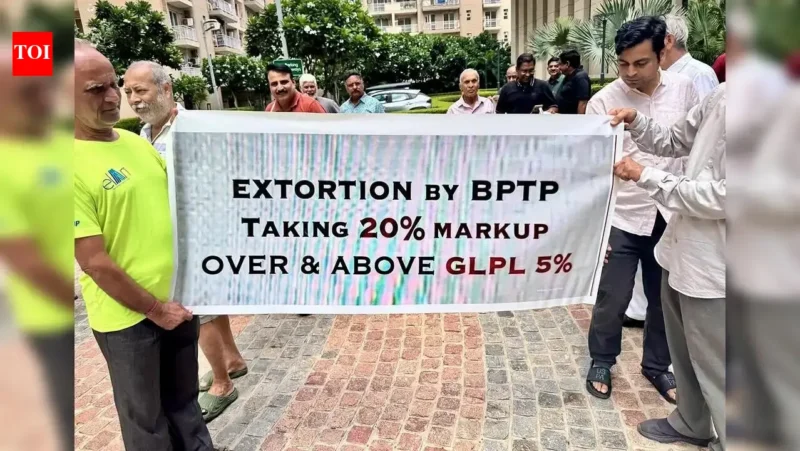
The High Court’s direction for CFSL examination of the disputed BPTP audio is a recognition that modern technology can be weaponised to create evidence whose authenticity is contestable only through specialised forensic means. The availability of such technology does not automatically prove fabrication, yet the readiness with which the claim is advanced, after prior defamation proceedings, invites the public to ask whether the legal process is being used to exhaust the resources and resolve of critical voices.
Every unanswered question compounds the concern. Why did the ED’s own earlier undertaking of cooperation not produce consistent appearance? Why does a company website describe active leadership while counsel describes peripheral advice? Why does the forensic examination of an audio become necessary only after defamation routes have been exhausted? Why do civil-imprisonment orders and PMLA arrests still leave thousands of occupation certificates pending? Until these questions receive answers grounded in transparent investigation rather than successive interim orders, the pattern will continue, the homebuyers will continue to wait, and the fourth pillar will continue to face pressure that ordinary citizens cannot match. The temple of justice deserves better than to be turned into a stage for such performances.