The ₹500-Crore Swap. Why Swiggy Is Walking Away From LYNK, What Udaan Is Really Buying And An IPO May Be The Real Endgame
A ₹500-crore deal is reshaping the B2B commerce map. Swiggy is giving up LYNK, yet investing in its buyer, while Udaan is absorbing the business just as it prepares for an IPO. The transaction looks strategic on the surface. Underneath it sits a bigger question: who really stands to win?

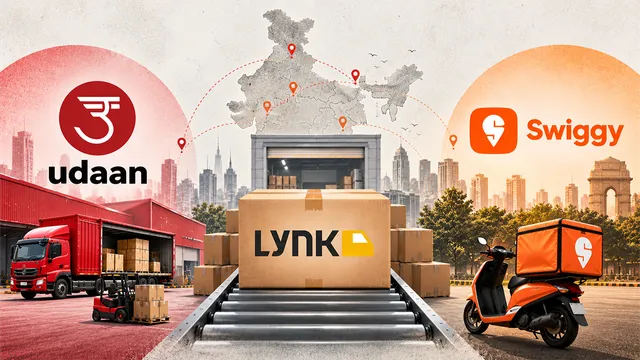
At first glance, Udaan’s ₹500-crore acquisition of Swiggy’s B2B distribution and logistics arm LYNK looks like a straightforward consolidation play. Look closer, and the structure tells a more interesting story.
This is not simply Swiggy selling an asset and Udaan writing a cheque. The transaction effectively moves LYNK into Udaan while giving Swiggy a minority stake in the very company acquiring it.
Swiggy is not walking away with ₹500 crore in cash. Instead, Udaan’s parent, Trustroot Internet, will issue preference shares to Swiggy, giving the food-delivery company a stake of around 2.8 per cent. Swiggy will also invest another ₹75 crore in Udaan, taking its holding to roughly 3.2 per cent.
For Udaan, meanwhile, the deal comes at a particularly consequential moment. The B2B commerce company has recently completed a $160-million recapitalisation and is positioning itself for a public listing. LYNK brings with it an established distribution network, relationships with consumer brands and a substantial revenue base, particularly across Bengaluru, Hyderabad, Chennai and Kolkata.
So the obvious question is not simply why Udaan wanted LYNK. It is why Swiggy wanted out of it now, why it chose Udaan as the buyer, and why it still wants a piece of the business that emerges on the other side.
The answers sit somewhere between two very different stories: Swiggy streamlining its portfolio and Udaan assembling the scale it needs for its next act. Whether this is a genuine strategic combination or a transaction that also happens to make Udaan’s IPO story considerably more attractive is the bigger question.
Why Swiggy Is Letting LYNK Go
LYNK was never meant to be just another logistics asset inside Swiggy. Acquired to build a stronger bridge between consumer brands and the retail network, it gave Swiggy a foothold in India’s fragmented B2B distribution market. The business has since grown into a sizeable operation, with revenue of about ₹668 crore in FY26.
Yet scale alone does not make an asset strategically essential.
Swiggy’s centre of gravity has increasingly remained its consumer-facing businesses, particularly food delivery and quick commerce. LYNK operates in a different world: it works with brands, distributors and retailers, where margins, working capital and distribution density matter more than consumer acquisition and order frequency.
That creates a natural strategic question for Swiggy. If a business is not central to the company’s core growth engine, does it make sense to keep committing management bandwidth and capital to building it?
The answer appears to be no.
The LYNK transaction allows Swiggy to simplify its operating portfolio while still retaining financial exposure to the business through Udaan. That is a materially different proposition from simply shutting the door on LYNK.
There is also a question of fit. LYNK’s distribution network and brand relationships could arguably be more valuable inside a company whose primary business is B2B commerce. Udaan already operates closer to the retailers and businesses that LYNK serves. What may have been a useful adjacent business for Swiggy could therefore become a core operating layer for Udaan.
That makes the sale less about LYNK failing and more about where LYNK makes the most strategic sense.
For Swiggy, the deal removes the responsibility of running the business directly. For Udaan, it creates an opportunity to absorb an established distribution network rather than build one market by market.
And that helps explain why Swiggy has chosen a stake in Udaan over a clean cash exit.

The Curious Part: Swiggy Isn’t Really Walking Away
The most revealing part of the transaction may be what Swiggy gets to keep.
Had this been a conventional sale, the logic would have been simple: Swiggy exits LYNK, collects ₹500 crore and moves on. Instead, it is exchanging the operating asset for an equity position in Udaan and adding another ₹75 crore of its own capital.
That changes the nature of the exit.
Swiggy will retain roughly 3.2 per cent of Udaan after the transaction. In effect, it is giving up direct ownership of LYNK while retaining exposure to the larger B2B distribution platform into which LYNK is being absorbed.
There is a certain logic to that arrangement. Swiggy no longer has to operate or fund LYNK as a standalone business, but it does not have to abandon the value it believes can be created from the business either. If Udaan succeeds in integrating LYNK, expands its distribution network and eventually reaches the public markets, Swiggy’s minority holding gives it a route to participate in that upside.
The additional ₹75 crore is important too. It suggests this is not merely a passive stake received as consideration for an asset. Swiggy is choosing to put fresh money behind Udaan at precisely the point when Udaan is preparing for its next phase.
That makes the transaction look more like a change in how Swiggy wants to participate in it. The operating risk moves to Udaan. The potential upside remains with Swiggy.
For Udaan, however, the equation is very different. It is taking on the business, integrating its operations and betting that LYNK can become more valuable as part of a larger B2B network.
That is the bet that matters now.
What Udaan Is Actually Buying
For Udaan, the attraction of LYNK is not simply the ₹668 crore of revenue it brings with it. The more valuable asset is the distribution infrastructure sitting underneath that number.
LYNK has built relationships with consumer brands and a network for moving products through modern and general trade channels. Its presence is particularly strong in Bengaluru, Hyderabad, Chennai and Kolkata, which together account for around three-quarters of its revenue. Those are not markets Udaan has to discover from scratch.
This gives the acquisition a practical advantage. Building a distribution network organically takes time, capital and, more importantly, density. Every additional retailer, brand and delivery route becomes more useful when the surrounding network is already large enough to support it. Buying LYNK gives Udaan a running system rather than another long expansion project.
There is also a potential complement between the two businesses. Udaan has spent years building its B2B commerce platform around retailers and business buyers. LYNK brings deeper capabilities on the distribution and brand side. Put together, the proposition is broader: Udaan can potentially sit closer to both ends of the supply chain.
That could matter more than the headline acquisition value.
The opportunity is to use the same network more efficiently – more brands through the same infrastructure, more retailers through the same system and potentially greater utilisation of logistics and distribution capacity.
But that value is not automatic. Combining two businesses does not, by itself, create operating leverage. Udaan will have to integrate LYNK without allowing the costs, working-capital demands or complexity of the acquired business to dilute the economics it is trying to improve.
That is why LYNK’s importance to Udaan should ultimately be judged not by how much revenue it adds, but by whether it makes the combined business better.
The ShopKirana Deal Was the First Clue
LYNK is not Udaan’s first attempt to add scale through acquisition. The company’s earlier purchase of ShopKirana offers a useful clue to the direction it has been taking.
ShopKirana gave Udaan another piece of the B2B distribution puzzle: access to retailers and a more established presence in the fragmented traditional trade ecosystem. LYNK brings a different but complementary layer, with its relationships with brands and its distribution infrastructure across key urban markets.
Taken together, the acquisitions point towards a broader ambition. Udaan is not merely trying to become a larger online marketplace for businesses. It is attempting to build a more integrated B2B commerce and distribution platform, combining digital transactions with the physical machinery required to move products at scale.
That distinction is important because India’s B2B commerce market has always had a problem that technology alone cannot solve. Retailers may be brought onto a platform digitally, but products still need to be sourced, stocked, distributed and delivered efficiently. The economics ultimately depend on how well those pieces work together.
ShopKirana and LYNK therefore serve different functions within the same larger strategy. The question is whether Udaan can make the pieces work as one business.
That is also where the timing becomes significant. Udaan is making these moves after years in which the B2B commerce sector was dominated by the pursuit of scale and market share. The current phase is different. Investors are increasingly looking for businesses that can demonstrate operating discipline, clearer economics and a credible route to profitability.
Udaan’s acquisition strategy therefore has to accomplish more than expansion. It has to help turn a collection of businesses and networks into a company that can withstand the scrutiny of the public markets.
Udaan Is Buying Scale At A Very Convenient Moment
The timing of the LYNK acquisition is difficult to ignore.
Udaan has just completed a $160-million recapitalisation and is preparing the ground for a public listing. Now it is adding a sizeable operating business, expanding its geographic footprint and bringing additional distribution capabilities into the fold.
For a private company, acquisitions can be about growth. For a company approaching an IPO, they inevitably invite another question: what will the combined business look like when investors get to judge it?
LYNK gives Udaan more scale at precisely the point when scale can strengthen the public-market narrative. Its FY26 revenue of around ₹668 crore is meaningful in its own right, but the strategic value is potentially larger if Udaan can combine that revenue with its existing platform and extract efficiencies from the enlarged network.
The recent capital raise also gives the company greater room to pursue that strategy. Udaan is no longer operating purely as a startup trying to capture market share. It is attempting to position itself as a mature B2B commerce business with the size and structure required for the next stage of its life.
There is, however, a difference between looking IPO-ready and being IPO-ready.
Public investors will not assign much value to revenue added through an acquisition if the transaction also brings higher costs, working-capital requirements or integration problems. Nor will they necessarily reward geographic expansion if it fails to translate into better margins.
That makes LYNK something of a test for Udaan.
If the company can demonstrate that the acquisition improves distribution density, strengthens relationships with brands and retailers and moves the combined business towards better economics, the deal becomes a strategic building block.
If it mainly makes Udaan bigger on paper, the IPO market will eventually ask the harder questions.
And that brings the story to the numbers.

The IPO Math Behind The Acquisition
The real test of the LYNK acquisition is therefore not how impressive the combined revenue looks. It is whether Udaan can turn that additional scale into a better business.
That distinction matters because B2B commerce is an unforgiving business. Revenue can grow rapidly while margins remain thin, working capital stays demanding and logistics costs eat into the economics. For Udaan, the acquisition only makes sense if the larger network creates efficiencies that neither business could achieve as easily on its own.
LYNK potentially gives Udaan several levers.
A larger distribution footprint can increase utilisation of existing infrastructure. Its relationships with consumer brands can add supply to Udaan’s existing retailer network. Udaan, in turn, can potentially push more products through LYNK’s established distribution channels. The more transactions and volumes that can move through the same infrastructure, the greater the possibility of operating leverage.
There is another financial signal in the structure of the transaction. Because Swiggy is receiving Udaan equity rather than a conventional cash payment, the deal effectively links the value of LYNK to the future value of Udaan itself. Swiggy is therefore accepting exposure to the proposition that the combined company will be worth more than the standalone businesses.
That proposition becomes particularly relevant ahead of an IPO.
Udaan’s recent recapitalisation and the LYNK transaction put the company on a path where scale, valuation and public-market readiness are increasingly connected. The acquisition can strengthen the equity story — but only if the underlying economics support it.
That is where the market will eventually draw the line.
A larger addressable market, more cities and higher revenue may make for a compelling presentation. Public investors will want to know something much simpler: how much profit can this enlarged platform ultimately generate, and how much capital will it take to get there?
Until Udaan can answer that convincingly, the LYNK acquisition remains a strategic bet rather than proof of a successful consolidation.
But Is This Really Strategic Consolidation?
There are two ways to read what Udaan is doing with LYNK.
The first is the straightforward strategic case. Udaan is assembling complementary pieces of India’s B2B distribution chain, adding LYNK’s brand relationships and physical network to its own retailer and commerce platform. If integration works, the combined company should have greater density, broader reach and potentially better economics.
The second reading is more interesting — and more relevant given the timing.
Udaan is preparing for an IPO. In that context, acquisitions can do more than improve operations. They can reshape the size, geographic footprint and growth narrative of a company before it presents itself to public investors.
That does not make the LYNK deal cosmetic. But it does raise the standard against which it should be judged.
Would Udaan have pursued LYNK with the same urgency if it were not moving towards the public markets? And is the acquisition being driven primarily by identifiable operating synergies, or by the need to demonstrate a larger, more complete business ahead of a listing?
The answer may ultimately be a combination of both.
There is nothing unusual about a company consolidating before an IPO. In fact, bringing related operations under one roof can make a business easier to understand and potentially more efficient. The problem arises when scale becomes a substitute for economics.
Udaan has spent years managing the difficult transition from a venture-backed growth story to a sustainable business. Its next valuation will depend less on how many markets it operates in than on whether those markets generate attractive returns.
That puts the burden on management to prove that LYNK is more than an addition to the top line.
If the acquisition improves the underlying economics, it is strategic consolidation. If it primarily improves the IPO narrative, investors may see it very differently.
The Numbers Need To Prove The Story
The transaction ultimately has to survive a fairly basic financial test: does the enlarged Udaan become a stronger business, or simply a larger one?
LYNK’s ₹668-crore FY26 revenue gives Udaan meaningful additional scale. But revenue is only the starting point. The more important questions concern margins, cash generation, working capital and the cost of integrating the business.
This is particularly relevant because distribution businesses can carry significant operating costs even when revenue growth looks healthy. Warehousing, transportation, inventory and credit to retailers can all consume capital. If Udaan is taking on those requirements along with LYNK’s revenue, the acquisition needs to produce enough incremental efficiency to justify them.
The transaction structure itself also offers an unusual valuation signal. Swiggy is receiving Udaan shares rather than cash, while separately investing ₹75 crore. That means both sides are effectively placing a value on Udaan’s future rather than settling the transaction entirely on the value of LYNK today.
For Udaan, that future valuation is now particularly important.
The company has recently raised fresh capital and is moving towards an IPO. The market will eventually look past the acquisition headline and examine whether the combined operation can deliver sustainable growth without requiring repeated infusions of capital.
That is the metric that will determine whether LYNK becomes a genuine value creator. The acquisition can add revenue overnight. It cannot manufacture profitability overnight.
And that is where Udaan’s IPO ambitions face their real test: whether the company can convert the scale it has spent years assembling into economics that public investors are willing to pay for.
What Swiggy Gets And What It No Longer Has To Carry
For Swiggy, the attraction of the transaction is ultimately about portfolio discipline.
LYNK may have become a sizeable business, but it sits outside the centre of Swiggy’s consumer-facing growth story. By moving it into Udaan, Swiggy can step away from the operational demands of running a B2B distribution business while retaining an economic interest in what happens next.
That is potentially a cleaner outcome than a conventional exit.
Swiggy gets Udaan shares in exchange for LYNK and is putting another ₹75 crore into the company. Its roughly 3.2 per cent holding means it retains upside if Udaan’s valuation rises – particularly if the company successfully reaches the public markets.
In other words, Swiggy is giving up control and operational responsibility, not necessarily future value.
That distinction is useful when looking at the transaction from Swiggy’s side. The company can concentrate capital and management attention on businesses closer to its core strategy while allowing LYNK to sit inside an organisation where B2B distribution is central rather than peripheral.
There is also a risk-transfer element.
The challenges of integrating LYNK, extracting synergies and improving its economics will now largely sit with Udaan. Swiggy’s exposure is reduced to a minority investment.
That makes the transaction relatively elegant from Swiggy’s perspective: dispose of a non-core operating business, participate in the buyer’s potential upside and avoid carrying the full burden of the next phase of LYNK’s development.
But it also means Swiggy is making a fairly clear judgement about where it expects value to accrue.
It appears to believe that LYNK may be worth more as part of Udaan than it is worth keeping inside Swiggy.
What Udaan Is Betting On
Udaan’s bet is considerably larger than LYNK.
The company is effectively betting that India’s B2B commerce market is entering a phase where distribution density matters more than simply adding users and transactions. If that is right, LYNK gives Udaan an important piece of the infrastructure needed to compete in that next phase.
The logic is straightforward. Udaan already has the digital platform and retailer relationships. LYNK adds distribution capabilities and deeper connections with consumer brands. ShopKirana adds another layer of reach into traditional retail. The opportunity is to make these networks work together rather than operate as separate businesses.
But integration is where the strategy can either succeed or unravel.
Udaan has to demonstrate that the combined network produces tangible benefits: better utilisation, lower distribution costs, stronger supplier relationships and more productive retailer relationships. If those gains remain theoretical, the acquisition becomes little more than another expansion exercise.
There is also the question of capital.
A business with a large physical distribution footprint can become more efficient as it scales, but it can also consume more working capital as volumes rise. Udaan therefore needs growth that improves the quality of its economics, not growth that simply increases the amount of money required to operate the platform.
That is particularly important before an IPO.
Public investors are unlikely to value Udaan simply because it has become larger. They will want evidence that the company has moved beyond the old venture-capital model of pursuing scale first and worrying about profitability later.
LYNK gives Udaan a chance to demonstrate exactly that transition.
The company now has to prove that scale can become leverage and that leverage can eventually become profit.

The Last Bit, The Bigger B2B Commerce Reset
The LYNK deal also reflects a broader change in the way India’s B2B commerce businesses are being built.
The first phase was about speed: acquire retailers, add suppliers, expand into cities and chase transaction volumes. Capital was available to fund that expansion, and scale itself was treated as a competitive advantage.
That model has become harder to sustain.
The market is now placing greater emphasis on distribution efficiency, contribution margins and the ability to build a business without constantly depending on fresh capital. In that environment, owning more pieces of the supply chain can make strategic sense — provided those pieces actually improve the economics.
That is the opportunity Udaan sees in LYNK.
Rather than spending years replicating distribution networks city by city, Udaan can acquire an existing operation and attempt to integrate it with the network it already has. The same logic explains why acquisitions such as ShopKirana matter to the company’s broader strategy.
This is less about building another marketplace and more about controlling enough of the underlying B2B infrastructure to make the marketplace work better.
For Swiggy, however, the same market is producing the opposite decision. It is choosing to step back from an adjacent B2B operation and focus on the businesses where it sees a clearer strategic advantage.
That contrast is telling.
One company is consolidating around B2B distribution; the other is deciding that it does not need to own that piece of the chain.
The LYNK transaction is therefore not just a deal between two companies. It is also a snapshot of where India’s internet businesses are in their evolution: fewer bets, tighter capital allocation and a much greater insistence that scale eventually translate into sustainable economics.