A basketball shoe does not make you faster. It helps determine how confidently you can use the speed you already have.
That distinction matters. Basketball is played in fractions of a second: a hard plant before a crossover, a sudden brake in transition, a jump followed by an awkward landing, a defensive slide that turns into a sprint. The shoe sits between the athlete and all of those movements, quietly managing the forces involved.
That makes basketball footwear less about a collection of impressive specifications and more about a relationship with the court.
The Court Is Part of the Equation
Basketball is unusual because the surface beneath an athlete is constantly involved in the movement itself.
A runner generally moves through a repeated forward cycle. A basketball player rarely gets that luxury. The game asks for acceleration, deceleration, lateral movement, jumping and rapid changes of direction, often within the same possession.
That is why traction matters so much. Grip is not simply about preventing a slip. It influences how decisively a player can plant the foot before changing direction or braking. On a clean indoor court, the outsole has to establish reliable contact without making movement feel cumbersome.
The same principle becomes more complicated outdoors, where dust, rougher surfaces and different court materials can change how an outsole behaves.
The useful question, then, is not simply whether a basketball shoe has “good grip.” It is whether its traction makes sense for where and how you actually play.
Cushioning Is About More Than Softness
Cushioning is often reduced to a question of comfort: softer must be better.
On a basketball court, it is more complicated.
Every jump, landing and repeated sprint places a different demand on the shoe. Cushioning needs to manage impact while still allowing the player to remain connected to the floor. Too much separation from the court can alter how movement feels; too little protection can make repeated activity feel unforgiving.
This is where midsole design becomes important. Different foams, geometries and cushioning systems create different relationships between impact absorption, stability and responsiveness.
Performance footwear is therefore rarely about maximising one characteristic. The interesting work happens in the compromise between them.
Stability Should Not Mean Feeling Restricted
Basketball footwear has to provide security without turning the foot into a passenger.
Consider a defensive slide. The player needs the foot to remain controlled inside the shoe while the body moves laterally. During a hard plant, the shoe has to maintain its relationship with the foot. During a jump, it needs to remain stable through take-off and landing.
That is where fit, lockdown, heel structure and the overall platform begin to matter.
A secure shoe does not necessarily need to feel rigid. Good support can be subtle. Ideally, it gives the player enough confidence to make an aggressive movement without constantly thinking about what the shoe is doing.
That distinction is important: support should enable movement, not become the movement.
Responsiveness Lives in the Small Moments
The word “responsive” appears frequently in performance footwear, but its meaning becomes clearer when you watch a player move.
Responsiveness is felt in transitions—the instant between planting and pushing off, the moment after a landing, or the quick re-acceleration after a stop.
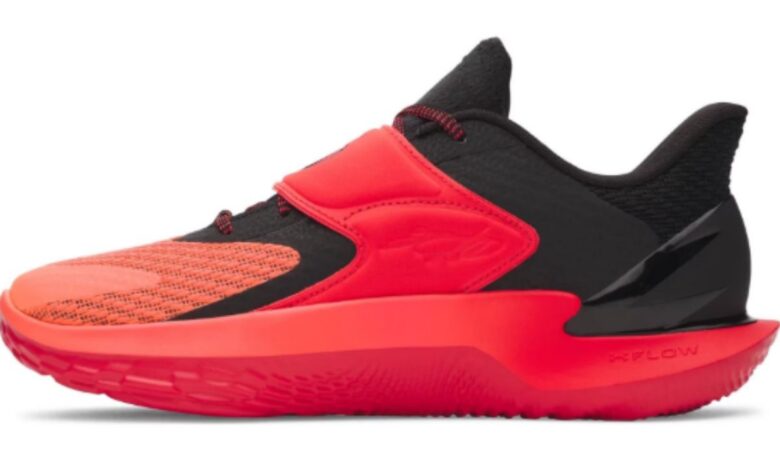
This is one reason lightweight, ground-oriented designs have become interesting in basketball. Under Armour, for example, uses UA Flow in basketball footwear as a cushioning and outsole system designed around court feel, grip and movement. The company’s current basketball range describes the technology in relation to cutting, starting and stopping rather than treating cushioning as an isolated feature.
The larger lesson extends beyond one technology: responsiveness is useful when it serves the movement the athlete is actually trying to make.
Fit Is Where Performance Becomes Personal
Two players can wear the same shoe and experience it very differently.
Foot shape, volume, preferred lockdown, playing position and even sock choice can change how a shoe feels. Some players prefer a close, almost contained fit. Others want more room through the forefoot. Neither preference is automatically more correct.
This is why performance footwear cannot be evaluated entirely through specifications.
A shoe can have an impressive midsole, sophisticated outsole or carefully engineered upper and still be the wrong choice if its shape does not work with the player’s foot.
Fit is not the final detail after the technology. It is the point where the technology has to meet the athlete.
Indoor and Outdoor Basketball Ask Different Questions
The court itself should influence the choice.
Indoor hardwood generally offers a relatively predictable playing surface, allowing outsole design to focus heavily on court contact and multidirectional movement. Outdoor courts are less forgiving. Abrasion, dust, heat and rougher surfaces can change both the feel and longevity of footwear.
That does not mean there is one universal formula for outdoor basketball, either. A player who spends most of the week on concrete has different priorities from someone who occasionally takes an indoor shoe outside.
The same principle applies to training. A basketball shoe used exclusively for games has a different job from one regularly worn through shooting sessions, conditioning drills and long practices.
The Best Shoe Is the One That Makes Sense for Your Game
There is a temptation to search for the single “best” basketball shoe, as though performance can be reduced to a ranking.
But footwear does not operate in a vacuum.
A quick guard may care deeply about court feel and lateral movement. A larger player may place greater emphasis on cushioning and stability. Someone playing primarily outdoors may think about durability differently from an indoor player. Another athlete may simply prioritise fit because an otherwise excellent shoe does not work with their foot.
None of these choices is inherently contradictory.
The more useful way to evaluate basketball footwear is to start with movement. What does your game ask your feet to do repeatedly? Where do you need security? How much cushioning feels appropriate? What surface are you playing on? Does the shoe remain comfortable after an hour rather than five minutes?
Those questions are more revealing than a feature list.
The Shoe Should Eventually Disappear
The most successful performance footwear often becomes least noticeable when the game begins.
You stop thinking about whether the heel is secure. You stop questioning the grip. You stop noticing the weight. The shoe simply becomes part of the movement.
That is the real relationship between basketball shoes and the court. They do not replace athletic ability, technique or decision-making. They create an interface through which those things happen.
Look at footwear that way and the question changes. Instead of asking which shoe has the most technology, the better question is: what does this shoe allow an athlete to do, and how naturally does it let them do it?
That is where performance footwear becomes genuinely interesting—not above the court, but in the few millimetres between the player and the floor.
Frequently Asked Questions
What should you look for in basketball shoes?
Start with the demands of your game: traction, cushioning, stability, fit, responsiveness and durability. The importance of each will depend on your playing style, surface and personal preferences.
Why is traction important in basketball shoes?
Basketball involves frequent acceleration, braking and lateral movement. Reliable traction helps the foot maintain contact with the court during these movements.
Is more cushioning always better?
Not necessarily. Cushioning needs to balance impact management with stability and court feel. The ideal amount is partly a matter of playing style and personal preference.
How should basketball shoes fit?
They should feel secure without creating uncomfortable pressure. The heel should remain controlled, while the forefoot should provide enough room for natural movement without excessive sliding inside the shoe.
Are basketball shoes suitable for outdoor courts?
Some can be, but outdoor courts can be considerably more abrasive than indoor hardwood. If you regularly play outside, consider how the outsole and overall construction are suited to that environment.
Do lighter basketball shoes perform better?
Not automatically. Lower weight can contribute to a quicker, less cumbersome feel, but weight has to be considered alongside cushioning, stability, support and durability.
When should basketball shoes be replaced?
Look for meaningful wear in the outsole, loss of cushioning or changes in fit and support. If the shoe no longer provides the traction, stability or comfort you rely on, it may be time for a new pair.