Trump Intervened To Bring Jensen Huang Back To Nvidia. The President’s Intervention Raises Conflict Of Interest Questions Even As The Chipmaker’s Troubles Are Far From Over
Jensen Huang is back at Nvidia, but his return has opened a far bigger controversy. Donald Trump's personal intervention, the President's own financial interests in the chipmaker, allegations surrounding a China-linked business and a growing list of regulatory investigations have placed Nvidia under an uncomfortable spotlight.

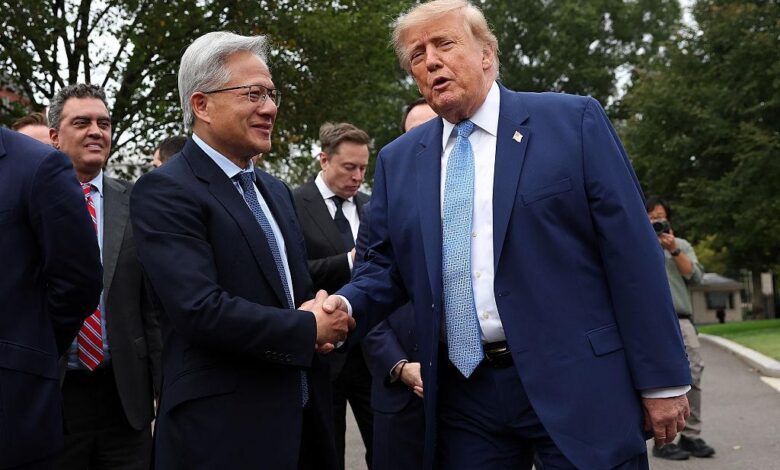
Jensen Huang is back at the helm of Nvidia, but the circumstances surrounding his return have raised a question that goes well beyond corporate leadership. Why did Donald Trump personally intervene in the affairs of a private technology company in which he holds millions of dollars in investments?
On November 23, Nvidia’s board reversed its earlier position and reinstated Huang after discussions involving senior US government officials.
Trump subsequently acknowledged that he had personally persuaded the board to bring the billionaire CEO back. The intervention has placed Nvidia at the intersection of corporate governance, presidential influence, national security and personal financial interests.
What makes the development particularly consequential is that Nvidia is not just another American technology company. It sits at the centre of the global artificial intelligence boom, supplies some of the world’s most powerful AI chips and has become a strategic asset in Washington’s technological competition with China. Huang may have reclaimed his chair, but the questions surrounding who influenced that decision, why it happened and whose interests it ultimately serves are only beginning.
Trump’s Nvidia Investments And The Conflict Of Interest Question
The controversy surrounding Trump’s intervention becomes more complicated when his personal financial interests in Nvidia enter the picture.
According to financial disclosures reported, the President held Nvidia shares valued in the millions of dollars, creating questions about the potential financial implications of his involvement in the company’s leadership decision. The timing is particularly significant. Huang’s reinstatement was followed by a dramatic rally in Nvidia shares, adding nearly $1 trillion to the company’s market capitalisation. Such a surge could have substantially increased the value of Trump’s holdings.
The White House, however, maintains that Trump’s investments are managed independently by third-party financial institutions and that neither the President nor his family directs individual investment decisions.
Nevertheless, the situation raises questions about the appearance of a conflict of interest, particularly when a presidential intervention is followed by a market movement that could benefit an asset held by the President.
There is also the question of Trump’s relationship with Huang. Nvidia’s chief executive has become an important interlocutor for the administration on artificial intelligence, semiconductor manufacturing and America’s technological competition with China. His access to the White House gives the relationship significance beyond an ordinary corporate-government engagement.
The central issue, therefore, is not simply whether Trump owns Nvidia shares, but whether the exercise of presidential influence over a company’s leadership can remain separate from the financial interests attached to that company.

Trump’s Nvidia Investments And The Conflict Of Interest Question
The controversy surrounding Trump’s intervention becomes more complicated when his personal financial interests in Nvidia enter the picture.
A November 16 report by The Washington Post, based on the President’s financial disclosures, estimated that Trump held between $13 million and $62 million in Nvidia shares as of the end of August 2026. The holdings were substantially larger than the $615,000 to $1.3 million reported at the end of 2024.
Separately, a Reuters report on November 19 revealed that Trump had purchased as much as $265,000 in Nvidia stock and sold up to $15,000 worth in September, weeks before the controversy surrounding Huang became public.
ABC News also reported that Trump’s accounts had continued trading Nvidia shares through September, with more than three dozen transactions involving purchases and sales worth millions of dollars during the year.
The White House has maintained that Trump’s stock and bond portfolio is independently managed by third-party financial institutions, with investment decisions made by independent managers rather than the President or his family. However, the disclosures have intensified questions about the potential conflict between his financial interests and his responsibilities as President.
Those questions have acquired greater significance because the Trump administration is directly involved in decisions affecting Nvidia, including semiconductor export permissions, access to the Chinese market and the company’s broader regulatory environment.
The timing of Trump’s intervention and Nvidia’s subsequent share-price rally adds another dimension to the debate. While there is no established evidence that he intervened to benefit his investments, the episode raises a broader governance question: how should a President’s financial interests be separated from decisions that can materially influence the fortunes of companies in which he holds substantial investments?

Nvidia’s Nearly $1 Trillion Market Rally
The market reaction to Huang’s reinstatement was almost immediate. On November 23, Nvidia shares surged 31.5%, marking their biggest single-day percentage gain since May 2003 and adding nearly $1 trillion to the company’s market value. The rally helped reverse a broader technology-stock sell-off that had intensified during Huang’s absence, with the Nasdaq Composite climbing 6.5% and the S&P 500 gaining 4.7%.
The scale of the recovery also demonstrated how closely investor confidence in Nvidia is tied to Huang’s leadership. As the company’s co-founder and the public face of the AI revolution, his absence had unsettled investors already concerned about the sustainability of AI spending and Nvidia’s enormous influence over the industry. His return provided immediate reassurance to markets, although the rally did not resolve the regulatory, governance and national security questions surrounding the company.

Why Jensen Huang Left Nvidia In The First Place
The controversy that triggered the leadership crisis began on November 12, when Jensen Huang stepped down as Nvidia’s chief executive after revelations about extramarital relationships, including one involving Alice Huang, a Chinese businesswoman and former senior executive at Singapore-based cloud computing company Megaspeed International.
Reports linking Alice Huang to an alleged Chinese intelligence operation brought an entirely different dimension to what might otherwise have remained a personal controversy. Huang acknowledged that he had made serious mistakes in his personal life and said he had not lived up to the standards expected at Nvidia.
The company’s board initially accepted his departure and appointed Chief Financial Officer Colette Kress as interim CEO. However, on November 17, the board rejected Huang’s offer to return, stating that it intended to find a permanent replacement. The position changed dramatically six days later, when the board reversed its decision and reinstated him following Trump’s intervention.
What had started as a leadership crisis involving personal conduct had now become a question of national security, corporate accountability and the extent to which political influence could shape the future of one of America’s most important technology companies.

The Megaspeed Connection And The China Chip Trail
At the centre of the national security controversy is Megaspeed International, a Singapore-based cloud computing company that provides AI infrastructure and has been listed as an official Nvidia cloud partner.
The US investigation into the company, however, predates the revelations surrounding Huang’s personal life. According to a joint statement issued by the US Departments of Commerce and Justice on November 16, investigators began examining Megaspeed in 2024 after identifying suspicious activity involving the potential diversion of sensitive semiconductors.
In May 2025, the Commerce Department sought records from Nvidia concerning direct and indirect sales to the company. A month later, Nvidia placed Megaspeed on its internal no-sell list. US and Singaporean officials subsequently conducted an on-site inspection and interviewed Alice Huang, who was then Megaspeed’s chief executive. The Justice Department later assumed responsibility for the criminal investigation into potential export-control violations.
Alice Huang’s position at the company has consequently attracted considerable attention. Megaspeed has confirmed that she left on August 30, 2025, and says she has no current role. Singaporean authorities, meanwhile, have said that investigations into the company and several individuals are continuing.
Alice Huang was issued a stern warning and barred from re-entering Singapore after police found that she had knowingly provided inaccurate information about her role in the company. However, Singapore’s authorities also stated that there was insufficient evidence to establish that she had committed offences relating to the suspected false declarations. Separately, allegations that she was connected to Chinese intelligence have not been established, and Beijing has rejected them.
The larger concern for Washington is whether advanced Nvidia processors, which are subject to US export restrictions, could have reached Chinese customers through intermediary companies and overseas data centres. That question now places Nvidia’s commercial relationships under scrutiny alongside the personal controversy involving its chief executive.

Washington Wants Answers From Nvidia
Huang’s reinstatement has done little to quiet the political criticism surrounding Nvidia. In fact, it has intensified demands from lawmakers in both parties for answers about the company’s handling of advanced chip exports and the circumstances surrounding the Megaspeed investigation.
Republican Senator Tom Cotton has called for stronger measures to prevent restricted AI processors from reaching prohibited buyers in China, including support for legislation that would require tracking advanced chips and reporting suspected diversion.
Democratic Senator Elizabeth Warren has also criticised the reinstatement, arguing that Nvidia must answer questions about its export-control compliance and the circumstances surrounding the controversy. The bipartisan reaction is significant because it shows that concerns about Nvidia’s China operations extend beyond the political divide in Washington.
Huang is expected to face congressional questioning on December 1, when he will participate in a closed-door interview with House committees overseeing foreign affairs, intelligence and China-related issues. Nvidia General Counsel Tim Teter is scheduled to appear on December 2, while Huang is also due to testify publicly before the Senate Banking Committee on December 3.
The lawmakers’ questions are expected to cover what Nvidia knew about the alleged diversion of its chips, its relationship with Megaspeed and whether existing safeguards were sufficient to prevent restricted technology from reaching Chinese entities.
Huang’s return to the CEO position does not alter these commitments. For Nvidia, the immediate challenge is therefore not simply restoring confidence among investors, but explaining its conduct to a Congress increasingly concerned about the national security implications of the global AI chip trade.

Nvidia’s Other Regulatory Problems
The controversy surrounding Huang’s departure and reinstatement is unfolding alongside a separate set of regulatory challenges that could have consequences for Nvidia’s financial reporting, acquisitions and business practices.
The US Securities and Exchange Commission is investigating potential accounting issues at the chipmaker. The agency has not publicly disclosed when the investigation began or which accounting practices are under examination.
One area attracting investor attention is Nvidia’s reporting of geographic revenue by customers’ headquarters rather than billing addresses. This change removed Singapore from the company’s geographic revenue breakdown, even as reported sales associated with the country had risen sharply in previous years.
The SEC inquiry also comes amid questions about complex financing arrangements involving AI companies that purchase Nvidia processors and build data centres. However, the precise focus of the investigation remains undisclosed, and the inquiry does not establish that Nvidia has violated securities laws.
The company is also facing scrutiny from the Department of Justice over its market position and commercial practices. Investigators have examined Nvidia’s acquisitions, investments and relationships with customers, including its proposed $12.9 billion acquisition of AI infrastructure company Hugging Face.
Questions have also been raised about whether Nvidia used its dominant position in AI processors to influence customers into purchasing associated networking products.
Separately, California Attorney General Rob Bonta has issued an investigative subpoena to Nvidia, seeking information about whether advanced chips or confidential company information reached China and whether investors or the public were adequately informed about potential risks. These are distinct investigations examining different aspects of Nvidia’s business, rather than findings of established misconduct.
Taken together, the investigations present Nvidia with a complicated challenge. The company is attempting to maintain its dominance in the global AI market while answering questions about its accounting, competitive practices, export-control compliance and corporate governance. Huang’s reinstatement may have resolved the immediate uncertainty over who leads Nvidia, but it has done little to reduce the regulatory attention surrounding the company.

How Nvidia Became Too Important To Ignore
Nvidia’s extraordinary influence over the global technology industry did not emerge with the arrival of ChatGPT or the recent explosion in generative AI. Founded in April 1993 by Jensen Huang, Chris Malachowsky and Curtis Priem, the company initially focused on developing graphics processors for the gaming and multimedia industries.
Its introduction of the graphics processing unit (GPU) in 1999 transformed computer graphics, but it was the development of CUDA in 2006 that would eventually open an entirely different market. The platform allowed developers and researchers to use Nvidia’s GPUs for complex computing tasks beyond graphics, including scientific research, machine learning and artificial intelligence.
A breakthrough came in 2012, when Nvidia GPUs powered AlexNet, a neural network that demonstrated the potential of deep learning and accelerated the adoption of GPU-based AI computing. As artificial intelligence became increasingly important, Nvidia found itself supplying the computing infrastructure required to train and operate increasingly sophisticated models.
Its chips, software ecosystem and networking technology became essential to technology companies investing billions of dollars in AI infrastructure. What began as a graphics-chip manufacturer had evolved into a central supplier to the global AI economy.
This transformation also made Huang increasingly important to US policymakers. Nvidia’s technology is now closely linked to America’s ambitions to maintain its lead in artificial intelligence, while restrictions on advanced semiconductor exports have made the company an important player in Washington’s efforts to limit China’s access to cutting-edge computing technology.
Huang’s leadership, therefore, is no longer just a matter of corporate succession. It has implications for the technology industry, America’s economic competitiveness and its national security strategy.

Jensen Huang Is Back, But What Happens Next?
Huang’s reinstatement may have resolved Nvidia’s immediate leadership uncertainty, but the company has made it clear that the internal investigations will continue.
In its November 23 announcement, Nvidia confirmed that its board had established an independent committee, supported by external legal counsel, to investigate whether Huang had been targeted by a foreign intelligence operation.
The company has also created a separate National Security and Export Control Committee, comprising independent directors, to oversee trade compliance and national security risks. In addition, Nvidia is beginning the search for a Chief Compliance Officer who will report to the board’s Nominating and Corporate Governance Committee.
These measures suggest that the company is attempting to strengthen oversight even as Huang resumes control. However, congressional scrutiny, the investigation into Megaspeed, export-control concerns and separate regulatory inquiries remain unresolved. The US government’s decision to place Megaspeed on its trade blacklist on November 24 has also ensured that the China-related controversy will continue to attract attention.
For Trump, the intervention has opened questions about presidential influence over private corporations and the management of personal financial interests.
For Nvidia, the challenge is to demonstrate that its governance and compliance systems can withstand scrutiny independently of who occupies the CEO’s office. Huang may be back, but the controversy surrounding his return has made Nvidia’s relationship with Washington almost as important as its dominance in artificial intelligence.