How Long Must Homebuyers At BPTP Discovery Park Beg For Electricity, Water And Basic Safety While Kabul Chawla Enjoys His Life At New York?
In Sector 80, Greater Faridabad, residents of BPTP Discovery Park—whose flats now command prices up to ₹2 crore, continue to report frequent power outages without individual electricity connections, maintenance charges that have climbed to approximately ₹9,000, inadequate and arbitrarily shifted parking, deteriorating common areas, non-functional street lights, stray cattle on surrounding roads, a liquor outlet opposite the society, waterlogging after light rain, and the absence of a promised sense of security. Possession began in 2019; maintenance collection in 2020. Haryana RERA records show repeated 2026 adjournments and a Representation-Cum-Complaint. The questions multiply: what was sanctioned, what was delivered, who is responsible, and why do these basic failures persist years later?

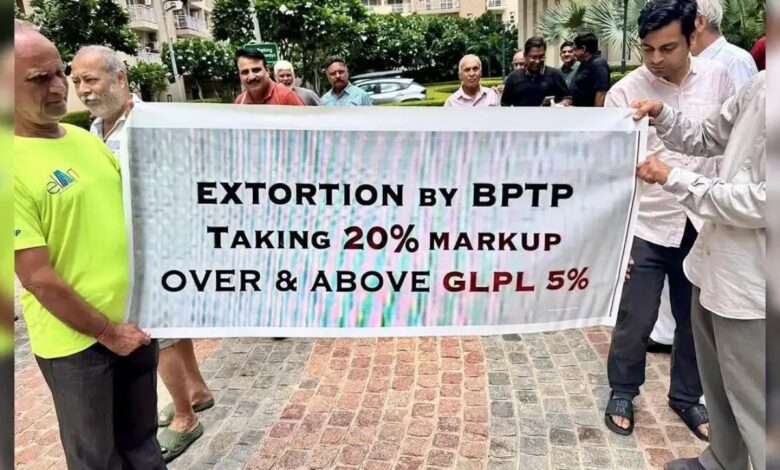
When Residents of BPTP Discovery Park Pay Escalating Maintenance Reaching ₹9,000 Yet Face Falling Plaster, Broken Playgrounds and Stray-Cattle Hazards, Who Exactly Is Accountable?
What does it mean when a residential project marketed for more than a decade as a premium address in Greater Faridabad still leaves its occupants fighting for the most elementary civic services? BPTP Discovery Park in Sector 80 stands as a stark illustration of that question. According to the detailed report published by Jagran on late September 2026, the project was launched in 2012, comprises more than 800 flats, and currently houses residents in roughly 600 of them.
Flats in the society are now reported to command prices reaching ₹2 crore. Possession is said to have begun in 2019; maintenance charges started being collected from 2020. Yet in late September 2026 the same residents described a litany of unresolved problems spanning electricity, maintenance billing, parking, construction quality, street lighting, stray cattle, a liquor shop opposite the gate, the absence of a temple, waterlogging and damaged roads.
The contradiction is immediate and troubling. How can apartments valued at up to ₹2 crore still leave their owners dependent on diesel generators during frequent outages, paying what they regard as arbitrary charges for that backup, while simultaneously shouldering maintenance bills that have risen to approximately ₹9,000? The figure of ₹2 crore is not an abstract market statistic; it represents life savings, bank loans, and the expectation of a secure, well-serviced home. When residents must repeatedly demand individual electricity connections that have not materialised years after occupation, the gap between the price paid and the service received demands rigorous scrutiny rather than polite acceptance.
Haryana RERA’s own database confirms that Discovery Park is a registered project under registration number 297 of 2017 dated 16 October 2017, carrying project ID RERA-PKL-591-2019, with BPTP Limited listed as the promoter. The same official record shows that the project continued to face regulatory proceedings throughout 2026. Hearings related to an extension were listed for 22 April, then adjourned successively on 3 June, 24 June, 8 July, 15 July, 12 August and finally to 30 September 2026.
In parallel, a Representation-Cum-Complaint against BPTP Ltd. was listed, with hearings on 29 July, 9 September and 16 September 2026, each marked as adjourned. The Jagran report appeared on September, mere days before the next scheduled listing. The coincidence of ongoing regulatory adjournments and contemporaneous resident complaints cannot be dismissed as unrelated administrative detail.
Consider first the electricity dispute, which residents identify as among the most serious. Sachin Guglani, Ritesh Kumar, Gaurav Gupta and P. Kendra Sharma told Jagran that they have repeatedly sought individual electricity connections yet have not received them. Power cuts are described as frequent; during outages electricity is supplied through the diesel-generator system, for which residents are charged amounts they consider arbitrary.
The absence of individual connections is not a minor inconvenience. It affects the ability to access state solar schemes, leaves households dependent on a single-point arrangement controlled by the developer, and creates a recurring financial burden whose calculation remains opaque to those who pay it.
This is not an isolated grievance confined to Discovery Park. Earlier in April 2026 the same newspaper reported that residents of various BPTP blocks in Greater Faridabad had approached Haryana Chief Minister Nayab Singh Saini specifically over the demand for individual electricity connections. They alleged that the builder had taken a single-point connection and was supplying power while residents sought individual meters.
BPTP’s representative Rohit Mohan stated at that time that the necessary electrical infrastructure already existed and that the company had no objection to individual connections. The factual tension is therefore clear: residents continue to report non-delivery, while the developer has publicly indicated that infrastructure is in place and that it does not oppose the change. Why, then, has the transition still not occurred months later? What procedural, technical or commercial obstacles remain unaddressed? The unanswered character of these questions only deepens the concern.
The maintenance-charge controversy compounds the electricity problem. Residents allege that the charge has now reached approximately ₹9,000. The chronology is itself revealing: launch in 2012, possession from 2019, maintenance collection from 2020, and by September 2026 a figure that residents describe as among the highest compared with other societies in the city.
Abhishek Aggarwal specifically alleged that after already paying maintenance, residents were now also being charged for water, and that Discovery Park’s maintenance ranked among the highest in Faridabad. The ₹9,000 figure must be examined with care. It is an allegation reported by residents rather than an independently audited comparative study of every society in the city. Yet even if the comparative claim requires further verification, the absolute level of the charge and the simultaneous imposition of water billing raise legitimate questions about transparency, contractual justification and the quality of services returned for the money extracted.
What precisely does a monthly outlay approaching ₹9,000 purchase when residents simultaneously report insufficient parking, plaster falling from flats, flooring coming off in parks, broken playground equipment and non-functional street lights? The human impact is cumulative.
Families who have invested crores find themselves writing additional large monthly cheques while the physical condition of common areas deteriorates and basic utilities remain unreliable. The interrogative pressure is unavoidable: if the charge is contractually authorised, where is the detailed break-up that demonstrates value for money? If the charge has risen without corresponding improvement, what regulatory or contractual mechanism exists to restrain it?
Parking arrangements form another layer of daily friction. Residents told Jagran that despite paying maintenance and other charges, parking spaces remain inadequate, locations are changed without adequate notice, and vehicles are parked so closely that even a person has difficulty passing between them. The practical consequence is not merely inconvenience; it is a daily negotiation of limited space that can escalate into neighbour disputes, damage to vehicles, and reduced accessibility for emergency services.
More serious still is the allegation that a substantial portion of land associated with Discovery Park has allegedly been used for another project. This claim, reported by residents, cannot be treated as established fact on the basis of the newspaper account alone. To determine whether any diversion or alteration of sanctioned project land occurred would require comparison of the approved layout plan, sanctioned plans, RERA Form A-H documents, licences, land records, zoning plans and the current physical layout. Until that documentary exercise is completed, the allegation stands as a serious unresolved question rather than a proven irregularity. Yet the very existence of the claim, voiced by occupants of a high-value residential project, underscores the need for transparent public clarification.
Construction quality concerns at BPTP add a further dimension of anxiety. Amit Gupta reportedly stated that residents had been promised comprehensive facilities at the time of booking yet now do not feel secure, alleging that plaster frequently falls from flats. Siddharth Gandhi pointed to the visible deterioration of common areas: flooring in parks coming off, playground equipment broken, repeated requests for repairs met with what residents describe as inadequate response. These are resident allegations, not the findings of a structural audit, municipal inspection or court-ordered technical evaluation.
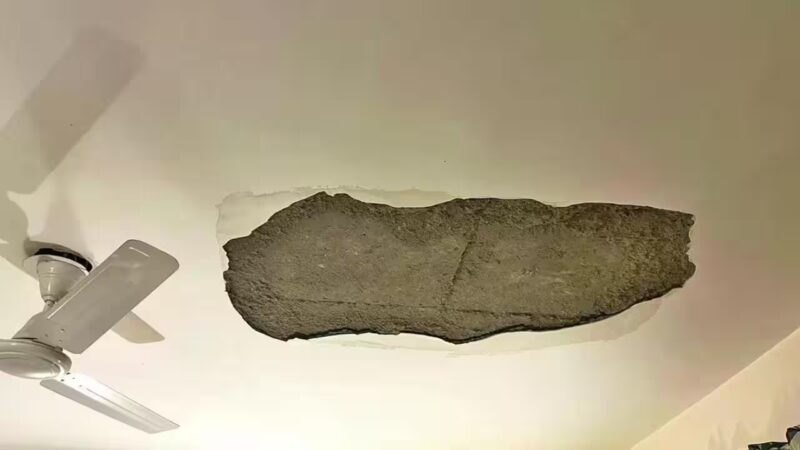
The distinction is essential. “Residents allege plaster is falling” is supported by the published report; “the buildings were constructed with substandard materials” would require independent engineering evidence. Nevertheless, the persistence of such complaints years after possession began raises legitimate questions about the durability of finishes, the responsiveness of the maintenance regime, and the gap between brochure promises and lived reality.
Street lighting and external infrastructure introduce yet another set of responsibilities that may not rest solely with the developer. Residents complained about the road between the BPTP bridge and the society, stating that street lights are not functioning properly. They said they had complained both to municipal authorities and to Haryana Shehri Vikas Pradhikaran (HSVP), yet the problem had not been resolved. Ashwini Gaud, Executive Engineer, HSVP, responded that the condition of street lights in Greater Faridabad was generally okay and that the department would inspect Sector 80 and replace defective lights.
The official reply is useful precisely because it demonstrates that some complaints concern public infrastructure for which government agencies share responsibility. The question therefore becomes one of coordination and accountability: which stretches fall under the developer’s residual obligation, which under the municipal corporation, and which under HSVP? Without clear demarcation and timely action, residents remain trapped between agencies.
Safety concerns extend beyond lighting. Gaurav Sethi, Jugal Kishore and Nitin Sharma reported that stray cattle congregate around the society and on surrounding roads, contributing to road accidents. Complaints to the municipal corporation had, in their view, produced insufficient action. They also expressed concern that foggy conditions could further elevate accident risks.
Again, these are resident claims rather than a quantified analysis of FIRs, traffic-accident statistics, municipal complaint records or CCTV footage. A stronger investigation would obtain those records. Until then, the allegation stands as a documented expression of fear and frustration that public authorities have a duty to examine.
The liquor-shop complaint introduces a different safety dimension. Nitin Sharma alleged that a liquor outlet is located directly opposite the society, that people gather there late at night, that women feel uncomfortable or unsafe while passing outside, and that loud music continues into the night. This is a resident’s allegation, not evidence that the outlet is illegally sited.
Establishing the precise licence holder, the licensed location, the distance from residential premises, the permitted operating hours, the history of police or excise complaints, and any noise-control action would be necessary before firm conclusions can be drawn. Yet the fact that occupants of a gated residential project feel compelled to raise such concerns publicly itself signals a breakdown in the sense of security that high-value housing is expected to provide.
Residents further complained that there is no temple within the society and that they must travel approximately 1.5 km to worship elsewhere. They said they had complained to Minister Rajesh Nagar, after which the builder gave an assurance but no temple was subsequently constructed. A temple is not ordinarily a mandatory amenity under real-estate regulation.
The more precise investigative question is therefore whether a temple or religious facility was explicitly promised in the sanctioned plan, the brochure, the agreement for sale or any allotment documentation. If it was promised, the failure to deliver acquires contractual and regulatory significance. If it was never promised, the absence remains a residents’ preference rather than a regulatory deficiency. Clarity on this point is still required.
Waterlogging and damaged roads form part of a larger Greater Faridabad infrastructure pattern rather than a problem exclusive to Discovery Park. Atul Tiwari complained about the poor condition of Greater Faridabad’s roads and inadequate drainage, noting that even light rainfall can result in waterlogging. The critical distinction is ownership and maintenance responsibility. Which internal roads and drainage systems inside Discovery Park remain under the developer or the residents’ association, and which fall under the municipal corporation or HSVP? Without that demarcation it is inaccurate to attribute every flooded stretch solely to BPTP. At the same time, residents living inside a completed project cannot be expected to accept chronic waterlogging as an inevitable feature of urban life.
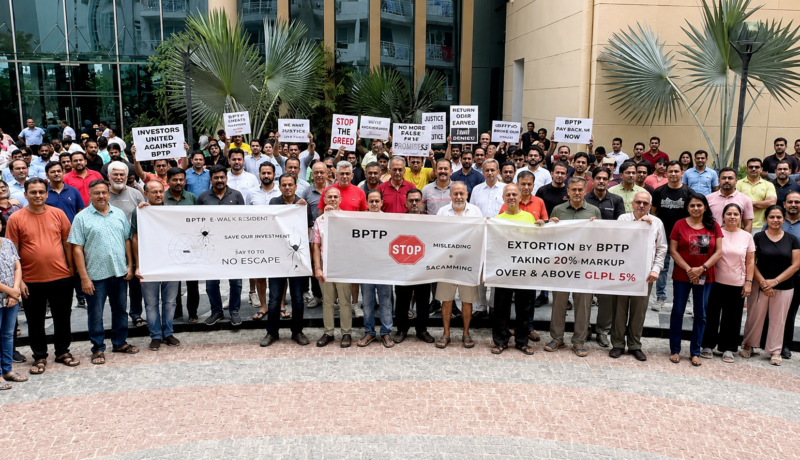
The regulatory trail recorded by Haryana RERA elevates the entire set of grievances beyond routine resident dissatisfaction. Multiple adjournments of extension-related hearings throughout 2026, culminating in a listing for 30 September, together with a parallel Representation-Cum-Complaint that itself was adjourned three times, indicate that the project’s regulatory status remains active and contested. The official database does not, on its face, disclose the precise content of the Representation-Cum-Complaint, yet the mere existence of repeated listings in the same year that residents are publicly documenting service failures invites closer examination of whether any outstanding obligations or orders remain unfulfilled.
Nor is Discovery Park an isolated pocket of complaint. In June 2026 Jagran reported protests by residents of BPTP A, C, M and J blocks over water, electricity and damaged roads. Residents alleged that water was sometimes supplied only after 25–40 hours, that unannounced power cuts continued, and that individual electricity connections remained unavailable more than a decade after occupation.
They also protested increased common-area maintenance charges and demanded that maintenance eventually be handed over to the municipal corporation. In August 2026 Amar Ujala reported a security complaint from F Block concerning the absence of a proper main entrance gate, allowing outsiders, stray animals and dogs to enter. The pattern across multiple blocks suggests that the problems voiced at Discovery Park form part of a wider and recurring homebuyer-service dispute in BPTP’s Greater Faridabad developments.
BPTP’s public responses have been limited. In the April 2026 electricity dispute the company stated that infrastructure existed and that it had no objection to individual connections. In the September Discovery Park report, however, Jagran recorded that it contacted BPTP for a response to the specific allegations but did not receive one by late night. The absence of a detailed, point-by-point reply to the September complaints leaves the resident narrative largely unchallenged in the public domain and deepens the perception of non-responsiveness.
What, then, stands as established fact and what remains allegation? From the official RERA record it is established that BPTP Limited is the promoter, that the project carries registration 297 of 2017 dated 16 October 2017 and project ID RERA-PKL-591-2019, and that multiple regulatory listings and adjournments occurred in 2026, including a Representation-Cum-Complaint.
From the Jagran report it is established that residents have publicly alleged the absence of individual electricity connections, frequent outages and arbitrary DG charges, maintenance reaching approximately ₹9,000 plus additional water charges, inadequate and shifting parking, alleged land use for another project, falling plaster, deteriorating parks and playgrounds, non-functional street lights, stray cattle, a liquor outlet opposite the society, the absence of a temple, and waterlogging after light rain.
These allegations require attribution unless independently verified. The most consequential open questions concern whether approved land or layout has been altered, whether promised amenities appear in sanctioned documents, whether the maintenance figure is contractually and legally justified, how DG charges are calculated, why individual electricity connections have not been provided despite the company’s earlier statement, whether structural defects exist that a technical inspection would confirm, and whether any outstanding RERA obligations remain.
The deeper investigative angle is therefore not simply that residents of one society complain about poor facilities. It is whether a project whose units now sell for up to ₹2 crore can continue to leave its occupants fighting for basic infrastructure years after possession, while regulatory proceedings remain in a state of repeated adjournment and similar grievances surface across multiple BPTP blocks in the same region.
The chain that requires examination runs from what was promised in marketing and agreements, through what was sanctioned in licences and plans, to what was actually constructed and delivered, what residents continue to pay, which agency bears responsibility for each missing or defective facility, what complaints have been filed and with what result, what the RERA record ultimately discloses, and whether discrepancies exist between the approved scheme and the lived environment.
Until those questions receive transparent, documented answers, the residents of Discovery Park, and of other BPTP developments in Greater Faridabad, remain entitled to ask how a premium-priced residential address can still leave them dependent on generators, writing large monthly cheques for services they regard as inadequate, navigating cramped and shifting parking, watching common areas deteriorate, and living with unresolved safety and infrastructure risks.
The regulatory and administrative systems that are supposed to protect homebuyers appear, on the available public record, to be moving slowly while daily life continues under the weight of these unresolved deficiencies. The concern is not rhetorical; it is the lived experience of hundreds of families who paid substantial sums for homes that were meant to deliver security, convenience and dignity.