New AI For Faster Visas, But Old Complaints And Frauds Still Haunt: The BLS International Saga
On 9 October 2026 BLS International announced an AI-first partnership with Signzy to detect document anomalies, tampering and deepfakes, promising faster, more secure visa and consular processing while governments retain final decisions. The layered stack with AWS and Sypha AI is presented as future-ready. Yet only months earlier the same company faced a Ministry of External Affairs debarment order later quashed on procedural grounds, fourteen documented complaints of forced optional services across multiple countries, and expansion of a Spanish criminal investigation in Algiers examining external providers amid alleged payments of up to €25,000 per family. Advanced tools may flag forgeries; they cannot substitute for internal accountability when applicants and missions raise systemic concerns.


AI for Faster Visas, Yet Old Complaints of Forced Fees Linger: How upgrade in tech can never fix the fraudulent core of BLS International?
On 9 October 2026, BLS International Services Limited announced what it described as a further strengthening of its technology stack. In a release carried by Express Computer, the company said it was building an AI-first, partner-powered ecosystem designed to make visa and consular services faster and more secure for applicants. The centrepiece was a partnership with Signzy to integrate document intelligence and deepfake detection capabilities into its document-processing systems. The stated aim was to identify anomalies, tampering and AI-generated forgeries, streamline verification workflows, and improve accuracy, consistency and turnaround times. Visa decisions, the company stressed, would remain firmly with governments.
Shikhar Aggarwal, Joint Managing Director, framed the move as central to how the firm scales and differentiates: pairing in-house innovation with industry-leading partnerships to create an agile, modular and future-ready stack. Arpit Ratan of Signzy added that the collaboration extended advanced AI verification, underwriting and fraud/AML intelligence to one of the world’s largest citizen and visa services networks. BLS already works with partners including AWS and Sypha AI. Its stated operating principle is clear: technology flags potential issues, people verify, and governments decide. The company also pointed to its CMMI Maturity Level 5 appraisal and ISO certifications as evidence of robust data security and privacy practices, including GDPR compliance.
The announcement arrives at a moment when the company is positioning itself as a technology leader in an industry that processes millions of applications across more than 100 countries for over 40 client governments. On paper, the upgrades address precisely the risks that plague visa systems: forged documents, synthetic identities and inefficient manual checks.

Yet the timing invites a sharper question. Only months earlier the same organisation was the subject of a formal two-year debarment order from India’s Ministry of External Affairs, a Delhi High Court judgment that set that order aside on procedural grounds while leaving service-quality issues open, and the expansion of a Spanish criminal investigation into an alleged visa-fraud network at the Algiers consulate that explicitly brought external service providers, including platforms of the BLS type, into its scope.
The contrast is difficult to ignore. Advanced algorithms can now scan for deepfakes. The more stubborn problem has always been whether the human and organisational layers surrounding those algorithms are themselves under effective scrutiny.
In August 2025 the Ministry of External Affairs issued a show-cause notice to BLS. On 9 October 2025 it followed with a debarment order (No. VII/415/30/2025) that barred the company from participating in future MEA and Indian Mission tenders for two years under Rule 151(iii) of the General Financial Rules, 2017. The order cited allegations including court cases and complaints from applicants. BLS immediately disclosed the order to the stock exchanges and stated that existing contracts would continue unaffected while it reviewed its legal options.
The company challenged the order in the Delhi High Court in W.P. (C) 16352/2025. On 18 December 2025 Justice Sachin Datta set the debarment aside. The court did not find that every complaint was false, nor did it declare the company free of service deficiencies. It held that the process itself was defective. The show-cause notice had particularised fourteen complaints; the final order relied on a broader claim of hundreds of complaints without giving BLS a proper opportunity to respond to those additional allegations.
Complaints had also been received against other providers; no clear standard operating procedure or numerical threshold justified singling out one company solely by volume. Challenges to competing bidders and disputes over financial penalties were treated as legitimate legal remedies rather than evidence of anti-competitive misconduct. The court left the door open for a fresh, properly particularised show-cause process on alleged substandard services.
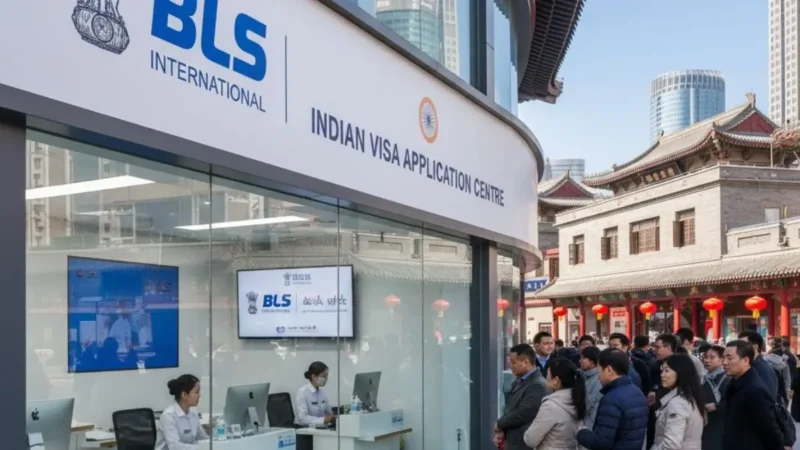
The 14 complaints listed in paragraphs 38–39 of the judgment form the most concrete public record of the allegations. They span Muscat (forced paid photography, 23 August 2023), Brampton and Toronto (compelled premium services and extra charges, November 2024 and March 2025), Dubai (forced optional services, December 2024), Kuwait (exploitative pricing for typing, photocopying, printing and photographs, March 2025), Ottawa, Vancouver, Mississauga and Surrey (forced premium lounge and courier services, April–July 2025), Kuala Lumpur (passport cover and courier presented as mandatory, May 2025), and several complaints received directly by the Ministry concerning photograph corrections and form-filling charges.
In each case the core allegation against BLS International is the same: services that the company presents as optional were, according to the complainants, treated as compulsory at the centre.
The Spanish Investigation: A Different Order of Risk
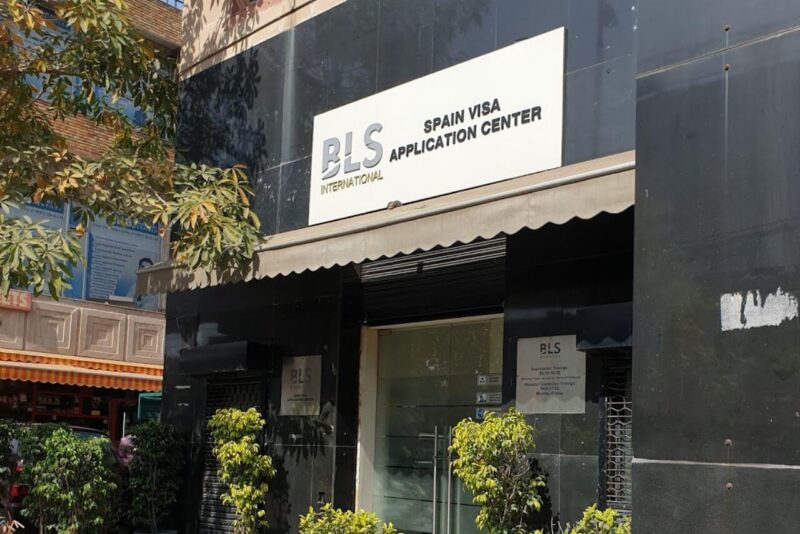
While the Indian administrative process was unfolding, a more serious development emerged in Spain. In April 2026 Spanish authorities arrested Vicente Moreno, chancellor and second-in-command at the Spanish consulate in Algiers, and Mohamed Boutouchent, a local consular employee. Moreno’s wife was also placed under investigation. By August 2026 the Audiencia Nacional, under Judge María Tardón, had expanded the probe to examine the potential role of external service providers that handle administrative aspects of visa applications and appointments. ObservAlgérie, The Objective and subsequent Indian reporting noted that judicial sources referred to “processing platforms of the BLS type.”
Families were allegedly charged as much as €25,000 for irregular assistance with visas, residence permits or work permits, sometimes involving unverified or falsified documents. Legitimate applicants were said to have been disadvantaged. The investigation encompasses suspected offences including criminal organisation, money laundering, influence peddling, document falsification by a public official and offences against the rights of foreign citizens.
Technology Flags, People Verify — But Who Watches the People?
The new AI stack is designed to flag document anomalies and synthetic forgeries with greater precision. That capability is welcome. Document fraud is a genuine and growing threat. Yet the complaints that reached the Ministry and the questions raised in the Spanish investigation did not primarily concern sophisticated forgeries that only deepfake detection could catch. They concerned the ordinary human interface: whether an applicant was told that photography, courier, lounge access or form-filling was compulsory when the published terms treated those services as optional; whether appointment access could be influenced by intermediaries; whether staff at the counter consistently applied the rules the company claims to follow.
An algorithm that spots a tampered passport page does nothing to prevent a counter staff member from presenting a premium lounge fee as mandatory. A layered technology stack does not automatically create an internal culture in which complaints are logged, investigated and used to change behaviour rather than managed for contractual survival. The High Court record shows that missions had issued warnings and financial penalties yet refrained from terminating contracts to avoid service disruption. That pragmatic choice may have protected continuity; it also left the underlying pattern of complaints insufficiently tested in public.
The company’s own principle, technology flags, people verify, governments decide, places the critical verification step squarely on human judgment and organisational systems. If those systems are not themselves subject to transparent, independent and timely scrutiny, the flags become decorative. Applicants under time pressure, often far from home and facing language or logistical barriers, remain vulnerable to the same practical imbalance that the fourteen complaints described.
How many of the hundreds of complaints cited in the October 2025 debarment order were investigated to a documented conclusion, and what proportion produced refunds, staff discipline or measurable process changes? Why were the additional complaints beyond the fourteen never particularised and supplied to the company before the ban was imposed? What comparative data for other service providers was placed before the Delhi High Court, and why has an anonymised version not been made public?
In the Algiers investigation, what specific evidence, if any, links individual employees of external providers to the alleged network, and has that material been shared with the companies concerned? What internal audit did BLS conduct of the centres named in the fourteen complaints, and what remedial steps followed? Does the new AI stack include monitoring of staff interactions and sales practices at the counter, or is its focus limited to document authenticity? What independent mechanism exists for an applicant who believes an optional service was presented as compulsory to obtain a rapid, binding review and refund?
The October 2026 announcement is a legitimate commercial and technological step. Detecting deepfakes and accelerating verification are public-interest goals. Yet the preceding eighteen months produced a formal debarment order later quashed for procedural unfairness, a concrete list of fourteen complaints that the Ministry treated as serious enough to justify blacklisting, an allegation of hundreds more that was never fully particularised, and the expansion of a criminal investigation in which external providers were named.
BLS has denied wrongdoing in the Spanish matter and maintained before the Delhi High Court that it investigates complaints and operates transparently. Those positions must be recorded. They do not close the gap between the technology narrative and the service-delivery record.
Advanced tools can flag forgeries. They cannot substitute for the harder, less glamorous work of ensuring that every staff member at every centre understands that optional means optional, that every charge is disclosed and receipted, that appointment systems are resistant to informal influence, and that complaints are treated as diagnostic data rather than contractual nuisances. Until that organisational layer is demonstrably robust, the AI-first ecosystem risks becoming another layer of sophistication built on foundations that applicants and regulators have already questioned.