When the Court Calls Accountability a ‘High-Sounding Word’
Why India Lacks Accountability, When Indian Judiciary Denies Setting The Accountability Of Indian Agencies, Who Else Can Be Approached For Setting Accountability

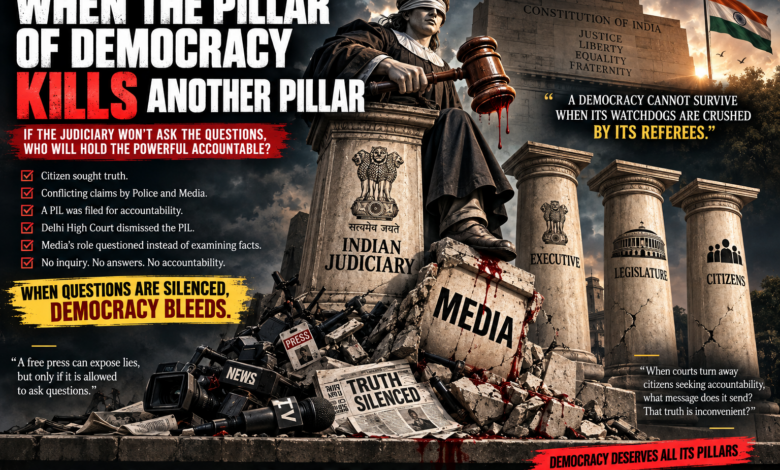
Nitin Naresh asked Delhi Police one question. The Delhi High Court told him the question itself was the problem. That is not jurisprudence. That is a system talking to the citizen like a nuisance.
On 16 September 2026, in Courtroom of the Delhi High Court, a Division Bench of Chief Justice Devendra Kumar Upadhyaya and Justice Tejas Karia disposed of WP(C) 13480/2026 — Nitin Naresh v. Union of India & Ors. — with the kind of oral contempt that Indian courts reserve not for armed agencies, but for the unarmed petitioner who still believes a representation is worth paper.
The petitioner was not asking the Bench to hang a constable. He was not asking it to declare that a lathi-charge happened. He was not asking it to rewrite the history of 20 July. He was asking the court to do the smallest, dullest, most bureaucratic thing a constitutional court can still do in a republic: direct a tax-funded police force to decide, in writing, a citizen’s representation about two publicly circulating versions of the same afternoon.
The Bench’s answer, in substance, was this: How dare you.
“All sorts of matters are filed. Everything that catches your imagination after reading the newspaper, you will file a petition? These high-sounding words, accountability, transparency are not to be used in a vacuum like this… Is there a duty on the Delhi Police to decide your representation?”
Read that last sentence again. Slowly. That is the Indian State, in robes, asking whether the police — paid from the Consolidated Fund, armed by statute, licensed to break bone in the name of public order — owe a citizen even a reasoned reply when its own social-media handles have told the country one story and the country’s cameras have told another.
If that is not a vacuum, the vacuum is the republic.
What Naresh actually filed — and what the court pretended he filed
Nitin Naresh described himself as associated with the media. He had already sent a representation to Delhi Police. The representation did not invent a riot. It pointed to a collision that any literate adult in Delhi had already seen: media reports and circulating video of baton use, tear gas, removals and detentions on one side; Delhi Police’s public handles on X, Facebook and Instagram insisting the opposite flavour of event on the other. He wanted the force to decide that representation. He wanted a record. He wanted the official version to stop floating as a press note and start existing as an accountable document.
That is the entire case.
The court recast it as a man who had read a newspaper and decided to become a public-interest tourist. “Media news is no evidence,” the Bench said, as if the prayer were to treat a headline as a conviction. It was not. The prayer was the opposite of a finding of fact. It was a request that the agency which denies the fact be made to answer the denial.
There is a difference — a difference first-year law students are taught — between asking a court to adjudicate history and asking a court to compel an authority to speak. Naresh asked for the second. The court punished him as if he had asked for the first, and then congratulated itself for protecting the docket.
The Bench wanted a “dispute between two parties” or a “violation of a legal or constitutional right.” Fine. Here is the dispute: a public force made a public claim; the public record contradicted the claim; a citizen asked the force to reconcile the two. Here is the right: Article 19’s information ecosystem, Article 21’s bodily integrity of the students who say they were beaten, and the ordinary public-law duty of a State instrumentality not to gaslight the people who pay its salaries.
The court found none of that “public interest.”
If forcing a police department to explain why its official mouth said “no sporadic violence, no arbitrary detentions” while hospitals were receiving injured protesters is not public interest, then public interest in this country has been defined downward until it fits only the cases the court already wants to hear.
20 July was not a rumour. It was a documented collision.
On 20 July 2026, the opening day of Parliament’s Monsoon Session, the Cockroach Janta Party’s unauthorised “Chalo Sansad” march tried to move from Jantar Mantar toward Parliament. Prohibitory orders under Section 163 BNSS were in force. Permission had been refused. Thousands came anyway. Barricades went up. Crowds pushed. Stones were alleged. Lathis and tear gas were used. Internet was restricted in parts of central Delhi. FIRs followed against unidentified persons for rioting, assault on public servants, damage to property.
That is not a “newspaper imagination.” That is the agreed skeleton of the day, accepted even by outlets that dislike the protest and outlets that romanticise it.
Delhi Police’s public line that day was not a careful operational briefing. It was a denial packaged for social media:
“Reports of sporadic use of violence and arbitrary detentions are incorrect. The protest was handled professionally in accordance with the law. People are requested not to fall prey to rumours or misinformation circulating on social media.”
Note the craft. The force did not say, in that formulation, “we used measured baton force after a breach.” It said the reports were incorrect and asked citizens not to believe what they were watching. Meanwhile BBC, Deccan Herald, Indian Express, Hindustan Times and others described cane charges, tear gas, and injured demonstrators. CJP released its own videos alleging police threw stones and used lathis. Police officers on the ground alleged stone-pelting from the crowd.
Then the numbers arrived, and they were not rumours either.
In a counter-affidavit later placed before the Supreme Court, Delhi Police itself said more than 30,000 people had gathered within about three kilometres, about 5,000 personnel were deployed, more than 240 police personnel were injured, and 218 protesters were also injured.
Two hundred and eighteen injured protesters and two hundred and forty injured policemen is not “handled professionally” in the sense of a quiet afternoon. It is a clash. A clash in which someone used force. A clash in which someone bled. A clash in which the public was told, on the day itself, not to believe the evidence of the street.
Separately, reporting based on a CRPF examination of RAF logs said one RAF personnel fired seven pellet-gun rounds in the Connaught Place area — five hitting people, two hitting the ground — after alleged stone-pelting. Named injured included a 19-year-old Delhi University student, a 25-year-old worker, and a journalist.
So the citizen’s question was not metaphysical. It was brutally concrete:
If a lathi-charge happened, why did the official handles deny the reports?
If it did not happen, why did half the national press, the cameras, the injury lists, and later a paramilitary log describe force?
Naresh did not offer to answer that question for the court. He asked the only body that owes an answer — the police — to write one down.
The High Court told him there was no duty to write it down.
The fourth estate printed a version. The armed estate denied a version. The judicial estate shrugged.
Media in this country is not a sacrament. It lies, it herds, it launders, it forgets. That is not an argument for treating a police denial as holy writ. The press is still the fourth pillar in the only sense that matters in a constitutional order: it is the only institution that can put a baton on a page before the State has finished writing the press note. When that page and that press note cannot occupy the same reality, a democracy does not get to call the contradiction “no evidence” and go to lunch.
Police departments are not private clubs. They spend public money. They carry public weapons. They file public FIRs. They issue public advisories. If they used force, the adult sentence is: We used force because X, under Y law, after Z warning, in this quantum, and here is the injury ledger. If they did not use force, the adult sentence is: Here is why the videos are not what they appear to be, and here is the hospital data.
What they issued instead was a social-media exorcism of “rumours.”
What the High Court issued instead was a sermon against “high-sounding words.”
Accountability is not a high-sounding word. Accountability is the difference between a republic and a police department with a verified tick.
A government department that takes salaries from the taxpayer does not get to deny an action “outright” merely because admitting it would be inconvenient. Force is sometimes lawful. Dispersal is sometimes necessary. An unauthorised march toward Parliament on the opening day of a session is not a picnic. None of that required a lie of omission. It required a justification. Justification is what separates a lawful lathi from a furtive one. The police chose denial. The court chose not to disturb the denial. The citizen was left holding a representation that, in the court’s view, the police were not even obliged to stamp.
This is what “who will set accountability?” sounds like when the last door closes
Naresh asked the Bench the only question that survives after a dismissal: if you will not entertain this, who will set accountability?
The Chief Justice’s reply was that accountability and transparency are not to be used “in a vacuum.”
Let us inspect the vacuum the court does not wish to see.
The docket the court is so anxious to protect is already a national humiliation.
As of 16 July 2026, NJDG figures placed before Parliament showed 96,024 matters pending in the Supreme Court and 64,72,536 in the High Courts. Of the High Court pile, 80,660 cases were older than 30 years. Delhi High Court itself carried 1,25,478 pending cases. Across the full system, end-2025 figures given to the Lok Sabha put the national backlog near 5.39 crore — about 4.76 crore in district courts, 63.66 lakh in High Courts, 92,101 in the Supreme Court at year-end, later climbing again toward 94,639 by August 2026. High Court vacancies in May 2026 stood at 326 of 1,122 sanctioned posts — roughly 29 per cent empty.
This is the system that cannot spare twenty minutes to tell a police commissioner to answer a representation, because the petitioner used the words “transparency” and “accountability.”
The police-accountability record is not a “vacuum.” It is a graveyard with a statistical headstone.
NCRB-linked analysis for 1999–2023 records 2,253 deaths in police custody and 2,373 cases registered against police personnel for human rights violations. Convictions in that set: three. All in 2017. For 2018–2022, the Status of Policing in India data shows cases registered in only about 10 per cent of police-custody deaths, and zero convictions in that five-year window. Across 2021–22 to 2025–26, Parliament was told that NHRC-linked police-custody death cases ran 140 to 176 a year, with 170 already recorded in 2025–26 up to 15 March — and one reported disciplinary action against an officer in connection with a custodial death in the entire five-year stretch.
That is not a functioning accountability machinery that the Delhi High Court needed to protect from a media-linked petitioner. That is a conviction rate that would embarrass a banana republic, wearing the uniform of the world’s largest democracy.
PIL itself has been talked down into a slur.
The Supreme Court has, in its own voice, watched the jurisdiction it invented decay into “Private Interest, Publicity Interest, Paisa Interest, Political Interest.” It has complained of a “mushroom growth” of frivolous PILs. Parliament’s own numbers show 3,525 PILs pending in the Supreme Court, 698 of them more than ten years old, the oldest from 1984; 570 new PILs admitted in 2025, with five-year disposals averaging about 374 a year. Empirical work on Bombay High Court PILs found more than half dismissed, about a fifth withdrawn, petitioners winning about 29 per cent of concluded matters. An Oxford study of 45 years of Supreme Court PILs found the poor and disadvantaged reduced to about 10 per cent of the surveyed PIL constituency.
So the jurisdiction built to hear the voiceless now spends its moral energy scolding the voiced. The student with a cracked scalp is “newspaper imagination.” The force with the verified handle is the adult in the room.
Who else, exactly?
This is the question the headline asks, and it deserves an unsentimental map.
The same High Court, on another day, in another cause title.
Possible. Also circular. The same Bench culture that calls a demand for a reasoned police reply a vacuum will not suddenly discover a duty because the petitioner changes his font.
The Supreme Court — and this is the fact the attack must not hide.
On 18 August 2026, a three-judge Bench led by CJI Surya Kant constituted a five-member High-Powered Enquiry Committee headed by former Supreme Court judge R. Subhash Reddy, with former High Court judges Ravi Shankar Jha and Shalinder Kaur, former CBI Director Rishi Kumar Shukla, and former Meghalaya DGP L.R. Bishnoi. The remit includes excessive force, pellet guns, violence by protesters, injuries, chain of command, and, on priority, alleged targeted violence, harassment and molestation of women protesters. The Court said the inquiry was not to be a one-time exercise. On 10 September it directed the committee to begin.
That committee is the adult process. It is also an admission. You do not build a five-member panel headed by a retired Supreme Court judge to examine “newspaper imagination.” You build it because the official story and the street story cannot both be true in full.
Which makes the Delhi High Court’s performance on 16 September even harder to defend. The apex court had already treated the July clash as a matter of constitutional gravity. A citizen asked the High Court only to make the local police answer a representation about the same clash. The High Court sneered at the vocabulary of accountability and sent him away. Two courts, one republic, two moral temperatures.
NHRC.
The Commission that registers the custodial-death file and watches disciplinary action arrive at the rate of one officer in five years. A recommendatory body with a compensation chequebook and almost no teeth in the face of a determined police hierarchy.
Internal police inquiry / Vigilance / CAPF’s own probe.
The RAF pellet-round finding shows that a force can count its own cartridges when the political weather demands it. It does not show that the force will, unprompted, retract a denial issued on the day of the march. Asking the accused institution to be its own historian is how India has produced the conviction numbers above.
Parliament.
Questions can be asked. Home Ministry affidavits can be tabled. The same Parliament is looking at 5-crore-plus pendency and 29 per cent High Court vacancies and has not yet legislated a police-accountability statute that actually convicts. Oversight that cannot produce a conviction in a decade of custody deaths is oversight as theatre.
The press again.
The fourth pillar can keep publishing the video. It cannot compel a file-noting. That is what courts are for. When courts treat the press as the disease rather than the symptom, they are not disciplining frivolous litigation. They are disciplining the only remaining public witness.
The street.
Which is how this country keeps rediscovering that when institutions refuse to write the truth down, the next generation writes it on a barricade.
So the honest answer to “who else can be approached” is: everyone, and therefore no one with a duty to answer in time. The Supreme Court committee is the least bad door still open on this protest. It is not a substitute for the principle the High Court spat on — that a police force which speaks to the public on social media can be made to speak to a citizen on paper.
The sentence the court wanted, and the sentence the republic needed
The court wanted this sentence: A man read the papers, used big words, wasted our morning. Dismissed.
The republic needed this sentence: A tax-paid armed force has issued a public denial that sits badly next to videos, injury counts and a later paramilitary log. Direct the Commissioner of Police to decide the representation by a date, on affidavit, with reasons. We make no finding on the merits. We refuse to treat official silence as official truth.
That second sentence would have cost the Board nothing in prestige and the police nothing but ink. It would have told every constable and every student the same thing: facts will have to live in a file.
Instead the Bench chose the older Indian reflex. Protect the institution from the question. Mock the vocabulary of the questioner. Call the absence of a private lis a want of public interest. Pretend that “media is not evidence” answers a prayer that never asked the media to be evidence.
Harsh? Yes.
Unfair to a court drowning in 1.25 lakh pending matters of its own? The drowning is real. The excuse is not. Courts that can find time to lecture a petitioner about newspapers can find time to issue a one-paragraph mandamus to a police department. They do it for tenders, for stray dogs, for festival routes, for the pet causes of the week. They did not do it here because the target of the representation was the police narrative itself.
That is the pinch. Not that India held an election last week and forgot. Not that habeas corpus has been repealed. Not that every judge is a courtier. The pinch is smaller and worse: when a citizen asks only for a reasoned official reply to a public contradiction about State violence, the constitutional court of the national capital can still say there is no duty to reply — and say it with a taunt.
A country in which the police may deny, the press may allege, the injured may queue, the Supreme Court may appoint a committee, and the High Court may still call the demand for a local answer a vacuum, is a country that has not abolished democracy. It has outsourced it to committees and press notes.
Accountability delayed to a retired-judge panel is still a form of accountability. Accountability sneered at in open court is a lesson. The lesson is for the next student who thinks a representation is a right, and for the next officer who learns that a denial on Instagram is, for a day and a docket, enough.
Naresh asked who will set the accountability if the court will not.
The Bench told him not to use the word.
The word does not become smaller because a court is tired of hearing it. The lathi does not become theoretical because a handle issued a clarification. And a democracy does not remain “free” in any sense that should comfort the taxpayer merely because the dismissal order was typed, stamped, and uploaded before lunch.