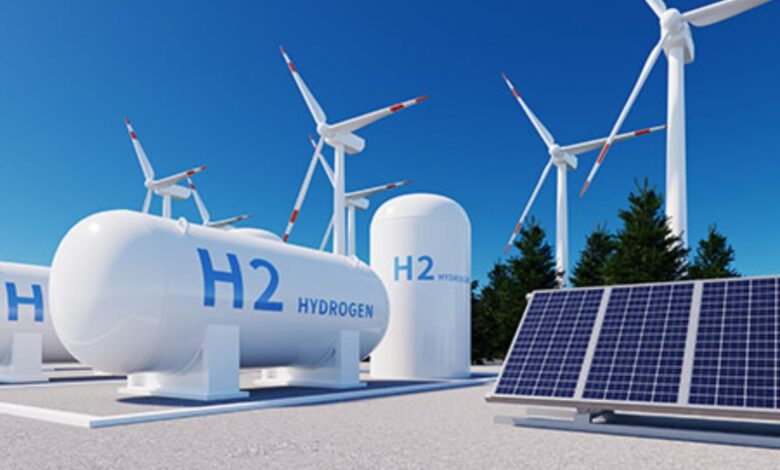
Before diving into the companies, it helps to understand exactly what a hydrogen fuel cell is and why it is generating such intense interest in India’s clean energy and mobility sectors. A fuel cell is an electrochemical device that generates electricity by combining hydrogen and oxygen — not through combustion, but through a controlled chemical reaction that produces electricity, heat, and water as its only byproduct.
Think of it as a battery that never needs recharging as long as you keep feeding it hydrogen fuel. This property — continuous power generation with zero direct emissions — makes hydrogen fuel cells uniquely suited to applications where batteries are too heavy, too slow to refuel, or simply too short on range: heavy trucks, buses, trains, marine vessels, backup power systems, and large-scale industrial energy supply.
India’s interest in hydrogen fuel cells is inseparable from two simultaneous national priorities. The first is decarbonising its transport sector, which is the second-largest source of the country’s greenhouse gas emissions and is particularly difficult to address in the heavy vehicle segment where battery electric solutions face real-world limitations around weight, range, and charging infrastructure.
The second is energy security — India imports over 85 percent of its crude oil, a vulnerability that hydrogen fuel cell vehicles directly reduce by enabling domestic hydrogen production from renewable energy to substitute for imported petroleum. The National Green Hydrogen Mission and the FAME (Faster Adoption and Manufacturing of Electric and Hybrid Vehicles) scheme’s gradual extension toward fuel cell vehicles have together created a policy environment that is encouraging both domestic innovation and international technology partnerships in this space.
It is important to set honest expectations about what this landscape looks like in 2026. India’s hydrogen fuel cell industry is at an earlier stage than its solar or wind sectors — most companies are in the pilot, pre-commercial, or early commercial phase rather than operating at mass-market scale. What the following ten companies represent, therefore, is not a mature industry but the credible, active frontier of one that is building with genuine determination. The list spans deep-tech startups, large Indian industrial companies pursuing hydrogen as a strategic adjacency, and established global players with meaningful India operations or partnerships.
1. H2e Power Systems
H2e Power Systems is the most singularly focused pure-play hydrogen fuel cell company to have emerged from India’s startup ecosystem, and for anyone trying to understand where indigenous fuel cell technology development is happening in the country, it is the natural first reference point. Founded and based in Pune — a city with a long engineering heritage in automotive and industrial technology — H2e has been developing Proton Exchange Membrane (PEM) fuel cell systems specifically engineered for the demands of the Indian operating environment.
That last qualifier matters more than it might initially appear. A fuel cell system designed and tested in Germany operates in ambient temperatures of 15 to 20 degrees Celsius with low dust and humidity variability. In India, the same system might face 45-degree summer heat in Rajasthan, 90 percent humidity during monsoon in Kerala, and highly variable power grid quality throughout. H2e’s engineering work addresses these specific adaptation challenges.
The company’s product focus spans stationary fuel cell systems for backup power applications — where the reliability advantage over diesel generators is increasingly valued by telecom towers, data centres, and hospitals — and fuel cell systems for mobility applications including material handling equipment, light commercial vehicles, and bus powertrains. In 2026, H2e represents one of the clearest examples in India of a company doing the foundational engineering work that will determine whether Indian fuel cell technology can eventually compete on cost and performance with international benchmarks.
Core focus: PEM fuel cell systems for stationary backup power and mobility, with India-specific engineering adaptation.
2. KPIT Technologies
KPIT Technologies occupies a distinctive and important position in India’s hydrogen fuel cell landscape because it approaches the technology not as a hardware manufacturer but as a software and systems engineering partner — and in modern fuel cell vehicles, software and systems integration are as critical to performance and safety as the electrochemical stack itself. KPIT is a Pune-headquartered global technology company that specialises in automotive software and engineering services, and its hydrogen fuel cell work is embedded within its broader vehicle electrification and powertrain technology practice.
The company has developed competencies in fuel cell system control software, hydrogen safety systems, powertrain integration architecture for fuel cell electric vehicles (FCEVs), and the testing and validation frameworks that OEMs require before deploying fuel cell vehicles commercially. It works with both Indian and international automotive manufacturers on these challenges. What makes KPIT’s contribution to the fuel cell ecosystem particularly valuable is that it provides capabilities that almost no Indian automotive company can build internally in a short timeframe — the specialised software engineering and systems integration expertise that bridges a fuel cell stack and a functional, safe, road-ready vehicle. As Indian commercial vehicle manufacturers accelerate their hydrogen pilot programmes, KPIT’s role in enabling those programmes is growing commensurately.
Core focus: Fuel cell vehicle software, powertrain integration, and systems engineering for automotive OEM partnerships across India and globally.

3. Thermax Limited
Thermax is one of India’s most respected industrial engineering companies, with a history going back to 1966 and a product portfolio spanning boilers, heat exchangers, absorption chillers, and industrial energy systems. Its relevance to hydrogen fuel cells comes through its Clean Energy division, which has been developing hydrogen and fuel cell-based energy solutions for industrial and commercial customers as part of a broader strategic pivot toward decarbonisation technology. Thermax’s approach to fuel cells is characterised by the same engineering rigour and customer-proximity that have defined its traditional industrial business — developing solutions that integrate hydrogen generation, fuel cell power generation, and waste heat recovery in configurations that make economic and operational sense for real industrial customers rather than laboratory demonstrations.
The company has been working on solid oxide fuel cell (SOFC) technology for high-temperature industrial applications, where the efficiency advantages of SOFCs — which can convert hydrogen to electricity at efficiencies above 60 percent while also recovering useful heat — make them particularly attractive for process industries with both power and heat requirements. Thermax’s established relationships with large Indian industrial customers, including refineries, chemical plants, and manufacturing facilities, give it a route to market that a pure-play startup without that customer trust and access would need years to develop.
Core focus: Solid oxide and PEM fuel cell systems for industrial energy applications, integrated with hydrogen generation and thermal energy recovery.
4. Tata Motors
Tata Motors is India’s largest commercial vehicle manufacturer and has been among the most active large corporations in developing hydrogen fuel cell vehicles for the Indian market. The company’s fuel cell bus programme — which has been running pilots in partnership with Indian Oil Corporation and various state transport undertakings — represents one of the most advanced practical demonstrations of hydrogen fuel cell technology in Indian public transportation.
Tata Motors’ fuel cell buses use hydrogen stored in high-pressure tanks onboard the vehicle, which is fed through a fuel cell stack to generate electricity that powers electric motors — delivering the smooth, quiet ride of a battery electric bus but with a refuelling time of minutes rather than hours and a range that is competitive with diesel alternatives.
In 2026, Tata Motors is at a pivotal moment in its fuel cell journey — moving from pilot demonstrations to the early stages of commercial procurement as some state transport corporations evaluate hydrogen buses as a long-term alternative to diesel fleets. The company’s scale, manufacturing infrastructure, and existing relationships with government transport authorities give it advantages in commercialising fuel cell vehicles that no startup can replicate. Its integration of fuel cell technology into the broader Tata Group’s hydrogen ecosystem — which includes Tata Chemicals’ hydrogen production work and the group’s renewable energy investments — creates a vertically integrated value chain that is unique in the Indian market.
Core focus: Hydrogen fuel cell buses and commercial vehicles, with advanced pilot programmes and early commercial deployment in partnership with public transport bodies.
5. Ashok Leyland
Ashok Leyland, India’s second-largest commercial vehicle manufacturer and part of the Hinduja Group, has been developing hydrogen fuel cell powertrains for buses and trucks in parallel with Tata Motors, and its programme represents a genuinely distinct technical and commercial pathway. The company has partnered with international fuel cell technology providers to accelerate its development timeline while simultaneously building internal engineering capabilities in hydrogen powertrains, fuel storage systems, and the vehicle integration work required to produce a commercially viable product.
Ashok Leyland’s hydrogen bus development has been supported by funding from the Department of Science and Technology and has undergone trial deployments with several state transport undertakings. The company’s focus on the 12-metre bus segment — the workhorse of Indian city transit — is strategic, because this is the volume segment where a successful commercialisation would have the largest immediate impact on urban air quality and transport emissions. Its manufacturing facilities in Tamil Nadu and Uttarakhand are being progressively oriented toward the possibility of scaled fuel cell vehicle production, contingent on the cost trajectory of hydrogen fuel and fuel cell stacks improving to commercially competitive levels.
Core focus: Hydrogen fuel cell buses and heavy commercial vehicles, with government-supported pilot programmes and partnerships with international fuel cell technology providers.
6. Bharat Heavy Electricals Limited (BHEL)
BHEL is India’s largest public sector engineering and manufacturing enterprise, and while it sits outside the startup definition entirely, its work in hydrogen fuel cell technology is too significant to exclude from any honest account of this landscape. BHEL has been developing PEM fuel cell technology through its research and development centre and has demonstrated fuel cell stacks, systems, and prototype vehicles in partnership with various government agencies and academic institutions. The organisation’s mandate explicitly includes developing strategic energy technologies for India, and hydrogen fuel cells fall squarely within that mission.
BHEL’s fuel cell development is significant for reasons that go beyond its own product portfolio. As a public sector entity with manufacturing scale, BHEL has the potential to produce fuel cell components domestically at a cost structure that could accelerate the entire Indian fuel cell industry by reducing dependence on imported stacks and components — currently one of the primary cost barriers to wider fuel cell adoption. The organisation has also been involved in developing hydrogen fuel cell-powered boats and unmanned aerial vehicles through collaborative programmes, demonstrating the technology’s versatility across applications beyond road transport.
Core focus: Indigenous PEM fuel cell stack development, fuel cell vehicles, and strategic technology development for national energy security through its R&D and manufacturing infrastructure.
7. Indian Oil Corporation — R&D Centre
Indian Oil Corporation (IOC), India’s largest national oil company, has been investing in hydrogen fuel cell technology through its R&D Centre in Faridabad with a consistency and seriousness that distinguishes it from the hydrogen announcements made by many energy companies that have not followed through with actual programme investment. IOC’s fuel cell work spans the development and testing of fuel cell-powered buses in partnership with KPIT and Tata Motors, the development of hydrogen refuelling station infrastructure, and research into the optimisation of hydrogen production from both natural gas reforming and electrolysis for transport applications.
IOC’s strategic interest in fuel cells is, at one level, counterintuitive — why would an oil company invest in technology that replaces petroleum? The answer is that IOC is pursuing an energy transition strategy that positions the company as India’s primary hydrogen fuel supplier as the transport sector decarbonises, effectively seeking to remain the fuel infrastructure provider to Indian mobility even as the fuel itself changes from petroleum to hydrogen. This gives IOC’s fuel cell programme a commercial logic and a level of sustained investment that project-specific research programmes typically lack, making it a more durable contributor to the ecosystem than its public sector label might initially suggest.
Core focus: Hydrogen fuel cell bus pilot programmes, hydrogen refuelling infrastructure development, and hydrogen production optimisation for transport applications.

8. Log 9 Materials
Log 9 Materials, the Bengaluru-based advanced materials and clean energy startup founded by IIT Roorkee alumni, brings to the hydrogen fuel cell conversation a scientific depth that is genuinely unusual in the Indian startup ecosystem. The company’s core research capability in electrochemical materials and nano-materials gives it the foundational scientific tools needed to address one of the most persistent technical challenges in PEM fuel cell development — the cost, durability, and performance of the catalyst layer, which currently relies heavily on platinum, one of the world’s most expensive metals.
Developing lower-platinum or platinum-free catalyst materials that maintain performance over the thousands of operating hours required for commercial viability is a fundamental research challenge that Log 9’s materials science expertise directly addresses.
Log 9 has been open about the fact that its primary commercial traction has come from its aluminium-air battery technology rather than fuel cells, and intellectual honesty about that distinction is important. But its fuel cell research programme is real, its scientific team is credible, and its work on electrode materials and membrane electrode assemblies represents the kind of foundational contribution that a maturing fuel cell industry depends on. In 2026, Log 9 occupies the important position of a research-stage fuel cell contributor whose longer-term commercial significance may ultimately prove larger than its near-term product revenue would suggest.
Core focus: Advanced materials research for fuel cell electrodes and catalyst systems, with broader clean energy technology development combining battery and fuel cell expertise.
9. Cummins India
Cummins India, the Indian subsidiary of the American engine and power generation technology giant Cummins Inc., is an important and sometimes underappreciated participant in India’s hydrogen fuel cell ecosystem. The global Cummins group has made hydrogen — both fuel cell technology and hydrogen combustion engines — a central pillar of its long-term strategy for decarbonising the commercial vehicle and power generation sectors where it has historically been dominant with diesel engines. That global strategy is being actively translated into the Indian market through Cummins India, which serves as both a manufacturing and commercial hub for the company’s hydrogen-related products in the Asia-Pacific region.
Cummins’ fuel cell work encompasses both PEM fuel cell systems for stationary power generation and fuel cell electric powertrain components for heavy vehicles, developed through its Accelera division that the parent company has established as its dedicated clean technology brand. The company’s manufacturing capabilities in Pune and its long-established relationships with Indian commercial vehicle OEMs and industrial customers give it a route to market for its hydrogen products that combines global technology depth with genuinely local commercial infrastructure. For industrial customers seeking proven, warranty-backed fuel cell power systems, Cummins’ brand trust and service network are a meaningful differentiator.
Core focus: PEM fuel cell systems for stationary power and heavy vehicle applications, leveraging global Cummins technology with Indian manufacturing and commercial operations.
10. Mahindra & Mahindra
Mahindra & Mahindra rounds out this list as one of India’s largest automotive and industrial conglomerates, whose hydrogen fuel cell programme reflects both the ambition and the honest reality of where India’s automotive hydrogen transition stands. Mahindra has been exploring hydrogen fuel cell technology for light and medium commercial vehicles, tractors, and off-highway equipment — a portfolio of applications where the group’s existing product strengths overlap with use cases where fuel cell technology’s performance advantages over batteries are most pronounced. Agricultural tractors in particular are an interesting application, since they often operate in remote areas without charging infrastructure and require sustained high-torque output that fuel cells can provide more efficiently than large battery packs.
Mahindra’s fuel cell programme has been progressing through internal research, academic partnerships, and selective engagement with international fuel cell technology providers. The group’s investment in SsangYong — the South Korean automotive manufacturer that has its own hydrogen vehicle research — has also given it access to additional technical perspectives on fuel cell vehicle integration. Mahindra’s contribution to this list is as an anchor customer and co-development partner as much as a technology developer: large Indian OEMs that commit to fuel cell vehicle programmes create the demand signals that justify investment in fuel cell component manufacturing and hydrogen refuelling infrastructure by every other player in the ecosystem.
Core focus: Hydrogen fuel cell vehicles for light commercial, agricultural, and off-highway applications, with an emphasis on use cases where battery limitations make fuel cells the more practical solution.
How to Read This Landscape Honestly
If you compare this list to the equivalent list for solar energy or battery electric vehicles in India, you will notice something important: the technology readiness level is substantially lower, the commercial deployments are more limited in scale, and the cost gap between hydrogen fuel cells and incumbent technologies remains larger than in those sectors. This is not a reason for pessimism — it is simply an accurate description of where the fuel cell industry is in its development curve, in India and globally.
The cost of hydrogen fuel cells has been falling consistently as manufacturing scale increases internationally, and the cost of green hydrogen — the fuel that makes the entire proposition zero-carbon — is on a similar declining trajectory driven by falling renewable energy costs and improving electrolyzer efficiency. The scenario in which hydrogen fuel cell heavy vehicles reach cost parity with diesel in India is not speculative; it is a question of timeline, and most credible analyses place that inflection point sometime between 2028 and 2035 for heavy buses and trucks, with industrial stationary applications potentially arriving at parity sooner.
The companies on this list are doing the work today that will determine whether India is a technology taker or a technology maker when that inflection arrives. The difference between those two outcomes is not merely a matter of national pride — it is the difference between India paying international licensing fees for fuel cell technology and India capturing the export value of fuel cell products manufactured domestically from an industry it helped build. That is the larger economic and strategic logic behind why companies as different as H2e Power and BHEL, Tata Motors and Log 9 Materials, are all working on this technology simultaneously, from different angles, at different scales, with different timelines. The ecosystem needs all of them.

Conclusion
India’s hydrogen fuel cell sector in 2026 is best understood not as an industry that has arrived but as one that is being deliberately and painstakingly constructed by a collection of public institutions, large corporations, and technology startups who recognise that the decisions made in the next three to five years will shape India’s position in one of the most significant technology transitions of the 21st century. The ten companies on this list represent the credible, active core of that construction effort — and following their progress is one of the most informative ways to track how seriously India is translating its green hydrogen ambitions into industrial and technological reality.