CBI Files Chargesheet In Anil Ambani Led RCom Case: How Did Public Money Keep Flowing Into A Collapsing Telecom Empire While Red Flags Multiplied for Years?
The October 2026 CBI chargesheet alleging a ₹3,750-crore wrongful loss to LIC over a 2012 NCD subscription is only the latest chapter in a sprawling saga of debt, diversion claims, insolvency, spectrum battles and parallel probes by the CBI, ED and SFIO. What began as a telecom giant’s commercial decline has metastasised into questions about circuitous transactions, evergreening, related-party movements, possible bank-official collusion and asset-shielding structures. With the Supreme Court monitoring investigations and public money at stake, the real issue is not merely corporate failure. It is whether systemic controls were systematically undermined, and whether the full human and fiscal cost will ever be fully accounted for.

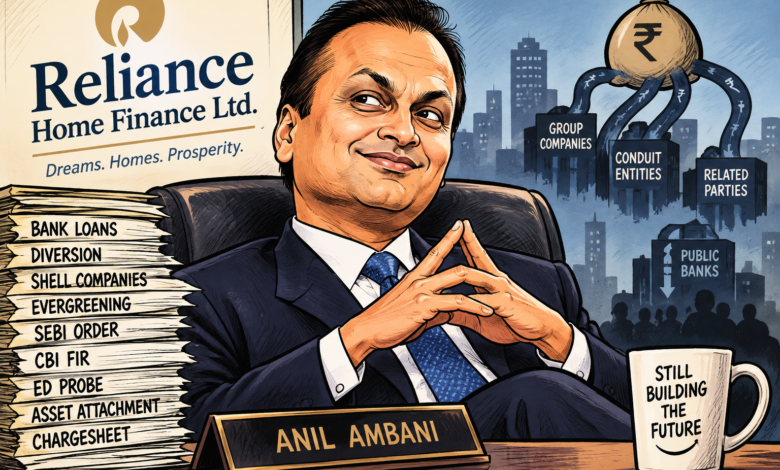
From Spectrum Controversies to Bank-Fraud Chargesheets: Who Protected the Pipeline of Credit to the Debt-Ridden Anil Ambani Group for So Long?
The CBI’s chargesheet filed on 3 October 2026 before the Special Judge for CBI Cases in Mumbai marks a sharp escalation in the scrutiny surrounding Reliance Communications Ltd. According to the agency’s own statement and contemporaneous reporting, the accused include Reliance Communications Ltd., Amitabh Jhunjhunwala (Group Managing Director of the Reliance ADA Group), Vishwas Joshi (Senior Vice-President, Reliance Capital Ltd.), and P. Venugopal (then Chief Investment Officer of LIC). The charges invoke criminal conspiracy, cheating and criminal breach of trust under the Indian Penal Code together with provisions of the Prevention of Corruption Act, 1988. The CBI has explicitly stated that further investigation continues.

What, precisely, is alleged? In 2012 LIC subscribed to non-convertible debentures worth ₹1,500 crore issued by RCom. The CBI investigation claims this subscription rested on “serious misrepresentations.” The funds so obtained were, according to the agency, subsequently diverted to other ADA Group companies. The alleged wrongful loss to LIC is quantified at ₹3,750 crore, not merely the original principal, but a larger figure that appears to incorporate consequent damage.
Consider the human and institutional weight of that ₹1,500 crore figure alone. LIC is not a private hedge fund; it is the primary vehicle through which tens of millions of ordinary Indian policyholders park their long-term savings and insurance premiums. When an institutional investor of this scale is induced, on the CBI’s account, to place such a sum into an instrument that later becomes the subject of a criminal chargesheet, the question is not abstract. It is whether the due-diligence processes inside India’s largest insurer were circumvented, diluted or simply overridden by representations that investigators now characterise as seriously misleading.
Two full paragraphs of evaluation are required here because every rupee of alleged loss ultimately traces back to households that believed their money was being managed with prudence. The CBI’s own language, that the funds were diverted after receipt, raises the further interrogative: once the money left LIC’s accounts, what internal controls inside RCom and the broader group failed so comprehensively that the proceeds could be redirected? And why did those controls, if they existed on paper, not trigger earlier alarms inside LIC itself?
The larger ₹3,750 crore alleged-loss figure compounds the concern. If the original subscription was ₹1,500 crore, the jump to ₹3,750 crore implies either interest, opportunity cost, further consequential damage, or a forensic reconstruction that the agency has not yet fully publicised. In either case, the number is not a technical accounting entry; it represents resources that could have been deployed for policyholder benefits, infrastructure, or other public-purpose investments.
When an enforcement agency places such a figure before a special court, the public is entitled to ask whether the same governance failures that allegedly enabled the original subscription also delayed recognition of the damage for more than a decade. The fact that the case was registered only in April 2026, based on an LIC complaint, itself invites scrutiny of institutional latency.
This LIC matter does not stand in isolation. The CBI has registered nine FIRs against RCom, Reliance Home Finance Ltd., Reliance Commercial Finance Ltd., Reliance Telecom Ltd. and other Reliance ADA Group entities on complaints from public-sector banks, LIC and the EPFO. Earlier releases spoke of seven cases; by October 2026 the count had risen to nine. The discrepancy itself is instructive: the investigative net has widened, not narrowed. Yet the public record still lacks a transparent, consolidated mapping of which FIRs attach specifically to RCom’s telecom operations and which attach to the group’s financial services arms. Opacity of this kind is itself a governance failure.
The largest single banking exposure cited in the CBI’s RCom-related material remains the SBI-led complaint. According to the agency, SBI alleged that RCom’s activities caused it a wrongful loss of approximately ₹2,929.05 crore. At the same time, the total exposure of 17 public-sector banks and financial institutions was placed at approximately ₹19,694.33 crore. The smaller figure is the alleged loss to one institution; the larger is the consortium-scale exposure.
Examine the ₹2,929.05 crore figure with the required depth. That sum is larger than the annual budgets of several smaller Indian states for certain social-sector programmes. When a public-sector bank records a loss of this magnitude, the consequences cascade: higher provisioning, pressure on capital adequacy, reduced lending capacity to genuine small and medium enterprises, and ultimately a fiscal burden that taxpayers underwrite through recapitalisation.
The CBI’s first chargesheet, filed on 29 May 2026, named 16 accused, including RCom, five senior RCom executives and ten officials of SBI, Bank of Maharashtra and the erstwhile Syndicate Bank. The inclusion of bank officials is critical. It signals that the investigation is not confined to the borrower side. Credit appraisal, end-use monitoring, letter-of-credit facilities and the eventual classification of accounts as non-performing all involve human decisions inside the lending institutions. If those decisions were compromised, whether by negligence, inducement or collusion, the damage is systemic, not merely corporate.
The still-larger ₹19,694.33 crore exposure figure demands even more extensive interrogation. 17 public-sector institutions collectively carried risk of this scale against a single corporate group whose telecom business was already under severe competitive and financial stress. What risk models, board-level discussions and concurrent-audit mechanisms permitted such concentration? When the CBI later alleged circuitous transactions through shell entities and the opening of discounted letters of credit for “bogus service-related transactions” with group entities, the natural question is whether any of the seventeen lenders detected the pattern in real time. If they did not, the failure is institutional.
If some did and still continued exposure, the failure is potentially more serious. The human impact is not abstract: every crore that becomes irrecoverable reduces the banking system’s ability to finance productive activity and increases the probability of future fiscal support from the public exchequer.
A separate Bank of Baroda complaint, registered in February 2026, alleged a loss exceeding ₹2,220 crore. The CBI has stated that Bank of Baroda was not part of the earlier SBI-led consortium; the exposure included portfolios inherited from the erstwhile Vijaya Bank and Dena Bank. The timing is noteworthy: the stay on classifying the account as fraudulent was vacated by the Bombay High Court on 23 February 2026; the bank filed its complaint the next day; searches followed. The sequence raises the interrogative of why a judicial stay had insulated the account for so long and whether similar stays elsewhere delayed other complaints.
The Enforcement Directorate’s parallel investigation introduces an even larger monetary scale. The ED has stated that the total outstanding amount involving RCom and related entities from domestic and foreign lenders stood at approximately ₹40,185 crore. Within this universe the agency has alleged that more than ₹13,600 crore was diverted for evergreening of loans, more than ₹12,600 crore moved to connected parties, more than ₹1,800 crore routed through fixed deposits and mutual funds before liquidation, and that bill-discounting mechanisms and foreign outward remittances were misused. These remain allegations; they are not judicial findings. Yet their scale obliges exhaustive examination.
Take the ₹13,600 crore evergreening allegation first. Evergreening is the practice of using fresh credit to service or repay existing obligations so that the borrower appears solvent longer than underlying cash flows justify. When the volume reaches five figures in crores, the implication is that multiple lenders were, knowingly or unknowingly, participating in a revolving door of liquidity that postponed recognition of stress. Each such postponement transfers risk from private balance sheets to public ones. The human cost appears in the form of delayed recognition of NPAs, delayed recovery actions, and the eventual socialisation of losses through bank recapitalisation or reduced credit to healthier borrowers.
The connected-party diversion figure of more than ₹12,600 crore requires equally granular scrutiny. Related-party transactions are not inherently illegal, but when they become the dominant channel for movement of borrowed funds, the economic substance of the original loan purpose evaporates. Depositors and policyholders have no visibility into these inter-company webs; they simply absorb the consequences when the web unravels. The further allegation that some loans were transferred outside India through foreign outward remittances raises additional questions of regulatory oversight under FEMA and the effectiveness of end-use certificates that banks routinely obtain.
Asset attachments by the ED illustrate the tangible stakes. In November 2025 the agency reported cumulative attachments of approximately ₹7,545 crore; subsequent actions, including the provisional attachment of Anil Ambani’s Pali Hill residence “Abode” valued at approximately ₹3,716.83 crore in February 2026, pushed the total higher.
The ED’s stated rationale for the Pali Hill attachment was that the property had been aggregated into the RiseE Trust, a private family trust, in a manner intended to create the appearance that Ambani did not personally own or control it, thereby shielding it from personal-guarantee liabilities. Whether that restructuring withstands judicial scrutiny remains to be determined; the allegation itself, however, forces a public conversation about the boundary between legitimate estate planning and the insulation of assets from legitimate creditor claims.
A further provisional attachment of approximately ₹3,034.90 crore in April 2026 encompassed a flat in Usha Kiran, a farmhouse in Khandala, land in Sanand and roughly 7.71 crore shares of Reliance Infrastructure held through a RiseE-linked structure. Each of these assets represents value that, if ultimately available for recovery, could reduce the net loss to public lenders. The fact that such large-scale provisional attachments have been necessary underscores how late the protective measures arrived relative to the period of alleged diversions.
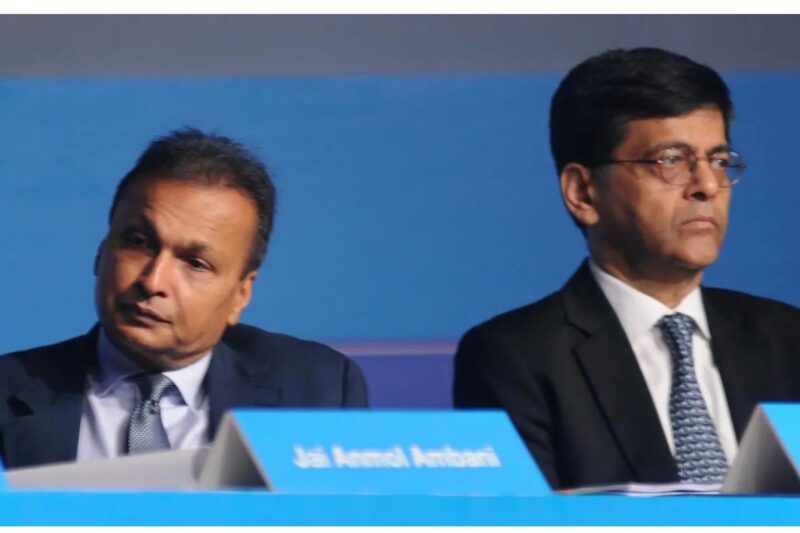
The arrest of former RCom director Punit Garg by the ED in January 2026, followed by a prosecution complaint, adds an individual dimension. The agency has alleged his involvement in the acquisition, concealment, layering and dissipation of proceeds of crime through foreign subsidiaries and offshore entities, including the purchase and subsequent sale of a Manhattan condominium.
Anil Ambani was not named as an accused in that particular complaint. The broader ED chargesheet filed later in 2026 reportedly quantified alleged proceeds of crime at approximately ₹40,186 crore and named, among others, RCom, Gautam Doshi, Sateesh Seth and Amitabh Jhunjhunwala. Allegations concerning false certification of the end-use of roughly $1 billion in Foreign Currency Convertible Bond proceeds form part of that larger narrative.
The Serious Fraud Investigation Office has also been directed by the Ministry of Corporate Affairs to examine the affairs of RCom and Reliance Communications Infrastructure Ltd. under Section 212 of the Companies Act, covering a period stretching back to FY 2008-09. The temporal breadth of the SFIO mandate is itself a comment on how long questions about the group’s corporate conduct have remained unresolved.
The Supreme Court’s monitoring of the broader investigation, arising from a PIL by former bureaucrat E.A.S. Sarma, elevates the matter beyond ordinary enforcement. On 4 February 2026 the Court examined status reports from the CBI and ED. On 23 March 2026 it directed that the investigations be conducted in a fair, transparent, independent and time-bound manner, and specifically required the agencies to examine possible irregularities, illegal acts, collusion, connivance and conspiracy involving public officials and financial institutions.
The Court’s recording of an ED reference to “Project Help”, allegations that insolvency proceedings were deliberately initiated through unrelated lenders and that claims of approximately ₹2,983 crore were settled for only ₹26 crore, further illustrates the range of issues under scrutiny. The Court expressly did not make findings on the merits of those allegations; their inclusion in the order, however, signals the depth of the questions being asked.
Historical context cannot be ignored, yet it must be handled with precision. The 2G spectrum case involved Reliance Telecom Ltd. and certain ADAG executives among the accused in the CBI’s 2011 chargesheet. On 21 December 2017 the Special CBI Court acquitted all accused in the principal criminal trial, holding that the prosecution had failed to prove the charges beyond reasonable doubt.
The CBI’s appeal against that acquittal was later admitted by the Delhi High Court and remains pending. It is therefore factually incorrect to describe RCom or its executives as having been convicted in the 2G criminal case. The CAG’s well-known ₹1.76 lakh crore figure related to estimated potential revenue loss from the allocation process; it was never established as a sum “stolen” by RCom in a criminal conviction.
The Ericsson contempt proceedings of 2019, the China Development Bank insolvency petition of 2017 (later withdrawn), the collapsed Aircel merger, the spectrum transaction with Reliance Jio that attracted CCI scrutiny, the AGR liabilities quantified by the government at approximately ₹25,194.58 crore for RCom/Reliance Telecom, and the Supreme Court’s February 2026 ruling that spectrum cannot simply be treated as an ordinary insolvency asset, all form part of the same long arc of financial stress and regulatory friction.
Collectively they demonstrate a company whose commercial model collapsed under debt, competition and statutory liabilities while parallel questions about the movement of borrowed funds continued to accumulate.
The wider ADA Group cases involving Reliance Commercial Finance (alleged loss of ₹4,097 crore to 13 public-sector banks) and Reliance Home Finance (alleged loss of ₹3,526.35 crore to 10 public-sector banks) reinforce the pattern of alleged diversion through intermediary entities. The ED’s examination of Yes Bank’s exposure to the group’s financial companies adds yet another layer. The investigative architecture is no longer confined to a single borrower or a single bank; it is an examination of an entire financial ecosystem.
What, then, is the central unanswered question? It is not merely why a telecom company failed. Companies fail. The far more serious question is whether funds borrowed for stated purposes were systematically moved through related parties, shell entities, inter-company arrangements and fresh borrowing facilities in a manner that postponed recognition of stress and transferred risk to public institutions.

The CBI speaks of circuitous transactions and shell entities; the ED speaks of evergreening, connected-party transfers and foreign remittances; the Supreme Court has directed examination of possible collusion involving bank officials. That combination elevates the matter from commercial default to a potential systemic governance failure.
Equally important is the reverse question: how did the banking system’s credit-appraisal, monitoring and early-warning mechanisms permit the alleged pattern to continue for so long? Large corporate facilities require multiple layers of approval and review. If those layers did not detect or did not act upon the alleged diversions, the failure is not confined to the borrower. The first RCom chargesheet’s inclusion of bank officials is an acknowledgement of that possibility.
As of early October 2026 the status remains fluid. The LIC chargesheet has been filed; further investigation continues. The SBI-related chargesheet and supplementary filings have named multiple accused, including bank officials; investigation continues. The Bank of Baroda case remains under investigation. The ED’s attachments and PMLA prosecutions proceed. The SFIO investigation is ongoing. The 2G acquittal stands, subject to the pending appeal. RCom remains entangled in insolvency proceedings whose recovery prospects have been complicated by the Supreme Court’s spectrum ruling.
The public is therefore left with a long chain of distinct but interconnected episodes rather than a single adjudicated “scam.” What can be stated with confidence is that the volume of public money at risk, the multiplicity of agencies involved, the Supreme Court’s monitoring directive, and the persistence of unanswered questions about fund flows and institutional oversight together constitute a matter of profound public concern. Whether the eventual judicial outcomes will match the scale of the allegations remains to be determined.
What is already clear is that the controls that should have protected policyholders, depositors and taxpayers appear, on the face of the investigative record, to have been insufficient, or insufficiently enforced, for far too long. The cost of that insufficiency, measured in crores and in eroded public trust, continues to mount.