Did CEC Gyanesh Kumar Himself Authorise The Changes To Form 6, Or Was He Acting On Someone Else’s Instructions? And In Either Case, Why Was The Change Made Despite Objections From Two Election Commissioners, Who Benefits?
CEC Gyanesh Kumar sits at the centre of a very simple question: who authorised the controversial changes to Form 6 during SIR? Two Election Commissioners objected, the ECI defended the move, and the Supreme Court says it never approved the modified form. So why was it changed, and who benefited?

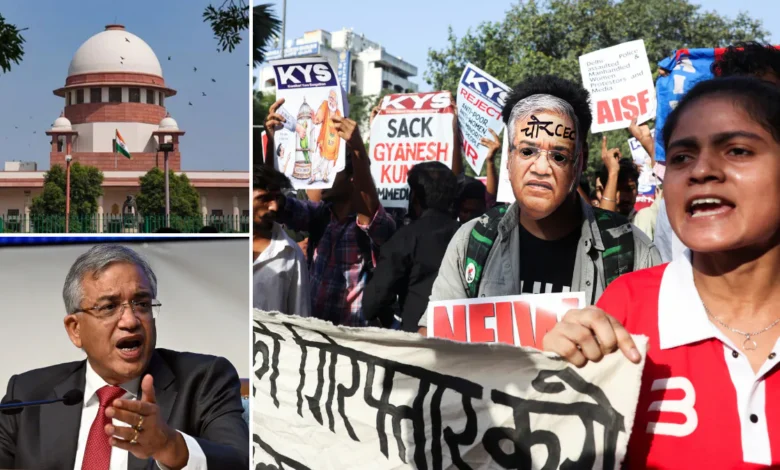
CEC Gyanesh Kumar is now at the centre of a controversy over changes made to Form 6 during the Special Intensive Revision of electoral rolls. On October 5, Chief Justice of India Surya Kant made it clear that the Supreme Court did not approve the modified Form 6. More importantly, the Court wants to see the Election Commission’s records and find out who actually modified the form.
That question matters because this was not simply a change in wording. The online Form 6 used for new voter registration was altered to include an additional declaration asking applicants whether they, their parents or grandparents had appeared on the electoral roll during the previous SIR.
The change was introduced on the ECI’s ECINet portal even though Form 6 is prescribed under the Registration of Electors Rules, 1960.
And there is another uncomfortable detail. Two of the three Election Commissioners – Vivek Joshi and Sukhbir Singh Sandhu – had reportedly objected to the change on record.
Joshi recorded that Form 6 could not be altered without amendments to the relevant rules. Sandhu concurred, and later reportedly described the alteration as “unauthorised” and “illegal”, calling for its immediate removal. Yet the change went ahead and remained on the portal.
The Election Commission has maintained that the additional declaration was applicable during SIR and has previously referred to the Supreme Court’s Bihar SIR judgment while defending it. But the Supreme Court has now drawn a very clear line: it did not approve any modified Form 6.
So the question is no longer merely whether Form 6 was changed.
It is who authorised the change, under what authority, why it was considered necessary, and why it proceeded despite objections from two Election Commissioners.
What Exactly Was Changed In Form 6?
Form 6 is hardly an obscure bureaucratic document. It is the application through which a person seeks to get his or her name added to the electoral roll as a new voter.
The controversy concerns an additional declaration inserted into the online version of the form during SIR. Applicants were asked to state whether their own name appeared in the electoral roll of the previous SIR, whether the name of a parent or grandparent appeared there, or whether neither their name nor those of their parents appeared in that earlier roll.
On paper, this may look like another verification question. In practice, it introduces an entirely new historical link into the registration process.
A young person applying to become a voter is no longer simply providing the information and declarations required under the existing form; the applicant is also being asked to connect themselves or their family to an older electoral roll.
And this is where the controversy begins.
The Indian Express reported that although the additional section itself was not marked mandatory, applicants could not proceed with submitting the online form without answering it.
That creates a very simple question: what exactly was this additional declaration supposed to achieve?
The Election Commission’s broader argument is that SIR requires greater scrutiny of electoral rolls and that additional information can assist that verification. The Supreme Court, in its May judgment on Bihar’s SIR, also recognised that the ECI has residual powers to formulate documentation suited to a special revision – but made clear that those powers are not unlimited.
That distinction matters.
Because the issue before the Court is not whether the Election Commission can ever conduct additional verification. It is whether this particular additional requirement was lawfully introduced, who authorised it, and what purpose it was actually intended to serve.
And that brings us to the question at the heart of this entire story: if the existing Form 6 was considered insufficient, what precisely was the ECI trying to fix – and why did the solution require changing the route by which new voters enter the electoral roll?
Why Was Form 6 Changed In The First Place?
The Election Commission’s stated reason is straightforward: SIR is supposed to produce cleaner and more accurate electoral rolls, and the additional declaration gives election officials another way to verify an applicant’s connection to an earlier electoral roll.
The declaration asks whether the applicant, a parent or a grandparent appeared in the previous SIR roll, with details such as the relevant constituency, polling station and serial number where applicable.
But that explanation leaves an obvious question unanswered: why was this additional information necessary at the point of registering a new voter?
The existing Form 6 already requires an applicant to provide personal details, age, ordinary residence and declarations relating to citizenship and whether the person is registered elsewhere. The new declaration effectively adds a historical family connection to the process.
And that is precisely why the stated objective needs to be examined rather than simply accepted.
The ECI can certainly argue that historical electoral-roll data helps identify duplicates or questionable claims. But the existence of a legitimate administrative objective does not automatically answer whether this particular mechanism was necessary or lawfully introduced.
The Supreme Court’s May 2026 Bihar SIR judgment recognised the ECI’s authority to seek appropriate documentation in a special revision, but the modified Form 6 declaration now at issue was introduced later and was not itself examined by that judgment.
That distinction has now become critical. The ECI had claimed that the Supreme Court had upheld the declaration. On October 5, the Court said it had not approved any modification to Form 6 and asked to see the records to determine who made the change.
So before anyone argues about whether the change was politically useful, there is a more basic question: what specific problem was the ECI trying to solve that existing verification procedures could not?
The Problem Began Inside The Election Commission
The most important part of this story may be what happened inside the Election Commission itself.
According to documents and reporting cited in the controversy, Election Commissioner Vivek Joshi objected to the Form 6 change, arguing that the prescribed statutory form could not simply be altered through an Election Commission instruction and that the matter needed to go through the proper rule-making process. Election Commissioner Sukhbir Singh Sandhu subsequently concurred.
Sandhu’s later objection was even more direct. On August 13, he reportedly described the alteration as “unauthorised and illegal” and called for it to be removed immediately, particularly because of the potential impact on young and first-time voters.
Yet the declaration had already been put onto the ECINET portal.
This is where the story stops being merely about the wording of a voter form and becomes a question about how India’s Election Commission makes decisions.
The ECI has not disputed that the objections existed. Its response has been that differing views are part of institutional decision-making and that the decisions ultimately taken by the Commission were unanimous. But that response does not answer the narrower question that now matters most: who actually authorised the technical and procedural change to Form 6?
There is another important detail. The statutory Form 6 available for download from the ECI did not initially contain the additional declaration, while the online version on ECINET did. The ECI later removed the SIR declaration from the portal in states where the revision had concluded and said that the forms prescribed under the Registration of Electors Rules, 1960 would be used outside the SIR period.
That leaves us with a remarkably simple question.
If two Election Commissioners objected to the change, and the Supreme Court says it did not approve it, who decided that it should be put onto the system in the first place?
And that is where the name of CEC Gyanesh Kumar inevitably enters the story – not because it has been established that he personally made the change, but because a petition before the Supreme Court specifically alleges that decisions concerning the SIR, including the Form 6 modification, were introduced under his authority without the concurrence of the other two Election Commissioners. The Court has now issued notice and sought the records.

So Who Actually Authorised The Change?
This is now the central question, and there is a very important distinction between what has been alleged and what has been established.
A petition before the Supreme Court alleges that CEC Gyanesh Kumar, acting along with the ECI’s Director General of IT, altered Form 6 digitally on the ECINet portal in July 2026. The petition further alleges that the change was made despite the objections of the other two Election Commissioners. The Supreme Court has not accepted those allegations as fact. It has issued notice and asked for the ECI’s records.
That is precisely why the CJI’s question – who modified what? – matters.
—-If Gyanesh Kumar personally authorised the change, the next question is why he did so when Vivek Joshi had already objected that the statutory Form 6 could not be changed without amending the Registration of Electors Rules, 1960, and Sukhbir Singh Sandhu had backed that objection.
—-If he did not personally originate the change, then the investigation has to move one level deeper. Who instructed the ECI’s machinery to make it? Who approved the technical implementation? Was there a written order, file noting, resolution or other authorisation? And if another authority directed the change, where is that record?
Those are not theoretical questions anymore. The Supreme Court has specifically said it wants the records so that it can establish who made the modification.
There is also a broader institutional question. The petitions before the Court allege that a series of SIR-related decisions were taken without the concurrence of the other two Election Commissioners.
The Court has now issued notice to the Centre, the ECI, Gyanesh Kumar and the other Election Commissioners. That means the issue before the Court extends beyond one voter form to the manner in which the country’s three-member Election Commission has been functioning.
But even if the records ultimately establish that Gyanesh Kumar authorised the change, that still would not answer the most important question: why?
If The Change Was Necessary, What Exactly Was It Supposed To Do?
The Election Commission’s stated justification for the additional Form 6 declaration is straightforward: SIR is intended to produce more accurate electoral rolls, and information linking a new applicant to an earlier electoral roll could help officials identify duplicate or questionable registrations. The declaration asks whether the applicant, a parent or grandparent appeared in the previous SIR roll.
But that explanation raises the next question: what did this additional requirement actually add?
The existing Form 6 already requires an applicant to provide personal details, age, ordinary residence and declarations concerning citizenship and registration elsewhere. The new declaration introduced a historical family connection into the process. For a young first-time voter whose parents or grandparents cannot be traced to the relevant old electoral roll, that creates an additional issue that did not previously exist.
The question, therefore, is not whether the ECI can conduct additional verification. It clearly can. The question is whether this particular requirement was necessary, what problem it was intended to solve and whether it created a meaningful additional burden for otherwise eligible voters.
That becomes more important because two Election Commissioners — Vivek Joshi and Sukhbir Singh Sandhu — reportedly objected to the change. Joshi questioned whether the prescribed Form 6 could be altered without amending the Registration of Electors Rules, 1960. Sandhu concurred and later reportedly described the change as unauthorised and illegal.
Yet the declaration was implemented on the ECI’s online system.
That brings us to the central question of this entire controversy: who authorised it?
If CEC Gyanesh Kumar personally approved the change, why did he proceed despite the objections of two other Election Commissioners? If he was acting on instructions from somebody else, then who gave those instructions, under what authority and where is the record authorising them?
The Supreme Court has now specifically asked to see those records. CJI Surya Kant said the Court had not approved any modified Form 6 and wanted to establish who had actually modified it.
That makes the administrative paper trail crucial. Was this a collective ECI decision? A decision attributed to the CEC? An instruction from another official? Or did an outside authority have a role?
Until the records are produced, it would be premature to say that Gyanesh Kumar personally ordered the modification. But equally, the question cannot simply be dismissed. Someone authorised the change, and the Supreme Court now wants to know who.

And Then There Is The Question Of Who Benefits
This is where the controversy moves beyond procedure.
If the additional declaration genuinely helps the ECI identify duplicate, fraudulent or otherwise ineligible registrations without materially affecting eligible voters, then the benefit is administrative: a more accurate electoral roll.
But if the requirement makes registration more difficult for people who cannot establish a connection to an older electoral roll, the impact needs to be measured.
How many applicants were affected? How many were unable to complete registration? How many applications were delayed or rejected? Which categories of voters were most affected?
Those questions matter because opposition leaders have alleged that the SIR process and the Form 6 change could benefit the BJP by making it harder for certain voters to enter the electoral rolls. That remains an allegation, not an established finding.
And there is another part of the SIR process that makes the question worth examining.
Form 7 allows existing voters to be challenged or their names sought for deletion. The filing of a Form 7 does not itself remove a voter; the objection has to be considered and substantiated.
Yet Karnataka has seen allegations of bulk Form 7 filings, including applications targeting large numbers of Muslim voters. In Babaleshwar, 1,373 applications were reportedly submitted on one day, with 1,363 coming from just 10 people. There were also allegations in Belagavi North involving pre-filled applications seeking deletion of Muslim voters’ names.
These allegations do not establish that the ECI deliberately targeted a community. But they do raise a broader question about the safeguards operating at both ends of the electoral-roll process.
On one side, an additional historical declaration has been added to the process of getting onto the roll. On the other, existing voters can face objections seeking their removal.
That is why the question of who benefits cannot be answered simply by looking at political claims. It needs data.
If the additional Form 6 requirement improves verification while leaving legitimate applicants unaffected, the ECI has a clear administrative justification. If it disproportionately affects eligible voters who cannot establish historical links to old rolls, then the ECI needs to explain why that burden was necessary.
What The Supreme Court Has Actually Said
One distinction is essential.
The Supreme Court has not declared SIR itself illegal. Nor has it approved every procedure adopted during SIR.
The ECI had previously referred to the Supreme Court’s Bihar SIR judgment while defending the additional Form 6 declaration. But the Court has now made clear that it did not approve the modified Form 6.
That leaves the ECI facing a fairly basic set of questions.
Who authorised the change? Why was it made? What legal authority was relied upon? Why did it proceed despite objections from two Election Commissioners? What measurable problem did it solve? And what effect did it have on eligible voters?
Only after those questions are answered can the final question be properly examined.
 The Last Bit, Who Benefited?
For now, the most important evidence may not be another political statement from either side. It may be the records the Supreme Court has asked the Election Commission to produce.
Because the controversy is no longer simply about whether Form 6 was changed.
It is about who changed it, why they changed it, and whether the explanation for that decision stands up once the paperwork is on the table.