From GST 1.0 To 2.0; Why Is The Government Changing GST Now, And What Does It Gain By Making The System Easier For Compliant Businesses?
GST has spent nearly a decade becoming India’s common indirect-tax system. Now, the government wants to fix what happens inside it. GST 2.0 is more about unlocking credits and less about changing rates, with the focus on speeding refunds and making compliant businesses carry less of the burden created by others.

When GST arrived in July 2017, the big promise was fairly straightforward: replace a maze of central and state indirect taxes with one national system. Excise duty, service tax, VAT and several other levies would give way to a common framework, allowing goods and services to move through the economy without the same patchwork of taxes and credits that businesses had dealt with for decades.
That was GST 1.0’s central achievement. It created the architecture for a common indirect-tax system and, over the years, the government built an increasingly digital machinery around it. Registration, invoicing, returns, input tax credit, e-way bills and eventually e-invoicing became part of one interconnected system.
But building a common tax system and making it easy to use are two different things.
The years since 2017 have exposed the friction. Businesses have had to deal with blocked or disputed input tax credits, delayed refunds, complicated compliance requirements and disputes that can arise not necessarily because the taxpayer has done something wrong, but because another entity in the transaction chain has failed to comply.
For a large business, a delayed refund or blocked input tax credit may be an accounting headache. For a smaller company, it can become a working-capital problem. Money that should be available for inventory, salaries, suppliers or expansion can remain locked inside the tax system.
The government has also accumulated something it did not have when GST was launched: years of transaction data and experience with how the system behaves in the real world.
That changes the question.
After nearly a decade, the issue is no longer simply whether India can operate a unified GST system. It is whether that system can become more predictable for businesses without compromising the government’s ability to detect and recover tax that is genuinely being evaded.
That is where GST 2.0 comes in.
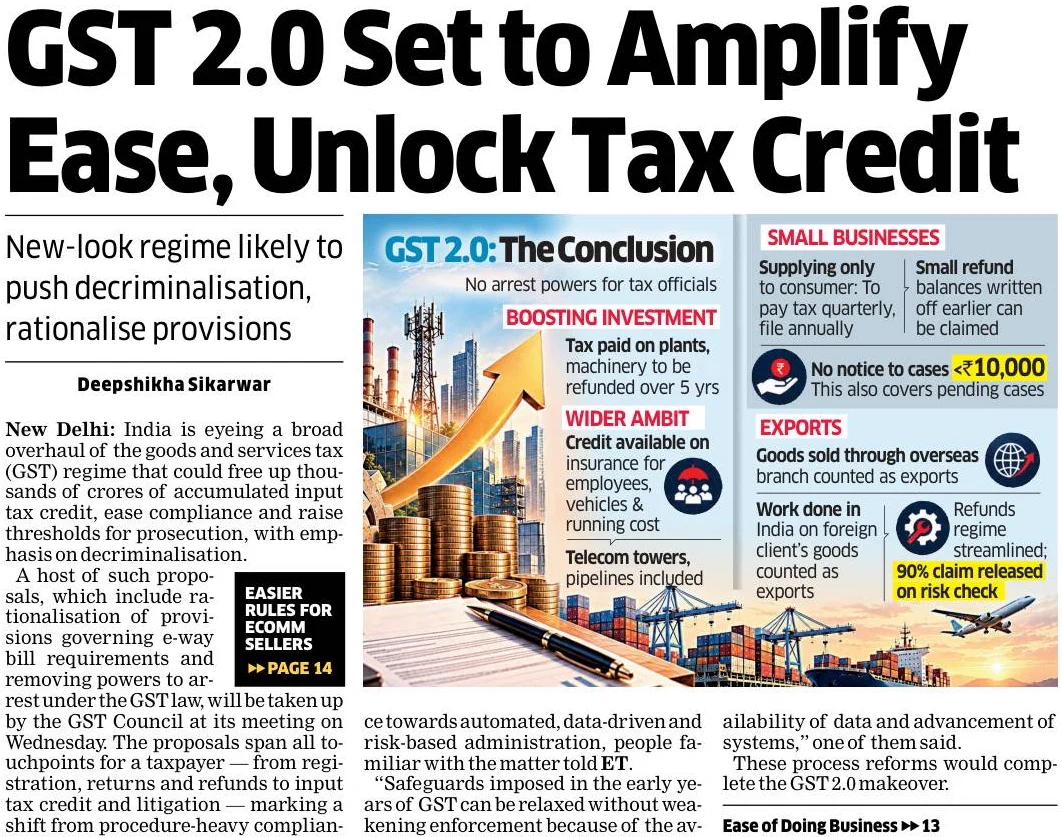
GST 2.0 Is Not About Another Rate Cut
The first thing to understand about GST 2.0 is what it is not.
It is not another exercise in changing the GST rate structure. The major rate rationalisation dealt with the question of what businesses and consumers should pay. The next phase is much more about what happens after those rates have been decided.
The proposals being considered by the GST Council cover some of the least glamorous parts of the tax system – registration, refunds, input tax credit, returns, litigation and enforcement. Yet these are precisely the areas that determine how much friction a business encounters while operating inside GST.
Take registration. A system that can identify low-risk applicants should not necessarily subject every business to the same degree of scrutiny. The proposals therefore include faster registration mechanisms for qualifying applicants.
The same thinking extends to refunds. If information already exists across GST, customs and other government databases, businesses should theoretically have less reason to repeatedly submit documents that the government can verify for itself.
Then there is litigation. Low-value disputes consume time for businesses and tax officials alike. Raising thresholds and reducing unnecessary proceedings is therefore not simply a concession to taxpayers. It can also allow the tax administration to spend its resources on larger and more consequential cases.
But the most consequential change may be around input tax credit.
GST was designed around the principle that tax paid at one stage of the supply chain should generally be available as credit against tax payable at the next stage. In practice, however, a genuine buyer can find itself exposed when a supplier fails to comply with its own tax obligations.
GST 2.0 is attempting to address that imbalance.
If a buyer can establish that the transaction was genuine and the prescribed conditions have been met, the proposed approach would allow the buyer to retain the legitimate credit while the tax authorities pursue the supplier who actually defaulted.
That is more than a technical adjustment to ITC rules. It points towards a different way of administering GST.
The government does not necessarily have to make compliance easier by becoming less capable of enforcement. With almost nine years of GST data behind it, the objective can increasingly be to identify who actually failed to pay the tax, rather than making every participant in the transaction carry the risk of someone else’s default.
And that is perhaps the real idea behind GST 2.0.
The first version built the common tax system. The second is trying to make that system work with less friction for the businesses that are actually complying with it.
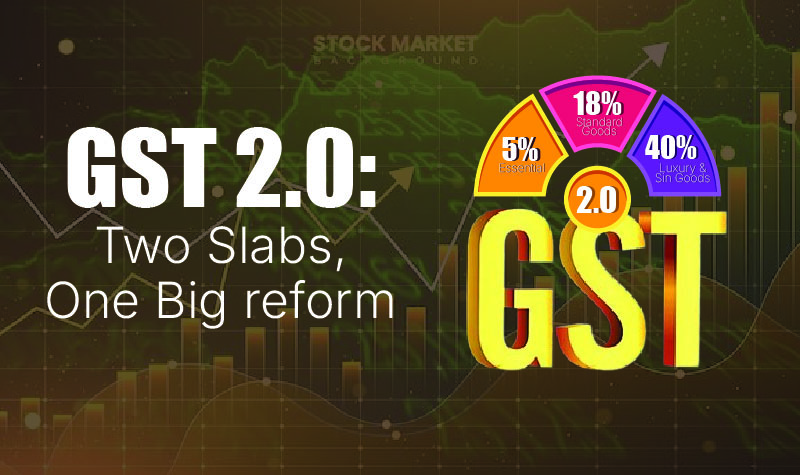
The ₹100 Question, Where Does The Tax Credit Go?
Input tax credit is one of the basic ideas on which GST was built. A business pays GST when it purchases inputs or services and, subject to the rules, can use that tax paid as a credit against the GST it collects on its own sales.
On paper, it is fairly simple.
The problem begins when the two sides of a transaction do not behave equally.
A business may purchase goods, receive an invoice, pay the supplier and conduct a perfectly genuine transaction. But if the supplier does not properly report the transaction or fails to deposit the tax collected, the buyer can face questions over the credit it has claimed.
That creates an unusual situation. The buyer may have complied with its part of the transaction, yet still carry a financial consequence because of something the supplier did.
The proposed GST 2.0 approach could change that.
Where the buyer can establish that the transaction was genuine and the relevant conditions have been satisfied, the buyer would retain the legitimate ITC, while the tax administration would pursue the supplier who failed to meet the tax obligation.
This matters because ITC is not simply an entry on a tax return. For businesses, it can represent working capital.
Imagine a company has legitimately paid GST on a large volume of inputs but cannot use the corresponding credit because of a supplier-side default. The money is effectively trapped. The company still has to finance its inventory, wages, suppliers and other operating expenses while waiting for the tax position to be resolved.
That is particularly significant in sectors and businesses where margins are tight or where the difference between input and output tax creates sizeable accumulated credits.
The proposed change therefore carries a larger message. The government appears to be trying to separate taxpayer compliance from supplier misconduct. That does not mean the supplier gets a free pass. Quite the opposite. The tax department can pursue the entity that actually failed to pay.
The shift is from asking every business to bear the risk of the entire transaction chain towards using the information available in the GST system to identify where the problem actually occurred.
For a tax system that increasingly has invoice-level information, that distinction becomes important.
The question is no longer simply whether the government can detect a mismatch. It is whether it can identify the right party to hold accountable.

Why Would The Government Give Businesses More Breathing Room?
At first glance, some of these proposals may appear surprisingly business-friendly. Wider access to credit, quicker refunds, faster registration and fewer low-value disputes can all reduce the friction businesses face.
So why would the government want to do this now?
The answer begins with what has changed since GST was introduced.
The government now has almost a decade of experience with the system, along with a vastly larger digital trail of economic activity. GST returns, e-invoices, e-way bills, customs information and other databases give tax authorities considerably more information about transactions than was available when GST began.
That makes a more targeted form of enforcement possible.
A tax administration does not necessarily have to choose between being tough on evasion and being easier on compliant businesses. Better information can, at least in principle, allow it to do both.
That is particularly relevant to the genuine-buyer ITC issue.
If the government can establish that a purchase actually happened, the goods or services were supplied, the buyer paid the supplier and the buyer itself complied with the relevant requirements, then making that buyer absorb the supplier’s tax default may be a poor use of the system.
The better target is the party that failed to discharge the tax obligation.
There is also a broader economic calculation.
Every rupee stuck in disputed ITC or delayed refunds is money that a business cannot use elsewhere. Releasing legitimate credits does not necessarily amount to the government simply handing out a new subsidy. It can mean returning working capital that was already embedded in the tax chain.
That money can then circulate through the economy – towards suppliers, wages, inventory, investment and expansion.
And there is a second benefit for the government.
A tax system that is easier for compliant businesses to navigate can reduce the cost of compliance and potentially improve voluntary compliance. At the same time, removing low-value disputes and unnecessary procedural work frees up tax officials to focus on cases where the risk of genuine evasion is higher.
So the logic behind GST 2.0 may be less about giving businesses a break and more about making the tax system more efficient for everyone involved.
The government gets a system that can potentially collect revenue with less friction, while businesses get a system in which compliance does not automatically mean carrying someone else’s tax risk.
The Government Is Trying To Unlock Working Capital Without Calling It A Stimulus
There is another way to look at the proposed expansion of input tax credit.
For businesses, GST is not simply about the final tax bill. It is also about when money leaves the business and when it comes back.
If a company pays GST on its inputs but cannot claim the corresponding credit, that money remains tied up. If a business is entitled to a refund but has to wait months for it, the economic effect is similar. The company has less cash available to run the business.
That is why the proposals around ITC and refunds matter beyond the tax department.
The GST 2.0 proposals could open the door to credits that are currently restricted or difficult to access, including certain credits relating to plant and machinery, input services and employee insurance. There are also proposals aimed at addressing situations where businesses accumulate credits because of differences between the GST rates on their inputs and finished products.
For the government, this is not necessarily the same thing as announcing a fiscal stimulus.
The money already exists. The question is where it is sitting.
If legitimate tax credits are released, that working capital can move back into the economy. A manufacturer can use it to buy more inputs. A retailer can finance inventory. A services company can meet its operating expenses. A growing business can deploy the money towards expansion instead of leaving it locked in a tax account or waiting for a dispute to be resolved.
The economic effect is therefore potentially broader than the immediate tax benefit.
There is also a competitive dimension. Businesses operating in sectors with large accumulated credits can effectively face a higher cost of capital because part of their money is sitting idle. Reducing that blockage can improve cash flows without the government necessarily having to spend money through a conventional budgetary programme.
The same logic applies to refunds.
If the government already possesses enough information to establish whether an export or refund claim is legitimate, requiring businesses to repeatedly prove what the system already knows adds cost without necessarily adding much protection against fraud.
This is where GST 2.0 begins to look less like a collection of isolated tax concessions and more like an attempt to improve the flow of money through the tax system.
The government still collects GST. Businesses still pay it. But legitimate credits and refunds are supposed to move through the system faster.
Refunds, Registration And Compliance Are Getting The Same Treatment
The same philosophy appears in areas that have little to do with ITC.
Take registration. Under the proposed reforms, qualifying low-risk applicants could receive GST registration much faster, with a three-working-day route being considered. The idea is relatively simple: businesses that can be verified through the government’s data systems should not have to endure the same process as applicants that present a higher compliance risk.
Refunds are moving in a similar direction.
Instead of treating every claim as a document-heavy exercise, the proposals envisage greater use of information already available with government agencies. Customs records, export data and other databases can potentially be used to verify claims without repeatedly asking businesses to produce paperwork.
That could matter particularly to exporters and businesses where refunds are a regular part of their cash-flow cycle.
Then there is the problem of low-value litigation.
A tax administration has finite resources. So does a business.
If officials and companies spend disproportionate amounts of time fighting over relatively small amounts, the system absorbs costs without necessarily producing much additional revenue. Proposals to introduce thresholds for show-cause notices and reduce proceedings over smaller amounts are therefore aimed at changing where administrative attention is spent.
There are also proposals that could simplify compliance for smaller businesses, including changes to return requirements for qualifying taxpayers.
None of this means that GST becomes a no-questions-asked tax system. The opposite is closer to the intended logic.
Where the government has sufficient information to determine that a business is low-risk and compliant, it can reduce the procedural burden. Where the data indicates a problem, the machinery can be directed towards that problem.
That is a significant change from treating every taxpayer as though the same amount of paperwork is necessary to establish compliance.
And it explains why technology sits at the centre of GST 2.0.
The more information the government has, the less justification there is for making every compliant business repeatedly provide the same information simply because the tax system has not yet learned how to use what it already possesses.
From Tax Inspector To Tax Data
The most consequential change in GST 2.0 may not be any individual ITC or refund proposal. It may be the gradual shift in how the government can enforce the tax.
GST began with a considerable amount of manual compliance. Over time, the system has accumulated e-invoices, e-way bills, returns, transaction records and links with other government databases. That gives the tax administration something far more useful than another form to be filled in: a growing map of how money and goods move through the economy.
The logical next step is to use that information more intelligently.
The proposed protection for genuine buyers illustrates this perfectly. Instead of treating a supplier’s failure as an automatic reason to question the buyer’s credit, the system could increasingly use transaction-level information to determine whether the buyer actually participated in a genuine transaction.
The same principle applies to refunds and registration. A low-risk business with a consistent digital history can potentially be processed differently from one where the data throws up significant inconsistencies.
That does not eliminate enforcement. It changes where enforcement is concentrated.
There is also a wider proposal to reduce the role of criminal proceedings and arrest in certain GST cases, while relying more heavily on financial penalties and recovery mechanisms. The underlying debate is not whether tax evasion should be ignored. It is about whether every serious compliance dispute should automatically acquire a criminal character.
For businesses, that distinction matters.
For the government, it can matter even more. Enforcement resources are limited. Every official hour spent on a minor dispute is an hour that cannot be spent examining a potentially significant case of deliberate evasion.
GST 2.0 therefore points towards a model in which technology does more of the routine checking and officials spend more time on the exceptions. If it works, that could make GST simultaneously less burdensome for compliant businesses and more focused when something actually goes wrong.
What The Government Gets Out Of GST 2.0
This is where the government’s interest in reform becomes clearer.
Making GST easier for compliant businesses may look like a concession, but there are several things the government can gain from it.
—First, better compliance. A complicated system creates opportunities for mistakes, disputes and delays. A simpler system can make it easier for businesses to comply voluntarily.
—Second, better use of administrative resources. If low-value disputes can be filtered out and routine decisions can increasingly be automated, tax officials can concentrate on cases that warrant closer examination.
—Third, more productive use of working capital. Faster refunds and legitimate ITC can put money back into businesses rather than leaving it trapped in the tax system. That money can then support consumption, investment, production and employment.
—And fourth, more targeted enforcement.
This last point is perhaps the most important.
The government does not necessarily have to choose between protecting taxpayers and protecting revenue. If its data systems are good enough, it can distinguish between a business that made a genuine purchase and a business participating in a fraudulent transaction.
That is the larger logic behind protecting genuine buyers from supplier defaults.
The tax department still gets to pursue the unpaid tax. What changes is who carries the immediate economic cost.
In that sense, GST 2.0 is not necessarily about making GST softer. It is about making the system more precise.
The government’s own incentive is fairly straightforward: a tax system works better when legitimate businesses can operate within it without unnecessary friction, while the administration can devote its attention to the transactions where the risk of actual evasion is higher.
The result, if the reforms work as intended, could be a GST system that is less expensive to comply with without becoming less capable of collecting revenue.

The Real Test Will Come After The Announcement
There is, however, a difference between a reform proposal and a reform that works on the ground.
The GST Council still has to consider and approve the various proposals, and the eventual rules will determine how much of the promised simplification actually reaches businesses.
The biggest test may be the definition of a genuine transaction.
If a buyer is to retain ITC when a supplier defaults, businesses will need clarity on what evidence is sufficient to establish that the purchase was genuine. If that test becomes so complicated that companies need another layer of documentation and professional advice simply to protect their credit, some of the benefit could disappear.
The same applies to automated refunds and faster registration. Technology can reduce friction only if the systems are reliable and the rules are applied consistently.
That is why GST 2.0 should not be judged merely by the number of reforms announced.
The real question is whether the reforms reduce the amount of time and money that compliant businesses spend managing GST while allowing the government to identify genuine evasion more accurately.
That is a much harder test and ultimately the one that will determine whether GST 2.0 becomes a meaningful second phase of the tax system or simply another round of rule changes.
The Last Bit, GST Has Entered Its Second Act
GST 1.0 was about creating the common indirect-tax architecture India had never had before. The rate rationalisation that followed was about simplifying what businesses and consumers paid. GST 2.0 is addressing the less visible problem: how that system actually functions once a business is inside it.
That is why the proposed changes to ITC, refunds, registration, compliance and enforcement matter.
The protection of a genuine buyer from a supplier’s tax default perhaps captures the shift best. If the government can identify the business that actually failed to pay the tax, there is less reason to make a compliant buyer carry that burden.
And that may be the real economic logic behind GST 2.0.
The government is not necessarily choosing between easier compliance and stronger enforcement. It is attempting to use the data and digital infrastructure built over nearly a decade to make the two work together.
If that happens, GST 2.0 will not simply make GST easier to navigate. It could make the entire tax system more efficient – for businesses, for the administration and ultimately for the economy.