Apple Pay And The ₹989 Crore NPCI Question What Is Really Happening Inside India’s Payments Market
Apple Pay has finally entered India, but its arrival raises a bigger question than whether iPhone users can tap to pay. With UPI handling billions of transactions every month and NPCI reporting a ₹989 crore FY26 surplus, Apple has stepped into a payments market where scale is enormous, but the economics are changing.

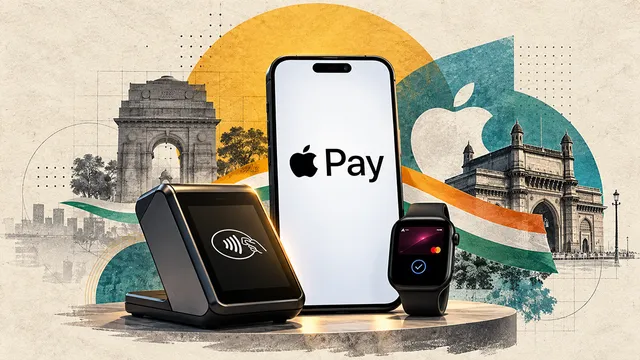
Apple has finally entered India’s payments market, more than a decade after Apple Pay first launched in the US. But its arrival is not quite the disruption that the name might suggest. For now, Apple is entering through a relatively narrow door: Axis Bank credit cards running on the Visa and Mastercard networks.
The service went live in India on September 30, allowing eligible Axis Bank customers to add their cards to Apple Wallet and use an iPhone, iPad or Apple Watch to make payments at supported stores, apps and websites. Apple says Apple Pay is already accepted by millions of merchants in India, with payment service providers including Cashfree, JusPay, Mswipe, Paytm, PayU, Pine Labs, Razorpay and Worldline supporting the rollout.
That sounds like a major expansion for Apple. It is, but there is an immediate catch. India is not a conventional card-payment market anymore. The country’s digital-payment revolution has been built around the Unified Payments Interface, or UPI, which allows consumers to move money directly between bank accounts, often simply by scanning a QR code. UPI processed nearly 24.5 billion transactions worth about ₹29.82 lakh crore in August 2026 alone, according to NPCI data.
Apple Pay, meanwhile, has arrived as a card-based service.
Apple is not entering India with a new version of UPI or offering iPhone users another way to scan the same ubiquitous QR codes. It is bringing Apple’s existing wallet-and-card model into a market where consumers have already become accustomed to a very different way of paying.
And that makes the launch less about whether Indians will use Apple Pay at all and more about which part of India’s payments economy Apple can actually capture.
.webp&w=3840&q=75)
What Apple Pay Is Actually Offering
At launch, Apple Pay supports eligible Axis Bank Visa and Mastercard credit cards. RuPay cards are not supported, and Apple has not launched UPI payments through Apple Pay. Apple’s own support page currently lists Axis Bank Visa and Mastercard credit cards as the eligible Indian cards, with additional banks expected to be added over time.
For users, the proposition is straightforward. A card can be added to Apple Wallet and authenticated through Face ID, Touch ID or the device passcode. At a compatible contactless terminal, the user can simply tap the device. Apple says card details are not stored on the device or its servers in their original form; instead, a unique Device Account Number and tokenisation technology are used to protect payment information.
The bigger issue is scale.
Axis Bank had about 16.3 million credit cards in circulation as of August, according to Reuters. That gives Apple a sizeable starting customer base, but it is still only one slice of India’s enormous payments market.
The absence of UPI is therefore not a minor launch limitation. It defines what Apple Pay currently is in India. Apple has entered the country’s credit-card and contactless-payment layer, not its dominant bank-to-bank payments network.
And that is where the ₹989 crore NPCI figure starts becoming interesting. NPCI’s FY26 revenue rose sharply even as its reported surplus fell. On the surface, those numbers appear contradictory. But they offer a window into something much bigger: how India’s payments system actually makes, spends and distributes money – and where Apple is trying to insert itself into that equation.
India’s UPI Problem Is Also An Apple Problem
The scale of UPI is what makes Apple’s entry into India particularly interesting. In August 2026, UPI processed 24.51 billion transactions worth ₹29.82 lakh crore, across 752 participating banks. NPCI Reuters estimates that UPI now accounts for about 84% of India’s digital-payment volumes, making it difficult for any new payments platform to operate in India without eventually confronting the system.
Apple Pay, however, is arriving on a completely different payment rail. Its initial offering is built around Visa and Mastercard credit cards, contactless terminals and Apple’s own wallet infrastructure.
In other words, Apple is asking Indian consumers to use a familiar card in a new way, rather than trying to replace the bank-account-to-bank-account system that has become the default for everyday payments.
That may explain why the launch is deliberately narrow. Axis Bank is Apple’s first partner, while discussions with larger issuers including HDFC Bank and ICICI Bank have reportedly not yet produced agreements. The sticking point is reportedly commercial terms. TechCrunch has reported that Apple is seeking roughly 20 basis points, or 0.2%, of each transaction, against an estimated 40–50 basis points of margin available in the relevant payments layer.
That is where Apple’s ambitions collide with India’s payments economics.
A fee that might look small on a single transaction becomes significant when multiplied across millions of payments. Banks, meanwhile, have little reason to surrender a meaningful portion of their existing interchange economics simply to put Apple Pay on top of a card that already works.
And Apple is not exactly entering a market where consumers are desperate for another payment option. UPI has trained Indians to expect payments to be immediate, simple and, for most everyday transactions, effectively free.
That leaves Apple with a more specific opportunity: India’s growing credit-card and premium-consumer segment, particularly among iPhone users who already carry eligible cards and shop at merchants equipped for contactless payments.
The question is whether that market is large enough to justify Apple’s commercial expectations.
The ₹989 Crore NPCI Question
This is where the headline number needs some unpacking.
NPCI’s surplus for FY26 fell to ₹989.45 crore, down 32.4% from ₹1,463.15 crore in FY25. At first glance, that looks like a worrying decline for the organisation sitting at the centre of India’s payments infrastructure.
But the underlying numbers tell a considerably more complicated story.
NPCI’s revenue from operations actually rose 21.8% to ₹4,239.97 crore during FY26, from ₹3,480.77 crore a year earlier. Total income increased 20% to ₹4,872.60 crore. Even more importantly, surplus before tax increased 5.4%, from ₹1,791.82 crore to ₹1,887.97 crore.
So the ₹989 crore figure does not mean NPCI suddenly generated ₹474 crore less before expenses and taxes. Much of the decline in the final surplus came from a sharp increase in tax expense, which rose from ₹328.67 crore to ₹898.52 crore. Total expenses also climbed 31.5% to ₹2,984.63 crore.
There is another important detail. NPCI is a Section 8 not-for-profit company, which is why its accounts refer to a “surplus” rather than conventional corporate profit. Its job is not simply to maximise earnings from UPI. It operates critical payment infrastructure and has to keep investing in that ecosystem.
That distinction matters because the real story is not that NPCI’s payment business is suddenly collapsing.
Quite the opposite.
Payment-services revenue, its largest revenue stream, rose to about ₹3,735.8 crore in FY26, accounting for roughly 88% of revenue from operations. At the same time, NPCI’s expenses rose considerably, with marketing alone reaching around ₹1,420 crore. Business Infomedia
There is therefore a bigger question behind that ₹989 crore figure: what does it actually cost to run, promote and expand India’s enormous payments infrastructure?
And that question becomes particularly relevant as UPI itself moves into a new phase.
From October 15, 2026, a 0.4% merchant discount rate will apply to specified UPI transactions above ₹2,000, while person-to-person payments and most smaller merchant transactions remain free. The government says around 96% of P2M transactions will remain unaffected and that the MDR is distributed among participants in the payments ecosystem rather than being a government charge.
So India’s supposedly “free” payments system is beginning to acquire a more visible commercial layer. And that is precisely the environment into which Apple has arrived.

Why UPI Is Suddenly Becoming A Money Question
For years, UPI’s greatest selling point in India was also its strangest economic feature. It became enormous without relying on the conventional merchant-fee model that powers much of the card industry.
That is now changing, at least at the higher end of merchant transactions.
Under the new framework taking effect from October 15, a 0.4% merchant discount rate will apply to specified person-to-merchant UPI transactions above ₹2,000, subject to a maximum charge of ₹300 per transaction. Person-to-person payments remain free, while transactions up to ₹2,000 and payments covered by the zero-MDR framework for small merchants will also remain free. The government says roughly 96% of P2M transactions will therefore remain unaffected.
The important point is that this is not a charge being imposed on consumers. The MDR is distributed among participants in the payment ecosystem. Under the current devolution formula, the issuer bank gets 40% of the MDR, the merchant acquirer 30%, the UPI app 20% and the app’s bank partner 10%. On a ₹10,000 transaction, that would mean ₹40 in MDR, of which ₹16 would go to the customer’s bank and ₹8 to the UPI app.
Suddenly, the economics of UPI become easier to see.
A payment that previously generated little or no direct transaction revenue can now create a revenue stream for several participants. That matters for an ecosystem processing billions of transactions every month.
It also changes the context in which Apple Pay has arrived.
Apple’s reported commercial discussions with Indian banks have centred on its own share of card-payment economics. TechCrunch reported that Apple was seeking around 20 basis points on transactions, while Business Standard reported that Axis Bank may ultimately pay Apple around 10–15 basis points from the interchange income it earns on card transactions.
The numbers are small when viewed individually. They become considerably less small when multiplied across millions or billions of transactions.
And this is where the two payment systems begin to look very different.
UPI is being opened to a controlled revenue mechanism while retaining free payments for consumers and most everyday transactions. Apple Pay, by contrast, is entering through the existing card ecosystem, where every participant already has a defined commercial role and Apple wants a share of that economics for providing the wallet and payment experience.
The battle, therefore, is not simply about which button Indians press when they pay. It is about who gets paid when they do.
The ₹989 Crore Figure Does Not Tell The Whole NPCI Story
That brings us back to NPCI’s ₹989.45 crore surplus.
The headline number is striking because it represents a decline of more than 32% from the previous year’s ₹1,463.15 crore. But reading that as evidence that India’s payments infrastructure is becoming less successful would be misleading.
NPCI’s operating revenue actually rose 21.8% to ₹4,239.97 crore in FY26 from ₹3,480.77 crore a year earlier. Its total income climbed 20% to ₹4,872.60 crore. More importantly, surplus before tax increased 5.4%, from ₹1,791.82 crore to ₹1,887.97 crore.
What changed dramatically was the tax bill.
NPCI’s tax expense jumped from ₹328.67 crore in FY25 to ₹898.52 crore in FY26, an increase of more than 170%. Total expenses also rose 31.5% to ₹2,984.63 crore. That combination pulled the final surplus down to ₹989.45 crore.
There is another reason the ₹989 crore number needs context.
NPCI is not a conventional listed payments company whose sole objective is to maximise shareholder profit. It is a Section 8 not-for-profit organisation responsible for operating and developing much of India’s retail-payment infrastructure. Its accounts therefore use the language of surplus rather than the conventional corporate profit model.
And the underlying payments business continued to grow.
Income from payment services, NPCI’s largest revenue stream, increased 16.3% to ₹3,735.8 crore in FY26 and accounted for about 88% of revenue from operations.
The more revealing story is therefore not that NPCI made ₹989 crore instead of ₹1,463 crore. It is that India’s payments infrastructure is becoming a much larger business while the cost of operating, expanding and maintaining that infrastructure is also rising.
That is particularly relevant when UPI is processing tens of billions of transactions a year, NPCI is investing in the ecosystem, payment companies are competing for users and merchants, and a new commercial framework is beginning to put a price on some of those transactions.
Apple has arrived at precisely this point.
It is not entering a payments market waiting to be invented. It is entering one that has already achieved enormous scale – and is now beginning to grapple with a question that Apple knows very well: How do you turn payments volume into a sustainable business without making the consumer experience more expensive?
Apple Is Not Trying To Replace UPI Yet
If Apple wanted to take on UPI directly, its starting position in India would be difficult. UPI already has the scale, the merchant acceptance and, crucially, the habit of the Indian consumer. A roadside shop, a large retailer, a food-delivery app and a neighbourhood service provider can all accept the same basic QR-based payment.
Apple Pay is therefore not really competing with UPI for every transaction.
Its immediate target is much narrower: the Indian consumer who already uses an iPhone, already owns a credit card and is willing to use that card for everyday spending.
That is a considerably smaller market, but it is also a market with a different economics.
India’s credit-card base has grown rapidly. RBI data showed around 124 million credit cards outstanding in August 2026, compared with roughly half that level in the years immediately after the pandemic. Axis Bank alone had 16.3 million cards outstanding, making it India’s fourth-largest credit-card issuer.
For Apple, this matters more than India’s total population or even its total digital-payment volume.
A consumer paying ₹150 for vegetables through UPI is not necessarily the customer Apple needs to win. A customer spending ₹8,000 on a premium purchase, booking a flight, paying for a hotel or shopping through an iPhone is a different proposition. Card payments generate interchange economics that can be shared among the issuer, network, acquirer and other participants. Apple is attempting to insert itself into that existing chain.
This also explains why the first rollout is built around Visa and Mastercard rather than RuPay. Apple is entering through the international card networks and the established credit-card ecosystem rather than trying to rebuild India’s payments infrastructure around its own wallet. Apple Pay currently supports Axis-issued Visa and Mastercard credit cards, while RuPay cards are excluded from the initial launch.
The strategy is therefore less revolutionary than it first appears.
Apple does not need to persuade 550 million UPI users to abandon their preferred payment method. It needs to make Apple devices a more useful and frictionless interface for the transactions that already happen on cards.
And there is a very Apple-like logic to that.
The company has historically used its hardware ecosystem to make adjacent services more convenient. Apple Pay makes the iPhone, Apple Watch and eventually the Mac part of the payment experience. The consumer does not have to pull out a physical card, enter a card number online or complete an OTP-heavy checkout. Apple says payments can be authenticated through Face ID, Touch ID or the device passcode.
That convenience may be enough to make Apple Pay useful without it ever becoming India’s biggest payment platform.
The bigger question is whether Apple can make the economics work at the scale it wants.
Apple’s India Opportunity Is Bigger Than Apple Pay
There is another reason Apple is unlikely to view the Indian launch simply as a payments-product rollout.
India has become increasingly important to Apple’s broader business.
The company has expanded its retail presence, manufacturing footprint and supply-chain operations in the country while simultaneously building a larger premium-device customer base. Apple Pay gives that existing ecosystem another layer of utility.
Globally, Apple says Apple Pay is now available in more than 90 countries and regions and works with more than 11,000 bank and network partners. India is one of the few major economies where the service had remained absent until now.
That absence became increasingly difficult to justify as India’s premium smartphone market expanded and contactless payments became more common.
The timing is therefore significant.
India already has more than 120 million credit cards, and analysts cited by Financial Express point to the growth in both credit-card usage and NFC acceptance as factors making the market more attractive to Apple.
Apple also does not have to build an entirely new payment habit.
The payment habit already exists. The card already exists. The merchant terminal may already support contactless payments. The bank already processes the transaction.
Apple is effectively asking: What if the iPhone becomes the card?
That is a much easier proposition to sell than asking India to adopt an entirely new payment network.

For Axis Bank, the attraction is equally clear. The bank gets an opportunity to make its cards more useful to a particularly valuable customer segment: digitally active and premium consumers who are already invested in Apple’s ecosystem. Axis has said the partnership could deepen card usage and customer engagement and potentially help with acquisition and retention among premium customers.
But there is a limit to how much Apple can extract from that opportunity.
The company reportedly sought around 20 basis points, or 0.2%, on Apple Pay transactions, according to people familiar with its negotiations. The payments economics available to banks are considerably narrower, estimated at roughly 40–50 basis points in the relevant layer. Business Standard reported that Axis may ultimately pay Apple around 10–15 basis points from the interchange income it earns on card transactions.
That difference explains why Apple’s India rollout is beginning with one bank rather than immediately covering the country’s biggest card issuers.
SBI, for example, evaluated a potential Apple Pay partnership but decided against joining the ecosystem for now, according to comments from its managing director. HDFC Bank and ICICI Bank have also been in discussions but had not finalised agreements at launch.
And this brings the story back to NPCI.
India’s payments market is already trying to work out how to create sustainable economics around an infrastructure that consumers have come to expect to be cheap or free. Apple is arriving with its own expectations about what the payment experience is worth.
The resulting tension is not really Apple versus UPI.
It is Apple entering an Indian payments system that is finally beginning to ask who should pay for the convenience of moving money.
The Banks Are The Gatekeepers
Apple may own the device, the wallet interface and the customer experience, but it does not control the payment rail underneath Apple Pay. In India, that makes the banks particularly important.
Every time an Apple Pay customer taps an iPhone or Apple Watch at a compatible terminal, the underlying transaction still moves through the existing card ecosystem. Visa or Mastercard remains the network. The issuing bank remains responsible for the card. The merchant’s acquiring bank and payment processor remain part of the transaction.
Apple is therefore trying to insert itself into an ecosystem that already has several participants – and each participant already has a reason to protect its share of the economics.
This helps explain the cautious rollout.
Axis Bank agreed to become the launch partner, while other major banks have so far been more reluctant. Reuters reported that HDFC Bank and ICICI Bank were in discussions with Apple but had not reached agreements at the time of launch. SBI, meanwhile, decided against a tie-up for now. (reuters.com)
The issue is not whether Apple can technically process the payment. It can. The issue is how much of the existing payment economics Apple should receive for putting its wallet between the customer and the card transaction.
That distinction is important because Apple’s negotiating position is very different from that of a new fintech entering India.
Apple already has hundreds of millions of devices in consumers’ hands globally. It can argue that Apple Pay makes those devices more useful, gives banks another way to engage premium customers and potentially increases card usage. Banks, however, can make an equally simple argument: the card already works without Apple Pay.

Why pay Apple for something the bank has already built?
That is particularly relevant in India, where banks have spent years building digital-payment infrastructure and competing aggressively for credit-card customers. If Apple wants a percentage of every transaction made through its wallet, the bank has to decide whether the incremental spending and customer engagement justify giving up part of its existing revenue.
The calculation could become easier if Apple Pay materially increases card usage.
A customer who carries an Axis card but rarely uses it could potentially become more active if paying with an iPhone is easier than pulling out the physical card. A premium customer could also move more spending from UPI to a credit card because of rewards, points and the convenience of contactless payment.
But that is an assumption that has to be demonstrated.
Until then, Apple’s bargaining power has a limit.
The company has entered India with one bank and two international card networks. To become a meaningful part of the country’s payments system, it needs more issuers.
And that means Apple eventually has to convince India’s largest banks that Apple Pay will generate enough additional value to justify Apple’s cut.
What Happens If Apple Wants UPI Next?
The really interesting question is what happens if Apple eventually decides that credit cards alone are not enough.
Because if Apple wants to become a genuinely mass-market payment platform in India, UPI is difficult to avoid.
The numbers are simply too large.
UPI processed 24.51 billion transactions worth ₹29.82 lakh crore in August 2026, according to NPCI. That is not a niche payment method that Apple can ignore while building a broad consumer wallet. It is the dominant digital-payment infrastructure used by Indians every day. (npci.org.in)
But getting into UPI would raise a completely different set of questions.
Apple would need to work within NPCI’s rules and India’s regulatory framework. It would also have to determine how Apple Pay would coexist with UPI apps, bank accounts and the existing payment architecture. The commercial model would be different from the one Apple is negotiating with card issuers.
Most importantly, Apple would have to decide whether the economics of UPI justify the effort.
The irony is that Apple’s biggest strength (its control over the user experience) is also where the Indian system is different. UPI is not controlled by one consumer-facing company. It is an interoperable infrastructure on which banks, third-party apps, payment service providers and merchants can interact.
PhonePe, Google Pay and Paytm can compete for the consumer without owning the underlying UPI rail.
Apple could theoretically do the same.
But if Apple were allowed to bring UPI into Apple Wallet, it could give iPhone users something they currently do not have: the ability to use India’s most widely accepted bank-payment system without leaving Apple’s own payment interface.
That would be a far more consequential development than the current launch.
It could mean an iPhone user would be able to keep a Visa or Mastercard credit card in Apple Wallet for card payments while also using a bank account through UPI for QR payments. The distinction between “Apple Pay” and “UPI” would then become much less visible to the consumer.
For Apple, that would solve its biggest weakness in India.
For banks, it could create another powerful distribution channel for their payment products. For merchants, it would simply be another way of reaching customers.
And for NPCI, it would raise a more fundamental question: how much control should a global technology company have over the consumer interface sitting on top of India’s most important retail-payment infrastructure?
That is why the current Apple Pay launch may be only the first chapter.
The immediate product is a credit-card wallet.
The much bigger opportunity – and the much bigger regulatory and commercial question – is whether Apple eventually gets a place inside India’s UPI ecosystem.
The Last Bit, The Real Battle Is Over The Payment Layer
Apple Pay’s India launch is therefore much more complicated than the arrival of another digital wallet.
Apple has entered a payments market that is already mature, deeply entrenched and unusually inexpensive for consumers. It has done so without UPI, without RuPay and initially with only one major banking partner. Yet that does not necessarily make the launch insignificant.
Apple does not need to replace UPI to make Apple Pay commercially useful.
It needs to capture a valuable segment of transactions already taking place on credit cards, make the iPhone more deeply embedded in consumers’ financial lives and persuade banks that paying Apple for that access produces enough additional spending to justify the cost.
For NPCI, the challenge is different. Its FY26 numbers show an organisation at the centre of a payments ecosystem that continues to expand rapidly, even as the costs of maintaining and developing that infrastructure rise. The ₹989 crore surplus is therefore not a simple measure of UPI’s success or failure. It is a snapshot of an ecosystem trying to reconcile enormous transaction volumes with sustainable economics.
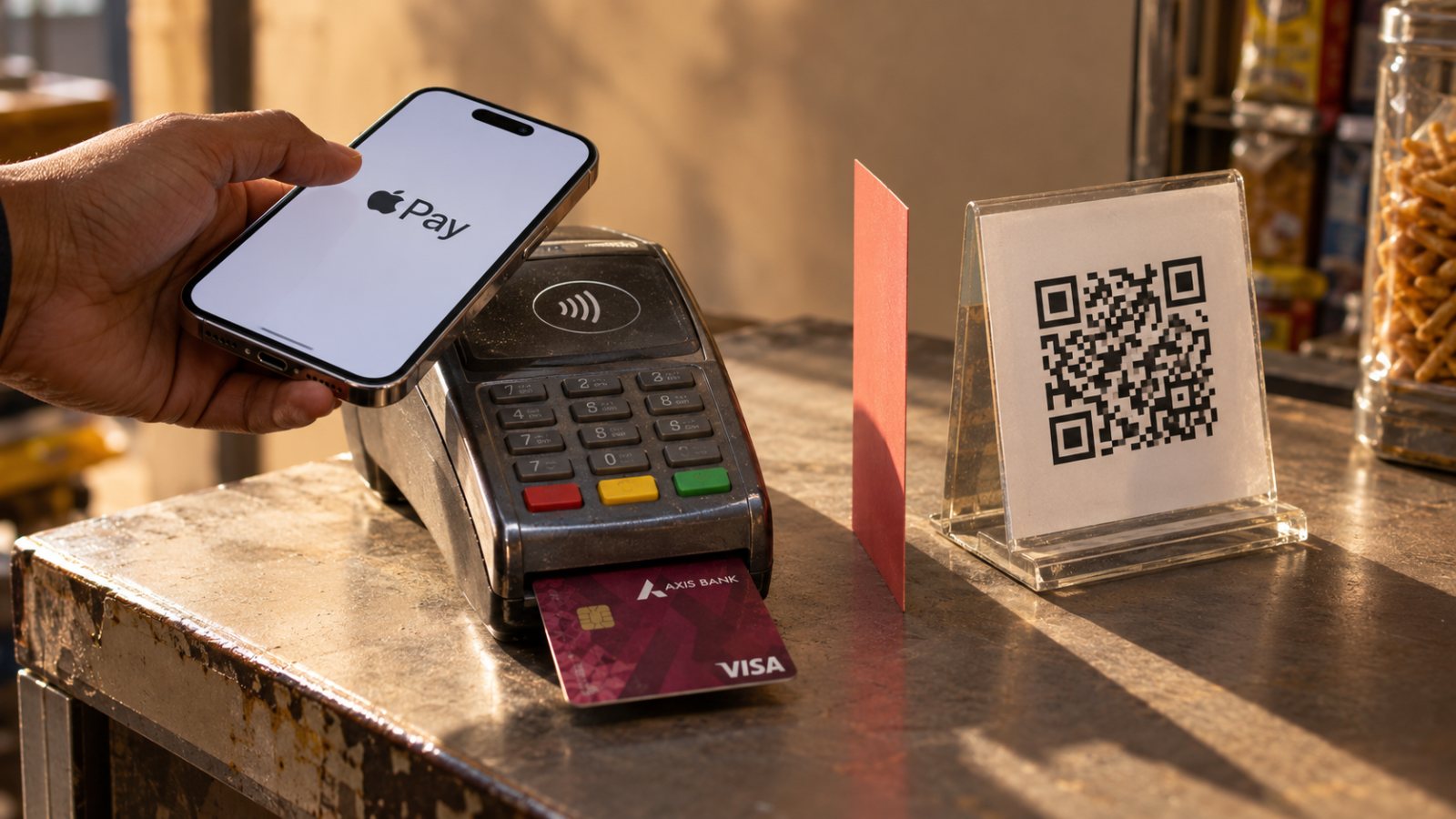
That makes Apple’s arrival particularly timely.
India is beginning to ask a question that other mature payments markets have been asking for years: who should earn money when people move money?
UPI has built its dominance by making the transaction almost invisible to the consumer. Apple has built its global payments business around making the device central to that transaction. Banks want to protect their economics. Card networks want their share. Payment apps want users and merchants. NPCI wants the infrastructure to remain scalable and viable.
Apple Pay has simply walked into the middle of that equation. For now, it is a relatively small player in a gigantic market.
But if Apple can expand its bank partnerships, persuade more Indian consumers to use cards through its devices and eventually gain access to UPI, its role could become considerably larger.
And that is why the ₹989 crore question matters.
The real story is not whether Apple Pay can make Indians stop using UPI.
It is whether Apple can find a profitable place inside one of the world’s largest payment ecosystems – without changing the economics that made that ecosystem successful in the first place.