India’s energy sector is experiencing a transformative phase in 2026, driven by ambitious renewable energy targets, technological innovation, and regulatory reforms. The country’s power trading landscape has evolved from a nascent market in the early 2000s to a sophisticated ecosystem featuring multiple exchanges, bilateral trading platforms, and emerging peer-to-peer energy trading solutions. With the government’s target of achieving 500 GW of non-fossil fuel capacity by 2030 and the integration of variable renewable generation, energy trading platforms have become essential infrastructure for balancing supply and demand across India’s vast geographical expanse.
The year 2026 marks a significant milestone with the implementation of market coupling, a mechanism that will aggregate bids across all power exchanges to discover a single market-clearing price, fundamentally altering the competitive dynamics of the sector. This comprehensive guide explores the top 10 energy trading platforms operating in India, examining their unique features, market positions, and contributions to the nation’s energy transition.
1. Indian Energy Exchange (IEX)
Indian Energy Exchange remains India’s undisputed leader in electricity trading, commanding an impressive 84 to 90 percent market share as of 2026. Established in 2008 following the Electricity Act of 2003, IEX has pioneered automated trading platforms for the physical delivery of electricity, renewable energy, and certificates across the nation.
The platform’s ecosystem comprises over 8,100 stakeholders spread across 28 states and 8 union territories, facilitating transparent price discovery and market efficiency. IEX operates multiple market segments including the Day-Ahead Market, where participants trade electricity for next-day delivery in 15-minute time blocks, and the Real-Time Market, which enables trading just one hour before delivery for real-time balancing of supply and demand fluctuations.
What distinguishes IEX is its comprehensive product portfolio extending beyond electricity trading to include Renewable Energy Certificates, Energy Saving Certificates, and specialized green markets. The exchange reported a remarkable 26 percent year-on-year surge in traded volumes in April 2025, reaching 10,584 million units, while the green market’s traded volume nearly doubled to 782 million units, reflecting the accelerating transition toward renewable energy sources.
IEX’s technological infrastructure features a robust, low-latency trading engine with secure clearing and settlement systems integrated with the national grid’s supervisory control and data acquisition systems. The platform provides nationwide automated trading with transparent price discovery mechanisms, making it accessible to buyers and sellers who can join as Full Members, Trader Members, or Clients. With a market capitalization exceeding Rs 11,000 crores and maintaining healthy financial metrics including a three-year Return on Equity of 39.2 percent, IEX continues to set industry benchmarks.
2. Power Exchange India Limited (PXIL)
Power Exchange India Limited, established in 2008 as India’s first institutionally promoted power exchange, serves as the second-largest trading platform in the country. Co-promoted by the National Stock Exchange of India and the National Commodity and Derivatives Exchange Limited, along with key power sector stakeholders including Power Finance Corporation, state utilities, JSW Energy, GMR, and Tata Power Trading, PXIL brings institutional credibility and diverse industry expertise to the market.
Operating under the regulatory oversight of the Central Electricity Regulatory Commission, PXIL provides a fully automated, secure platform for electronic trading of power and allied products. The exchange operates through its nationwide trading platform PRATYAY, which employs a uniform price matching and open auction mechanism to ensure fair pricing and market transparency.
PXIL offers comprehensive market segments including the Day-Ahead Market for next-day trading, the Day-Ahead Contingency Market for last-minute changes, an Intra-Day Market for same-day urgent power needs, and Term-Ahead Markets featuring Week-Ahead and Any-Day Contracts for advance planning. The platform also facilitates trading in Renewable Energy Certificates, where each certificate represents one megawatt-hour of renewable energy, helping market participants meet their Renewable Purchase Obligations.
In recent years, PXIL has demonstrated impressive financial growth, with revenue expanding from Rs 40 crores in FY 2021-22 to Rs 63 crores in FY 2023-24, accompanied by EBITDA growth from Rs 15.7 crores to Rs 22 crores over the same period. The company maintains healthy profitability with net profit margins approaching 39 percent. With the implementation of market coupling in 2026, PXIL is positioned to leverage a more level playing field, as the price discovery advantage traditionally held by the dominant exchange diminishes, creating opportunities for competition based on innovation, service quality, and value-added offerings.
PXIL has also launched innovative products including the Green Term-Ahead Market for advance trading of renewable power and the Real-Time Market for last-hour delivery trades. The exchange received significant validation in 2025 when Norwest Venture Partners acquired a 5 percent stake, underscoring confidence in PXIL’s growth trajectory as the Indian power market continues its rapid evolution.
3. Hindustan Power Exchange (HPX)
Hindustan Power Exchange represents the newest entrant among India’s major power exchanges, having commenced operations in 2022 after receiving final approval from the Central Electricity Regulatory Commission. Despite its relatively recent entry, HPX has quickly established itself as a significant player, leveraging advanced technology and strong institutional backing to carve out its position in the competitive landscape.
HPX is promoted by a powerful consortium combining complementary expertise. PTC India Limited brings decades of experience in power trading and market development across India and South-East Asia. BSE Investments Limited contributes extensive knowledge in operating exchanges and trading platforms as one of the world’s oldest and fastest stock exchanges. ICICI Bank Limited adds financial expertise in clearing and settlement operations, being among India’s largest private banks. This unique blend of sectoral knowledge, exchange management capability, and financial discipline positions HPX advantageously as the market undergoes structural transformation.
The platform provides a comprehensive marketplace for various electricity products, offering participants an opportunity to transact in a transparent and equitable manner. HPX operates multiple market segments including the Day-Ahead Market, Term-Ahead Market, Intra-Day Market, and specialized Contingency Contracts for managing unforeseen electricity demand or supply variations. The exchange has introduced innovative Green Contingency Contracts specifically focused on renewable energy sources to meet urgent needs while supporting sustainability objectives.
HPX’s technological foundation enables high-frequency trading, real-time market data dissemination, and seamless settlements. The exchange is supported by a diversified team of power sector professionals with expertise spanning regulatory compliance, policy frameworks, and operational challenges in electricity trading. This operational excellence has translated into impressive financial performance, with HPX achieving a profit after tax margin of approximately 34 percent despite being in its early growth phase.
The implementation of market coupling in 2026 represents a particularly significant opportunity for HPX. Under this mechanism, all three exchanges will operate at the same market-clearing price, eliminating the legacy advantage of incumbent platforms and enabling competition based on service innovation, transaction efficiency, and technological superiority. Industry analysts project that HPX’s revenue should exceed industry average growth rates due to its very low base, technical advances, expanding product basket, and increasing liquidity in newer product segments.
4. PTC India Limited
PTC India Limited, established in 1999 as a government-initiated public-private partnership, serves as one of the country’s pioneering power trading companies, focusing on bilateral and long-term trading arrangements that complement the exchange-based market. The company holds the distinction of being India’s leading provider of power trading solutions, with operations extending beyond domestic markets to include cross-border power trading with Nepal, Bhutan, and Bangladesh.
Unlike exchange platforms that facilitate anonymous, standardized transactions, PTC India specializes in structured bilateral agreements where price, volume, and delivery timelines are negotiated in advance, offering certainty and stability for both generators and consumers. The company engages in long-term trading of power generated from large projects, medium-term trading arrangements, and short-term trading to address supply-demand mismatches across regions and states.
PTC India’s comprehensive service portfolio encompasses end-to-end marketing strategies for power generation projects, regulatory studies, and advisory services to electricity utilities. The company serves a diverse clientele including state distribution companies, private distribution entities, corporate consumers, and entities trading power on exchanges. As of 2025, PTC India has facilitated trading of approximately 82.75 billion units of electricity, demonstrating the scale of its operations.
The company’s cross-border trading operations represent a unique strength, positioning it as a key facilitator of regional energy integration in South Asia. PTC India has been designated as the nodal agency for cross-border power trading, enabling it to capitalize on growing power demand in neighboring countries. This strategic positioning not only diversifies revenue streams but also contributes to regional energy security and diplomatic cooperation.
Financial performance reflects PTC India’s established market position, with trailing twelve-month revenues reaching approximately Rs 14,800 crores as of mid-2025. The company maintains a market capitalization exceeding Rs 5,600 crores and provides a compelling dividend yield of approximately 6 percent, making it attractive to income-focused investors. PTC India also serves as a co-promoter of Hindustan Power Exchange, holding a 25 percent stake and bringing its trading expertise to the exchange platform segment.
5. NTPC Vidyut Vyapar Nigam Limited (NVVN)
NTPC Vidyut Vyapar Nigam Limited, formed in 2002 as a wholly owned subsidiary of NTPC Limited, operates as India’s second-largest power trader by volume, commanding approximately 19 percent market share in the trading segment. NVVN holds the highest Category I power trading license according to Central Electricity Regulatory Commission regulations, reflecting its capabilities and operational scale.
NVVN’s business model centers on providing solutions for uncontracted power through bilateral arrangements and exchange-based trading. The company serves as a crucial link between power generators, particularly NTPC’s vast generation portfolio, and distribution companies across the country. As a trader member of both Indian Energy Exchange and Power Exchange India Limited, NVVN actively participates in Day-Ahead Market, Term-Ahead Market, and Real-Time Market segments, along with trading Renewable Energy Certificates and Energy Saving Certificates.
A distinctive aspect of NVVN’s operations is its role as the nodal agency for the Jawaharlal Nehru National Solar Mission Phase I, where the company bundles solar power with relatively cheaper untied thermal capacity from NTPC’s generating stations. This innovative bundling mechanism makes renewable energy more economically viable for distribution companies while supporting India’s renewable energy targets. The approach addresses the intermittency challenges of solar power and provides price stability to buyers.
NVVN has also been designated as the nodal agency for cross-border trading of power with Bangladesh, Bhutan, and Nepal, currently exporting 710 megawatts to Bangladesh, representing approximately 61 percent of total power exports to that country, and supplying up to 350 megawatts to Nepal. The Ministry of Power has additionally nominated NVVN as the Settlement Nodal Agency for grid operation-related charges with neighboring countries including Myanmar, underscoring its critical role in regional power trade.
Beyond conventional trading, NVVN has diversified into renewable energy project development, including rooftop solar installations at premier national institutes such as IIT Jodhpur and IIM Udaipur, solar projects at airport locations under memoranda of understanding with the Airport Authority of India for decarbonization initiatives, and pioneering waste-to-energy projects including a 600 tonnes per day torrefaction plant in Varanasi. The company has also ventured into electric mobility, supplying electric buses to urban transport corporations.
Financial metrics reflect NVVN’s robust operational performance, with the company maintaining comfortable capital structure and healthy profitability margins. As a wholly owned subsidiary of NTPC, which carries AAA credit ratings, NVVN benefits from strong financial and operational support, enabling it to pursue ambitious growth initiatives while maintaining balance sheet strength.
6. State-Level Peer-to-Peer Energy Trading Platforms
India’s energy landscape in 2026 includes innovative peer-to-peer energy trading platforms emerging at the state level, transforming how distributed renewable energy producers interact with the power system. Three states—Karnataka, Uttar Pradesh, and Delhi—have issued guidelines and regulations to enable blockchain-based peer-to-peer trading, allowing prosumers with rooftop solar systems to sell surplus electricity directly to other consumers through transparent, decentralized digital ledgers.
The Karnataka Electricity Regulatory Commission pioneered this approach by proposing comprehensive regulations in early 2024 that enable peer-to-peer solar energy trading via blockchain technology. Under these frameworks, consumers can become prosumers, selling excess solar power directly through approved platforms. The regulations outline detailed procedures for registration, approval, and trading mechanisms, requiring participants to install post-paid smart meters for accurate measurement and billing.
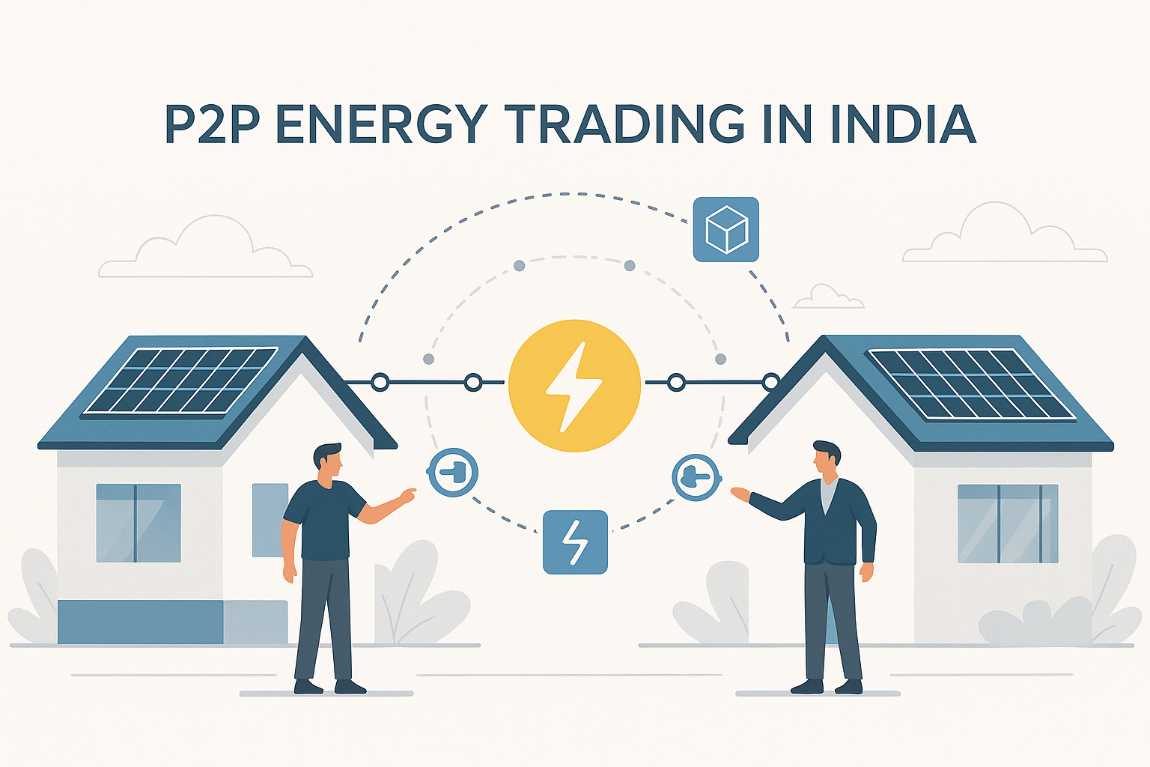
These peer-to-peer platforms offer multiple benefits across the energy ecosystem. For prosumers, they provide monetization opportunities for surplus generation, improving return on investment for distributed solar installations. For consumers, they enable procurement of green energy at competitive rates, often below grid tariffs, while supporting the renewable energy transition. The platforms also enable active demand-side management through real-time data on usage and transactions, empowering consumers to optimize their energy consumption patterns and reduce electricity bills.
The regulatory frameworks specify that distribution companies manage billing and settlements, ensuring system stability while enabling peer-to-peer transactions. Some state regulations explicitly recognize dynamic pricing to be set through platforms, allowing real-time price adjustments based on supply and demand conditions. This sophisticated pricing mechanism can incentivize consumption when renewable generation is abundant and discourage usage during peak demand periods, contributing to grid balancing.
While current regulations limit participation primarily to rooftop solar consumers in some states, the framework is expected to expand to include other distributed renewable energy sources such as small wind turbines and biomass-based systems as the market matures. The platforms incorporate advanced features including real-time monitoring, forecasting, automatic matching of trades, and demand response capabilities, representing the cutting edge of energy trading technology.
As smart meter deployment accelerates across India—with approximately 2.56 crore smart meters installed as of July 2025 under the Smart Meter National Programme—the infrastructure foundation for peer-to-peer trading is strengthening. These platforms represent a decentralized future for energy markets, complementing centralized exchanges and contributing to the democratization of electricity trading.
7. Green Energy Exchanges and Renewable Trading Platforms
The proliferation of renewable energy capacity in India has catalyzed the development of specialized trading platforms and products focused on green power. These platforms address the unique challenges and opportunities associated with trading variable renewable energy, including solar and wind power that experiences generation fluctuations based on weather conditions.
Indian Energy Exchange and Power Exchange India Limited have both launched dedicated Green Day-Ahead Markets and Green Term-Ahead Markets, allowing market participants to specifically trade renewable electricity. These green markets operate parallel to conventional power trading segments, providing transparent price signals for renewable energy and enabling distribution companies and open-access consumers to meet their Renewable Purchase Obligations through market mechanisms rather than solely through long-term power purchase agreements.
The green markets have experienced exponential growth, with IEX reporting that its green market traded volume nearly doubled to 782 million units in April 2025. This remarkable expansion reflects both regulatory push, through renewable purchase obligation mandates, and market pull, as consumers increasingly seek clean energy for sustainability commitments and corporate goals.
Renewable Energy Certificate trading represents another crucial component of India’s green energy trading ecosystem. RECs decouple the environmental attributes of renewable generation from the physical electricity, enabling generators in resource-rich locations to sell electricity locally while selling the green attributes separately to obligated entities anywhere in the country. This mechanism improves the economic viability of renewable projects and provides flexibility for meeting renewable targets.
The Real-Time Green Markets introduced by exchanges address the intermittency challenge of renewable generation, allowing market participants to trade renewable power just hours before delivery. This capability is particularly valuable as solar and wind forecasting improves, enabling generators to participate in markets closer to actual generation timeframes and reducing scheduling errors and associated penalties.
Innovation continues with proposals for High Price Real-Time Markets specifically designed for situations where conventional supply is constrained and renewable generation commands premium values. These specialized products enhance market depth and provide generators with revenue optimization opportunities while ensuring that demand is met through market mechanisms even during supply stress.
8. Corporate Power Purchase Agreement Platforms
The rise of corporate renewable energy procurement in India has spawned specialized platforms facilitating Power Purchase Agreements between large commercial and industrial consumers and renewable energy generators. These platforms streamline the complex process of negotiating, structuring, and executing long-term renewable PPAs, which have become increasingly popular as corporations pursue ambitious sustainability targets.
Corporate PPA platforms provide matching services connecting generators with suitable offtakers, standardized contract templates that reduce negotiation time and legal costs, financial structuring assistance including bankability assessments, regulatory compliance support for navigating open access regulations and renewable purchase obligations, and portfolio management tools for tracking generation and consumption.
Major renewable energy developers including ReNew Power, Azure Power, and Greenko Energies operate platforms enabling corporate customers to secure long-term renewable power at fixed or escalating prices, providing budget certainty and protection against fossil fuel price volatility. These platforms have facilitated multi-megawatt solar and wind PPAs for major technology companies, manufacturing facilities, and commercial real estate developers seeking to decarbonize their operations.
The Group Captive and Third-Party Open Access models have gained particular traction, with platforms helping multiple consumers pool their demand to achieve economies of scale in renewable procurement. This structure is especially valuable for mid-sized consumers who may not have sufficient individual load to justify dedicated renewable projects but can benefit from shared generation assets.
Recent regulatory reforms including the Green Open Access Rules have simplified the process for even smaller consumers to access renewable energy through these platforms, with reduced minimum consumption thresholds and streamlined approvals. The platforms handle the complex regulatory paperwork, wheeling and banking arrangements, and coordination with distribution companies, making renewable procurement accessible to a broader range of commercial and industrial consumers.
9. AI-Powered Energy Analytics and Optimization Platforms
The integration of artificial intelligence and machine learning technologies into energy trading has given rise to sophisticated analytics platforms that enhance decision-making for market participants. These platforms process vast amounts of data including historical prices, weather forecasts, grid conditions, fuel prices, and regulatory changes to provide predictive insights and optimization recommendations.
AI-powered platforms offer capabilities including price forecasting using advanced algorithms that analyze multiple variables to predict electricity prices hours or days in advance, enabling traders to optimize their bidding strategies, demand forecasting that helps consumers predict their power requirements and schedule purchases optimally, generation forecasting for renewable assets using weather data and machine learning models to improve accuracy and reduce balancing costs, and risk management tools that assess portfolio exposure and recommend hedging strategies.
Several Indian technology companies and startups have entered this space, developing India-specific solutions that account for the unique characteristics of the domestic power market. Platforms like Envision Digital bring global expertise in energy optimization while customizing offerings for Indian market conditions. These solutions integrate with exchange trading platforms through APIs, enabling automated trading based on algorithmic strategies.
Real-time market monitoring capabilities have revolutionized how traders operate, with AI systems continuously analyzing market data streams and alerting users to emerging opportunities or risks. The ability to process news feeds, weather updates, grid congestion information, and price movements simultaneously provides traders with comprehensive situational awareness that would be impossible through manual monitoring.
For distribution companies and large industrial consumers, AI-powered platforms optimize the mix of power procurement sources—balancing long-term contracts, day-ahead purchases, real-time markets, and captive generation—to minimize costs while ensuring reliable supply. These systems can automatically adjust procurement strategies based on changing market conditions, effectively functioning as always-on energy managers.
10. Blockchain-Based Energy Trading and Settlement Platforms
Blockchain technology is emerging as a transformative force in India’s energy sector, enabling transparent, secure, and automated energy trading and settlement. Beyond the state-level peer-to-peer platforms previously discussed, several technology companies are developing blockchain-based solutions for wholesale market applications, microgrid management, and automated contract execution through smart contracts.
Blockchain platforms offer distinct advantages for energy trading, including immutability ensuring that all transactions are permanently recorded and cannot be altered retroactively, enhancing trust and reducing disputes, transparency with all market participants able to view transaction history while maintaining privacy through encryption, automation through smart contracts that execute automatically when predefined conditions are met, eliminating manual intervention and reducing settlement times, and disintermediation reducing reliance on central clearing agencies and potentially lowering transaction costs.
Power Ledger, a blockchain-based trading platform with operations in India, has developed solutions for tracking renewable energy attributes, enabling carbon credit trading, and facilitating peer-to-peer energy transactions. The platform has collaborated with state governments and utilities on pilot projects demonstrating blockchain’s potential for transforming energy markets.
Grid Singularity focuses on developing decentralized energy marketplaces using blockchain technology, enabling localized trading and optimization. Their platform supports the integration of distributed energy resources including rooftop solar, battery storage, and electric vehicles, creating virtual microgrids where energy can be traded locally before accessing broader markets.
The tokenization of energy assets represents another innovative application, where renewable energy projects or generation capacity can be fractionalized into digital tokens tradeable on blockchain platforms. This approach democratizes investment in energy infrastructure and provides generators with alternative financing mechanisms beyond traditional debt and equity.
As India’s power sector embraces digitalization through the India Energy Stack initiative aimed at enhancing digital infrastructure across generation, transmission, and distribution, blockchain platforms are positioned to play an increasingly important role. The technology’s ability to handle high transaction volumes, ensure data integrity, and enable automated settlements aligns well with the requirements of modern energy markets characterized by distributed generation, real-time trading, and millions of participants.
Conclusion: The Evolving Energy Trading Landscape
India’s energy trading ecosystem in 2026 represents a dynamic and sophisticated marketplace that has evolved dramatically from its origins in the early 2000s. The top ten platforms discussed—from dominant exchanges like IEX to innovative blockchain solutions—collectively facilitate the efficient allocation of hundreds of billions of units of electricity annually, supporting India’s economic growth while enabling the integration of massive renewable energy capacity.
The implementation of market coupling in 2026 marks a watershed moment, fundamentally altering competitive dynamics and leveling the playing field among exchanges. This reform, combined with ongoing digitalization through the India Energy Stack, acceleration of smart meter deployment, and maturing regulatory frameworks for peer-to-peer trading, positions the sector for continued innovation and growth.
For market participants—whether generators seeking optimal revenue realization, distribution companies managing procurement portfolios, commercial consumers pursuing sustainability goals, or traders capitalizing on arbitrage opportunities—understanding and effectively leveraging these diverse platforms has become essential. Each platform serves distinct needs and offers unique capabilities, from the liquidity and price discovery of major exchanges to the specialized services of bilateral trading companies and the cutting-edge technology of AI and blockchain platforms.
Looking ahead, India’s energy trading platforms will continue evolving to address emerging challenges and opportunities, including the integration of energy storage systems that can time-shift renewable generation, the electrification of transport creating new demand patterns and flexibility resources, the proliferation of distributed energy resources requiring sophisticated aggregation and optimization, and cross-border trading expansion as regional interconnections strengthen and energy diplomacy advances.
The platforms profiled in this article represent the infrastructure backbone supporting India’s ambitious energy transition, facilitating transparent price discovery, efficient resource allocation, and the seamless integration of clean energy sources that will power the nation’s sustainable growth trajectory through the rest of this decade and beyond.