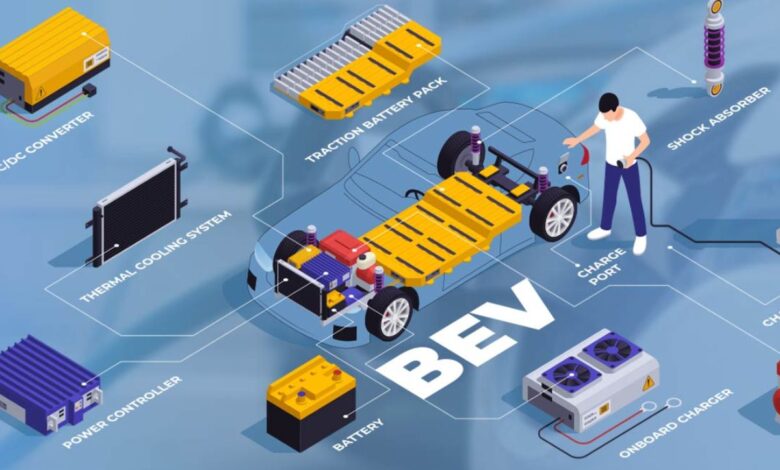
India’s electric vehicle market has witnessed exponential growth in 2026, with the country emerging as one of the fastest-growing EV markets globally. The foundation of this electric mobility revolution rests on a robust ecosystem of component suppliers who manufacture everything from batteries and motors to controllers and charging systems. These suppliers are not only catering to domestic demand but are also positioning India as a global manufacturing hub for EV components.
With the government’s continued push through policies like the FAME II scheme, Production Linked Incentive (PLI) programs, and the ambitious target of achieving significant EV penetration by 2030, India’s EV component manufacturing sector has matured significantly. As of 2026, over two million electric vehicles were sold in the previous fiscal year, creating enormous demand for locally manufactured components.
This comprehensive guide explores the top ten EV component suppliers in India who are driving this transformation and making India self-reliant in electric mobility technology.
1. Exide Industries Limited
Exide Industries stands as India’s most established battery manufacturer, with over 75 years of experience in energy storage solutions. The company has successfully transitioned from its traditional lead-acid battery business to become a major player in lithium-ion battery manufacturing for electric vehicles.
Through its dedicated arm, Exide Energy Solutions, and a strategic joint venture with Swiss company Leclanché, Exide is building India’s first large-scale lithium-ion gigafactory. Located in Karnataka, this facility is expected to achieve a capacity of 6 GWh by the end of fiscal year 2026, making it the first gigafactory of real scale in India. The company has also entered into a technology transfer agreement with SVOLT, a China-based lithium-ion battery producer, enabling access to cutting-edge battery manufacturing technology.
Exide’s product portfolio includes batteries for electric two-wheelers, three-wheelers, four-wheelers, and commercial vehicles. The company’s strong relationships with original equipment manufacturers across vehicle segments, combined with its extensive distribution network spanning over 60 countries, position it as a market leader. In the first half of fiscal year 2025, Exide recorded revenue of approximately INR 16,588 crores, demonstrating strong market presence and financial stability.
2. Amara Raja Energy & Mobility Limited
Amara Raja Energy & Mobility, formerly known as Amara Raja Batteries, has emerged as a formidable competitor in India’s EV component space. The company is investing heavily in lithium-ion battery technology, with a cumulative investment exceeding Rs 1,200 crores in its New Energy Business as of 2026.
The company is constructing a massive gigafactory in Telangana with plans to achieve 16 GWh of lithium-ion cell capacity and 5 GWh of battery pack capacity over the next decade. The first phase of the battery pack plant was inaugurated with a capacity of 1.5 GWh, and the company expects to begin commercial production of Nickel Manganese Cobalt (NMC) chemistry-based cells by late 2026. Additionally, Amara Raja is developing Lithium Iron Phosphate (LFP) chemistry-based cells with an initial capacity of 4-6 GWh.
The company has signed licensing agreements with Gotion High Tech Company to access advanced battery technology and has established partnerships with leading EV manufacturers including Ather Energy and Piaggio India. With fourteen manufacturing facilities across India and exports to over 60 countries, Amara Raja maintains a 25 percent market share in the lead-acid battery segment while aggressively expanding in lithium-ion technology. In Q2 FY26, the company reported revenue of Rs 3,467 crores with a net profit of Rs 276 crores, showing strong growth momentum.
3. Sona Comstar (Sona BLW Precision Forgings Limited)
Sona Comstar has established itself as India’s premier supplier of EV drivetrain components and traction motors. Headquartered in Gurugram, the company operates eleven manufacturing and assembly facilities across India, the United States, Mexico, and China, making it a truly global player in the automotive technology space.

The company’s EV product portfolio is comprehensive and includes differential assemblies for electric cars, hub-wheel motors for two-wheelers, drive motors for two- and three-wheelers, motor controllers, Belt Starter Generators for hybrid vehicles, and complete e-axle systems. Since starting production of indigenous traction motors at its Chennai plant in November 2020, Sona Comstar has sold over 180,000 EV traction motors, establishing itself as one of India’s largest manufacturers in this segment.
Sona Comstar has formed strategic partnerships with global technology leaders including Equipmake (UK) for high-performance electric powertrains and C-Motive Technologies for electrostatic motors. In Q2 FY2026, the company achieved its highest-ever quarterly revenue of INR 11.44 billion, representing 24 percent year-over-year growth. Battery electric vehicles contributed 32 percent of total revenue, and the company’s order book stands at an impressive INR 236 billion, with 70 percent attributed to EV programs.
4. Varroc Engineering Limited
Founded in 1990, Varroc Engineering has evolved into a key player in India’s EV components ecosystem. With 35 manufacturing facilities and 11 engineering centers across ten countries, Varroc brings global expertise to India’s electric mobility sector.
At the Bharat Mobility Global Expo 2025, Varroc showcased its comprehensive range of indigenous e-mobility solutions including traction motors, controllers, DC-DC converters, and both AC and DC chargers. The company’s focus on lightweight designs, optimized battery performance, and robust research and development support has enabled it to secure significant contracts with major EV manufacturers.
Varroc’s product offerings extend beyond powertrains to include external illumination systems, electrical and electronic components, and body and chassis parts specifically designed for electric vehicles. In the first half of FY2025, Varroc Engineering recorded revenue of INR 20.8 billion, with new orders pushing its peak annualized revenue in the order book to INR 6 billion. The company counts Bajaj Auto among its key clients in the e-mobility space.
5. Tata AutoComp Systems Limited
As part of the Tata Group, Tata AutoComp Systems leverages its parent company’s strong automotive heritage to deliver cutting-edge EV components. The company has established multiple joint ventures with international players to manufacture motors, controllers, and battery packs for electric vehicles.
Tata AutoComp’s strategy focuses on creating integrated solutions that address the complete EV component requirements of manufacturers. The company has formed partnerships with global technology leaders to bring advanced manufacturing capabilities to India, ensuring that Indian EV manufacturers have access to world-class components at competitive prices.
The company’s extensive reach through the Tata Group’s ecosystem provides it with unique advantages in terms of research and development capabilities, manufacturing excellence, and market access. Tata AutoComp supplies components to major automotive manufacturers and is actively expanding its footprint in the rapidly growing electric vehicle segment.
6. Greaves Cotton Limited (Including Ampere Vehicles)
Greaves Cotton has successfully transformed itself from a traditional internal combustion engine manufacturer to a major player in electric mobility. Through its subsidiary Ampere Vehicles, Greaves has established a strong presence in the electric two-wheeler market while also developing comprehensive EV powertrain solutions.
The company’s acquisition of Ampere Vehicles marked its entry into electric two-wheelers, while the purchase of Excel ControlLinkage enhanced its control systems capabilities. At the Auto Expo 2025, Greaves Cotton unveiled its complete mobility solutions encompassing electric two-wheelers, three-wheelers, and electric powertrains.
Greaves has formed a strategic partnership with Chara Technologies to develop rare-earth-free EV motors, targeting up to 50 percent energy savings and 30 percent lower carbon dioxide emissions. The company’s focus on clean technology powertrain products, including advanced engines and control systems, positions it well for India’s sustainable transportation future.
7. Mahindra Electric Mobility Limited
Mahindra Electric, part of the Mahindra Group, has been a pioneer in India’s EV sector long before electric vehicles gained mainstream acceptance. The company specializes in manufacturing electric vehicle powertrains, battery packs, and complete EV platforms, with particular strength in commercial and fleet applications.
Mahindra’s approach emphasizes ruggedness, commercial viability, and scalability for heavy-duty applications. The company has developed electric solutions for taxis, delivery vans, and utility vehicles, addressing the specific needs of fleet operators and government agencies. With India’s growing demand for electric commercial vehicles, Mahindra Electric is well-positioned to expand its market share.
The company’s investment in battery technology and vehicle platforms demonstrates its commitment to creating comprehensive solutions rather than just individual components. Mahindra’s extensive automotive manufacturing experience translates into reliable, durable EV components suitable for Indian operating conditions.
8. Delta Electronics India Private Limited
Delta Electronics India, a subsidiary of Taiwan’s Delta Electronics, has emerged as a leading supplier of EV charging infrastructure and power electronics in India. The company’s expertise spans charging stations, battery management systems, and power conversion systems essential for electric vehicles.
Delta leads the Indian market in EV charging infrastructure, providing both the hardware and software solutions needed to support the country’s expanding EV ecosystem. The company’s dual role as both a component supplier and charging solutions provider gives it a unique advantage in supporting India’s electric mobility growth.
The company manufactures DC contactors, converters, and safety devices designed to handle high-voltage EV systems with efficiency and reliability. Delta’s charging solutions range from 3 kW to 300 kW, catering to everything from small electric two-wheelers to heavy commercial vehicles and buses.
9. Minda Industries Limited
Headquartered in Delhi, Minda Industries has established itself as a comprehensive supplier of EV-specific components including lighting systems, switches, sensors, and brake systems. The company’s focus on electronics and mechatronics has enabled it to develop sophisticated components that meet the unique requirements of electric vehicles.
Minda’s product portfolio includes intelligent lighting solutions, advanced sensor systems for battery monitoring and vehicle control, and electronic switches designed for the high-voltage environment of electric vehicles. The company serves both domestic and international markets, supplying to major EV manufacturers across vehicle segments.
The company’s investment in research and development has enabled it to stay ahead of rapidly evolving EV technology requirements. Minda Industries has developed partnerships with global technology providers to bring cutting-edge solutions to the Indian market while maintaining competitive pricing.
10. Lucas TVS Limited
Lucas TVS, a joint venture between India’s TVS Group and Germany’s ZF Friedrichshafen AG, specializes in manufacturing motors, controllers, and starter generators for electric vehicles. The company brings together Indian manufacturing efficiency with German engineering excellence.
The company’s product range includes BLDC motors, motor controllers, and integrated systems for electric two-wheelers, three-wheelers, and light commercial vehicles. Lucas TVS leverages its strong automotive heritage and engineering capabilities to develop reliable, efficient components suited for Indian operating conditions.
With manufacturing facilities in Chennai and other locations, Lucas TVS has established itself as a trusted supplier to major EV manufacturers in India. The company’s focus on quality and performance has earned it a strong reputation in the growing Indian EV component market.
The Road Ahead
India’s EV component manufacturing sector is at an inflection point in 2026. With domestic demand surging and government support remaining robust through schemes like FAME II and PLI programs, these top ten suppliers are not only meeting current requirements but are also investing heavily in next-generation technologies.
The shift from import dependency to indigenous manufacturing is accelerating, with companies establishing large-scale gigafactories and forming strategic partnerships with global technology leaders. India’s vision of becoming a global manufacturing hub for EV components is becoming a reality, driven by these industry leaders.
The combined investments, technological capabilities, and manufacturing scale of these ten companies position India to compete globally in the EV component space. As the market continues to expand, these suppliers will play a crucial role in making electric vehicles more affordable, accessible, and suitable for Indian conditions while simultaneously contributing to India’s goals of energy independence and environmental sustainability.

For manufacturers, fleet operators, and stakeholders in India’s electric mobility ecosystem, these ten component suppliers represent the backbone of the industry, enabling the transformation of transportation and contributing significantly to the country’s sustainable development objectives.