India’s Clean Air: From Fundamental Right To Private Luxury
How Breathing Became a Privilege, Not a Right?!

Introduction: The Commodification of Oxygen
In the winter of contemporary India, breathing has become a class marker. Not wealth, not education, not even political access—but the simple act of inhaling air that doesn’t burn the lungs or shave years off one’s life expectancy. In a country whose Constitution implicitly promises the Right to Life under Article 21—repeatedly interpreted by courts to include the right to a clean and healthy environment—clean air has quietly exited the realm of public entitlement and entered the gated compounds of private luxury.
The transformation is stark and measurable. The poor breathe policy failure. The middle class breathes resignation. The rich breathe filtered, monitored, app-enabled air—at a premium. This is not metaphor. It is market reality. Across Indian metros, the Air Quality Index (AQI) has transcended its original purpose as an environmental indicator to become a pricing variable, a real estate differentiator, a hospitality feature, and increasingly, a migration criterion. Clean air has been systematically repackaged—not as a public good the state must deliver, but as a lifestyle upgrade you can purchase if you can afford it.
This transformation didn’t happen overnight. It was manufactured through a deliberate pattern of regulatory inertia, political gaslighting, corporate opportunism, and a disturbing normalization of ecological inequality. The result is a nation where constitutional rights have been quietly privatized, where survival itself has become a consumer choice.
The Constitutional Promise: Clean Air as a Fundamental Right
India’s constitutional framework for environmental protection is robust and unambiguous. Article 21 of the Indian Constitution, which guarantees the fundamental right to life and personal liberty, has been expansively interpreted by the Supreme Court to encompass the right to a clean and healthy environment. This jurisprudential evolution represents decades of progressive legal interpretation.
The landmark case of Subhash Kumar v. State of Bihar (1991) established that the right to life includes the right to enjoy pollution-free water and air. The Supreme Court declared unequivocally that access to clean air and water is not a luxury but a fundamental right enforceable under its writ jurisdiction. This principle was strengthened through the M.C. Mehta series of environmental cases beginning in 1986, where the Court treated the right to live in a pollution-free environment as integral to Article 21.
In 2024, the Supreme Court achieved another jurisprudential milestone in M.K. Ranjitsinh v. Union of India, recognizing for the first time the right to be free from the adverse effects of climate change as a fundamental right under Articles 21 and 14 of the Constitution. Chief Justice D.Y. Chandrachud’s bench found that the right against the adverse effects of climate change and the right to a clean environment are “two sides of the same coin.” The Court explicitly acknowledged that climate change disproportionately affects vulnerable populations, making environmental degradation not merely an ecological issue but a violation of dignity and equality.
Most recently, in October 2024, the Supreme Court reiterated that every citizen has the fundamental right under Article 21 to live in a pollution-free environment. The Court emphasized that the government has a duty to protect citizens’ rights to live with dignity in a pollution-free environment, criticizing the ineffective enforcement of anti-pollution laws. The Court’s language was forceful: “The time has come to remind the Government of India and the State Governments that every citizen has a fundamental right under Article 21 of the Constitution of India to live in a pollution-free environment.”
Yet this expansive constitutional guarantee exists in jarring contradiction with lived reality. While the highest court of the land repeatedly affirms clean air as a non-negotiable right, millions of Indians wake up each morning to AQI readings that would qualify as environmental emergencies in most developed nations. The gap between constitutional promise and implementation failure has created a vacuum—one that private markets have rushed to fill.
The Magnitude of the Crisis: India’s Toxic Burden
The scale of India’s air pollution crisis defies easy comprehension. According to the Global Burden of Disease Study 2019, 1.67 million deaths were attributable to air pollution in India in that year alone, accounting for 17.8% of all deaths in the country. The majority of these deaths resulted from ambient particulate matter pollution (0.98 million) and household air pollution (0.61 million). The death rate from ambient particulate matter pollution increased by an alarming 115.3% between 1990 and 2019.
A Harvard study published in Lancet Planetary Health found that long-term exposure to air pollution increased deaths by 1.5 million per year when compared to conditions if India met World Health Organization recommendations for safe exposure. Critically, the entire population of India—all 1.4 billion people—lives in areas where PM2.5 levels exceed WHO guidelines. Some regions measured levels of up to 119 micrograms per cubic meter, dramatically higher than what both WHO and Indian standards consider safe.
The impact on life expectancy is staggering. Research from the Energy Policy Institute at the University of Chicago found that air pollution is likely to reduce the life expectancy of approximately 40% of Indians by more than nine years. More than 480 million people living in central, eastern, and northern India endure significantly high pollution levels. According to the Air Quality Life Index 2021, average life expectancy in India could increase by five years if levels of toxic particles were brought down to meet WHO specifications. In Delhi specifically, residents are losing over 8 years of life expectancy due to prolonged exposure to polluted air—equivalent to the damage caused by chronic smoking.
The economic toll mirrors the human cost. The Global Burden of Disease Study 2019 estimated the economic loss from air pollution-related mortality and morbidity at $36.8 billion in 2019, representing 1.36% of India’s GDP. The study concluded that these pollution-related losses “could impede India’s aspiration to be a $5-trillion economy,” noting that successful pollution reduction would lead to substantial benefits for both population health and the economy.
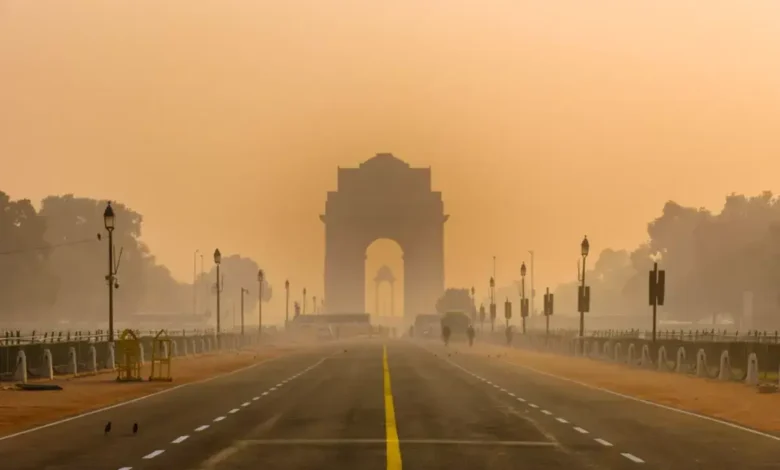
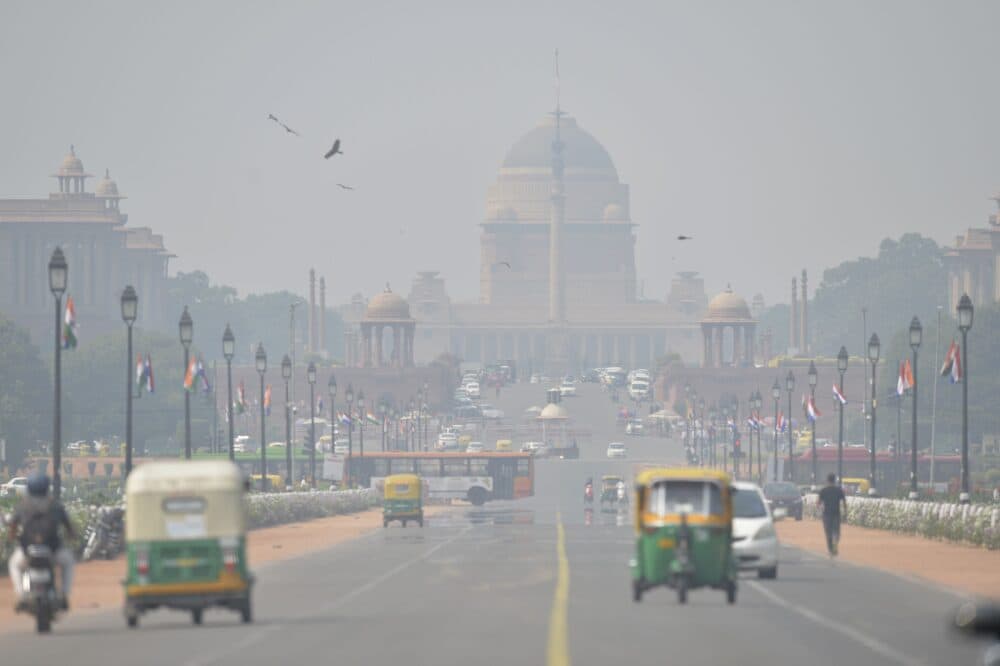
Delhi, the nation’s capital, has become emblematic of this crisis. As of January 2026, Delhi has recorded AQI readings of 459 on the overall index, with specific periods showing levels in the “severe plus” category. In November 2024, Delhi recorded its worst air quality of the season with a 24-hour AQI reading of 491, classified as “severe plus.” The Supreme Court of India itself remarked in November 2019 that “Delhi has become worse than narak (hell),” with Justice Arun Mishra stating it is “better to get explosives, (and) kill everyone.”
The Great Gaslighting: When the State Normalized Toxicity
India did not wake up one day and decide that 300 AQI is “not so bad.” The population was trained to believe it through a systematic pattern of state behavior. The Indian state’s response to air pollution has followed a predictable and documented pattern: downplay, deflect, delay. Every winter, particularly in North India, citizens are subjected to a familiar script.
First comes denial. Official pronouncements minimize the severity, suggesting seasonal variations or questioning measurement methodologies. Then comes blame-shifting—to stubble burning by farmers, Diwali crackers, weather patterns, “geographical compulsion.” The Delhi government has even been accused of deliberately distorting AQI data, with Municipal Corporation tankers witnessed spraying water around air-quality monitoring stations to suppress readings that suggested catastrophic air quality.
Finally comes symbolic action without structural change: odd-even vehicle schemes, temporary firecracker bans, emergency meetings that dissolve with the smog. The National Clean Air Programme (NCAP), launched to cut pollution in 102 of India’s most polluted cities by 20-30% by 2024, has struggled with enforcement. As Thailand’s experience with farmland burning demonstrates, rules without enforcement are meaningless. Slash and burn farming practices continue despite legal prohibitions because political will remains absent.
What never materializes is accountability. Official thresholds are quietly reinterpreted. International standards are dismissed as “Western benchmarks unsuitable for Indian conditions.” Public messaging subtly shifts from prevention to adaptation. Masks, air purifiers, “stay indoors” advisories—all signals that the state has abdicated its primary duty and outsourced survival to individual households. This represents not environmental governance but environmental gaslighting. When toxic air becomes routine, outrage becomes fatigue. And fatigue is fertile ground for commodification.
AQI Enters the Real Estate Brochure: Monetizing Clean Air
Once the state stopped guaranteeing breathable air, the market stepped in—not to fix the problem, but to monetize its absence. In December 2025, multiple real estate developments began explicitly advertising clean air as a premium amenity. As Home Pravesh reported, luxury housing in India now features “low-AQI locations” in sales brochures alongside traditional amenities. What was once a fundamental human necessity is now being reframed as a premium commodity.
According to SKJ Landbase’s analysis, developers across India openly advertise “low AQI living,” “oxygen-rich homes,” and “clean air ecosystems.” Advanced air-filtration systems, smart ventilation, and in-project green zones headline sales brochures. Projects near parks, forests, or low-traffic corridors command higher premiums. Interior air quality has become a tangible selling point, with clean air now selling homes as effectively as location or design.
The technological integration is sophisticated. Developers install advanced HVAC filtration systems, seal buildings with controlled airflow, provide indoor air monitoring dashboards, and landscape micro-forests that stop at the compound wall. Nimbus Realty’s project in Sector 168, Noida, promises “mountain-like air quality” inside homes through multi-stage filtration systems with HEPA filters designed to trap even the tiniest dust particles and harmful PM2.5 pollutants. The price: approximately ₹4.24 to ₹10.05 crore per flat.
Industry experts acknowledge this shift represents a fundamental change in buyer priorities. Sanjeev Singh, Managing Director of SKJ Landbase, observes that “homebuyers today think beyond luxury interiors. They focus on daily well-being. Clean air, green surroundings, and healthier living environments now influence final purchase decisions more than ever.” Aditya Shah of Mayfair Housing notes that “homebuyers are particularly concerned about clean air and certified indoor air quality today. This stems from worsening AQI levels and rising pollution in our cities.”
The Ram Rattan Group’s developments in Naugaon exemplify this new luxury paradigm. Marketing materials emphasize that for High Net-Worth Individuals (HNIs) and Non-Resident Indians (NRIs), the Air Quality Index has “emerged as the new luxury metric.” The developments promise “markedly cleaner air and pollution-free surroundings,” explicitly positioning clean air as a defining parameter of premium living. The company chairman states: “Luxury today is defined by the quality of air you breathe and the peace your home gives you.”
The implication is stark: the city may choke, but you won’t—if you can pay. Developers don’t promise cleaner cities; they promise cleaner enclaves. The air outside remains a civic problem. The air inside becomes a private asset. This is environmental inequality engineered into architecture.
From Slums to Smart Homes: Environmental Apartheid
Pollution is not democratically distributed. Those with the least resources inhale the most toxins. In India, this manifests spatially and economically. Informal settlements, industrial zones, traffic corridors, construction belts—these are not accidental overlaps. They result from zoning choices, weak enforcement, and political expendability.
The Global Burden of Disease Study found significant geographical variation in pollution exposure and health impacts. Southern Indian states, which have implemented stronger pollution control policies, show lower death rates and better health outcomes compared to northern states. State-by-state analysis revealed more than three-fold variation in air pollution death rates, with Delhi, Uttar Pradesh, Bihar, and Haryana showing the highest ambient particulate matter pollution rates.²³
Contrast this with premium townships: located away from industrial clusters, buffered by private green zones, equipped with filtration technology that compensates for public failure. One India breathes exhaust, dust, and chemical residue. Another breathes curated oxygen. And between them stands the state—neutral in posture, complicit in outcome.
The M.K. Ranjitsinh judgment explicitly recognized this environmental inequality, highlighting that forest dwellers and indigenous communities are more disadvantaged by climate change and pollution. Yet this judicial acknowledgment has not translated into enforcement mechanisms that protect vulnerable populations. Instead, market mechanisms have accelerated the stratification, with clean air becoming one more axis along which Indian society is being divided.
The Middle Class: Too Aware to Ignore, Too Weak to Escape
Perhaps the most tragic figure in this story is the Indian middle class. They understand the science. They read AQI charts. They worry about their children’s lungs. According to Wikipedia’s compilation of medical research, air pollution in Delhi has irreversibly damaged the lungs of 2.2 million children. Parents watch these statistics with growing alarm, yet find themselves trapped.
The middle class response has been to adapt through consumption. Air purifier sales in India have surged, with devices from brands like Honeywell, Dyson, Philips, Xiaomi, and Coway becoming household staples. Consumer reviews reveal the desperation: “When the AQI in Delhi hit 800, I needed a machine that didn’t just filter—it needed to fight,” writes one verified buyer. “Absolute necessity if you live in Delhi NCR,” states another. These devices cost between ₹10,000 to ₹50,000 or more, with filters requiring replacement every 6-12 months.
Yet these individual solutions remain inadequate. The middle class cannot move to hill towns. They cannot afford sealed luxury homes with centralized air treatment systems. They cannot insulate themselves completely. So they adapt in other ways: masks become normal, coughs become seasonal, asthma becomes common, longevity quietly shrinks. They track pollution apps obsessively—not to demand change, but to plan survival.
The shift from citizen to consumer is complete. Instead of demanding that the state fulfill its constitutional obligation to provide clean air, the middle class has been conditioned to purchase what should be their birthright. This represents a profound failure of democracy, packaged as a triumph of consumer choice.
Greenwashing the Crisis: When Luxury Pretends to Be Sustainability
The real estate industry insists this transformation represents “innovation.” Hospitality brands call it “green travel.” Lifestyle platforms frame it as “wellness.” Yet scratch the surface and contradictions emerge. A luxury resort advertising pristine air often relies on heavy construction in ecologically sensitive zones, private transport access, and energy-intensive filtration systems. Clean air is preserved for guests by exporting pollution elsewhere.
The certifications—LEED, GRIHA, IGBC—provide legitimacy but rarely address the fundamental issue: these developments succeed at the micro level precisely because they fail at the macro level. The promised “green corridors” and “sustainable design” exist as isolated bubbles within an unsustainable urban matrix. As Sarang Kulkarni of Descon Ventures notes, achieving genuine indoor air quality control requires sealed building envelopes combined with centralized filtration systems and extensive ducting—solutions that are “complex, costly, and demand continuous maintenance.”
Industry advocates correctly point out that green buffers and gardens help by absorbing carbon dioxide and blocking some particulate matter, but acknowledge they cannot fully replace mechanical air filtration. Both approaches must work together. Yet this admission reveals the core problem: private solutions, no matter how sophisticated, cannot solve a public crisis. Project-level interventions cannot substitute for city-level pollution control.
The poor don’t get to vacation from pollution. They live in it. And while luxury resorts market “clean air retreats” to the affluent, the workers who maintain these facilities often commute from areas with severe pollution. This is not sustainability—it is environmental apartheid with a green veneer.
The Dangerous Shift: From Collective Failure to Personal Responsibility
Perhaps the most insidious consequence of clean air’s commodification is ideological. When clean air becomes a purchasable feature, pollution ceases to be seen as a governance failure. It becomes a personal problem. Can’t breathe? Buy a purifier. Move neighborhoods. Upgrade your lifestyle. This logic absolves the state and legitimizes inequality.
Author and photographer Vivek Joshi captured this transformation in a widely-resonant LinkedIn post, noting that housing marketing has progressed from “golf-facing” and “river-facing” residences to “sea-view” apartments, and now to “low AQI locations.” He argued that what was once a fundamental human necessity is being reframed as a premium commodity, drawing parallels with how drinking water has been commodified, packaged, and priced according to affordability rather than abundance. Clean air, he warned, is heading down the same path.

This reframing is profoundly dishonest in a country where millions cannot choose where they live, work, or breathe. The notion of “choice” presumes agency that most Indians simply do not possess. A construction worker cannot choose to work in a “low AQI zone.” A domestic worker cannot afford an apartment with HEPA filtration. A farmer cannot relocate away from fields where stubble must be burned.
Environmental justice becomes recast as individual lifestyle optimization. The structural causes of pollution—inadequate regulation of industry, poor urban planning, insufficient public transport, weak enforcement—fade into background noise. What remains is a narrative of personal responsibility: if you’re breathing bad air, it’s because you haven’t made better choices. This victim-blaming obscures the systemic nature of the crisis and the state’s constitutional duty to protect all citizens equally.
Courts, Committees, and the Illusion of Action
Yes, India has environmental jurisprudence. Yes, courts have repeatedly acknowledged the right to clean air. Yes, committees are formed, reports commissioned, targets announced. The Supreme Court Observer’s 2024 review notes that particular benches regularly monitored enforcement of the Environment Protection Act, pollution and deforestation issues in the national capital. The Court delivered what has been labeled a landmark decision recognizing the right against the adverse effects of climate change.
But outcomes remain elusive. Why? Because enforcement collides with political cost. Polluters are voters, donors, employers. Structural reform threatens growth narratives entrenched in political economy. The Supreme Court’s own October 2024 order revealed this frustration, criticizing “ineffective enforcement of anti-pollution laws” and “limited action against stubble-burning offenders.” The Court stressed the importance of “strict enforcement of environmental laws, punitive measures, and collaboration between the federal and state governments.”
The reality is that incrementalism prevails—carefully calibrated to appear active without being disruptive. New monitoring stations are announced but not sufficiently deployed. The NCAP proposal to set up rural monitoring stations and increase PM2.5 monitoring across the country remains partly aspirational.³⁰ Meanwhile, private markets move faster. They don’t wait for policy clarity. They price failure in real time and profit from it.
The Geneva Environment Network has noted that while India has established some of the most sophisticated frameworks concerning state obligations and individual environmental protections, the gap between rights recognition and rights realization remains vast. The constitutional protection is absolute; the implementation is contingent. This gap is where private enterprise has found opportunity.
Clean Air as the New Caste System
In modern India, caste is no longer only hereditary. It has become environmental. Your AQI exposure increasingly correlates with income, location, mobility, and political relevance. This correlation is not accidental. It is systemic. When access to clean air depends on purchasing power, inequality is no longer just economic—it becomes biological. Some lungs will last longer than others.
The data bears this out starkly. The Global Burden of Disease Study found that 51.4% of deaths attributable to air pollution occurred in people younger than 70 years. These premature deaths are concentrated among economically disadvantaged populations who lack access to healthcare, nutrition, and environmental protection that might mitigate pollution’s impact. The wealthy can afford air purifiers, private healthcare, and periodic escapes to cleaner environments. The poor cannot.
This biological stratification operates alongside India’s historical caste hierarchies, often reinforcing them. Dalit communities and tribal populations are disproportionately likely to live in pollution hotspots, work in hazardous occupations, and lack access to mitigating resources. The M.K. Ranjitsinh judgment acknowledged this reality, noting that forest dwellers and indigenous communities face particular disadvantage from environmental degradation.
What emerges is a new form of untouchability—not based on birth but on breath. The privileged inhabit sealed environments with filtered air, while the marginalized navigate daily existence in toxic atmospheres. This environmental stratification perpetuates across generations: children born into privilege breathe cleaner air from birth, while children born into poverty face irreversible lung damage before they can even exercise choice.
The Final Irony: Marketing the Absence of Governance
Perhaps the cruelest irony is this: industries now profit by advertising what the state has failed to provide. Real estate developers market clean air as an achievement of engineering when it should be a baseline of governance. Air purifier companies post record sales because the government cannot fulfill its constitutional duty. Luxury resorts monetize clean mountain air as a premium experience rather than the default condition of human habitation.
This commercialization has been normalized to a remarkable degree. Marketing materials treat clean air with the same language once reserved for swimming pools and clubhouses—as an amenity to differentiate premium products. The absurdity has become invisible: we live in a country where advertisements explicitly promise that residents will be able to breathe properly, and this is considered an acceptable market position rather than an admission of state failure.
Clean air is no longer a promise of democracy. It is a feature of capitalism. The nation, gaslit into acceptance, scrolls past AQI alerts the way it scrolls past bad news—numb, adapted, resigned. The constitutional right enshrined in Article 21 exists in the abstract; in concrete reality, clean air is allocated by market forces according to ability to pay.
Conclusion: Reclaiming the Right to Breathe
India does not suffer from lack of data on air pollution. Multiple studies have quantified the crisis with precision. The country does not lack legal framework; the Supreme Court has repeatedly affirmed clean air as a fundamental right. What India lacks is political courage to implement what its Constitution promises and its courts mandate.
Until clean air is reclaimed as a non-negotiable public right rather than a purchasable privilege, every “low AQI home” advertisement is a silent indictment of governance.
Every air purifier sale is evidence of state abdication. Every premium development with sealed buildings and HEPA filtration is a monument to systemic failure. The path forward requires acknowledging uncomfortable truths. Private solutions, no matter how sophisticated, cannot substitute for public responsibility. Individual consumption cannot replace collective action. Market mechanisms will not solve what political will has failed to address. The commodification of clean air must be recognized not as innovation but as a symptom of democratic failure.
Real solutions exist. Strict enforcement of emission standards for industry and vehicles. Massive expansion of public transportation. Aggressive penalties for stubble burning with simultaneous support for alternative practices. Urban planning that prioritizes green spaces and transit corridors. Investment in renewable energy. Regional cooperation on transboundary pollution. None of these solutions are technologically impossible; they are politically inconvenient.
The Supreme Court’s observation that Delhi has become worse than hell should have been a turning point. Instead, it became another statistic, another headline, another moment of outrage that faded with the news cycle. The 1.67 million annual deaths attributable to air pollution should constitute a national emergency. Instead, they are absorbed as the cost of “development,” naturalized as unfortunate but inevitable.
A nation that asks its citizens to buy oxygen has already failed them. The question is whether India will continue down this path of privatized survival or reclaim the constitutional promise that clean air is not a luxury upgrade but a fundamental right belonging equally to every citizen, regardless of purchasing power. The choice is political, not technical. The solution requires will, not just technology. Until that will emerges, the poor will continue breathing policy failure, the middle class will continue buying resignation in the form of air purifiers, and the rich will continue breathing filtered luxury—while the Constitution’s promise of equal protection remains, quite literally, up in the air.