Court Orders FIR Against Ex-SEBI Chief Madhabi Puri Buch. How An Anti-Corruption Crusader Got Caught In A Web Of Scandals


India’s first woman SEBI chief, Madhabi Puri Buch, was known for her regulatory reforms, but today is sitting on a mount of allegations. The Anti-Corruption Bureau has been directed by a special Mumbai court to register an FIR against her and five other officials in connection with an alleged stock market fraud and regulatory violations.
The order, issued by Special ACB Court Judge Shashikant Eknathrao Bangar, cited prima facie evidence of regulatory lapses and collusion that necessitated a fair and impartial probe. The court has decided to monitor the investigation and has sought a status report within 30 days.
The case revolves around allegations of fraudulent stock market activities, including the listing of a company that did not meet the prescribed regulatory norms. The complainant, reportedly a media reporter, accused SEBI officials of failing in their statutory duty, thereby enabling market manipulation and corporate fraud.
SEBI To Challenge…
SEBI has announced plans to challenge the special Mumbai court’s order directing an FIR against its former chairperson, Madhabi Puri Buch, and five other officials. The regulator, in an official statement expressed its intention to take appropriate legal steps to contest the corruption probes.
The controversy stems from the Mumbai Anti-Corruption Bureau’s (ACB) special court ruling, which mandated an investigation into the alleged irregularities in granting listing permission to Cals Refineries Ltd.
The case revolves around claims that the company was listed on the Bombay Stock Exchange (BSE) in 1994 without fulfilling necessary regulatory conditions under the SEBI Act, 1992, SEBI (ICDR) Regulations, 2018, and SEBI (LODR) Regulations, 2015.
SEBI, however, has raised concerns about the procedural fairness of the court’s decision. It stated that the special court allowed the application for an FIR without issuing a notice to SEBI or providing an opportunity for the regulator to present its case.
Additionally, SEBI has questioned the credibility of the complainant, describing them as a “frivolous and habitual litigant.” The regulator noted that the same applicant has previously filed cases that were dismissed by courts, with costs imposed in certain instances.
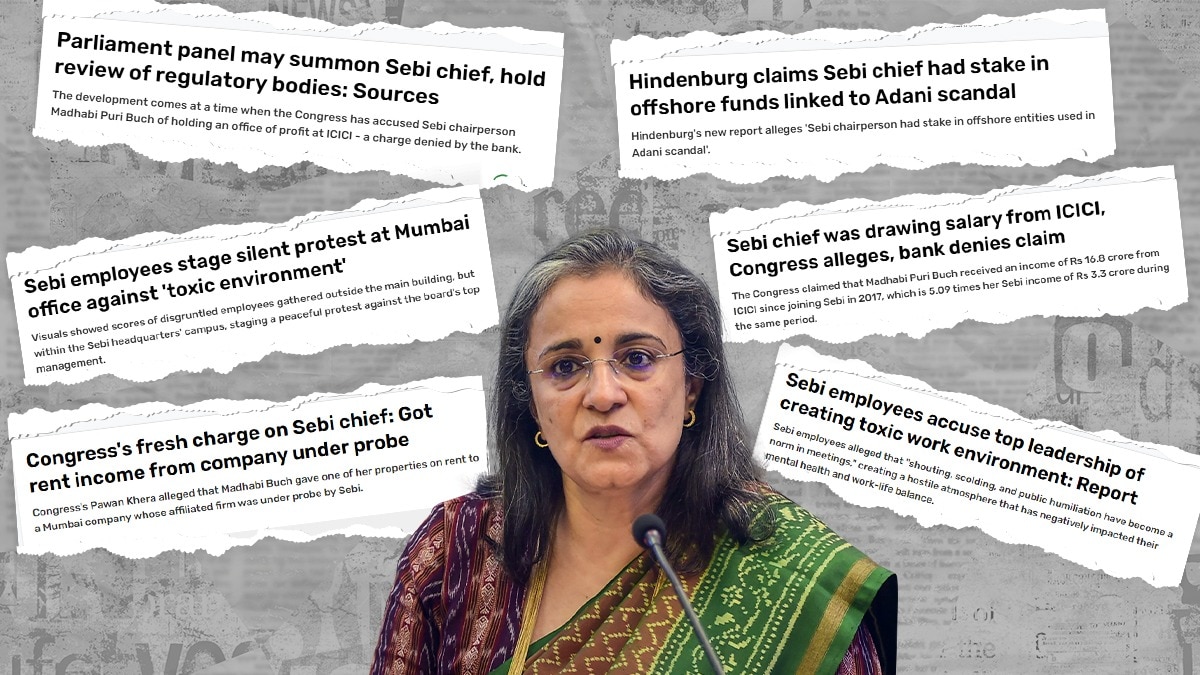
The Fall From Grace
Madhabi Puri Buch’s career arc could have been the stuff of legend – private-sector professional breaking into the bureaucratic fortress of Indian regulation, shaking up the system with reforms, and leaving behind a legacy of efficiency and transparency. Instead, she finds herself at the center of an ever-growing list of controversies, that have overshadowed her achievements.
The fall from grace has been swift and unforgiving for someone hailed as a reformist. The accusations against her are not just about regulatory missteps but extend to conflicts of interest, corporate favoritism, and a toxic work culture at SEBI. In a world where perception often dictates reality, the damage has already been done, irrespective whether or not she is ultimately found guilty of any wrongdoing.
The Adani Controversy. Where It All Began
Buch’s troubles began with allegations of her soft stance on the Adani Group, first flagged by U.S.-based short seller Hindenburg Research. The timing couldn’t have been worse as India was already dealing with international scrutiny over corporate governance, and SEBI’s perceived inaction on Adani’s offshore fund structures only fueled suspicions.
The conflict-of-interest claims hit closer to home when it was revealed that Buch’s husband, Dhaval Buch, had investments linked to offshore entities reportedly tied to Vinod Adani, the elder brother of Gautam Adani. Though she denied any wrongdoing and pointed out that these investments were made before she took office, the damage was done. The Congress party latched onto the allegations, turning them into a political weapon against the ruling government, making Buch’s position even more precarious.
SEBI’s Internal Turmoil
While the Adani controversy put her in the spotlight, it was not the only storm brewing under her leadership.
SEBI employees themselves started speaking out against an alleged toxic work environment, with claims of a dictatorial leadership style, undue pressure, and decision-making that left many feeling sidelined.
Regulators operate on trust, and when internal discontent spills into the public domain, it raises uncomfortable questions. Was Buch too focused on efficiency at the cost of transparency within SEBI itself? Did she alienate key people within the organization, leading to an erosion of internal checks and balances?
Strength or a Fatal Flaw?
Madhabi Puri Buch has never been known for taking the easy route. Former colleagues describe her as sharp, detail-oriented, and someone who understands the pulse of the market.
Even her quick decision-making has been praised as a key reason for her rise; however Buch herself has admitted that she is an incredibly tough boss and perhaps even “impossible” to work with.
Hence, the revolt within SEBI tells its own story. Nearly 1,000 officers formally complained to the Finance Ministry about her leadership style, alleging harsh treatment, an unhealthy work culture, and unreasonable expectations. Micromanagement, minute-by-minute monitoring, and shifting goalposts; these were just some of the concerns raised.
It’s ironic. A leader who was brought in to clean up the markets now faces accusations of mismanaging her own organization.

When Credibility Comes into Question
The timing of these internal complaints was particularly damaging. They surfaced just as Hindenburg Research reignited allegations that Buch and her husband had financial ties to offshore entities involved in the Adani scandal. Suddenly, what was initially seen as a regulatory battle became deeply personal.
—Hindenburg’s accusation was straightforward – SEBI, under Buch, had failed to take meaningful action against the Adani Group despite damning evidence. SEBI denied the claims, insisting that Buch had disclosed all potential conflicts and had recused herself from related matters. But that didn’t stop the political firestorm.
—Congress leader Pawan Khera added fuel to the fire, alleging that Buch continued to receive Rs 17 crore in salaries from ICICI Bank even after taking over as SEBI chief. The bank denied this, clarifying that she had only received retirement benefits.
—Then came more allegations—Congress claimed that Buch had rental income from Carol Info Services, a firm linked to Wockhardt, a company under SEBI’s scrutiny.
—The party also alleged that her husband received Rs 4.78 crore from Mahindra & Mahindra while Buch was handling arbitration cases related to the group. Mahindra & Mahindra dismissed this as “false and misleading,” stating that Dhaval Buch was paid solely for his expertise in supply chain management.
—And just when it seemed like the worst had passed, another revelation hit—Buch allegedly holds a 99% stake in Agora Advisory, a consultancy firm that reportedly provided services to listed companies regulated by SEBI, including Mahindra & Mahindra, ICICI Bank, Dr. Reddy’s, and Pidilite.
The Silence…
Hindenburg then quickly called out her silence, posting on X (formerly Twitter).
At this point, the perception battle was already lost. Buch may have explanations for each accusation, but in the court of public opinion, silence often speaks louder than words.
Why Integrity Is Super Important For SEBI
Credibility is everything for a regulator. Perception drives trust, and trust is what keeps the financial markets functioning smoothly. But both SEBI and Madhabi Puri Buch faced a credibility crisis.
In the world of regulation, perception matters just as much as the rulebook. Her reputation as a no-nonsense reformer propelled her rise, but with every fresh allegation, that image took a hit – if Buch lost credibility, SEBI lost credibility. And if SEBI loses credibility, investor confidence in India’s markets could take a serious beating.
It should be noted, this isn’t the first time SEBI’s integrity has been questioned.
Back in 2007, the regulator indicted National Securities Depository Limited (NSDL) over a massive Rs 500 crore scam where thousands of demat accounts were fraudulently created to corner shares in IPOs.
At the time, NSDL’s chairperson was C.B. Bhave, who then became SEBI’s chairman in 2008 while SEBI was still investigating NSDL. The conflict of interest was obvious, but the UPA government allowed Bhave to serve his full term.
That episode left SEBI bruised, and Buch was brought in years later to restore its credibility. And in many ways, she did. Under her leadership, retail participation in India’s stock markets skyrocketed. But trust, once lost, is hard to regain and calls for her to step down became stronger.
The Last Bit
Buch’s tenure as SEBI chief is nearing its end. Three years is a long time in the stock market, but reputations can be built or destroyed, in a matter of days.
The special ACB court’s directive to register an FIR against Buch and other SEBI officials is perhaps the most serious blow yet. While SEBI has pushed back, calling the complainant a “habitual litigant” and questioning the legal basis of the order, the fact remains that a regulatory chief facing corruption allegations is an embarrassment for India’s financial markets.
Even if she manages to clear her name, the legacy she leaves behind will always have an asterisk next to it. The irony is hard to miss, a reformist regulator who sought to clean up the markets now finds herself battling allegations of impropriety.