How Coffee Is Rewriting Nagaland’s Rebellion Script. Indian Coffee Is Stirring Global Demand And Export Fortunes, No Longer Just Local!


Just off National Highway-2, the vital road linking Assam, Nagaland, and Manipur, sits Juro Coffee House, home to a live roastery set up earlier this year. But this café is more than just a pitstop and is now being viewed as a symbol of a quiet but powerful transformation brewing across the state.
For decades, Nagaland’s story was dominated by an armed struggle for independence. Since India’s independence, the region has seen violent clashes between security forces and separatist groups. A plebiscite held by Naga rebels after independence saw an overwhelming vote for separation from India, a result the Indian government has never recognized. This long conflict left deep scars on the state’s political and economic fabric.
Historically, Nagaland’s economy has leaned heavily on agriculture – paddy, bananas, oranges, and leafy greens like mustard were the staple crops. But now, a new story is being written, one cup at a time.
Across the state, a wave of cafés, farms, and roasteries is pushing locally grown Arabica and Robusta coffee into the spotlight. And Juro Coffee House is right at the heart of this revival.
Although coffee was first introduced in Nagaland in 1981 by the Coffee Board of India, the industry only began to gain momentum after 2014. Since then, a mix of government policy changes and the passion of young entrepreneurs has sparked a small but vibrant coffee movement.
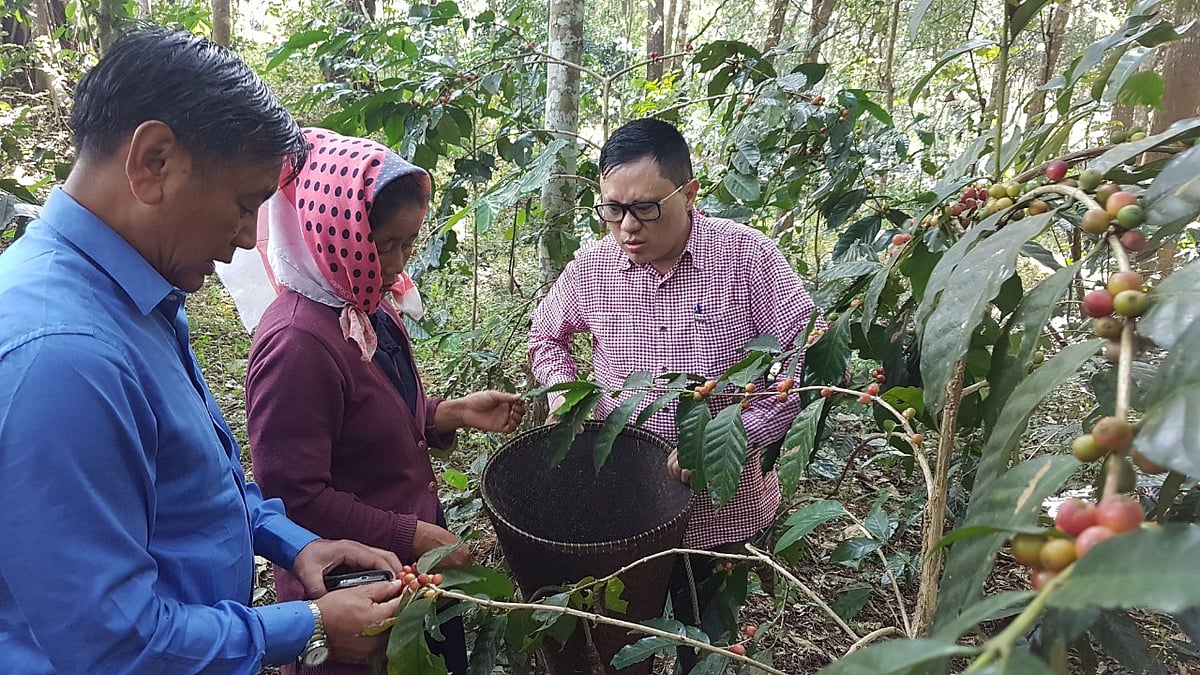
Today, the state has nearly 250 coffee farms spread across over 10,000 hectares of land in 11 districts. Around 9,500 farmers are now cultivating coffee. Eight roastery units have emerged, alongside a growing number of local cafés in cities like Dimapur and Kohima and even in the more remote districts of Mokokchung and Mon.
.jpg)
For Searon Yanthan, founder of Juro Coffee House, it all began during the COVID-19 pandemic. Like many Naga youth studying or working elsewhere in India or abroad, the lockdowns brought him home and with it, unexpected opportunity. He had been on the verge of graduating when the pandemic hit and left college without a degree. During the lockdown, he hitched a ride in a government vehicle from Dimapur and made it back to his family’s coffee farm, 112 km from Kohima.
His father had first planted coffee there in 2015, and Yanthan ended up staying seven months. During that time, he discovered something surprising: most farmers did not know much about the quality of their beans. It wasn’t shocking, though coffee still isn’t a part of daily life in most Naga homes.
That experience planted the seed for Lithanro Coffee, the parent company behind Juro, which Yanthan launched in 2021. He started visiting farms across the region, working with farmers to improve crop quality and plantation maintenance. Once he set up his own processing unit, he began inviting farmers over, serving them freshly brewed cups made from their own beans, often for the first time in their lives.
Today, he sources coffee from around 200 farmers, in addition to his own estate-grown beans.
For Yanthan, coffee represents more than just a product and is a way to rewrite what success means for Naga youth. In a state where private-sector opportunities are limited, and government jobs are seen as the ultimate goal, coffee offers a different kind of aspiration.
“Every village you visit,” he says, “you’ll see parents working hard on the farms, hoping their children land a government job.” But now, thanks to this new wave of homegrown enterprise, a fresh path is opening up, grounded in the land, but looking far beyond it.

The Success Story
So what really changed for Nagaland’s coffee scene in 2015? Most buyers and roasters point to a key decision by the state government – handing over the reins of coffee development to the Land Resources Department (LRD). This department had a broader reach and experience in running schemes supported by both the state and central governments. And it made all the difference.
Back then, Nagaland was not just physically cut off from the rest of India — there was barely any internet connectivity. But fast forward a few years, and farmers, roasters and buyers were able to connect with the outside world through online platforms, giving rise to new markets and fresh interest. “The market wasn’t like what it is today,” recalls Albert Ngullie, the LRD director.
The department began building nurseries, offering free coffee saplings, and even started supporting farmers with post-harvest infrastructure – coffee pulpers, washing stations, and curing units across a few districts. Entrepreneurs were also encouraged to open their own roastery units, adding more value locally.
One of the early movers was Lichan Humtsoe. He quit his government desk job at the LRD to launch his own venture, Ete Coffee — “Ete” meaning “ours” in the Lotha Naga dialect — in 2016. He was the first to source, serve and market Nagaland’s specialty coffee. Today, Ete runs cafes, roasteries and even a coffee lab where they study the chemistry of local fruits as potential flavour notes.
The company also operates a coffee school in Nagaland, with another campus in neighbouring Manipur, complete with its own curriculum and training modules to groom the next generation of coffee professionals.
According to Humtsoe, Nagaland’s coffee journey has been a great example of how the private sector and the government can complement each other effectively.
The timing has been fortuitous. As Nagaland’s coffee ambitions grew, so did India’s coffee exports. In 2024, the country crossed the $1 billion mark in coffee exports for the first time — double the output from 2020–21. While most of India’s coffee still comes from Karnataka, there’s been a conscious push to expand cultivation into the Northeast.
That said, creating a thriving coffee culture in Nagaland hasn’t been easy. The state has faced decades of unrest, which left it with fragile infrastructure and a heavy dependence on central government funds. Growing up in the ’90s, a time when army operations against insurgents were common – Humtsoe had no inclination to be part of the Indian mainstream. He even stopped speaking Nagamese, the lingua franca among Nagaland’s 16 tribes. But over time, he grew disillusioned with separatist politics and began to see the irony in rejecting India while relying on its funds.
Coffee, for him, became a way to reclaim purpose, not just for himself but for his community.

The Quality Question
Ngullie from the LRD says that Nagaland’s coffee movement is more than beans, it is also helping preserve forests. “We don’t do land clearing,” he says, suggesting that coffee is easing the transition away from traditional slash-and-burn farming to more sustainable agroforestry.
The LRD procures quality seed varieties from the Coffee Board and distributes them to farmers. And it’s paying off. Farmers are now earning more than they used to.
Take Limakumzak Walling, a 40-year-old farmer from Khar village in Mokokchung district. His father was one of the first in Nagaland to plant Arabica back in 1981. But back then, there was no real market for it. “It was more of a burden than a bonus,” he says.
Earlier, the Coffee Board would buy beans and then auction them in Bengaluru — often taking over a year to pay farmers. But since the state government took charge, the payments have become quicker and more direct, with buyers sourcing directly from farmers. Walling now gets paid upfront though the income is still modest. He earns less than ₹2 lakh (around $2,300) a year and still practices jhum (slash-and-burn) cultivation like many others.
And while the state is pushing for more sustainable farming practices, recent satellite data suggests that jhum cultivation might be on the rise again a reminder that the shift to coffee and climate-friendly farming is still a work in progress.
The Future of Naga Coffee
India may be the world’s seventh-largest producer of coffee, but when measured against global export powerhouses like Brazil, Vietnam, Colombia, or even Italy, it still has a long road ahead.
In Nagaland, that road is both winding and promising.
The state government says exports are climbing, but entrepreneurs on the ground paint a more tempered picture. Vivito Yeptho, Nagaland’s first certified barista and co-founder of Nagaland Coffee, recalls their last major international shipment – 15 metric tonnes to South Africa – was back in 2019. Since then, the buzz has been more local, more intimate.
Still, the victories are far from insignificant. In 2024, Nagaland hit its highest-ever production at 48 metric tonnes, according to state officials. Yeptho says his company now supplies beans to 40 cafes across India – 12 of them nestled in the Northeast itself. And globally, Naga coffee is beginning to percolate into the spotlight: it clinched silver at the 2022 Aurora International Taste Challenge in South Africa, and struck gold a year later.
“If we’re serious about exports, we need to be producing 80 to 100 MT annually,” Yeptho admits. But before scaling, the ground reality remains: quality and post-harvest processing need focused attention.
India’s Coffee Story Is Growing – Globally and at Home
Centuries ago, a Sufi saint changed the course of India’s history with seven seeds. Baba Budan smuggled Mocha beans from Yemen and planted them in the hills of Karnataka. That act, almost mythic in hindsight, sparked a legacy that has today placed India among the world’s top coffee producers.
Fast forward to 2024, and India’s coffee exports have hit a new milestone, crossing $1.29 billion, nearly doubling from $719 million in 2020-21. In January 2025 alone, over 9,300 tonnes were exported, with Italy, Belgium, and Russia among the top buyers. Arabica and Robusta dominate the Indian coffee landscape, most of it exported as green (unroasted) beans. But demand is growing for roasted and instant variants as India’s coffee narrative evolves beyond just beans.
Coffee culture is no longer a south India phenomenon. From college towns to corporate lobbies, café counters are brewing briskly across the country. Consumption has risen from 84,000 tonnes in 2012 to 91,000 in 2023, a shift that reflects changing tastes and rising aspirations, even in rural regions.
Karnataka still leads the pack, producing over 248,000 metric tonnes in 2022-23, followed by Kerala and Tamil Nadu. These shaded plantations, often nestled in rich ecological zones of the Western and Eastern Ghats, do more than produce coffee, they help preserve biodiversity, contributing to a fragile but vital ecological balance.
To keep up with rising demand, the Coffee Board of India is betting big on newer frontiers, non-traditional areas like the Northeast. Through its Integrated Coffee Development Project (ICDP), the Board is helping boost yields, support sustainability, and introduce coffee to fresh terrains.
The Araku Valley is already proof of what’s possible. With backing from the ITDA and funding from the Girijan Co-operative Corporation, nearly 150,000 tribal families have upped production by 20%. For them, coffee is not just a crop, it is a tool for empowerment and self-reliance. A true embodiment of Aatmanirbhar Bharat.
These stories 0 from Araku to Mokokchung – form the mosaic of India’s coffee resurgence. They are indicative of the promise of rural entrepreneurship, the need for ecosystem support, and the magic that happens when tradition meets modern ambition.
For Nagaland, and the rest of India, the journey is still unfolding but a promising one.