How India Is Becoming A Trillion-Dollar Economy While Producing A Generation Of Screen-Addicted Brainless Dancing Zombies!
The piece blends national economic analysis, urban-rural dynamics, and commentary on the cultural and institutional collapse around employment, education, and aspirations, leading to digitally distracted, underprepared citizens.

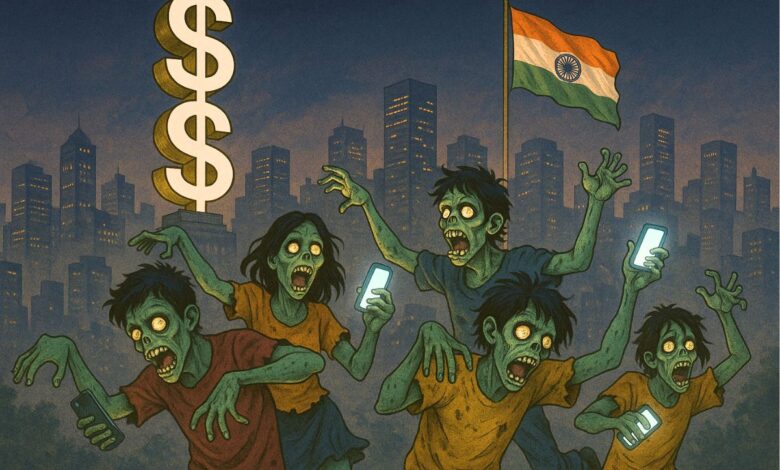
India’s meteoric rise to the world’s fourth-largest economy is being trumpeted everywhere; a $4+ trillion GDP and counting…
Politicians and pundits celebrate overtaking Japan and chasing China, but beneath the hype lies a darker reality. For most Indians, especially the young, life is not improving in step with those headline numbers. Growth has come with jobless expansion, galloping inequality, and a terrifying hollowing out of skills and aspirations. We are here to expose and pull back the curtain asking why India’s tryst with trillion-dollar wealth may be a Faustian bargain, exchanging real human development for mere statistical triumph.
India’s economy is indeed large on paper. IMF data project GDP of about $4.187 trillion for fiscal 2025, nudging it past Japan. But this figure is almost meaningless for the average Indian. With 1.46 billion people, India’s GDP per capita is only about $2,880, a fraction of Japan’s $33,900. In fact, India is set to become the fourth-largest economy with arguably the world’s largest poor population.
A World Inequality Report found the top 1% of Indians own over 40% of the nation’s wealth, while the bottom 50% hold just 3%. The top 10% of earners take 57% of national income. In short, India’s growth is overwhelmingly captured by a tiny elite. GDP growth is real, but for whom? If billions live in informal labour or subsistence farming, a $4T economy is a mirage, which is great for self-congratulation, worthless for mass uplift.
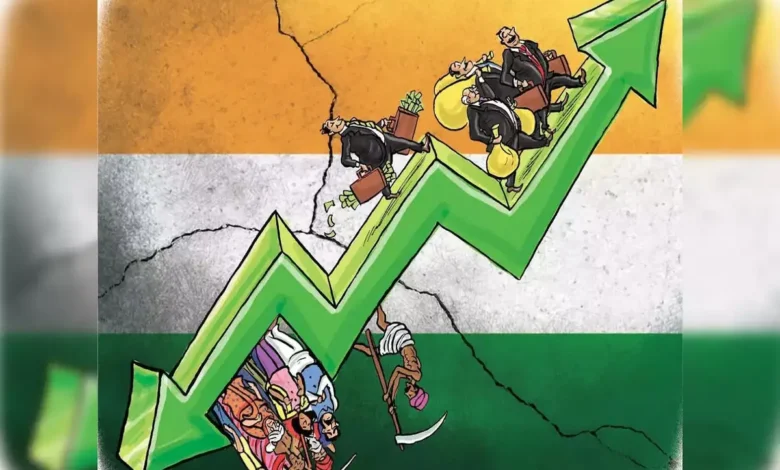
What exactly is powering this nominal growth? Predominantly services. Today, services contribute over half of India’s GDP. As the Economic Survey notes, services’ share of total output has climbed from ~51% in 2014 to about 55% by FY2025. Finance, IT, telecom, and other tertiary sectors have boomed. The finance minister even boasts services are roughly 64% of GDP. Yet services employ far fewer people. According to official figures, only about 30% of Indians work in services; the rest toil in agriculture or industry. The paradox: more than half of national output comes from a sector that employs only a minority.
The mismatch is deadly for jobs. From 2015–16 to 2022–23 India formally added 12.5 crore jobs, but astonishingly only 86 lakh (0.86 crore) of those were in manufacturing. In other words, manufacturing, the traditional engine of employment, contributed just 7% of new jobs, while services accounted for 4.9 crore. In contrast, agriculture (not highlighted in recent data but known to be stagnant) saw minimal gains.
The media-loving tech and telecom sectors produce eye-popping revenue, but they’re capital-intensive, not labour-intensive. Even the $200+ billion IT-BPO industry employs only about 3.7 million people, which is less than 1% of India’s half-billion workforce, despite being nearly 10% of GDP. Meanwhile, India’s booming call centres, startup hubs and design studios voraciously consume digital infrastructure and glass skyscrapers, but simply do not absorb the surging army of diploma-holding youth coming out of colleges every year.
This lopsided growth has earned India the reputation of “jobless growth.” While GDP ticks upward at 6–7%, unemployment climbs. Recent data are grim. CMIE reports India’s overall unemployment leapt to 9.2% in June 2024 (from 7% in May), the highest in years. Rural unemployment was even higher (9.3% in June) and urban 8.9%. These are shocking numbers for a supposedly high-growth economy. How can nearly 1 in 10 workers be jobless when the economy is supposed to be on fire? The answer lies in precarious informality and weak job creation.
In reality, India’s workforce is overwhelmingly informal. By one estimate, 82% of workers are in the informal sector and a full 90% in informal employment; jobs without contracts, social security or stability. WIEGO similarly notes that 90% of Indian workers are on informal arrangements. From day laborers in construction and tiny roadside vendors, to freelancers with no labor rights, most Indians scrape by without formal pay or benefits. This means millions of “jobs” involve neither growth nor dignity: casual farm labor, self-employed petty trade, or precarious gig work. Many in their 20s go from one odd job to another without prospects for advancement. Wealth is generated and consumed, but little trickles down to this vast informal majority.
The manufacturing sector has been an even bigger letdown. The government’s marquee Make-in-India campaign was supposed to transform India into a global factory, doubling manufacturing’s GDP share by 2047. Instead, manufacturing languishes at a mere ~12–15% of GDP; barely higher than a decade ago. In April 2025 India’s finance minister acknowledged manufacturing is only about 12% of GDP and promised a goal of 23% in two decades. That admission underscores how far off target India remains.
Real job creation in factories is almost nonexistent. An analysis of RBI and official data found formal manufacturing added just 86 lakh jobs from 2015–16 to 2022–23 ; about 10 lakh jobs a year on average. This miniscule number accounts for only 6.9% of all jobs created in that period. Worse still, informal manufacturing lost jobs: between 2015 and 2022, 54 lakh manufacturing jobs disappeared, victims of Demonetisation, GST disruption and the pandemic. Even the jobs that remain haven’t lifted productivity. The average value added per manufacturing worker in 2022-23 was virtually unchanged from 2015-16. In short, factories neither employ nor enrich significantly.
This stagnation has real consequences. As manufacturing falters, so do incomes and rural livelihoods. Agricultural incomes remain constrained by low productivity, and 70% of the population is rural. Over 80% of rural workers are still tied to agriculture or allied jobs, many living hand-to-mouth.
A Business Standard editorial highlights the dismal truth: a “large proportion” of rural 18–25-year-olds have never been employed and increasingly do not even aspire to work, given the lack of non-farm opportunities. Why learn skills if there’s no job to match them? Many rural families see migration to cities or the Gulf as the only escape. Those left behind face a bleak world of stagnant farm incomes, day-wage drudgery, and government dole that is inadequate and irregular.
Meanwhile, the millions of young men and women who do make it to towns and cities face intense competition for scarce jobs. A gulf has opened between what employers want and what universities teach. This education-to-employment pipeline has broken down. The weekly youth unemployment crisis is chronic: a survey by Mercer-Mettl in early 2025 found a shocking 57.4% graduate unemployment; meaning just 42.6% of graduates are employable. In plain terms, more than half of college degrees in India do not meet job-market needs.
Technical skills, especially in new fields like AI and data analytics, are in high demand, but universities produce only a few industry-ready coders. Ironically, while roughly 46% of engineering and science grads are fit for emerging AI/ML roles, most of the mass-produced degrees land holders in call centers or sales jobs that machines are eating away. Even core soft skills are lacking: fresh graduates routinely flunk communication, problem-solving or English proficiency, creating huge skill gaps.

These gaps hit the most vulnerable especially hard. In rural areas, 40% of youth openly admit they struggle to find jobs simply because of “lack of skills and language proficiency”. Many are so discouraged that they migrate to cities seeking training or white-collar jobs in vain. Surveys show huge pent-up frustration: a third of respondents cite limited regional opportunities as a top hurdle. The net result is glaring underemployment: young graduates end up in retail or driving cabs. The stigma of unemployment hangs heavy. Traditional “safety valve” routes like teaching or civil service exams are clogged or seen as inadequate.
And as jobs vanish, hope fades. A new trend has emerged: instead of steely ambition to become engineers or doctors, many youths have latched onto glamourized escape routes of influencer fame and social media shortcuts. This is the era of digital escapism. Walking in the corridors of engineering colleges or IT offices, you now see students scripting Instagram reels and polishing YouTube thumbnails instead of solving equations.
A May 2025 Outlook Business feature captures the zeitgeist bluntly: “Gen Zs are dropping out of college and abandoning stable careers to become content creators – betting their futures on follower counts, brand deals and the promise of a fragile fame”. In one telling statistic from that piece, an “overwhelming share” of surveyed Gen Zers in India already identifies as “creators” rather than engineers or managers.
In short, many young Indians have revised their career dreams. A decade ago, being hired by a Big Tech firm was the apex of aspiration. Today, an online influencer seems sexier. For a reality check: India’s richest have parlayed coding or factories into wealth, but for the masses of Gen Z and Gen Alpha, it feels easier to pursue likes and views than laborious study.

According to a U.S. study cited by Entrepreneur magazine (likely similar trends in India), 57% of Gen Zers worldwide want to be influencers, and 53% call it a “respectable” career choice. The same social media platforms that stoke FOMO also spread misinformation. UNESCO found that 62% of digital “creators” globally don’t bother fact-checking before posting; showing that a culture of quick likes often trumps critical thinking.
This pervasive digital addiction is literally epidemic. According to a Lancet study cited in EducationWorld, 1 in 3 Indian children uses social media, and 11% show signs of extreme addiction, complete with withdrawal symptoms when their devices are taken away. Psychologists warn of widespread attention disorders: hooked on short-form videos, the average teenager has the focus span of a goldfish.
Generation Z is effectively growing up in a dopamine loop of endless reels, short clips, and influencer theatrics. In classrooms, teachers notice new syndromes: poor concentration, fake classwork with smartphones hidden, and a craving for screen-time that feels like a drug. Some call it a “new epidemic,” and indeed many young Indians now rate their overall mental health as poor if they exceed a few hours of social media.
The result of this digital overdose is a hollowing out of aspirations. Once upon a time, millions of parents told their kids to become engineers or doctors. Now, too many youths say, “Why bother? I have my YouTube channel.” The decline in basic literacy and curiosity is a real fear. Schools and colleges often remain teaching factories for outdated syllabi; channeling energy into TikTok memes seems more rewarding.
Instead of learning new skills, youths memorize Instagram filters. Ironically, while BharatNav scheme teaches kids to code, many would rather master a trending dance. A GlobalDevIncubator report notes rural youths do have dreams but no local jobs, so they default to “easy” digital careers. Lacking direction, they cling to any ray of “success” on Instagram, often mindlessly chasing virality rather than mastering a craft.
At the same time, India’s leadership seems to encourage this trend, with misguided priorities. Just in 2025, the government announced a massive $1 billion fund to fuel the “creator economy”. It also earmarked Rs. 391 crore to set up an “Indian Institute of Creative Technology” in Mumbai’s Film City, essentially an IIT-like campus for digital content skills.
The information minister trumpeted this as empowering “energetic creators” to get capital and hone skills. Meanwhile, where is comparable investment in, say, science and engineering research? Disappointingly, India still spends well under 1% of GDP on R&D. Official data show gross R&D expenditure is merely 0.64–0.66% of GDP, a far cry from the 3% + of China or 2.8% of the U.S. Each rupee poured into online studios is a rupee not spent on laboratories, technical institutes or vocational training.
Even education faces neglect. To be fair, India does allocate about 4–5% of GDP to schooling, roughly meeting UNESCO’s 4–6% target. But much of that money disappears in administrative overhead or ineffective mid-level bureaucracy. Quality remains uneven: top universities produce fine graduates, but overcrowded public schools still churn out rote-learning certificates.
In budget after budget, unions pump up schemes like PM eVIDYA or Digital India, but core issues (like teacher training, curriculum overhaul, rural school infrastructure) get only lip service. Meanwhile, flip-side initiatives gleam on the front pages: subsidized smartphones, free data from telecom jigsaws, and now creator grants. The message to a poor villager: “We’ll give you a smartphone so you can watch reels; we might even fund your next viral dance!” It is grotesquely upside-down.
To compound the irony, emerging technologies poised to boost productivity are also displacing people. Artificial Intelligence and automation are sweeping across industries worldwide, and India is not spared. Global reports estimate tens of millions of jobs are at risk. The IMF warns AI “poses risks of job displacement” especially in emerging economies. ILO projections put 75 million jobs globally at complete risk of automation.
Studies find even high-wage jobs are not safe; nearly half of top-quartile U.S. jobs are exposed to AI. In India, a shocking 69% of current jobs are theoretically automatable. Low-skill IT and BPO jobs, once seen as fallback careers for middle-class youth, are evaporating. Software testing, data entry, call-center support, all these categorised as routine clerical work can be done faster by bots. “It’s been happening for the last two or three years in an accelerated fashion,” admits an industry veteran. Already, textile giants are planning to replace 10,000 workers with robots.
Generations of parents dreamed that higher education or a white-collar job would guarantee security. Now, even those are hollow promises. The pandemic accelerated digital transformation, and AI threatens to accelerate the decimation of mid-skill jobs. Losing these jobs is not a distant fear: a Brookings study found Indians disproportionately at risk because so much employment is repetitive and service-oriented. Tech companies are telling workers bluntly that if “a job requires four manual testers, automation can reduce it to one”. Young engineers who once flocked to campus recruitments are now anxiously reskilling or grabbing gig work. The upshot: the old ladder to middle-class life has missing rungs.
Put it all together: massive GDP numbers, but terrifyingly few stable jobs for most people, especially youth. The shards of India’s dream economy are held together by credit, fancy skyscrapers, and billions of digital screens; yet people on the ground feel deprived and disillusioned. Inflation-adjusted wages for ordinary workers have hardly budged in years; farm incomes oscillate on rain; city rents and school fees outstrip rises in earnings. Even the limited gains in income are not evenly shared.
It is no wonder that inequality is deepening. When GDP grows 6–8% but the vast majority gets informal work or remains jobless, poverty rates barely budge. Household surveys show many Indians now feel economically insecure. Consumer spending booms, but often on status symbols (smartphones, glittering malls) rather than basic needs. The aspirational Bollywood-fantasy lifestyle is pushed by media, but under the surface people are barely coping. A recent survey by Oxfam shows India’s poverty reduction has slowed. The richest continue to get the lion’s share of new wealth. In practice, the “trickle-down” in trickle-down economics is more of a teased drop in an already half-empty pail.
Urban India too is faring unevenly. Major cities are engines of growth, but this generates slums and satellites. Young migrants cram into poorly paid service jobs, as cab drivers, food delivery boys, contractual helpers, not the cushy tech jobs of the glossy images. These gig workers have unstable incomes and no social safety net. Many urban families now juggle credit card debt just to send kids to private schools or to keep up with rising costs.
In education and tech, there are glaring absurdities: state-of-the-art IITs and AI labs exist in isolation, while rural schools below them still lack libraries, labs and decent teachers. The digital divide persists: internet connections exist, but online “education” often means watching poverty porn reels instead of biology lectures.
All this should raise uncomfortable questions: How can India’s economy be celebrated abroad when its people feel left behind at home? The tension between macro and micro is becoming palpable. Street protests by unemployed graduates are more common; there were large farmer agitations in 2020–21. Millions of young adults, instead of career-building, spend their days on social media or seasonal work. The “national ambition” of being a $5T economy overlooks the ground reality of billions living on the edge.
This is a polemical wake-up call. The contradiction is stark: India claims victory in the global economy while failing to secure its citizens’ future. The irony stings: India has more millionaires and tech unicorns than ever, yet also the world’s largest child population and millions of school dropouts. It boasts democratic success and soft power, yet trust surveys show Indians lack faith in institutions (education, law, employment) that should deliver opportunity. The complacent narrative of “booming GDP automatically makes India great” is being exposed as a mirage.
To avoid a generational disaster, India must urgently reconcile macro and micro. That means shifting priorities: quality jobs over vanity metrics. Instead of just counting telecom towers and skyscrapers, policymakers should ask, “How many livelihoods did we create today?” The country needs a massive push in skilling and reskilling; not only on trendy digital subjects, but basic literacy, vocational training and English-language outreach in villages. Schools and colleges must teach relevant skills and critical thinking, not just churn out degrees that employers disdain.
Make-in-India should be revived to truly fill its name. Investment in manufacturing, from electronics to pharmaceuticals, must be matched by reforms (electricity, logistics, land, labor laws) to actually make factories viable. This will create the middle-skill jobs that mere service-sector expansion cannot. Similarly, rural India needs diversifying beyond farming: agritech, food processing, renewable energy projects and rural SMEs could absorb youth if given credit and training.
Crucially, technology must be harnessed to empower people, not just profits. AI and automation will arrive; India should use them to complement workers, not replace them wholesale. That means fostering “AI-for-all” models and safety nets. The Economic Survey itself warns India cannot afford mass job loss from AI and calls for institutional support. Left unchecked, automation could deepen inequality by replacing low-wage jobs. India must invest in retraining programs, extend social security to all workers, and encourage businesses that scale up jobs alongside technology.
On the cultural front, the nation must question the glamorization of influencer culture. Social media has its place, but let us not pretend getting likes equals success. Media literacy and digital ethics should be taught early, so young people understand the pitfalls of misinformation and addiction. Role models should be teachers, scientists, innovators, not just Instagram or bollywood stars. Public messaging must evolve from “India will be economic superpower” to “India will be literate, skilled and fair society”.
At the policy level, there must be a recalibration of spending. A $1B creator fund looks utterly absurd when classrooms still lack toilets, labs still lack equipment, and R&D labs run on a pittance. If the government can mobilize Rs. 400 crore for a media college, it can surely boost health, sanitation and primary education budgets. Every rupee spent on building yet another cinema city or startup accelerator is a trade-off against health clinics, teacher training or rural roads that create inclusive growth. India’s leadership must shift from chasing flashy headlines to quietly fixing fundamentals.
The image of India as the “sleeping giant” no longer suffices; we must reckon with what we’ve awakened to. The macroeconomic charts will look even more impressive if high GDP growth continues, but if the people, especially youth are worse off in other ways, what is success? A GDP that grows 8% a year but keeps 8% of the population jobless and millions illiterate is no victory. A few skyscrapers and tech IPOs, while farmers commit suicide or coaches prey on hopeful students; that is the real India behind the numbers.
This polemic does not reject development. Rather, it demands responsible development. India can aim to be a trillion-dollar economy with better jobs, not in spite of them. The choice is stark: either continue as a façade of prosperity, eventually fracturing under unaddressed social strife, or use the economic momentum to empower citizens. The clock is ticking. If India does not course-correct, it risks a bitter irony: overtaking rich countries on paper, but falling behind in the one ranking that truly matters – human well-being and opportunity for its people.
In the end, what good is a $4 trillion economy if the children of India inherit a country of unemployment, addiction, and broken dreams? The numbers are large, but the image is small: it is a nation where youth stare at their phones with glazed eyes, where factories lie half-empty, and where wealth perches atop a shrinking pyramid of happy few. We must disturb this complacency: celebrate the GDP only if, and only if, it lives up to lifting India’s soul, not just its statistics.