What’s Real At Ola Electric? Definitely Not Their Margins, Metrics, Or Math!
Ola Electric’s Ever-Changing Ebitda Breakeven Claims, Unrealistic Margin Projections, And How It Misleads Shareholders And Stakeholders Through Erratic Communication And Unverifiable Promises.

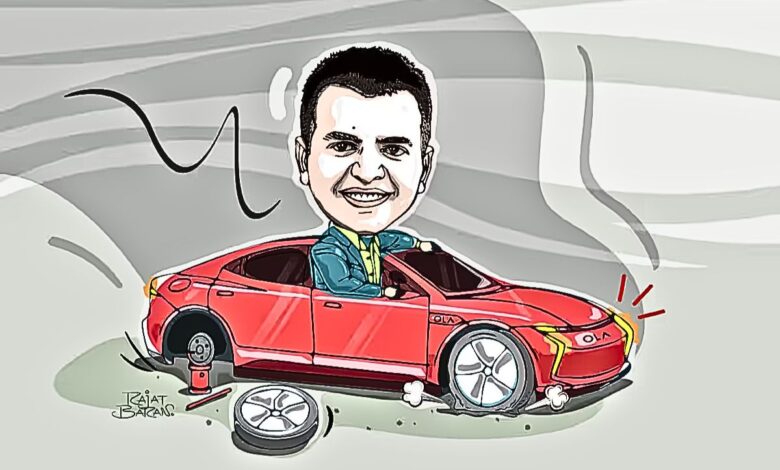
Ola Electric’s narrative of success is shattered by its stock chart. Once a poster child of India’s EV revolution, the company’s stock plunged over 60% from its August 2024 peak as reality failed to match management’s soaring projections. Behind the hype lurks a disturbing pattern: wildly contradictory break-even targets and fantastical margin promises that shift week to week, with no hard data to back them.
In February 2025, founder Bhavish Aggarwal told the media Ola Electric needed to sell 50,000 scooters/month to hit EBITDA breakeven. Three months later, in May’s earnings call, management quietly revised that to 25,000–30,000 units, and by the end of May bragged that 25,000 units would suffice. This whipsaw of numbers, 50k one day, 30k the next, then 25k, left investors bewildered and exposed the company’s forecasts as plucked out of thin air.
Each data alone is implausible given Ola’s recent sales (just ~25k in January 2025), but the way the target bounced around is worse than useless, because it’s outright misleading. As one industry analyst bluntly noted on social media, “the founder himself does not know” what breakeven is. Investors who were holding out for clarity must wonder which number was “real”; or if any number can be trusted at all.
The gross-margin projections are even more brazen. In Q4 FY2025, Ola’s auto division reported a 19.2% gross margin. Yet without any convincing explanation, management insists that 28–30% is achievable in Q1 FY2026, and that margins will soar to roughly 35% by September 2025. In other words, the company is claiming to hike its gross margin by nearly 15 %age points in two quarters, largely on the strength of an untested Gen3 scooter platform and production-linked incentives (PLI) that may kick in.
The logic is left entirely opaque. For example, in the May 2025 earnings call, Aggarwal simply attributed the jump to “our Gen 3 platform” and unspecified cost reductions. Investors have no way to verify this; one prominent observer sarcastically pointed out that Ola Electric is forecasting margins to “surge from 19.2% to 25–28% in June quarter, and then expand by another 5–7% in the September quarter” without giving any numbers to show how.
This is not just aggressive, it’s bordering on fantasy. Automobile manufacturing rarely sees such a leap in margins so fast, absent miraculous efficiencies or massive price hikes. Yet Ola’s leaders present these numbers as if they were a fait accompli. In lieu of hard data, they rely on buzzwords like “Project Lakshya” and “Gen3.” But absent any real evidence, the aggressive forecasts ring hollow, especially when they contradict each other or reality.
The pattern is painfully clear: overpromising and underdelivering has become Ola Electric’s modus operandi.
The company’s leadership repeatedly doles out “outlandish projections,” only to see them flatline in the red quarter after quarter. Retail investors, who now own the bulk of Ola Electric’s shares, have learned this the hard way. In its last earnings release, Ola Electric plastered slides about cost-cutting projects and new product launches, but delivered a horrific Q4 with 60% revenue collapse and ₹870 crore loss.
Actual deliveries fell from over 115,000 to just 51,375 scooters year-over-year, despite management’s repeated assurances. To cite one stark example: Ola Electric claimed in a regulatory filing that it “sold more than 25,000 units in February” and captured 28% market share, whereas government registration data show only 8,647 Ola scooters entered the market in that month. This yawning gap between what Ola Electric says and what it does has become routine.

This woeful track record should cast doubt on every future claim from Ola’s investor relations team. Yet management’s communications remain curiously immune to accountability. In official filings and press conferences, the company’s tone is relentlessly optimistic: cost savings are ramping up, new models are coming, profitability is “in sight”.
In reality, however, key metrics keep missing targets and hand-waving explanations replace solid evidence. Even auditor’s reports have started to sound alarms: Ola’s latest FY25 financials by Auditor BSR & Co LLP carried an “unqualified opinion” but with a “grave concern” flag on its massive Rs 2,391-crore negative operating cash flow, up sharply from Rs 633 crore a year earlier, combined with persistent losses and underwhelming sales. Internally, creditors and employees reportedly fretted about delayed payments and departures. Yet publicly, Aggarwal and his team insist everything is under control, touting unused IPO funds and PLI windfalls as safety nets.
No amount of corporate pep talk can make up for such glaring inconsistency. Investors have every right to question the credibility of Ola’s forecasts. If one day the company says it will break even only when it sells 50,000 scooters a month, and just two months later says 25,000 are enough, which statement should anyone believe? The only honest answer is: neither, until we see the proof. As one analyst noted, Ola’s projections seem to be “throwing numbers at the wall without any real idea”. The pattern is so repetitive that it can no longer be dismissed as a one-off mistake. It is a pattern of error, obfuscation, and self-contradiction that erodes any semblance of trust.
The gap between press statements and performance is stark. When Ola Electric raised its hand late in FY25 to claim profitability by FY26, market observers were dubious. By May 2025, shares had collapsed 68% from the IPO high, as institutional investors offloaded in frustration. Rating agencies and brokers turned bearish: Kotak slashed its target price to ₹30, explicitly warning that delays and weak demand could send Ola Electric toward a cash crunch.
Media coverage has grown scathing. A Mint columnist headlined that Q4 results “disappoint[ed] the Street,” while pointing out that Ola’s revenue “fell below smaller rival Ather’s for the first time”. Even an investment-research platform noted that Ola’s once-heroic expansion plan is now “at risk of becoming a cautionary tale of aggressive expansion and financial overreach”. In short, Ola’s story of an unstoppable EV juggernaut has crashed into the gritty reality of missed targets and disgruntled investors.
The fact here is not just that Ola’s numbers keep changing; it’s that the company is not being held to account. Every error is swept under the rug and replaced with the next optimism. For example, management still talks up cost savings of ₹90 crore a month and promises of break-even “a quarter ahead of analysts’ estimates”, but never revisits the credibility of its past promises.

Shareholders receive glossy newsletters full of bullet-point ambitions, yet no follow-up on whether old goals were met or why they failed. There’s no penalty or even public disclosure when a forecast is reversed. Instead, the narrative simply moves on. This lack of transparency, a refusal to connect the dots between prognosis and outcome, leaves investors and employees alike asking: who in this organization actually knows what’s going on?
One does not have to be a stock-market sleuth to sense something is amiss. The facts speak for themselves. In just two years, the company told investors it would double domestic EV market share (to over 50%), invest billions in India’s first gigafactory, and sell millions of scooters annually. Today, none of those have materialized, yet leadership still talks about being “in line of sight” of profitability as if nothing has changed.
Every revised projection is cloaked in optimism about future products or policy incentives, but never qualified with “if” or “but”. This onslaught of optimism, unsupported by credible data, has tangible costs. It chews up retail shareholders the 17 lakh (1.7 million) people who backed Ola Electric’s IPO, and leaves them holding the bag of unmet expectations. It sows uncertainty among analysts who see wildly shifting targets and wonder which scenario to trust.
Worse, it undermines the broader EV ecosystem in India. Investors who swallow Ola’s rhetoric once may think twice before funding the next EV startup. When the poster child of India’s EV boom flunks so publicly, it fans doubts about the viability of fledgling EV companies everywhere. If Ola Electric can’t credibly forecast its own scooter sales, why should anyone believe tech investors other projections for battery startups, EV chargers, or related infrastructure? Confidence is fragile, and Ola Electric’s antics are a blow to the entire sector’s credibility. In a market where many EV companies are young and unprofitable, integrity of communication is everything; a promise here or there is understandable, but a consistent pattern of misdirection is poison.
At this point, Ola Electric’s leadership must answer some very direct questions: Which of your promises can shareholders actually rely on? Why should anyone trust a 35% margin forecast or a 25k unit breakeven target when past numbers proved outlandish? Shareholders deserve more than corporate PR; they deserve clear, data-backed explanations. Unfortunately, Ola Electric’s track record suggests that until now, delivering that has not been a priority.
In conclusion, Ola Electric today looks less like a rapidly scaling tech startup and more like an entrenched incumbent clinging to a narrative of inevitable success, even if the numbers contradict it. The evidence is in its own words and results.
Claim: “We’re improving margins and cutting costs, so breakeven is just around the corner.”
Reality: Deliveries and revenue keep falling, losses keep growing, and guidance keeps shifting to fit the headlines.
Moreover, hardly anyone knows why the founder is back to raising money mere 9 months after IPO, when 52% of the money he had raised remains untouched? Ratings agency ICRA has confirmed that Rs 2.8k crore of the Rs 5.5k crore Ola Electric had raised via fresh issuance in the IPO remains unused, invested in bank FDs that have earned Ola Electric big crores in interest income. Of this, Rs 1.2k crore was specifically to be used for expanding the capacity of its cell plant from the initial test capacity of 1.4GWh to 5GWh, which is 3.6x, all by February 2025 (promised in the IPO papers). None of that has happened.

With every passing quarter of unmet targets, the gap widens between Ola Electric’s polished story and its business reality. Unless management fundamentally changes its approach, with true accountability and realistic forecasting, one can only expect that confidence will continue to erode, and Electric’s once-storied “EV revolution” may end as a cautionary tale.