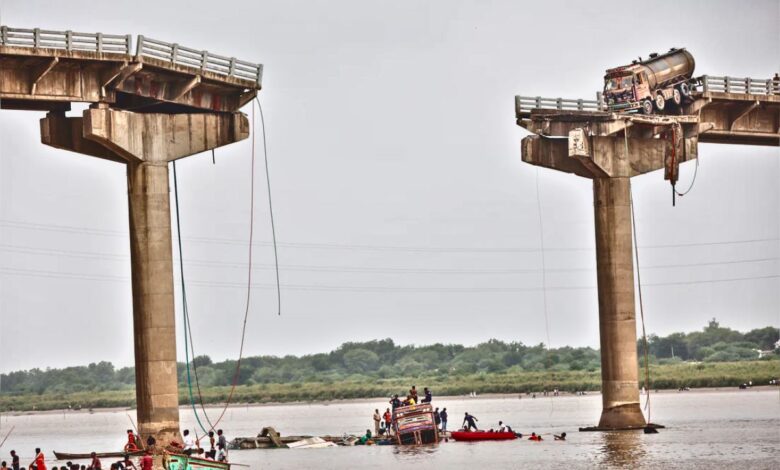
Imagine you’re driving home with your family in Gujarat. The road ahead is smooth, and you cross a tall, majestic bridge over a swollen river. Suddenly, the concrete gives way under your wheels. You plunge hundreds of feet into the raging water. You manage to crawl out of the wreckage, only to realize your father, the man at the wheel, is gone. And this is not any story, this is a real accident from Gujarat!
In the chaos, frantic bystanders rescue you and treat your wounds. But while you and your family are in shambles, the system above simply moves on. There are no thunderous apologies from officials, no immediate resignations. Instead, the only choices offered to you are grief and the grueling task of arranging last rites for your loved ones and for a broken infrastructure. Tragically, this is not fiction. In July 2025, 35-year-old Sonalben Padhiyar screamed for help as her van plunged into the Mahisagar river; by the time rescuers arrived, her husband and two young children had drowned. Her anguished cries were echoed by thousands across Gujarat, but the only response was condolences and ex-gratia cheques.
This 40-year-old slab bridge failed under routine traffic despite repeated warnings. The Gambhira bridge in Vadodara, over the Mahisagar River, was 43 years old and infamous among locals for its perilous state. Residents had pleaded with authorities for years that the bridge “shook violently” as trucks passed and needed urgent repairs.
In 2022 villagers even demanded the load be restricted. But little was done besides a few patch-up repairs. So, in a single instant on July 9, 2025, the bridge slab buckled. Multiple vehicles, two trucks, a Bolero SUV, an auto-rickshaw, and more fell 15–20 meters into the river. Local fire crews and villagers mounted rescue operations, pulling survivors from the water, but 13 lives were lost (later official counts rose to 15–17). Little Ganpat Solanki, one rescued driver, recounted how “the truck suddenly began shaking violently before I could grasp what was happening, the bridge collapsed and I plunged into the river”. Scenes like these have become chillingly familiar.

Major Gujarat Bridge Failures (2015–2025)
- Morbi Suspension Bridge, Machchhu River (Oct 30, 2022): A 143-year-old suspension bridge in Morbi collapsed minutes after reopening following repairs, killing 135–141 people (mostly visitors on Diwali). Investigations later revealed shoddy renovation and overcrowding well beyond its 125-person capacity.
- Halvad River Bridge, Morbi (Aug 26, 2024): A brand-new concrete span built just a year earlier collapsed during heavy rains. Thankfully no one was on it at the time, but the episode exposed poor construction quality in a bridge supposedly fit to open Gujarat’s biggest power plant.
- Janada Bridge, Patlia River (Botad, Monsoon 2023): A rural bridge barely 3 years old buckled under monsoon floods. Again, there were no fatalities, but villagers were stranded and public anger soared.
- Palanpur Metro Flyover (Oct 23, 2023): Two girders of an under-construction overbridge in northern Gujarat collapsed during work, killing 1 construction worker and injuring 2. This illustrated even new engineering works weren’t safe without vigilance.
- Hatkeshwar Flyover, Ahmedabad (2017–2022): Built in 2017 to “last 100 years,” it was declared structurally unsound within 5 years. The AMC eventually floated tenders to demolish this million-crore project—an embarrassment that made headlines.
- Mumtapura Flyover, Ahmedabad (Dec 21, 2021): A section of the newly built Mumtapura flyover caved in during construction. Fortunately there were no deaths, but it underscored reckless work by contractors.
- Ambedkar Bridge, Mehsana (Feb 14, 2024): A 10-year-old span sunk into the ground after heavy rains, again without loss of life. Locals had repeatedly complained about structural issues in the 2014-built bridge.
- Bamangam–Parij Bridge, Kheda (Oct 4, 2023): This small link between two villages collapsed with a loud crash. Villagers had begged authorities to repair it for years; miraculously it happened with no one on it.
- Dhandhusar Bridge, Uben River (Junagadh, 2023): A 45-year-old rural bridge partly caved during rains, cutting off five villages.
- Khari River Bridge, Mehsana (2020): One side of this bypass bridge sank into marshy soil after just a few years. No collapse, but it shows countless bridges had been quietly failing, waiting to happen.
Each of these incidents, whether fatal or narrowly avoided, tells the same story:
Gujarat’s bridges, old and new, are crumbling.
In many cases, officials knew of the danger. For example, a local Panchayat member in Vadodara said villagers “had been raising this bridge issue that the bridge shook violently. They had asked to reduce the traffic load. But nothing was done”. Such warnings were ignored repeatedly. Instead of acting, authorities often simply apply one more layer of tar or repaint iron bars as if band-aids cure broken bones.
Infrastructure on the Edge
The pattern is nationwide, but Gujarat has become a grim poster child. A 2020 study found 2,130 bridges collapsed in India between 1977–2017, mostly due to floods and quakes (80%), but 10% were due to material deterioration. Even routine wear and tear is now causing disasters.

In just the last five years (2019–2024) the government admits 42 major and minor bridges have given way, and 21 of those were on national highways or still under construction. This is not a statistical anomaly but a symptom: India’s bridge stock is ageing dangerously. In Gujarat, many spans date from the 1970s–1980s. The Gambhira bridge itself was built in 1985 and had long outlived its design life. The Highways Ministry study notes bridges older than their planned lifespan require urgent replacement, yet funding and modernization lag.
It is often said these are “acts of God,” but natural forces only delivered the final blow. The real failure lies in human neglect. For instance, the Morbi suspension was “recently renovated,” yet investigators found that steel cables were only painted, not replaced. In Ahmedabad a new concrete flyover cracked before opening. Even robust-looking river spans like Halvad and Janada buckled under normal rain. Clearly, in the last decade Gujarat’s bridge safety has deteriorated drastically, both because aging structures were left to rot and because new ones were built carelessly or with shoddy materials.
Government Response: Rituals Over Reform
Predictably, each collapse has followed a press-release script. Within hours of the Gambhira disaster, Prime Minister Narendra Modi was on Twitter expressing that the loss was “deeply saddening” and offering condolences. The state’s chief minister pledged relief for survivors. Large ex-gratia cheques were announced (Rs.4 lakh by Gujarat, Rs.2 lakh by the Centre per victim). A high-level technical committee was formed to “investigate causes”. All very procedural.
But ask yourself: when was the last time a politician quit over such a catastrophe? In India’s political theater, no one resigns. As former finance minister P. Chidambaram wrote after Morbi, “no one apologised, no one offered to resign and in all likelihood no one will be held accountable and punished”. After every tragedy, we hear calls for audits and safety reviews, but precious little structural reform follows. Gujarat’s own High Court flatly demanded in 2023 that the government draft a bridge maintenance policy, asking who would be held responsible if another disaster struck. Yet today, even after multiple collapses, such a policy is nowhere in evidence.
Meanwhile, political parties engage in their familiar blame game. The opposition Congress was quick to declare that warnings went unheeded and declare the collapse a “disaster waiting to happen”. Congress president Mallikarjun Kharge thundered that the BJP-led state (and by extension the Centre) had “crossed all limits of indifference”, decrying a “leadership crisis, rampant corruption and incompetence” behind every crash. He noted that 7 major bridge failures have occurred in Gujarat since 2021.
At the same time, BJP spokesmen shrugged and blamed “heavy rains” or the contractor. The truth is, whoever sits in Gandhinagar or Delhi, they prefer public relations to public safety. As one PTI report wryly put it, our leaders seem “busy only in making speeches and issuing advertisements in the name of ‘governance’”. The biggest irony: our elected officials call themselves “non-biological” entities who feel no pain, no guilt. “No one ever resigns,” goes a cynical joke because governments are “utterly spiritual,” unaccountable to mortal tragedies.
When Will the System Wake Up?
For the common man, bridge collapses mean devastating loss and lasting hardship. Families mourn loved ones, villages lose connectivity, and commuters are forced onto detours. After the Gambhira collapse, it was reported that the only remaining route from South Gujarat to Saurashtra would add 50 km to everyone’s journey. Truckers, farmers and schoolchildren alike now face traffic jams at Vasad toll plazas instead of a quick shortcut. Boats and rescue crews retrieving bodies rake up rivers of grief, but the real debris is administrative: ignored memos, unfilled audit reports, and a culture of “talk, no action.”
Experts argue that under our laws, states have a duty to keep bridges safe. As one Indian Express columnist reminded readers, “Under our Constitution, the life of every citizen must be protected by the state.” When it fails, governance is reduced to “a mere paper exercise”.
In fact, the doctrine of res ipsa loquitur (the thing speaks for itself) should apply: if a state-managed bridge collapses, the presumption is negligence unless proven otherwise. Yet in Gujarat, and India generally, no official has been punished for these deaths. The Morbi case saw contractors and managers detained, but no politician or engineer lost their post. After Morbi, Gujarat’s CM and ministers called it “an act of God” in private, but paid the victims only with words.

This cycle of catastrophe must end. When will citizens demand final accountability? Perhaps when it becomes impossible to accept anymore that government blames destiny while people keep dying. As one angry editorial asked: why should officers escape liability for “criminal negligence” when factories kill workers? Gujarat’s courts, activists, and families can remind us: this is the very reason we elect public servants. If not to preserve life and safety, then why do they govern at all? Until systemic overhauls, mandatory audits, transparency in tenders, real-time maintenance, and stiff penalties for dereliction, the bridges will continue to crumble. And with each collapse, the only things we’ll hold last rites for are victims and the pretense of accountability.