We Live In A Country Where Faith Comes Before Facts. How Are We Going To Compete In The Global AI Race With This Attitude?
Even as Indian engineers write world-class code, our national curriculum and politics seem to be stuck on autoplay with ancient tunes. We proudly brag that our youth are top coders, yet we systematically strip science and logic from the classroom. In recent years education has become a battleground where textbooks are “poisoned” with ideology, schools shut down for religious events, and student diets consist more of dogma than data. This bizarre collision, with technologists who can write the next great AI app, but allege that “no one saw an ape turning into a man”, is not just satire; it’s our reality. How will a nation that teaches its children to worship code by day and pray by night ever compete in the global AI race? The situation is grim: our fundamentalism-driven policies are choking innovation and hollowing out rational thought.

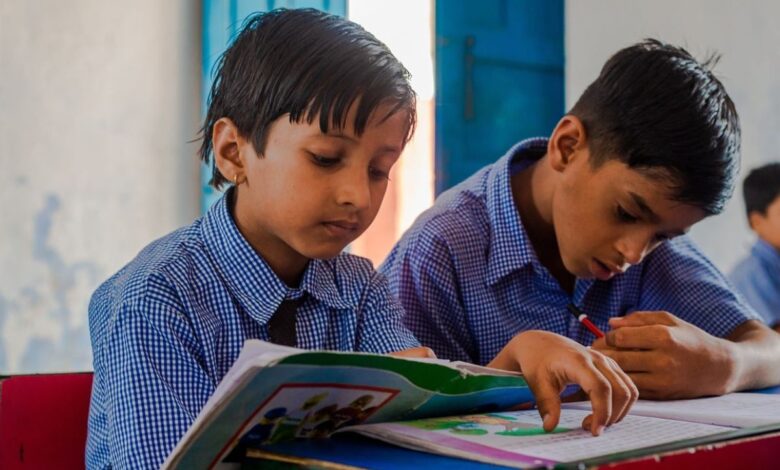
Education Under Siege by Politics and Piety
India’s classrooms have become collateral in political and religious turf wars. In July 2025, for example, Haryana’s Nuh district, long a flashpoint between Hindu pilgrims and local Muslim communities, was placed on “high alert” for a religious procession. Authorities suspended all mobile internet and SMS in the entire district for 24 hours and closed every school (government and private) for the day. The official rationale was fear of “inflammatory content and rumours” leading to violence. In other words, security concerns around a centuries-old faith ritual routinely snuff out modern education. The image of schoolchildren barred from campus so adults can carry holy water in a pilgrimage is grotesque: sacred events taking priority over science exams.
Shutting down the internet is common too. In recent years the government has ordered scores of communication blackouts across India, ostensibly to “maintain public order”, that directly sabotage learning. Human Rights Watch notes India imposed “54 cases to prevent or in response to protests, 37 to prevent cheating in school examinations”. These shutdowns are indiscriminate: they corrode free speech and collective rights, turning citizens into “suspect” witnesses. Academics warn that cutting access to broadband is effectively banning the right to education.
One UN rapporteur observed that Internet blackouts “often have a severe impact on the right to education, impeding learners in accessing online education, taking online exams or applying online for scholarships.” During the recent farmers’ protests, for instance, thousands of students like 19-year-old Krishna Kumari found themselves suddenly offline and unable to study: “When the government shut down the internet during farmers’ protests in 2021, we had no means of studying,” she told. Gone were lecture videos, online tutorials, and even simple WhatsApp study groups that had become lifelines during Covid lockdowns.
The irony is devastating: just as the rest of the world plugs teachers’ smartphones and students’ tablets into the AI grid, India regularly cuts that lifeline. Our “Digital India” mantra turns to digital disconnect every time nerves fray. In fact, it was found that the same BJP government that “assiduously pursued” nationwide connectivity is undermining its own goals by throttling the net. Even bank transactions and ration cards now need internet, yet educational connectivity is snuffed out whenever the authorities feel itchy. Students are left offline in a digital era, buffaloed by politicians more eager to deploy prayer meetings than satellite links.

Curriculum Hijacked: Pseudoscience Over Proven Science and Facts
The siege extends into what we actually teach. Across textbooks and syllabi, empirical learning is being shaved away in favor of ideology. By April 2023 it was widely reported that the Union government had quietly purged evolution from Class 9 and 10 science. As Al Jazeera notes, Darwin’s theory “was quietly removed from the examination syllabus for the students of Class 9 and Class 10; by 2022-2023, the topic of evolution was completely purged from school textbooks”.
In one fell swoop, millions of children will grow up “not know who Darwin was or what his theory says” unless they pursue science very late. This isn’t accidental; it follows a 2018 pronouncement by a government minister that Darwin was “scientifically wrong” and humans have always been humans, not descended from apes. Historian S. Irfan Habib chillingly sums up the effect: “The current government is assaulting the ethos of India by poisoning the school curriculum.” Ask ten high-schoolers whether evolution is true, and many have no clue why their species exists beyond handed-down myth.
Other history lessons have similarly been sanitized. In the rush to rewrite our past, countless chapters are being chopped. As The Washington Post reports, even chapters on the Mughal emperors, who built the Taj Mahal and reigned for centuries, have vanished from new textbooks. The million-dollar stone of Agra will still stand, but students won’t hear in class who built it or why.
Chapters on India’s caste cruelties and the 2002 Gujarat riots have also been scrubbed. Details like the brief post-independence ban on the RSS after Mahatma Gandhi’s assassination have been pulled out, along with any mention that “Hindu extremists” plotted to kill Gandhi. The net effect is staggering: kids learn the word “Taj Mahal” without any context, clueless that the country around it was once a pluralistic cauldron. Social media memes have lampooned this absurd rewriting — one joked the Taj was now “built by aliens” in the sanitized textbooks — yet the truth is no joke.

A cartoon quip on Darwin’s theory can be- “There’s also my theory that we all come from a bad dream I’m having.” India’s curriculum edits aren’t subtle. By 2023, NCERT and other boards systematically cut references to Muslim rulers (Mughals and Sultans), denying that a major portion of Indian history ever happened. The tender ages that should study factual evidence in science and society are instead left with holes and holy texts. The students lose their birthright to rationalism and inherit myths. One commentator fears this isn’t mere “streamlining” for pandemic-era workload; it’s a concerted “Hindu-izing” of textbooks. In effect, India is turning back the intellectual clock in classrooms, replacing context and curiosity with a one-sided folklore.
Worse still, modern subjects are tainted by superstition. As the Economic Times observes, India’s great coders are increasingly comfortable pushing their faith into tech policy. Financial educator Akshat Shrivastava warns that “certain old societal trends, reflecting a lack of scientific temperament”. He points to the “growing acceptance of pseudoscience, gambling, and astrology” as “signs of regression rather than progress”.
At a time when countries are debating ethical AI frameworks, India is debating how many planets rule a boy’s horoscope. Political incentives reward such spectacle. Shrivastava notes that “politics often favors short-term populist moves”, such as approving caste-based caste curricula or holding mass religious ceremonies, rather than investing in education and research. The result: the country’s scientific horsepower is constantly veering off track, chasing superstition instead of satellites. Apple or IBM become punchlines for superstition-promoting politicians.
Global Comparisons: Watching Our Rivals Zoom Ahead
Meanwhile abroad, rivals run full-throttle. China’s government has muscled AI into every classroom by mandate. Starting fall 2025, Beijing’s municipal authorities ordered “at least eight class hours of AI instruction per academic year” in every primary and secondary school. Even six-year-olds learn basics of algorithms and robotics in experimental courses. The goal is to create generations fluent in machine intelligence — a “teacher-student-machine learning model” says the official plan. This year China’s start-ups have already sent shockwaves through global AI markets. Its homegrown AI labs are launching multi-billion-dollar models to rival ChatGPT.
By contrast, Indian students are greeted by chapters on the Ramayana, not R programming. Where China is issuing national AI syllabi, India is excising Darwin’s chapter. The U.S. is only now grabbing the wake-up horn: a 2024 Executive Order and a 74-page “toolkit” guide schools on incorporating AI. But America is still debating, not mandating. Singapore, South Korea, Finland and Canada have also moved boldly to fold AI education into all levels. South Korea, long a tech powerhouse, has implemented smart homework tutors and aims by 2025 to insert AI coursework at every grade level. In the land of Samsung and Hyundai, AI lectures are becoming as routine as math or English.
India, by contrast, occupies 14th place in the world on AI research contribution. We produce coding graduates by the million, but relatively few PhDs: India has only one-third the number of engineering doctorates of the U.S. or China. We rank third in raw AI paper count (84,000 between 2010–2019), but China’s output was nearly six times larger (472,000) and even the U.S. outproduced us by 3.7 times. On patents and funding the gap is starker: U.S. firms pumped $25 billion into AI in 2019, China about $5 billion, while India scraped barely $1 billion. Wall Street calls, Google labs and Y Combinator bagels are fueling the next AI miracle, but our ministers are busy rededicating schools to Sanskrit prosody.
From San Francisco to Seoul, the message is clear: AI is the new frontier of economic power. Globalists quip that this “AI space race” is our Sputnik moment. Yet India’s leadership still lectures on “Digital India” in one breath and flouts its own principles by shutting the internet every time a ruckus brews. Our comparators are teaching calculus to robotic arms while ours are teaching Vedas.
Pseudoscience & National Destiny
This misalignment between belief and logic isn’t just academic; it eats into democracy and innovation. Think of AI as a virus: civilizations with a strong scientific immune system thrive. Civilizations that led in technology have wielded economic and political power, notes Shrivastava. The pattern is ancient (Mesopotamia, Rome) and modern (Silicon Valley, Shenzhen). Yet in India religion repeatedly trumps reason. Election speeches often invoke gods, not data. Policies on healthcare, education, infrastructure can stall if they collide with a religious agenda. A needless boycott of biotechnology (like fluoridation or genetically-modified crops) or a rash of restrictions on sex education and virus prevention all have roots in dogma.
When public funds go to air-conditioned temples rather than research labs, long-term goals sour. We saw COVID-19 protocols delayed by astrologers’ predictions. We watch start-ups struggle to land venture capital when politicians promise jobs via rallies, not skills. Religious loyalties drive votes; rational, long-range planning takes a backseat. The Economic Times article mentioning Akshat Shrivastava nails it: “economics rewards forward-looking, tech-driven planning, [but] politics often favors short-term populist moves that do not align with long-term innovation goals”. Thus we applaud a rocket launch on TV while dismantling the science curriculum.
Paradoxically, the very fabric of democracy is fraying as reason is cast aside. India’s Constitution promises scientific temper and free speech, yet we muzzle both under the pretext of “hate” laws or “security” crackdowns. Thousands of Kashmiri children lost years of schooling under a prolonged internet blackout. Across the country, students lose their lunch stipend if the net goes down. The only winners: rumor-mongers and dogmatists. A trade union leader rightly asks, “The internet is important to the work I do… So, if they shut down the internet, it prevents us from communicating effectively.”. Replace “work” with “school” and it’s the same story. Scholarly freedom becomes impossible when dissent is demonized and global ideas are stopped at the border.
The Cost of Going Offside
What do we gain by this drift away from reason? Perhaps short-lived political cheers and the comfort of tradition, but the cost is existential. Our democracy thrives on debate and innovation; instead it is hijacked by incendiary processions and textbook politics. Young minds see idols before atoms, hearsay before hypothesis. It is hard to dream of launching satellites if our dreams are still interpreted by priests.
Meanwhile, other nations seize the lead in AI’s global treadmill. If the race to technological supremacy is indeed the fourth industrial revolution, India is kneecapped. Without a reinvigorated emphasis on science and critical thinking, we risk becoming a backwater of superstition in the Information Age. The “Digital India” slogan rings hollow when the digital highway is chained shut. The “New India” of 2047 can only arise if we choose education and inquiry over enchantment and ignorance. Until then, every step forward in IIT halls is matched by two steps back in syllabus halls.

The evidence is grim: censorship of history, censorship of cyberspace, censorship of curiosity. The Economist-tracked surveys show India slipping behind on innovation indices even as domestic piety indices soar. As one historian warns, our leaders are waging a war on rational education in order to convert schoolchildren into believers. In both India and abroad, some have recognized this pattern: “the right wing in India do not want critical-thinking, rational-thinking, progressive students,” chides Utathya Chattopadhyaya. By privileging dogma over data, India is educating a generation to trust charlatans over researchers.
It’s an uncomfortable truth: in 2025 the phrase “Techade” rings hollow here. We have the engineers, but not the environment. We have the IDEs (integrated development environments), but lack the scientific environment those engineers need. Our Republic was founded on values of liberty, equality and fraternity; none of which flourish under a syllabus of half-truths and superstition. If this persists, India will not just fall behind in AI; it will forfeit the very foundations of modern democracy.