Loot On The Pretext Of Ladki Bahin Yojna?
Maharashtra’s Ladki Bahin Scheme: A Wasting Scandal in the Name of Welfare

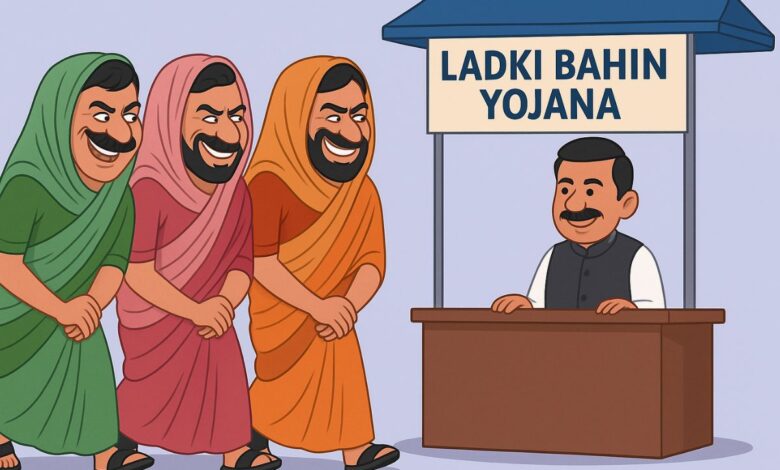
In August 2024, Maharashtra’s new Mukhyamantri Majhi Ladki Bahin Yojana, a scheme promising ₹1,500 per month to poor women was launched amid great fanfare. It was billed as an election-year gift to underprivileged daughters and sisters. But within months, a state audit uncovered shocking fraud and mismanagement. Tens of thousands of ineligible recipients had slipped through the cracks, and far from empowering women, the scheme ended up bleeding the exchequer. The revelations are both attacking in their scale and deeply disturbing in their implications.
Launch of the Ladki Bahin Yojana. Recall How The Government officials ceremonially held up a giant “cheque” for the scheme. But despite such grand announcements, a 2025 audit found massive irregularities, including 14,298 men fraudulently claiming benefits meant only for women.
Nearly 10 months after launch, the Women & Child Development department’s audit found that 14,298 men had illegally received Ladki Bahin payouts. These men manipulated the online registration to pose as female beneficiaries, siphoning off ₹21.44 crore of public money. In context, every one of those payments (₹1,500 × 10 months each) went to the wrong people. And that was only the beginning of the waste: by 2025 the scheme’s losses had ballooned to ₹1,640 crore in just its first year due to other blatant abuses.
- Men as “beneficiaries”: 14,298 male applicants fraudulently enrolled as women, pocketing at least ₹21.44 Cr.
- Triple-claims from families: About 7.97 lakh women were enrolled as third family members (only two women per household were allowed). This blatant rule-breach alone cost the state roughly ₹1,196 Cr.
- Over-age recipients: 2.87 lakh beneficiaries were over 65 (the upper age limit), costing about ₹431.7 Cr.
- Wealthy households: 1.62 lakh beneficiaries came from families owning four-wheelers, even though ownership of such assets disqualified applicants.
- Government employees: Over 2,200 Ladki Bahin recipients turned out to be state government employees (their claims were later cancelled).
Every one of these categories violated the scheme’s own rules, and collectively they demonstrate systemic breakdown. In total, 26.34 lakh of the initial applicants were flagged as ineligible after cross-checks; their benefits were promptly frozen in June 2025. (WCD Minister Aditi Tatkare reported that roughly 26.34 lakh bogus applications were identified and suspended.) The scale of this fraud means money was paid out to people who didn’t need it, while the truly poor were effectively cheated.
The figures are laid out starkly below for Ladki Bahin Yojana:
| Irregularity | Count (approx.) | Loss to Exchequer (₹ crore) |
| Men fraudulently enrolled as women | 14,298 | 21.44 |
| Third-women claims in families | 7,97,000 | 1,196 |
| Beneficiaries above age 65 | 2,87,000 | 431.7 |
| Families with 4-wheelers (ineligible) | 1,62,000 | ~243 (est.) |
| State govt. employees | ~2,200 | (cancelled) |
Each of these failures represents either gross negligence or deliberate graft. Critics are aghast that a program “launched to help poor women” could be so brazenly hijacked. Deputy Chief Minister Ajit Pawar (NCP), who is in charge of social welfare, admitted the outrage: “There is absolutely no reason why men should be [beneficiaries]. We will recover the money given to them. If they do not cooperate, further action will be taken,” he told reporters. In July 2025, Pawar said thousands of fraudulent beneficiaries had already been identified and funds recovery was under way.
Yet even as officials scramble to plug the leaks, questions about accountability grow louder. Opposition leaders demand probes and blame the ruling alliance. NCP MP Supriya Sule, herself the daughter of late Maharashtra chief minister Sharad Pawar, publicly charged that a “bigger conspiracy” lay behind the lapses. She asked, “Which company was given the contract for registrations?” and demanded an SIT/ED investigation. Some contractors have already complained that ₹1 lakh crore worth of infrastructure projects remain unpaid, allegedly because funds were siphoned to pay Ladki Bahin stipends. (That money could have finished roads, schools and hospitals.) Even seasoned voters were shocked: how could so many wrong people get in? How can the government explain hundreds of millions wasted?
The political fallout is severe. The Mahayuti coalition (BJP-led government with Eknath Shinde’s Shiv Sena faction and Deputy CM Ajit Pawar’s NCP) had touted Ladki Bahin as a vote-winning scheme. Union Minister Ramdas Athawale (Republican Party of India) later praised it as the “kingpin” of the alliance’s victory in 2024. But now critics say the scheme’s very success was its undoing: it attracted slack oversight and became a cash bonanza for insiders.
For example, transport minister Pratap Sarnaik warned that MSRTC buses lose ₹3 crore a day under the new concessions for women and seniors; yet Deputy CM Shinde flatly refuses to cut any freebies, Ladki Bahin included. This exemplifies the “freebie trap” that experts have long warned about: pledges made for votes can swell debt and encourage corruption.
Indeed, even the courts have taken note. In August 2024 the Supreme Court chided Maharashtra for having “funds for freebies” like schemes to help women and unemployed youth but not for paying court-ordered compensation. And in early 2025, a PIL in the Bombay High Court called Ladki Bahin a “politically motivated freebie” that might bankrupt the state. The government’s reply defended the scheme as constitutional welfare targeting anaemic or jobless women, but hindsight is unforgiving: millions were improperly paid, and the state’s books are suffering for it. Even an analysis noted that the scheme’s ₹46,000 crore annual cost (over 1% of GDP) has already dragged Maharashtra’s debt higher.
Yet despite this wastage in public funds, details on who is technically responsible remain murky. The online registrations ran through the Aaple Sarkar portal (MahaOnline), but the IT firm or contractors hired to process applications have not been publicly named. No politician has yet owned up to wrongdoing. (A cynical voter might ask whether any absentee “hand” steered money toward loyal constituencies.)
Supriya Sule’s demand to find “which company was given the contract” underlines that suspicion. So far, the government’s stance has been defensive: it emphasizes technical glitches and bureaucracy (“data issues,” “duplication” of schemes, etc.) rather than malfeasance. Even legislative allies have crossed swords; for instance, Union ministers have accused the opposition of politicizing the issue, and state spokespeople insist strict eligibility checks will follow.
Yet the facts are chilling. A government-approved beneficiary list from early 2025 still spanned 2.25 crore women nationwide; meaning nearly all eligible stipend payments were made, even as a quarter-million rupees per household drained away in fraud. Each fraudulent payment meant one poor woman got nothing. The scheme’s secrecy around data feeds and enrollment algorithms only feeds conspiracies. The government says technical audits are underway, but it has no easy answers for why 14,000 men and thousands of unqualified women breezed through.
The fact underscores the negligence: each “culprit” row is a known rule broken. The cumulative damage, over ₹1,640 crore, far exceeds the annual budget for many vital programs. In a state already grappling with a projected ₹9+ lakh crore debt and a widening revenue shortfall, such wastage is disastrous.
Politicians from all sides are now scapegoating each other. Opposition legislators accuse the ruling BJP–Shinde Sena–NCP alliance of deliberate corruption, and promise to make voters pay at the polls. Governing party leaders retort that they are the ones who found and froze the fraud, while the opposition is playing politics. High-profile cabinet members have ordered internal reviews and audits, and a special drive to remove unauthorized beneficiaries. Yet no private contractor has been held to account; only a handful of clerks or bankers (and the hapless fake claimants) facing action so far.
The human cost is equally stark as this was meant to be a women’s empowerment program. Instead, thousands of deserving women saw their names vanish from approved rolls, or their payments delayed, while bureaucratic scandals raged around them. Many rural women waited in lines at banks or post offices (as news reports showed) hoping to receive their modest ₹1,500, only to be told later that their names didn’t exist or had been “suspended”. In effect, honest beneficiaries have been punished for the government’s failures, prompting accusations that the truly poor have once again been cheated by those in power.

In sum, the Ladki Bahin saga is a stinging lesson in governance. A scheme launched with glossy PR has devolved into a cautionary tale: ring-fenced welfare funds can be diverted, and without rigorous checks, even the noblest programs collapse. The evidence suggests at best gross mismanagement and at worst cynical patronage. Whoever is to blame, the political fallout is real.
Demands for accountability are growing louder; from news media, civil society activists, and even the Supreme Court. Voters will judge those who promised relief but delivered scandal. Unless full transparency and justice follow, Maharashtra’s Ladki Bahin will go down in infamy as a massive fraud against the very women it was meant to serve. The guilty must face scrutiny and the state must tighten every loophole, or lose its own credibility and future.