Eduquity: Why The Government Is Allowing The Persistent Presence Of A Blacklisted Company In India’s Examination System?


In India, there are plenty of youngsters competing for a limited number of government posts, and therefore, the integrity of the exam process is absolutely paramount. These exams are seen as the passport to a secure future and involve dreams, years of preparations, and substantial personal sacrifices. Yet the mechanism that is meant to ensure these exams are kept fair is failing.
This is clear from the repeat appointment of Eduquity Career Technologies Pvt Ltd, a Bengaluru firm with a dubious past history of exam problems, to conduct important tests like the Staff Selection Commission (SSC) Phase-13 exam in 2025. We here now analyse Eduquity’s dubious record, the government failures that let such a firm operate, and the dire implications for India’s students, whose futures are being jeopardized.

Let’s Start With Eduquity’s Rocky Past
Eduquity was founded by Ramachandra Dhirendra and Visweswar Akella in 2000. It is a pioneer in India’s online testing market and claims to have assisted more than 100 million candidates in taking exams in government, education, and business. Its website boasts a “zero failure rate” and claims to be efficient at handling large, significant exams. But if you dig deeper, you can see numerous failures that have damaged people’s faith in its capability.
2022 Madhya Pradesh Teacher Eligibility Test (MP-TET) Leak
In March 2022, Eduquity was contracted to conduct the Madhya Pradesh Teacher Eligibility Test (MP-TET) for Class-3 teachers. This test is extremely crucial for individuals who aspire to become teachers, but the test suffered a major setback when screenshots of the question paper were widely shared on social media just days prior to the test.
According to a report by Dainik Bhaskar, Eduquity had outsourced the task of conducting the test to a Rajasthan-based company named Sai Educare Private Ltd, making people doubt their control and responsibility. The leak invited a lot of outrage, with some labeling it “Vyapam-3,” drawing a comparison to the infamous Vyapam scam that hit job recruitment in Madhya Pradesh. This incident proved that Eduquity failed to perform its duty of making the exam materials secure, which is extremely critical for any testing agency.
2023 Madhya Pradesh Patwari Scandal
In the following year, Eduquity was entrusted with conducting the Madhya Pradesh Patwari recruitment test for over 8,900 posts in the Group-2, Sub-Group-4 Combined Recruitment Test 2022. The test was held between March 15 and April 26, 2023, and saw 9.74 lakh candidates apply. But when the results were released on June 30, 2023, there were cheating reports. In a report by Newslaundry, seven out of the top ten candidates took the test at the NRI College of Engineering in Gwalior, owned by BJP MLA Sanjeev Kumar Kushwaha, sparking allegations of cheating.
Further investigation indicated that at least 30 candidates misrepresented disabilities in order to get special quotas, and 217 candidates did not satisfy age requirements. The incident led then-Chief Minister Shivraj Singh Chouhan to stop appointments and call for a judicial inquiry headed by retired High Court Justice Rajendra Kumar Verma, with the report due by August 31, 2023. The exact findings of the inquiry are not for the public to know, but the incident served to prove that Eduquity could not keep the test fair.
2024 Maharashtra MBA CET Technology Issues
In 2024, Maharashtra’s Common Entrance Test (CET) Cell appointed Eduquity to conduct the MAH MBA CET, an MBA and MMS course entrance test. Information regarding a “collapse” is not available, but reports in 2023 indicate technical issues in the MBA CET, such as server crashes and timer malfunctions that affected students.
A report by Free Press Journal on March 26, 2023, indicated that students experienced issues such as blank screens and premature termination of tests, resulting in re-examination demands. While the 2024 test was conducted on April 1-3, 2025, without cancellation, the absence of clear information regarding Eduquity’s performance raises continuing questions regarding its dependability with technology. A suit in the Bombay High Court, according to the user’s question, indicates dissatisfied students, but exact outcomes are not evident.
2025 SSC Phase-13 Exam Cancelled
The latest incident happened in 2025 during the SSC Phase-13 exam, a national exam for government jobs. Eduquity won the contract over competitors like TCS because they offered a lesser price of ₹220 per student as opposed to TCS’s ₹350. Eduquity did not have a significant problem when the exam got canceled due to a technical glitch.
Candidates traveled 400-800 km at their own cost to reach the exam centers only to be faced with abrupt cancellation notices on notice boards. No prior text messages or emails were sent, and helpline numbers were not answered, as people grumbled on social media like Reddit. The improper communication and confusing rescheduling plans left students in the dark, fueling their ire and questioning Eduquity’s operational gaps.
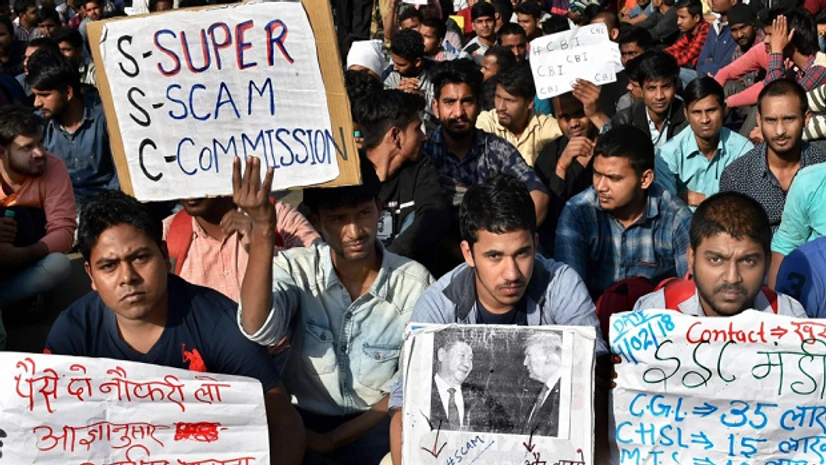
Eduquity’s success in securing contracts, given its history, is suspect due to blacklisting claims. This February 12, 2025, Times of India article covers a petition by Asif Ali, which claims Eduquity was blacklisted by the central government and most of the states, including Assam, Meghalaya, Nagaland, Arunachal Pradesh, Jammu & Kashmir, and Gujarat. But a July 8, 2024, Newslaundry article correction states that Eduquity was not blacklisted by the Central Directorate General of Training (DGT) in 2020 but was actually marked as ineligible and not officially blacklisted. The distinction raises questions about how much Eduquity was actually blacklisted, but the repeated accusation by several states and exams suggests there could be larger issues.
Bureaucratic Failures: A System Which Permits Poor Performance
The repeated selection of Eduquity is a symptom of a larger issue in India’s government administration. The contracting process for tests tends to select the lowest bidder, such as Eduquity’s ₹220 per student offer for the SSC Phase-13 test. This emphasis on price disregards past performance, so that poorly performing companies can return. One Reddit user, Nishant Singh, 28 years old in Lucknow, commented on his outrage: “I don’t know why a blacklisted firm is given a tender again. Who are the individuals giving these tenders out? A blacklisted firm cannot receive a tender without some malpractice.”
The absence of a clear, readable database of blacklisted companies makes the issue worse. A few states, such as Uttar Pradesh and Assam, have blacklists of companies, but no central system exists to ensure that a company blacklisted in one state cannot operate in another. Eduquity and other companies exploit this loophole to keep getting contracts despite past failures. Unless severe penalties, such as long bans or fines are imposed, companies have little to worry about while students suffer the consequences.
The Human Cost: The Students Left in the Lurch
For young people in India, competitive tests like the SSC, MP-TET, and Patwari exams are vitally important; they are a chance for improved employment and a superior life. Cancellation of the SSC Phase-13 exam for one, for example, impacted many candidates who spent time, money, and emotional capital studying. Some traveled to another state, spending money they could not really afford, only to be told nothing by the authorities. A July 24, 2025, Reddit entry by user priyanshu_inn reported their experience: “Reached the center 2 hrs ago, paper was from 1:30 and entry from 12:30 the paper was delayed by 1 hr. At 2:30, we were told it’s canceled.”
Such events happen with regularity. In 2023, Bhopal students demonstrated against the Patwari exam leak, calling for a fair probe. In 2022, the MP-TET leak made potential teachers wonder about the integrity of the system. Such events can stall careers for years, forcing candidates to redo studies or lose their dreams. The psychological cost is very high, with students like Sanchit Sharma, a 29-year-old candidate, calling paper leaks and cancellations “the new normal.“

Eduquity is not the sole company with this problem. Other companies like Aptech Ltd and Edutest Solutions have faced the same allegations but continue to get contracts. Aptech, suspended by the Gauhati High Court and Jammu & Kashmir due to problems, got a contract instead of Eduquity in a 2022 tender, even though Eduquity scored higher in technical appraisals. Edutest, suspended by Uttar Pradesh and Bihar, administered tests for the Council of Scientific and Industrial Research (CSIR) in 2024, even after their managing director was arrested for a cheating scandal. This perpetual issue suggests a failure to make exams fair over price or political influence.
The National Educated Youth Union (NEYU) and other campaigning groups have been demonstrating against Eduquity. They are urging the authorities to reconsider Eduquity’s involvement in high-stakes exams. The solution is to make radical changes:
Tighter Vendor Screening: Establish a national database of blacklisted companies, available to all government bureaus, so repeat offenders cannot be awarded contracts.
Open Tender Procedures: Publish detailed criteria for tender awards, like past performance indicators, to ensure accountability.
Prioritize Reliability Over Cost: Place more emphasis on technical competence and expertise than on cost in tender assessments.
Improved Communication: Offer timely communication to candidates regarding changes in examinations to minimize disruption.
Permanent Bans for Repeat Offenders: Place long-term or permanent bans upon companies that continuously commit mistakes to prevent negligence.
At the end…
The Eduquity case illustrates the issues in India’s testing system. A company that has been infamous for paper leaks, technical problems, and reported blacklisting continues to conduct tests that affect the lives of many students. This is not an isolated issue with one company; it illustrates a system more concerned about saving money than doing something extraordinary in what it does, at the expense of students. As India attempts to stand up for its youth, it must address these recurring issues to ensure that students’ aspirations are not dashed by preventable errors. The time to change is now, before yet another test fails and yet another cohort of students are left waiting.