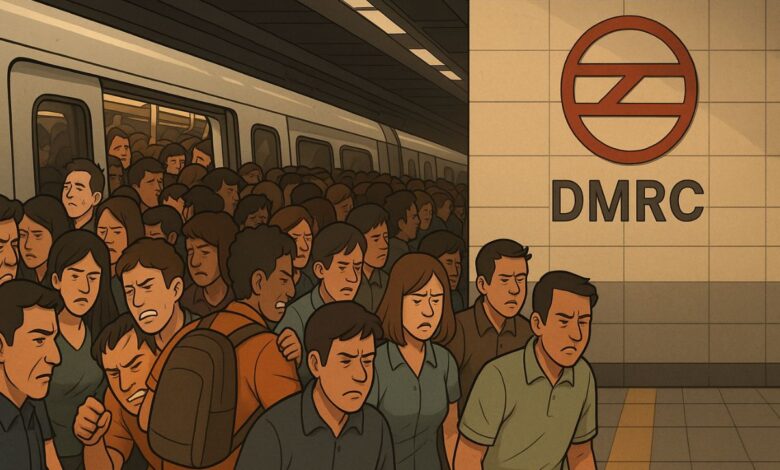
Delhi’s metro system, usually hailed as a lifeline for “Delhities”, has recently seen alarming crowd surges that raise the question revolving around that “could a disaster akin to a stampede be looming?” The concern isn’t unfounded. Early this year, a crowd crush at New Delhi Railway Station, outside the metro system, tragically claimed 18 lives. That February 2025 railway stampede jolted public consciousness and put a spotlight on overcrowding dangers in public transit.
Now, Delhi Metro riders are increasingly worried that similar conditions in the metro like packed platforms, stalled trains, festival rushes might turn commuter hubs into grounds for chaos. Multiple “stampede-like” incidents within the metro network in 2025 have heightened these fears, and many are asking whether enough is being done to prevent a catastrophe.
Can We Ask what the Delhi Metro Rail Corporation (DMRC) and authorities are doing, in coordination with the government, to manage the swelling crowds and avert disaster?
Below is the list of overcrowding incidents of the past few years, how officials responded, and what measures are underway to ensure the Metro doesn’t turn into another stampede flashpoint.
A Year of Near Misses: Stampede-Like Incidents in 2025
2025 has seen multiple crowd crises in the Delhi Metro, each offering a glimpse of how quickly a routine commute can descend into mayhem. From technical glitches to festival rushes and even unfounded rumors, various triggers have led to sudden surges of passengers and chaotic scenes reminiscent of stampedes. Passengers have shared harrowing accounts of being stuck in unmoving throngs, fearing that a single spark, a fall, a shove, a panic could have led to tragedy. Below we recount some of the most notable incidents this year across the metro network:
February 2025: Late-Night Festival Rush at Jama Masjid Station
One of the first major scares of 2025 unfolded on February 13 at Jama Masjid station on the Violet Line. It was late evening on Shab-e-Barat, an Islamic holy night, and large crowds had gathered in Old Delhi. As festivities wound down, a wave of devotees poured into the Jama Masjid Metro station, all eager to head home around the same time. The sudden influx of riders overwhelmed the station’s exit points. In a scene captured on a viral video, dozens of commuters resorted to jumping over the Automated Fare Collection (AFC) gates to escape the bottleneck. Shaky footage shows people vaulting turnstiles amid cheers and commotion.
What exactly happened? According to officials, two trains arrived back-to-back around 11:15 PM, unloading a combined crowd swollen by Shab-e-Barat returnees. To make matters worse, the exit gates malfunctioned at that critical moment, causing an impasse at the turnstiles. A Central Industrial Security Force (CISF) report later noted the station controller opened a side gate to relieve pressure, but some impatient passengers still climbed over the stalled exit gates while shouting in alarm. For a few minutes, order broke down, a stampede-like scenario in the making.
Officials were quick to downplay the incident. The very next day, DMRC’s spokesperson Anuj Dayal clarified that it was a “momentary reaction” by some commuters to a temporary surge, and that security staff were present and the situation never slipped out of control. No injuries were reported, and metro staff swiftly intervened to guide the crowd. Delhi Police, however, took the matter seriously as an FIR was registered for the Jama Masjid station chaos, treating the gate-jumping as a breach of law and order. The incident, coming on the heels of the deadly railway station stampede, was a sobering reminder of how vulnerable even the metro could be to crowd disasters if multiple factors go wrong at once.

June 2025: Snake Rumor Triggers Panic in a Crowded Coach
If the Jama Masjid episode was a case of overcrowding sparked by external events, another bizarre incident in June showed how panic and misinformation can also create a stampede-like chaos. During the evening rush on June 19, women in a ladies-only coach suddenly began shrieking and scrambling onto seats, trying to get away from something unseen. A rumor had spread that a snake was loose on the train. Within seconds, fear rippled through the coach, passengers clutched their sarees and bags tight, jumping onto benches to avoid an imagined slithering menace. A viral video of the scene shows pandemonium in the crowded compartment, with no snake actually visible.
It turned out to be a false alarm, likely a small lizard mistaken for a snake, according to one account, but the mass hysteria was real. Commuters later commented online that such panic, even over a rumor, “isn’t funny. Panic like this can cause people to get hurt,” highlighting how a sudden fright in a packed space can lead to people trampling or pushing one another. Thankfully, in this case, quick action prevented any injuries.
The train’s operator immediately halted the train at Akshardham Station on the Blue Line, and officials evacuated all passengers safely. Anuj Dayal of DMRC reported that within minutes the train was emptied and sent to the depot for inspection, where indeed no snake was found, only a tiny baby lizard that likely sparked the scare.
Commuters were stranded shoulder-to-shoulder on platforms, an image that raised alarms about stampede-like risks. DMRC commended the alert passenger who pulled the alarm and urged riders to “remain vigilant and report any such concerns to staff” rather than inciting panic. Still, the incident reignited debate about safety preparedness in crowded metro cars. With social media amplifying rumors in real time, experts noted that clear communication from authorities is vital to prevent mass panic. In this case, a potentially dangerous rush was averted by the operator’s calm response. Yet commuters were left rattled, realizing that even a baseless rumor can nearly set off a stampede inside a moving train.
August 2025: Technical Glitch Overwhelms the Yellow Line
Most recently, on August 29, a technical failure on the busy Yellow Line during the morning rush hour led to scenes of massive overcrowding at multiple stations. The snag occurred between Vishwavidyalaya and Central Secretariat, a core stretch through the heart of the city causing trains to run at crawl pace and long delays. Within minutes, the ripple effects were felt across the line as platforms began filling beyond capacity as incoming trains offloaded passengers who found their onward journey stalled.
At major stops like Hauz Khas and Rajiv Chowk, commuters were stranded shoulder-to-shoulder, packed so tightly that breathing room disappeared. Several riders posted startling photos on X of the crowd crush, describing it as “severe overcrowding & stampede-like situations” at metro stations. One image from Hauz Khas showed a sea of bodies on the platform, no space to move, and palpable anxiety in the air.
“I have never seen something like this at Delhi Metro,” one user commented as pictures of the Hauz Khas jam went viral. Hundreds of people were stuck on the concourse and stairs, waiting for trains that in some cases wouldn’t arrive for 20–30 minutes. A commuter noted that a ride from Vishwavidyalaya to GTB Nagar, typically a 3-minute hop took nearly 50 minutes that day.
The inconvenience to thousands of office-goers and students was immense, but more worrying was how precarious the crowd control became. “This is Hauz Khas station right now,” one rider reported online, “if anyone trips here, it could get very bad.” People recalled the New Delhi railway stampede, anxious that one trigger in such packed conditions could lead to a crush.
Delhi Metro authorities did manage to avoid disaster on August 29. By late morning, the DMRC tweeted that the technical issue had been fixed and assured that service was returning to normal, apart from some residual train bunching. Extra staff were deployed at the busiest stations to manage queues. Fortunately, no injuries or medical emergencies occurred during the Yellow Line disruption.
But the incident underscored a stark reality that during peak hours, the margin for error in the metro is very thin. As one daily rider noted, “when trains get delayed even a bit, the stations just start overflowing, it can turn into a stampede if not handled fast.” The Yellow Line snag was a wake-up call, reinforcing the need for robust crowd management every single day, not just during special events.
Everyday Rush-Hour Crush: “A Stampede Can Happen Anytime”
While the above incidents were triggered by specific events, daily overcrowding is a chronic issue that has long had commuters on edge. Many Delhi Metro stations are routinely packed during peak office hours as it conditions that some say are accidents waiting to happen. “There is always a fear of a chaotic situation developing due to the crowding,” one regular passenger observed about the jammed evening scene at Hauz Khas station.

Hauz Khas, an interchange between Yellow and Magenta lines, has become notorious for its swelling crowds and long passageways where streams of commuters intersect. “The platform at Hauz Khas is always very congested and any untoward incident, even a stampede, can happen,” says Shefali Arora, who travels daily to Gurgaon. She and others urge Delhi Metro to take more measures to decongest such choke points.
And it’s not just Hauz Khas. Other key junctions and high-traffic stations see similar crunches. Rajiv Chowk (the interchange of Blue and Yellow lines in Connaught Place) is famed for its crowds. At day’s end, queues often stretch outside the station as security checkpoints struggle to keep up. “In central Delhi, at Udyog Bhawan, Central Secretariat and Rajiv Chowk, queues stretch even outside in the evening when all offices get over at the same time and the security screening cannot quickly clear the flow,” notes Amit Bhatt, a transportation expert.
He adds that even in Gurgaon’s business district, Sikanderpur and Millennium City Centre stations see serpentine queues on weekday mornings. Commuters at stations like Laxmi Nagar and Chandni Chowk report escalators packed three-abreast with people, staircases overflowing, and platforms where one can barely step off the train without being pushed by the crowd. “Last Sunday, I almost couldn’t use the escalator at Chandni Chowk because of the huge number of people,” recalls Satyajeet Khurana, describing a crush even on a weekend.
Inside the trains isn’t much better during rush hour. Coaches are crammed to the doors, leaving “no space to wiggle,” as commuter Aashi Singh puts it. She sometimes lets an overly crowded train go and waits for the next one, or retreats to the women’s coach which is “more manageable space-wise”. Such tactics are small personal coping mechanisms, but they don’t solve the larger issue. The Delhi Metro’s popularity and the strain on its capacity is soaring. On August 8, 2025, the metro recorded its highest ever single-day ridership: 81.8 lakh (8.18 million) journeys.
This broke the previous record of ~78.7 lakh set in late 2024, and on multiple days each month the ridership now peaks well above 70 lakh. Simply put, Delhi’s commuters have come to rely heavily on the Metro, often because other public transport options are inadequate. For context, the city needs an estimated 11,000 buses to meet demand, but only about 7,600 are in service, many of which break down regularly. With buses in short supply or unreliable, more people cram into metro trains, compounding the crowding problem.
Passengers and experts alike are sounding alarms that these daily “crush hour” conditions need urgent attention. Arnav Rastogi, a student commuter, says the status quo is not sustainable. “The frequency of trains should be increased to prevent overcrowding, and other measures should be taken to manage the throngs of passengers”. Many call for better last-mile connectivity and buses to spread out the passenger load.
Others emphasize technology and infrastructure. Amit Bhatt suggests deploying AI-driven crowd management tools and building more spacious station layouts. “If there’s demand for two staircases, build three for smoother flow,” he advises, pointing to Hong Kong and Singapore’s transit systems as examples. There is a clear consensus that without intervention, the metro’s growing crowds could lead to a disaster. As one Reddit user quipped after experiencing a Green Line rush, “it honestly felt like a stampede situation.” That anxiety is increasingly common among Delhi’s metro riders.
Are Authorities Doing Enough? DMRC’s Response and Government Measures
Faced with both specific scare incidents and day-to-day overcrowding, what are the metro authorities doing to prevent a stampede? The Delhi Metro Rail Corporation, in coordination with the Delhi government and central agencies, insists it has taken numerous steps to bolster safety and manage crowds. In fact, DMRC officials say they were already ramping up measures even before the recent incidents, partly in response to ridership hitting new highs.
Delhi Metro’s management claims a proactive approach to crowd control. A senior DMRC official, speaking in March after the railway station tragedy, noted that as the network expands and ridership keeps climbing, they continuously monitor footfall and upgrade infrastructure to handle future demand. This has included remodelling several busy stations like Chandni Chowk, New Delhi, Kashmere Gate, Shahdara, Dilshad Garden, and Gurgaon’s main interchange to improve circulation space. Many stations have seen additional AFC gates installed for smoother entry/exit, expanded concourse areas, and more escalators, lifts, and even moving walkways (“travelators”) to speed up movement. Signage has been improved, and real-time Passenger Information Displays help direct people and prevent bottlenecks in passageways.
Perhaps most critically, DMRC says it is optimizing operations to reduce crowding. Train frequency and capacity have been hiked wherever possible. “In case of any overcrowding, additional or even empty trains are inducted on the affected sections,” the official explained. This was evident during the Raksha Bandhan festival rush, when DMRC ran 92 extra train trips on a single day (August 8, 2025) and another 455 extra trips the next day to accommodate surging crowds.
The metro’s control center keeps tabs on station density, and if one station is overloading, they can dispatch unscheduled trains or bypass certain stops to ease pressure. Real-time updates on social media also aim to alert commuters about delays or crowding so they can plan alternative routes. These efforts, DMRC says, reflect an all-hands-on-deck strategy to prevent the kind of scenario that led to fatalities at the railway station. “We are acting swiftly to prevent a potential disaster,” an official told the Times of India, emphasizing measures from tech upgrades to staffing.
The authorities are also investing in future solutions. In Phase IV of the metro expansion, the DMRC is incorporating artificial intelligence for crowd management. Managing Director Vikas Kumar has discussed plans to use AI-powered CCTV monitoring and facial recognition to automatically detect crowd build-up and deploy controls, even things like digital signage directing flows or regulating entry if a platform is over-saturated. The new lines will also feature Platform Screen Doors (PSDs) at all stations.
PSDs not only prevent accidents on tracks but also help organize boarding by making passengers queue along the doors. This structured lining-up can significantly reduce push-and-shove behavior when trains arrive, as observed in many Asian metros. Furthermore, DMRC has been quietly retrofitting existing interchange hubs with steel railings along platforms to guide passenger movement. By June 2025, 26 of the 29 interchange stations had these railings installed on both up and down platforms. The barriers keep commuters from crowding too close to the edge and encourage orderly lines while waiting. Though less high-tech, this is a practical step to enhance safety at the very stations that see the worst crowding.
Government bodies are in the loop and supportive of these efforts. The Delhi government has publicly acknowledged the crowding issue as part of a broader transit challenge. It told the Supreme Court that it’s working to augment the bus fleet, since the metro alone cannot carry the entire load of commuters. The central government, which co-owns DMRC, has also shown interest in safety upgrades. For instance, funding for Phase IV includes provisions for advanced signaling and control systems, which should allow higher train frequencies and thus less waiting-induced crowd buildup.
After the New Delhi railway station stampede, India’s Railway Minister announced a “complete overhaul” of crowd-control at major rail hubs, introducing measures like color-coded tickets and operational “war rooms” to monitor crowds. While that was for Indian Railways, a similar mindset is informing metro operations. Emergency drills, closer coordination with CISF (which handles metro station security), and better crowd fencing and policing during festivals are being implemented in the metro system as well. Notably, in the Jama Masjid incident, after the FIR, there was a greater police and CISF presence during subsequent festival nights to ensure orderly dispersal of crowds.
From the perspective of Delhi Metro commuters, these steps are welcome but perhaps not fully sufficient. Many riders are unaware of behind-the-scenes upgrades; what they experience is the daily jostle. Some also point out that public etiquette and awareness need improvement. Videos of the Jama Masjid gate-jumping prompted outrage not just at authorities but at the passengers who broke rules. “How dare the passengers break the law in presence of authorities?
It reflects poorly on everyone’s responsibility,” one commentator fumed. DMRC has occasionally run awareness campaigns urging patience and proper use of facilities. But when tempers run high in a delay, or panic strikes, appeals to civic sense often go out the window. This is why many argue that robust engineering and planning, rather than just discipline, must lead the way in crowd management. The metro’s management seems to agree, given their multi-pronged approach of expanding capacity, using tech, and redesigning physical spaces to naturally channel crowds safely.
Vigilance and the Road Ahead Is The Only Way To Prevent A Disaster
The string of stampede-like incidents in Delhi Metro in 2025 has been a clear warning signal. Overcrowding is not a trivial inconvenience. It is a serious safety hazard. Whether it’s a festival-night rush, a rumor-induced panic, or a rush-hour service delay, the outcome of unmanaged crowds can be deadly, as sadly demonstrated by the February railway station tragedy. The silver lining is that Delhi Metro’s incidents so far have been near-misses rather than actual disasters, and each has provided lessons that can prompt improvements.
Commuters and experts suggest a combination of solutions moving forward. On the infrastructure side, continued expansion of network capacity is key. More coaches on trains, higher frequency during peaks, and expedited construction of Phase IV corridors to spread passenger loads. Crowd analytics should be leveraged. If certain stations regularly see extreme crowds at specific hours, dynamic strategies like timed entry (holding back some passengers at concourse level briefly) could be used to prevent platform overcrowding. Cities like Tokyo and London use such mechanisms during peak congestion, sometimes even temporarily closing gates to let platforms clear out. Delhi Metro has not commonly done that (as it would be unpopular), but safety might necessitate it in worst-case scenarios.
On the operational front, better real-time communication is vital. The June “snake” panic showed that quickly informing passengers about the reality (or falsity) of a situation can curb hysteria. If station announcements or a staff presence had immediately assured people there was no snake, some of the chaos might have been avoided. DMRC could train staff to handle crowd psychology, calming messages, guiding panicked commuters to exits calmly, etc.
The role of CISF is also pivotal. As the eyes on the ground, they need to identify and intervene at early signs of dangerous crowding. It’s worth noting that CISF did exactly that at Jama Masjid by opening a side gate when the AFC gates failed. That kind of improvisation can release pressure in critical moments. For passengers, a bit of cooperation and patience goes a long way.
Yes, no one likes being stuck in a packed station, but trying to barge through or bypass systems can make things worse. The metro culture in Delhi is still maturing. Contrast this with, say, Singapore’s MRT where queuing is orderly even under crowd pressure. Campaigns to instill such behavior, possibly through signage or periodic announcements (“Let people exit first,” “Do not push, help is on the way” etc.), could gradually shape commuter habits.
In conclusion, Delhi Metro is at a crossroads. It stands as a hugely successful public transport system, yet its very success has engendered new risks in the form of overcrowding. The question “Is Delhi Metro another ground for stampede?” is provocative, but not without merit given recent events. The good news is that the authorities are neither oblivious nor inactive as significant measures are in play. However, vigilance must be constant. As ridership continues to break records and the city’s reliance on the metro increases, there is zero room for complacency.
- Every crowded platform needs a management plan.
- Every special event or festival needs coordination with metro services.
- Every technical glitch needs rapid response units to prevent pile-ups.

Delhi’s commuters have placed their trust in the Metro’s “reliability and seamless connectivity,” as a DMRC official proudly noted. It is now incumbent on the system to live up to that trust by not only moving people efficiently, but also keeping them safe in the densest of crowds. The recent close calls should be treated as trials by fire opportunities to improve before something worse happens.
If Delhi Metro can successfully implement the planned upgrades, educate the public, and coordinate with government initiatives, it can ensure that it never actually becomes the “ground for stampede” that some fear. Instead, it can remain a symbol of a city moving forward, safely, in an orderly fashion, one journey at a time.