George Everest Estate Tender: Collusion Allegations And The Compromising Connection With Ramdev’s Patanjali Empire; Is It Monopoly In Making?

The Scenic Estate and a Controversial Tender of George Everest Estate
In late 2022, the Uttarakhand Tourism Development Board (UTDB) floated a high-profile tender for developing adventure tourism at the historic George Everest Estate near Mussoorie. The estate, a picturesque 142-acre property that includes a historic house, museums, an observatory, parking facilities, and more, had been recently spruced up by the state with new infrastructure.
In fact, the government had invested ₹23.5 crore, borrowed from the Asian Development Bank, to build amenities like pathways, a helipad, wooden huts, a cafe, museums, and other facilities on site. This “ready-made” tourist park was to be handed over to a private operator for an annual concession fee. Shockingly, that fee was set at just ₹1 crore per year, a strikingly low price for control of such a large developed property.
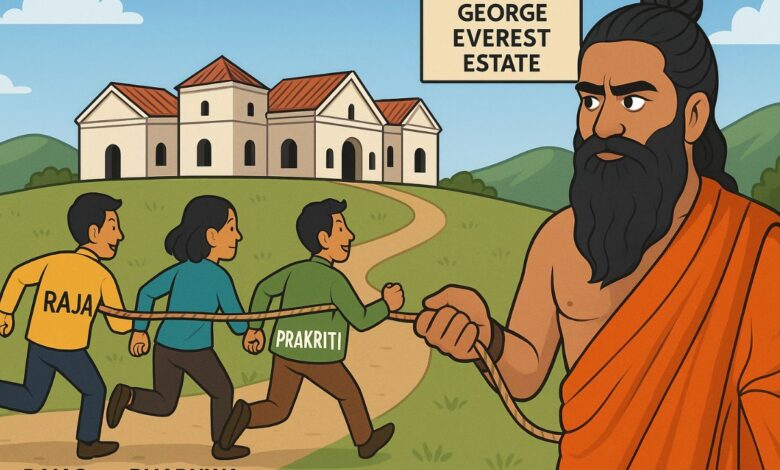
When bids were opened in February 2023, only three companies participated, and the results immediately raised eyebrows. The highest bid, exactly ₹1 crore per year (exclusive of taxes), came from a little-known adventure sports firm called Rajas Aerosports & Adventures Pvt Ltd. The other two bidders, Bharuwa Agri Science Pvt Ltd and Prakriti Organics India Pvt Ltd, quoted far lower fees of ₹65.27 lakh and ₹51 lakh respectively.
On paper, it looked like Rajas Aerosports had simply outbid two competitors to win a 15-year contract (extendable by another 15 years) to operate the George Everest Estate adventure tourism park. However, a closer examination revealed an extraordinary situation. All three bidding companies were connected to the same man, Acharya Balkrishna, the billionaire co-founder of Patanjali Ayurved and longtime aide of yoga guru Baba Ramdev. What should have been a fair competitive bidding process instead appears to have been a one-horse race dressed up with proxy bidders…
Three Bidders, One Beneficiary Raises The Doubt Of Collusion Allegations
According to an investigation by The Indian Express, Acharya Balkrishna was the common thread linking all three bids. Company records show that Balkrishna held over 99% ownership in two of the firms (Bharuwa Agri Science and Prakriti Organics) and was a significant shareholder (25.01%) in Rajas Aerosports at the time of bidding. In other words, the losing “competitors” were essentially companies controlled almost entirely by the same person who partly owned the winner. This meant that Balkrishna stood to win no matter which of the three bidders prevailed, which is a situation that on its face looks like bid-rigging.

Such an arrangement flies in the face of the tender’s own rules. All bidders had been required to sign an explicit anti-collusion undertaking declaring that they had “not acted in concert or in collusion with any other Bidder or person” in preparing and submitting their bids. Furthermore, the tender conditions warned that if the UTDB found any evidence that an operator “has engaged in corrupt or fraudulent practices in competing for or executing the contract,” it could disqualify them or terminate the contract.
On paper, these clauses are meant to prevent exactly what appears to have happened, which is coordinated bidding by allied entities to distort the competition. Yet, despite Balkrishna’s overlapping stake in all three companies, the tender was not scrapped or flagged, and Rajas Aerosports was duly awarded the contract in July 2023.
The collusion concerns are hard to ignore. Essentially, one businessman’s empire fielded multiple horses in the race, ensuring the outcome was in his favor no matter what. By holding dominant shares in Bharuwa Agri Science and Prakriti Organics (over 99% in each) and a significant stake in Rajas, Balkrishna had skin in every game. This kind of setup is widely viewed as anti-competitive because it defeats the purpose of an open tender and there was no genuine independent competitor at all.
The fact that the bids from the two companies were much lower than Rajas’s bid (₹51–65 lakh vs ₹1 crore) only reinforces the suspicion that they were never meant to win. Perhaps, they merely created an illusion of competition while helping set a low benchmark that Rajas could just exceed. If a truly independent bidder had participated, perhaps the concession fee might have been bid up higher than ₹1 crore, yielding more revenue to the state. Instead, with only Balkrishna-linked firms in the fray, the auction’s outcome was effectively predetermined.
Official Defenses Are As Usual, Which Is “Not Unusual” and “No Witch Hunt”.
Faced with questions about the blatant conflict of interest, Uttarakhand tourism officials have offered a staunch (if perplexing) defense. Amit Lohani, Deputy Director of UTDB’s adventure tourism wing, downplayed the issue when asked whether price discovery can be fair if all bidders share a common shareholder.
Lohani argued that the annual concession fee of ₹1 crore was a fair assessment by the government and noted, “The tender was open, and anyone could participate. This is not an unusual matter that some have shareholding in other companies.” In essence, his response was that nothing in the rules explicitly forbade one person from investing in multiple bidding companies, as long as they are separate legal entities, and that the process was open to all.
Col. Ashvini Pundir, an Indian Army veteran who was serving as Additional CEO (Adventure Sports) of UTDB during the tender, took a similar line. “It is not collusion because these companies are independent entities,” Pundir told the media. “We do not go for a witch hunt of companies and their backgrounds. You just give the highest bidder the tender, and the bottom line is the company is valid and legal.”
According to him, the government’s job was simply to award the contract to the highest quote meeting the criteria, not to scrutinize ownership structures or sniff out potential collusion unless obvious illegality was proven. By this reasoning, as long as each company had the proper registrations and paperwork, the tendering authority had no obligation to investigate who ultimately owned those companies.
These explanations have prompted considerable criticism. Is it truly “not unusual” for multiple bidders in a public tender to share essentially the same owner? In well-run procurement processes, that scenario is indeed highly unusual, and typically it would ring loud alarm bells. Anti-collusion rules exist precisely to prevent bidders from acting in concert.
Even if the letter of the law doesn’t explicitly bar one individual from holding stakes in multiple bidders, the spirit of fair competition is clearly violated. Lohani’s assertion that this situation is normal has been met with skepticism and concern, with observers noting that his statement seems to normalize what looks like brazen bid-rigging. If no outside companies chose to bid (more on that below), the onus was even higher on officials to ensure the limited bidders were truly independent competitors.
Col. Pundir’s “no witch hunt” stance also raises questions. An army veteran in a leadership role might be expected to uphold rigorous standards, yet here he appeared surprisingly unconcerned by the obvious red flags. His focus on the companies being “valid and legal” missed the point that legality on paper doesn’t guarantee integrity of the process. By that logic, any number of shell companies controlled by one cartel could bid in a tender and as long as they were incorporated entities, officials would simply accept the outcome.
Critics argue that this hands-off approach amounts to willful blindness. Public authorities have a duty of due diligence to ensure healthy competition, especially in major projects on public property. Looking into whether bidders have common ownership or are colluding is not a “witch hunt”, it’s basic prudence. In this case, a simple check of the Ministry of Corporate Affairs records would have revealed the shared shareholder instantly. Failing to do so (or ignoring it) allowed a potentially anti-competitive arrangement to go unchallenged.
What is the story behind Lack of Competition and the ₹1 Crore Fee?
One of the most troubling aspects of this saga is that no truly independent company appears to have bid for the George Everest Estate contract at all. Despite the tender being officially open to anyone, the only participants were the trio of firms linked to Balkrishna. If another adventure tourism operator or hospitality company was interested, they either did not know about the opportunity, or felt it was not worth competing, possibly suspecting an inside arrangement. Amit Lohani’s comment that “anyone could participate” rings hollow given the outcome. The lack of outside bidders meant the concession fee was effectively capped by what Balkrishna’s companies decided to offer.
The winning bid of ₹1.00 crore per annum has drawn criticism for being too low for such a prime asset. Notably, the Leader of Opposition in Uttarakhand, Yashpal Arya of the Congress, pointed out that the estate comprises 762 bighas (approximately 142 acres) of valuable land. By government circle rates, the land value itself would be around ₹2,757 crore, Arya said, and many times higher at market prices in a tourist hotspot. Of course, the government did not sell the land. It retained ownership and only licensed the operation for tourism, but the comparison underscores how vast the property is.
Even if we focus just on potential revenue, the deal appears skewed in the operator’s favor. In the first year of operations under Rajas Aerosports, the estate attracted 2.2 lakh tourists, with thousands taking paid helicopter rides, generating a windfall for the company. Rajas Aerosports’ own reported revenue jumped more than eightfold from ₹1.17 crore in FY 2022-23 to ₹9.82 crore in FY 2023-24 after it began operating the George Everest Park. Yet, the company’s annual payment to the state remains ₹1 crore (plus a modest 3% yearly escalation).
It doesn’t take an MBA to see that the math heavily favors the private player. The government essentially traded away a fully developed tourist estate for a token annual fee, while the operator can potentially gross many crores every year from ticket sales, parking charges, and adventure activities.
Why set the fee at ₹1 crore? Officials claim this figure was arrived at through assessment of the business potential and that ₹1 crore was a reasonable starting point. It is possible that when the tender was conceived, the state wanted to attract bidders by not overpricing the concession. However, with only related companies bidding, the competitive pressure to bid higher was absent. Bharuwa Agri Science’s bid of ₹65 lakh and Prakriti Organics’ ₹51 lakh essentially anchored the price far below the ₹1 crore mark. Rajas Aerosports bidding exactly ₹1.00 crore ensured it just cleared the bar to win, but not a rupee more than needed.
If even one external bidder had participated, they might have forced a higher price or at least given the state a market-tested value. The absence of outside bids thus effectively turned the tender into a closed-loop deal within the Patanjali/Balkrishna stable. This raises the question that “was the playing field truly level and widely advertised?”
Some observers have wondered if the tender was drafted or timed in a way that discouraged big players or kept it under the radar of potential competitors, though no hard evidence of that has emerged. What is evident is that the government and winning company are now having to defend why such a prized project is fetching only ₹1 crore a year, an amount that the estate’s ticket sales can likely surpass in a few weeks.

Even BJP leaders have faced uncomfortable questions. When Congress’s Yashpal Arya demanded a probe, pointing to a “fraud” in which a contract worth “billions” (in terms of land value and revenue potential) was bagged for just ₹1 crore a year, the ruling party’s response was defensive. A spokesperson for the BJP in Uttarakhand insisted the process was lawful and accused the opposition of negativity, but notably dodged the specific issue of all three bidders being tied to Balkrishna.
The Chief Minister’s Office issued a statement that all regulations were followed and highlighted the tourism services now being offered at the estate, without addressing the core issue of competition. These non-answers have only reinforced the impression that something is amiss; if everything was above board, officials could simply list other genuine bidders or explain why having one person behind multiple bids isn’t a conflict. Their inability or unwillingness to do so speaks volumes.
Due Diligence Concerns: Lessons from history shows similar frauds, lets take the example of the Eduquity Exam Scandal
The George Everest Park episode casts a harsh light on the lack of due diligence by authorities in vetting bidders and contracts. Unfortunately, this is not an isolated problem. A parallel can be drawn to a recent national scandal in another domain, which is the Staff Selection Commission (SSC) exam vendor controversy involving a company called Eduquity. In 2023-2025, SSC (the central government body that conducts major recruitment exams) faced massive protests from aspirants over repeated exam cancellations and technical glitches.
It came to light that SSC had contracted its exam conduct to Eduquity, a firm that students allege was blacklisted by the Education Department and even linked to the infamous Vyapam exam scam. Handing over such a critical examination to a tainted company sparked outrage, as many saw it as a failure of oversight. Despite Eduquity’s troubling track record including past bans and allegations of facilitating cheating, the SSC had still awarded it the contract, resulting in chaotic exam centers, malfunctions, and cancellations nationwide.
The Eduquity fiasco demonstrates the consequences when officials do not thoroughly check a contractor’s background or choose to ignore red flags. In that case, lakhs of job aspirants suffered, exams were jeopardized, and the commission’s credibility took a hit. Eventually, even political leaders had to step in to assure students that the situation would be fixed. This raises a pertinent question “whether authorities learning any lessons?” In the Uttarakhand tourism project, the stakes were different. It’s a tourism venture, not an exam, but the underlying issue is similar. Here was a marquee public project where a basic background check (shareholding patterns of bidders) could have prevented a compromised outcome.
Yet, those in charge either failed to conduct that check or brushed aside its implications. If due diligence is considered “witch hunting,” as Col. Pundir phrased it, then we have a problem. Proper vetting of bidders is a fundamental responsibility, not an optional exercise in paranoia. By not scrutinizing who was behind the bids, UTDB may have allowed a form of bid-rigging to occur, just as SSC, by not scrutinizing Eduquity’s record, enabled an unqualified vendor to botch a vital process.
Had Uttarakhand officials been more vigilant, they might have noticed that two of the bidding firms, Bharuwa and Prakriti, were barely related to adventure tourism at all (their names suggest agriculture and organics businesses). Meanwhile, the winner Rajas Aerosports, though genuinely an adventure sports company, was partially financed by the same individual who outright owned the other two. A simple question is “Do these companies have any common investors or directors?”, would have revealed the overlap immediately.
This is the kind of question that should be routine in any tender evaluation to avoid anti-competitive collusion. The fact it apparently wasn’t asked (or was ignored) in this case suggests at best negligence, and at worst complicity. Going forward, the state government’s procurement process may need reform and perhaps independent oversight to ensure transparency. Just as the SSC saga has prompted calls for stricter oversight of exam vendors, the George Everest case is prompting calls for stricter scrutiny of bidders in government contracts. No one wants a tourism project to turn into a scandal or fiasco, but ignoring early warning signs is how scandals germinate.
Government Investment, Private Profit: A ₹23.5 Crore Facelift
Perhaps the most galling aspect to critics is how the public sector built up the asset, only for a private entity to reap the profits on easy terms. Between 2019 and 2022, the Uttarakhand tourism department poured money (much of it via an ADB loan) into upgrading the George Everest Estate. They restored Sir George Everest’s historic house, developed museums and an observatory, laid roads and trails, installed a parking lot and even a helipad; essentially turning a once-neglected colonial-era property into a ready-to-run tourist attraction. All this was done under a special program to boost tourism, and it was completed by late 2022.
Then, almost immediately, the state handed this “spruced-up” estate to Rajas Aerosports for operation. It’s as if the plate was prepared and garnished by the government, and served to a private party for a nominal fee, to borrow a metaphor making the rounds. The operator did not have to invest in major infrastructure, and hard work (and financial risk) was already taken by the government. Rajas’s role is essentially to maintain the facilities and run the adventure activities and ticketing.
Even on the maintenance side, the Tourism Secretary’s statement notes that the arrangement is an operation & maintenance contract and all assets remain government-owned. In theory, this means the government built it and just hired a firm to operate it. That model isn’t unusual by itself (many public facilities are managed by private concessionaires). What is unusual is the sweetheart terms and the cloud over how this operator was chosen.
The revenue figures illustrate how lucrative the arrangement is. During its first full year, as mentioned, the site saw 220,000 visitors. The fee structure at George Everest Park, as reported, includes charges like ₹200 for adult entry (₹100 for children), parking fees ranging from ₹100–200 for a few hours (and up to ₹1,000 for premium parking near the museum), and steep prices for joyrides, ₹5,000 for a 5-7 minute helicopter ride, ₹7,999 for 10-12 minutes, and even ₹30,999 for a 50-60 minute Himalayan expedition flight.
There’s even a ₹1.84 lakh per hour rate for chartering the helicopter. These prices are not cheap, and together with the sheer footfall, they suggest that Rajas Aerosports is likely generating several crores of rupees each year from the venture. The state tourism department’s own records through November 2024 showed significant earnings from the site, which aligns with Rajas’s reported turnover jumping to ₹9.8 crore.
Against this backdrop, the ₹1 crore plus GST that Rajas pays the government looks almost token. In fact, Uttarakhand officials have boasted that they collected over ₹5 crore in GST from the area in two years, aside from the lease amount. But GST is just a tax on transactions (and that ₹5 crore, if accurate, actually underscores how much business is happening there). The lease amount remains ₹1 crore/year to UTDB, a figure dwarfed by what tourists are paying on site.
It’s easy to see why opposition leaders like Arya argue that the public exchequer is losing out on huge revenue by effectively subsidizing a private operator’s profits. Had the concession fee been, say, a revenue-sharing model or a higher fixed amount, the state could recoup more of its ₹23.5 crore investment faster. Instead, at ₹1 crore a year (with 3% annual increase), it would take decades for the nominal fees to even equal the upfront investment, let alone the land value or the ongoing revenue potential.
This scenario has fueled allegations of cronyism, essentially that the government “gifted” a fully-developed tourist project to a favored firm linked to a politically influential figure (Balkrishna, and by extension Baba Ramdev and the Patanjali empire) at a throwaway price. In April 2023, even before the controversy erupted, the then Tourism Secretary Sachin Kurve (who also held the Civil Aviation charge) pushed for Rajas Aerosports to be involved in other projects, writing to India’s aviation regulator to favor Rajas’s proposals.
It is almost as if Rajas was being groomed or hand-held by the state to succeed. The company not only got the estate contract but also, within months, was granted a pilot project under the Uttarakhand Air Connectivity Scheme to run subsidized helicopter shuttles from Dehradun’s Jolly Grant airport to Mussoorie. Under that scheme, Rajas enjoys additional perks like exemption from landing fees and a government subsidy of ₹5,000 per seat per sortie (to keep ticket prices for tourists low).
These decisions may have been made in the interest of promoting tourism, but the pattern where the same company getting multiple benefits reinforces the impression that the state is going out of its way to boost Rajas Aerosports’ business.
The Push for Rajas: Is There Any Inside Connections?
How did Rajas Aerosports, a relatively small company until recently, come to be the Uttarakhand government’s go-to choice for adventure tourism initiatives? The timeline suggests there were internal champions for Rajas within the bureaucracy. In July 2022, months before the tender was even announced, Col. Ashvini Pundir (then Additional CEO, Adventure Sports, UTDB) wrote to the Tourism Secretary proposing that the George Everest Estate project be executed by Rajas Aerosports on a pilot basis for one year. This indicates that Rajas was already on the department’s radar as a favored operator.
Perhaps Rajas had made a private proposal or conducted demonstrations of gyrocopter flights (the estate project was promoted as part of a “Himalayan Darshan” gyrocopter program). Pundir’s suggestion effectively was to hand the project to Rajas directly for a trial. However, by December 2022, the department instead decided to issue a formal tender (likely to follow procedure and avoid questions about direct allotment). Even so, given how the bidding played out (with only Rajas and its sister companies participating), one wonders if the tender was merely a formality to achieve the same outcome that Pundir had initially recommended.
Col. Pundir’s enthusiasm for Rajas did not go unnoticed. Was it simply that Rajas Aerosports was the only player in Uttarakhand with the capacity for such adventure sports operations? Manish Saini, Rajas’s managing director, has indeed claimed that his firm was the only bidder with actual experience in aero and adventure sports, implying others were not qualified. It’s true that Rajas Aerosports had been around since 2013 and had engaged in activities like skydiving, paragliding, etc., whereas the other two bidding entities (Bharuwa Agri and Prakriti Organics) had no background in tourism.
So one interpretation is that Pundir saw Rajas as the only viable operator to run the estate, and thus he backed them from the start. However, the deeper question is why Rajas alone? There are other adventure tourism operators in India. Companies running paragliding sites in Himachal, hot air balloon firms, or helicopter tour providers in other states. Could none of them have been attracted to Mussoorie? Or was Rajas given an inside track that discouraged others?
No direct evidence has emerged of Col. Pundir having a personal stake in Rajas Aerosports. He is not known to have any official role in the company, and he was a serving army officer on deputation to the tourism board. It’s possible that he genuinely believed Rajas (with the Saini brothers at the helm) had the expertise to make the Himalayan gyrocopter vision a reality. Yet, given that soon after the tender, Balkrishna’s companies dramatically increased their stake in Rajas (more on that later), skeptics suspect that Pundir’s patronage of Rajas might have been influenced by who was behind Rajas financially.
Balkrishna had been a 25% shareholder since 2018, something presumably known in at least some circles. It is not far-fetched to imagine that an influential Patanjali-linked figure lobbying for tourism projects could sway bureaucratic decisions. Uttarakhand is, after all, Baba Ramdev’s karmabhoomi. Patanjali’s headquarters and flagship institutions are based in Haridwar, and the state’s political leadership has long been on cordial terms with Ramdev and Balkrishna.
Opposition parties are certainly asking whether the unusual favoritism shown to Rajas Aerosports was a result of political connections. They point out that the government not only awarded Rajas the estate contract under dubious circumstances, but also bent over backwards to accommodate them in the aviation scheme. The fact that Sachin Kurve, the then Tourism and Civil Aviation Secretary, personally wrote to the DGCA recommending Rajas’s gyrocopter operations “be considered favourably” is telling.
Secretaries usually don’t single out a private company for endorsement in communications with regulators, unless there is a strong reason or pressure. (By contrast, when the gyrocopter joyride services are being re-tendered in 2025 after a crash incident, no single company is being backed; it’s an open field again.) All of this suggests a concerted push within the government to make Rajas Aerosports the prime beneficiary of new tourism initiatives. Whether that push came from well-meaning technocrats who trusted Rajas’s capabilities, or from high-level influence linked to Patanjali’s clout, is the crux of the matter.
As of now, no concrete proof has surfaced of bribery or personal gain by officials like Lohani or Pundir. There are no known criminal records or past scandals involving them that the public is aware of. Amit Lohani appears to be a career tourism officer (listed as a Deputy Director in the department’s contacts) and Col. Pundir is a respected army officer who was on deputation. Neither has publicly acknowledged any relationship beyond professional interactions with Balkrishna or Ramdev’s circles.
However, their dismissive responses to the collusion questions have, in a way, tied their reputations to this case. If an independent investigation occurs, it may probe whether any undue influence or communication happened between the bidders and these officials. Short of that, we may never know if Lohani and Pundir were simply negligent or were knowingly complicit in enabling a rigged bid. The optics certainly are not flattering. It looks like powerful people’s friends were given the benefit of the doubt while basic procurement safeguards were ignored.
Who Are the Saini Brothers, The Founders of Rajas Aerosports?
Lost in the focus on Balkrishna is the story of the entrepreneurs who actually built Rajas Aerosports from the ground up, the Saini brothers. Manish Saini and Mayank Saini, hailing originally from Ghaziabad (Uttar Pradesh), started Rajas Aerosports and Adventures Pvt Ltd in May 2013. Both brothers were the initial directors of the company, signaling a family business venture in the niche field of adventure sports. The company’s objective, as per its filings, is to promote commercial adventure activities such as skydiving, aero sports, water sports, etc.. For several years, Rajas Aerosports operated relatively under the radar, likely conducting skydiving events or adventure camps on a modest scale.
It appears the Sainis were passionate about aerial sports, perhaps among the few Indians trying to develop skydiving or gyrocopter tourism as a business. By 2017, one of the brothers (Mayank Saini) had also ventured into hospitality; records show a Rajas Parsili Resorts Pvt Ltd incorporated in 2017 with Mayank as a director, suggesting they branched into eco-tourism resorts.
This indicates the Sainis were actively expanding in the tourism/adventure sector even before any association with Patanjali. There is no public indication that the Sainis had any criminal background or political affiliations. By all accounts, they were ordinary businessmen trying to carve out a niche in adventure tourism, which is a sector that often struggles to find funding and government support in India.
The turning point for Rajas Aerosports came in July 2018, when Acharya Balkrishna invested in the company. We do not have details on how this partnership came about, possibly through a chance meeting at an adventure event or via mutual contacts in Uttarakhand. But the investment was significant. As of March 2023, Balkrishna owned 25.01% of Rajas’s shares.
The remaining shares were split between the Saini brothers (together about 49.99%) and a third individual, Som Suvedi, who held 25%. Som Suvedi is based in Haridwar, which is notable as Haridwar is the hub of Patanjali. Suvedi’s role isn’t widely reported, but his presence as a director and stakeholder (5-6% by FY23) suggests he might have been another early investor or partner. It’s possible Suvedi helped connect Rajas to Balkrishna, or he could be a local adventure sports enthusiast who teamed up with the Sainis.
With Balkrishna’s entry in 2018, Rajas Aerosports likely received a capital boost and valuable connections. From that point on, Rajas had the backing of one of India’s richest men (Balkrishna featured in rich lists with a net worth in the tens of thousands of crores) and by extension, access to the Patanjali group’s resources and political clout. For the Sainis, this was a game-changer as they could dream bigger and propose projects like Himalayan gyrocopter safaris with a serious financier behind them.
There’s no evidence that the Sainis themselves engaged in any malfeasance; indeed, Manish Saini maintains that Balkrishna was a “passive investor” and that Rajas is operated solely by its founders and management. When controversy erupted, Manish stressed that he had “no connection with the other two firms” (Bharuwa and Prakriti) and that he wasn’t involved with them at all. In his view, the anti-collusion clause did not apply to Rajas because Rajas (and he) did not coordinate with those bidders, effectively arguing that Balkrishna’s minority stake was a coincidental commonality, not an active collusive arrangement.
This defense raises semantic distinctions. From Manish Saini’s perspective, he is correct that Rajas Aerosports as a company did not conspire with Bharuwa or Prakriti in the sense that the management of Rajas (led by Saini) is separate and they did not sit in a room with the other firms to fix the bid. But critics would respond that collusion can happen through a single guiding mind at the ownership level, i.e., Acharya Balkrishna, even if the operational teams are different.
The Sainis can legitimately claim they focused only on their bid. However, if Balkrishna or his representatives controlled the bids of the other two, then collusion occurred regardless of whether Manish directly talked to them or not. In any case, it appears the Sainis are keen to protect the image of Rajas as a serious, independent operator and not merely a Patanjali front. They highlight their unique experience in the field, implying that their win was because of capability and not just connections.
To date, no criminal or compromising events involving Manish or Mayank Saini have come to light in the public domain. They are not political figures; if anything, they are now involuntary figures in a political controversy. One might say the Sainis hit the jackpot with the George Everest project as it catapulted their company’s revenues eightfold and positioned them as pioneers of a new tourism model in Uttarakhand. But the scrutiny that followed also put them in an uncomfortable spotlight.
There is a risk that their genuine work in adventure sports could be overshadowed by the taint of cronyism due to their investor. It’s a classic catch-22 for entrepreneurs that having a powerful backer opens doors, but when those doors open too easily, questions arise. The Sainis insist Rajas Aerosports is not an affiliate or subsidiary of Patanjali and that no investor directs its operations. Going forward, if they wish to maintain credibility, they might need to prove that by operating with transparency and perhaps reducing the dominance of any one shareholder, though given subsequent events, Balkrishna’s grip has only tightened.
The Elephant in the room is Acharya Balkrishna, who is none other than Ramdev’s Aide and his right hand in Expanding Patanjali Empire
The central figure tying this all together is Acharya Balkrishna, a name well known in business circles but perhaps less so to the general public until his involvement in Patanjali Ayurved made headlines. Balkrishna, now in his early 50s, is the billionaire co-founder and CEO of Patanjali Ayurved Ltd., the Ayurveda-based FMCG giant that he built alongside yoga guru Baba Ramdev.
While Ramdev is the public face of Patanjali, with his saffron robes and fiery speeches, Balkrishna has been the behind-the-scenes strategist and money-manager. As of 2016, Balkrishna owned a staggering 94% of Patanjali Ayurved’s shares, effectively making him one of India’s richest individuals (he appeared on the Hurun Rich List with an estimated wealth of ₹25,600 crore around that time). Patanjali’s meteoric rise (with revenues hitting ₹5,000 crore in 2015-16 and growing since) turned Balkrishna into a powerhouse in the consumer goods industry.
However, Balkrishna’s journey has not been without controversy. For years, questions lingered about his citizenship and educational qualifications. Born to Nepalese parents and raised in India, Balkrishna at one point held an Indian passport based on certain academic certificates, which investigative agencies later alleged were forged. In 2011-2012, under the previous national government, the Central Bureau of Investigation (CBI) booked Acharya Balkrishna in a case of cheating and criminal conspiracy, accusing him of obtaining fake educational degrees in order to procure an Indian passport.
The case led to his arrest in 2012, making quite a splash in the media at the time. Yet, the matter took a dramatic turn after 2014 when the BJP-led NDA government came to power under Narendra Modi. By 2016, as The Quint reported, all charges against Balkrishna were dropped. The CBI’s pursuit cooled off, and Balkrishna was free of the legal cloud. It was widely perceived, rightly or wrongly, that his closeness to the new establishment helped ease his troubles.
After all, an RTI disclosure later revealed that Patanjali had donated ₹11 lakh to the BJP in 2009 (when the party was in opposition). And Baba Ramdev himself was an outspoken supporter of Narendra Modi in the 2014 elections, campaigning for him and reportedly helping mobilize support. The implication was clear. Balkrishna and Ramdev had friends in high places, and their goodwill was reciprocated.
Balkrishna’s influence extends across dozens of enterprises. By one count, he serves as a director in 34 different companies associated with Patanjali’s sprawling interests (from food and cosmetics to education and wellness). His empire is not just about selling shampoo and ghee; it also touches sectors like education (Patanjali runs a university), healthcare (Ayurveda clinics), and even media (there were reports of Patanjali attempting to buy a news channel, though that didn’t materialize). With that context, Balkrishna’s foray into adventure tourism via Rajas Aerosports is one more extension of his entrepreneurial spread.
It’s worth noting that Patanjali Ayurved itself is not directly in the tourism business; rather, Balkrishna appears to have pursued this personally through stakes in separate companies (possibly seeing potential synergies with wellness tourism or simply as a diversification). The companies Bharuwa Agri Science, Prakriti Organics, etc., which he owns almost entirely, suggest he has a network of ventures in different fields like agriculture, organic foods, solutions, etc. They might have been vehicles for various projects or investments. For instance, “Patanjali Revolution” and “Fit India Organic” (two other firms that bought into Rajas) carry names resonant of Patanjali’s ethos.
The political connections of Balkrishna and Ramdev are no secret in Uttarakhand. Patanjali’s headquarters in Haridwar was given land and incentives by the state government in the mid-2000s when Uttarakhand was newly formed. Over time, Patanjali’s projects have often found favor with BJP-led governments across India. For example, in December 2017 it emerged that the Maharashtra government (then BJP-led) allotted nearly 230 acres of prime land in Nagpur to Patanjali at well below market rates, which is land worth ₹268 crore given for just ₹58 crore.
In Himachal Pradesh, the BJP government in 2018 controversially slashed the lease price of 28 acres of forest land for a Patanjali herbal garden from ₹27 crore to ₹2.3 crore (over 90% discount) by using special powers, which led to protests and a walkout by Congress in the state assembly. These instances reveal a pattern of Patanjali or its trusts receiving preferential treatment in land allotments and contracts. Supporters might argue these were to encourage investment and development, but the optics are of favoritism.
Against this backdrop, the George Everest estate deal looks like part of the same pattern. Acharya Balkrishna, by virtue of his immense wealth and political rapport, is in a position to influence or at least benefit from government decisions. It might not be as direct as a phone call ordering an official to pick Rajas Aerosports, but the deference shown by bureaucrats to entities linked with him suggests an environment where his interests are rarely impeded by the state.
In fact, Balkrishna’s private secretary and Patanjali spokespeople openly acknowledge that Patanjali (the company) was “directly involved” in Rajas Aerosports, meaning Patanjali’s leadership knew and supported these ventures. However, they carefully maintain that Rajas is not a subsidiary and that Balkrishna’s role is merely as an investor, not a controller. This distinction is their shield as investment, they insist, does not automatically equal management control or “collusion” in wrongdoing.
Isn’t this a Pattern of Favoritism for Patanjali and its Political Patronage?
The George Everest tender controversy can be viewed as a microcosm of a larger phenomenon often alleged in India, which is crony capitalism; where businesses close to the ruling establishment receive favorable deals, possibly at the expense of fairness and public interest. Baba Ramdev and Acharya Balkrishna’s Patanjali empire has often been cited in discussions of cronyism in the past decade. To be clear, Patanjali also earned its success through savvy marketing and tapping into swadeshi (indigenous) sentiment, but there’s no denying that political tailwinds helped. Prime Minister Modi himself praised Patanjali products in early years, and BJP leaders often shared stage with Ramdev. This proximity has yielded tangible benefits:
- Land and Real Estate Deals: As mentioned, states governed by the BJP have tended to bend rules or give discounts to Ramdev’s organizations. The Nagpur land for a food park, the Himachal land for a herbal garden, and even some deals in Madhya Pradesh and Uttar Pradesh have raised questions. In one case, a journalist collective reported how Patanjali used shell companies to acquire land in the Aravalli hills (Haryana) for a wellness center, skirting environmental regulations. In Uttarakhand itself, Patanjali was allotted land in the pristine hills of Pithoragarh for herb cultivation; when that project stalled, there were calls to take back the land. These instances build a perception that Patanjali-related ventures get easy access to public resources.
- Regulatory Favors: During the COVID-19 pandemic, Patanjali launched “Coronil”, an herbal product it touted as a cure for COVID. The claim was widely criticized as unscientific. Initially, Patanjali got an encouraging platform where a Union minister even attended the product launch. Only after public outrage did authorities make Patanjali retract the claim of it being a “cure” (it was then marketed as an immunity booster). While not directly related to financial corruption, the incident showed how Patanjali could push boundaries with tacit official support, something not afforded to others peddling dubious remedies.
- Cases and Investigations: The contrast in how cases against Patanjali figures are handled versus others is striking. As noted, Balkrishna’s fake degree case was effectively shelved after 2014. In another instance, the Uttarakhand High Court in 2021 quashed an FIR against Ramdev and Balkrishna over allegations of spreading false information about a medicine (they had published a booklet with bizarre claims about cow urine as a cure, leading to a case for misleading ads). The court’s decision might be legally sound, but it added to a series of legal victories for them. On the flip side, media houses critical of the government, like NDTV or NewsClick (discussed later), have faced relentless investigations and arrests. The disparity suggests a double standard where friends of the regime seem to operate with more leeway.
- Encouragement in New Ventures: The way Uttarakhand’s tourism department tried to involve Rajas Aerosports in multiple projects is reminiscent of how governments sometimes single-source projects to favored companies. For example, there have been allegations in other states of contracts being tailored for particular companies (be it a construction firm close to a minister, or a software provider linked to a politician’s family). In Uttarakhand, one could question whether the decision to invest heavily in George Everest Estate and then lease it out cheaply was influenced by the knowledge that a Patanjali-linked entity would take it over. Congress’s Yashpal Arya certainly alleged that “the entire process of the tender has been designed to benefit one company”. It’s hard to prove intent, but circumstantial evidence like Pundir’s early recommendation of Rajas and Kurve’s letters on Rajas’s behalf bolster that claim.
In sum, the broader pattern is that Acharya Balkrishna (and by extension, Baba Ramdev) have enjoyed an exceptionally cozy relationship with the powers-that-be, translating into business advantages. The Uttarakhand government’s handling of this tourism project fits that pattern where rules are bent or ignored to ensure a win for the home team. This doesn’t just raise moral questions, but also legal ones. If it’s demonstrated that the tender was essentially rigged, it could be challenged in court or investigated by anti-corruption bodies. As of now, the state government is staunchly defending the project as above-board, which is unsurprising given its stake in the matter.
The Chief Minister’s office emphasized that all regulations were adhered to, a claim that may be technically true in terms of paperwork, but arguably false in spirit. Meanwhile, the BJP’s spokesperson’s retort was to recall how the site was dilapidated pre-2012 and how it’s now a thriving tourist spot, implicitly crediting the government (and by extension Rajas) for development.

This argument that “Look, we developed it and brought economic activity, why complain?” is a common defense in cronyism allegations. It says that even if our methods were preferential, the end justifies the means because the public is getting a developed project. However, good ends do not excuse potentially corrupt means. A project can be beneficial and still be tainted by collusion in how it was awarded.
Post-Tender Maneuvers: Rajas Becomes a Patanjali Affiliate
If there were any remaining doubts about the collusive nature of the bidding, what happened after Rajas Aerosports won the contract should dispel them. Roughly two and a half months after the Letter of Award was issued (the LoA came on July 21, 2023), the ownership structure of Rajas Aerosports changed dramatically. Filings with the Registrar of Companies show that on October 9, 2023, five companies, Prakriti Organics India, Patanjali Revolution, Bharuwa Agro Solution, Bharuwa Agri Science, and Fit India Organic, were recorded as new shareholders of Rajas Aerosports.
If those names sound familiar, it’s because most of them were either bidders or are known to be owned by Balkrishna. Indeed, Prakriti Organics and Bharuwa Agri Science were the two “rival” bidders that lost to Rajas. Now, suddenly, they acquired a combined 17.43% stake in Rajas Aerosports. Additionally, four Balkrishna-owned companies (Bharuwa Agro Solution, Bharuwa Solutions, Fit India Organic, and Patanjali Revolution) together took 33.25%. In one fell swoop, all these entities linked to Balkrishna collectively owned about half of Rajas. Combined with Balkrishna’s existing 25%, this raised his effective shareholding in Rajas Aerosports to around 69.43%, a clear majority control.
The timing and pattern of these share acquisitions strongly indicate that they were planned all along. During the bidding, Balkrishna’s stake in Rajas was 25.01%, likely kept at a minority level deliberately. Had he owned, say, 70% of Rajas at the time of tender submission, the common ownership of all three bidders would have been even more blatant and perhaps indefensible. By keeping Rajas’s shareholding structure slightly more diversified (with the Sainis holding ~50% combined, Balkrishna 25%, Suvedi 25%), the appearance of three distinct bidders was maintained.
After winning, the need for that facade fell away. The losing companies and other sister firms could then openly consolidate ownership of Rajas. Essentially, Rajas Aerosports became another company in Balkrishna’s 99%-club, joining the likes of Prakriti Organics and Bharuwa Agri which he already fully controlled. As a result, what started as a 25% stake turned into a nearly 70% controlling stake within a few months of securing the government contract.
This sequence can hardly be seen as coincidence. It’s evident that the three companies were acting in concert and that Balkrishna (directly or through proxies) orchestrated the post-tender merger of interests. One could call it a “family project” in a business sense, where various arms of the Patanjali/ Balkrishna business family cooperated to corner a deal. The formalistic argument that “these are independent entities” crumbles when you see them recombine like Voltron into one entity after the tender.
If challenged legally, this could be used as evidence of an underlying understanding between the bidders, i.e., that they never truly intended to compete with each other. In many jurisdictions, such behavior might attract scrutiny under anti-trust or anti-cartel laws. For instance, India’s Competition Act prohibits bid-rigging and cartelization, and the Competition Commission of India (CCI) can investigate even tacit collusion if there are patterns like common ownership or management controlling bids. While the CCI typically needs a complainant or reference to act, the facts here would present a strong case for investigation.
From a governance perspective, the post-tender share swaps make the government’s stance look even weaker. If Amit Lohani or Col. Pundir were to be asked now, “Do you still think there was no collusion?”, how could they possibly ignore that the losing bidders literally became co-owners of the winner soon after the award? It is the textbook definition of acting “in concert”. The UTDB’s tender clause was meant to prevent exactly a situation where bidders collude for one to win and then share the spoils, and here we have the losing bidders sharing the winning company itself!
The authorities might claim they were unaware of these corporate moves (indeed, the changes happened months after the tender process was over). But now that it’s public, there is mounting pressure to revisit the contract. The opposition has called for a judicial probe or CBI inquiry. If a probe happens, it will surely look at whether there was a premeditated agreement between Balkrishna and the Sainis that in the event of winning, Balkrishna’s firms would take majority control of Rajas. Such an agreement, even if unspoken, would imply that Rajas Aerosports was effectively an arm of Balkrishna’s business empire all along, meaning the other two bids were stooges to fulfill the tender formality.
Legally, the question is tricky. The contract was awarded to Rajas Aerosports, which at the time was not majority-owned by Balkrishna. The collusion clause was violated by the bidders if they “acted in concert”. Did they? If one can infer an implicit understanding (which the share purchase pattern suggests), then yes, they likely did. But proving an implicit collusion in court often requires either documentary evidence or testimony (like emails, phone calls, or whistleblowers), unless the circumstantial evidence is overwhelming.
Here, the circumstantial evidence is pretty strong. Whether the government of Uttarakhand will act on it is another matter. So far, they have circled the wagons to protect the contract, since canceling it would be an embarrassment and would anger a powerful ally. But the story is out in the open, and it certainly violates the public trust even if it hasn’t (yet) violated the letter of any enforced law. The post-tender consolidation confirms for many observers that this was, in effect, a rigged tender that succeeded.
Investor vs Controller: The Patanjali Defense and the NewsClick Double Standard
Throughout the unfolding of this issue, Rajas Aerosports and Patanjali’s spokespersons have clung to a line of defense worth examining, the idea that a mere investor’s presence does not amount to collusion or control. As the Rajas spokesperson put it, many Indian companies share common investors, but that “does not imply operational linkages or bid-rigging”. He emphasized that all strategic and management decisions in Rajas are taken by its founders (the Sainis), portraying Balkrishna as a passive financial backer.
In a similar vein, after the controversy, Uttarakhand’s Tourism Secretary Dhiraj Garbyal told the press that “the named person is not a director in any of the firms” and that “anyone can invest in multiple firms”, essentially arguing that Balkrishna’s role was that of a shareholder, not a board director, so officially he wasn’t running those companies. By this logic, they want to separate ownership from collusion, unless you can show that Balkrishna actively coordinated the bids (which he denies), his being a shareholder in all three doesn’t automatically incriminate the companies.
This hair-splitting has drawn ridicule in many quarters, especially when contrasted with how shareholding links have been interpreted in other recent high-profile cases. A glaring example is the case of NewsClick, a progressive news website that became the target of government action in 2023. NewsClick’s founder and editor, Prabir Purkayastha, was arrested under India’s harsh anti-terror law (UAPA) in October 2023 after a New York Times report alleged that NewsClick received funding from a network associated with a pro-China businessman.
The allegation was that Chinese government propaganda might have been pushed through NewsClick’s content; a claim that was and remains unproven. Nevertheless, the presence of a foreign (Chinese-linked) investor in NewsClick was treated by authorities as de facto evidence of a sinister conspiracy. Purkayastha, a 75-year-old journalist, was jailed for seven months without bail, accused of “receiving foreign money” and conspiring to undermine national security. It was only in May 2024 that the Supreme Court intervened, declaring his arrest and the remand process illegal and ordering his release on bail. The top court found that the police had not even provided proper grounds of arrest in writing, calling the detention “invalid in the eyes of law”.
The NewsClick case starkly illustrates a double standard in how investment links are viewed. In New Delhi, a media outlet having a foreign investor (who was not even proven to dictate content) led to the founder being treated as a criminal for alleged collusion with a foreign power. The government justified the crackdown under the premise that foreign funding of media must be scrutinized and, if problematic, punished.
In Uttarakhand, by contrast, multiple companies sharing the same domestic investor (with clear financial motive to collude) is brushed off as benign. The irony has not been lost on commentators. If one were to apply the NewsClick standard here, Acharya Balkrishna’s deep involvement in all bidding companies would be seen as prima facie evidence of a conspiracy to hoodwink the tender. But because Balkrishna is a politically aligned figure, no such thunderbolt fell on him. The law was not weaponized in the same way; in fact, it wasn’t even enforced in the normal way (since the anti-collusion clause was ignored).
Another analogous situation is how foreign funding or shareholding is often viewed with suspicion in sectors like NGOs. Many NGOs have been harassed or shuttered under the Foreign Contribution Regulation Act (FCRA) for receiving funds from abroad under vaguely defined “anti-national” pretexts. Yet, having an Indian billionaire silently back three firms to monopolize a bid draws no such nationalist scrutiny.
Of course, the contexts differ, one is about national security and ideology, the other about economic fairness. But at core, both involve the question that does an investor’s influence pose a problem? In NewsClick, the establishment’s answer was yes (even without evidence of editorial interference), whereas in the Balkrishna case, the establishment’s answer is no (despite evidence of coordinated economic behavior).
It highlights how definitions of “collusion” or “influence” can be conveniently fluid. If Acharya Balkrishna were an opposition politician or an inconvenient businessman, one could imagine a very different response. For instance, if tomorrow it was found that a Chinese or foreign entity had quietly funded three companies to bid in an Indian defense contract, authorities would likely come down hard, citing security and collusion. But here, since the benefactor is an ostensibly patriotic figure (Ramdev’s aide) and the project is domestic tourism, the entire matter is being downplayed by those in power.
Legally, Balkrishna’s team can argue they didn’t break any specific law as it’s not illegal to own stakes in multiple companies, nor illegal for those companies to bid on the same tender, unless it’s proven they explicitly colluded. And collusion is typically a hard thing to prove without a smoking gun. They can maintain that each company acted independently and Balkrishna just happened to invest in each looking for good returns. However, common sense strains at that explanation. The subsequent consolidation of Rajas’s ownership by Balkrishna-controlled firms gives away the game. “Passive investor” or not, the outcome of the tender served Balkrishna’s interests perfectly, that can’t be mere chance.
If we take the Patanjali spokesperson’s quote of “Investment by any individual or entity… does not translate into management control”, at face value, then one wonders why Balkrishna felt the need to ramp up his investment after the contract was won. If control was not an issue, he could have left Rajas as it was. Instead, his companies swallowed up Rajas’s shares in short order, suggesting a desire for direct control of the lucrative venture. So the defense is somewhat self-defeating as they claim the investment was passive, yet they acted in a way that any reasonable person would interpret as exercising control once it mattered.
The NewsClick saga ended (for now) with the Supreme Court upholding the rule of law, noting that due process was violated and releasing Purkayastha. It was a reminder that even if authorities stretch a narrative (Chinese funding = terrorism), courts can demand actual evidence and adherence to procedure. In the case of the George Everest tender, no court has yet weighed in.
But if one did, it might similarly cut through the convenient narratives and focus on the essence. Did these entities act in concert, contrary to their sworn declarations? Did the public authority fail to ensure a fair process? Those questions have straightforward answers from the facts. The worry is that in our system, it often takes a determined petitioner or an independent institution to enforce accountability, which may or may not happen here. So far, only the media and opposition have carried the torch, while law enforcement and regulators have shown zero interest in probing a politically sensitive deal.
Legal Outlook: Collusion Laws and Accountability
From a legal standpoint, the George Everest Estate tender episode sits at the intersection of procurement law, contract law, and competition law. The tender was governed by Uttarakhand’s state procurement rules (2017 rules were cited by officials), which presumably incorporate standard clauses about fair competition. As we’ve noted, the tender documents themselves contained an anti-collusion affidavit requirement.
If that affidavit was breached, the government in principle has the right to cancel the contract and even blacklist the firms for future projects. The clause explicitly says the contract could be terminated if corrupt or fraudulent practices in bidding are found. Right now, despite clear evidence of collusive behavior (common ownership), the UTDB has not taken any such action. Why? Possibly because they would argue they do not see it as collusion without proof of coordination. More cynically, because doing so would be politically unpalatable.
However, if an independent agency like the Competition Commission of India (CCI) were to examine this, it might view the matter differently. The Competition Act, 2002 defines “bid rigging” as any agreement between enterprises which has the effect of eliminating or reducing competition for bids or adversely impacting or manipulating the bidding process. A shared majority owner across bidders would certainly fit the spirit of that definition.
The CCI in the past has penalized companies for bid-rigging in government tenders (for example, cartelization by suppliers in railway tenders, etc.), even when the evidence was largely circumstantial, based on unusual bidding patterns or identical pricing. Here we have an unusually clear line of evidence which is the ownership trail. If a complaint is filed to the CCI by, say, a competing firm or even a citizen, the CCI could open an inquiry. The companies involved (and individuals) could face penalties if found guilty, usually hefty fines (a percentage of turnover) and cease-and-desist orders.
Another avenue is the criminal law. If it is alleged that there was a conspiracy to deceive the government (by misrepresenting independent competition), theoretically the state’s Anti-Corruption Bureau or even the CBI could register a case of cheating the government (Section 420 IPC) and criminal conspiracy (120B IPC). That would require political will, which currently, in the state government, does not exist (since they insist nothing wrong happened).
The Leader of Opposition’s call for a CBI inquiry or a judicial probe is essentially to get an independent look, since the local authorities might be compromised. A CBI probe, if it happened, could subpoena documents, emails, etc. from the involved companies to see if there was coordination. It could also question officials on why they ignored the red flags. But unless courts intervene or the central government allows the CBI (which is under the central government) to take up the case, that remains a distant prospect.
Legally, one could also consider if the contract can be voided by a court for being against public policy due to collusion. A public interest litigation (PIL) could be filed in the High Court of Uttarakhand seeking cancellation of the tender and a rebid, citing violation of Article 14 of the Constitution (equality before law and non-arbitrariness in state action).
Courts have in the past struck down tender awards if the process was found to be mala fide or rigged. The evidence here might persuade a court that the process was vitiated. The affected company (Rajas) would, of course, fight such a move, claiming that they did nothing wrong and invested based on a legitimate award. It would be a complicated legal battle pitting anti-corruption principles against the sanctity of contracts.
The Uttarakhand government’s stance so far has been to dig in and deny wrongdoing. The Chief Minister’s office provided a timeline and asserted rules were followed. The Tourism Secretary even said a probe would be ordered only if a formal complaint is received, a way of deflecting responsibility. Now that opposition leaders have publicly demanded a probe, it puts some pressure, but if the government chooses, it can still stonewall unless compelled by a court or higher authority.
The BJP at the state and central level may also calculate the political cost. If this issue gains traction as a symbol of corruption, they might opt for damage control by at least feigning an investigation or easing Rajas out quietly. On the other hand, if they judge that the public at large isn’t too perturbed (tourism projects aren’t everyday concerns for most voters), they may well brazen it out, portraying it as an opposition fuss over a successful project.
The tale of the George Everest Estate adventure tourism project is a telling case study in how governance can be undermined by cronyism and lack of transparency. What began as an initiative to boost tourism and local economy in Uttarakhand has been overshadowed by revelations of insider dealing. A project that should have been a matter of pride, a historic estate revitalized and attracting visitors, now carries the taint of scandal. The core issues exposed by this investigation speak to larger problems in the system:
In conclusion, the saga is a mix of the good, the bad, and the ugly in contemporary India. The good, a unique tourism venture bringing new experiences and economic activity. The bad, the opaque and collusive manner in which the venture was awarded, short-changing the public interest. The ugly, the revelation that rules can be flexibly applied, depending on who stands to benefit. Whether this story becomes a catalyst for positive change or just another scandal soon forgotten will depend on the actions taken in its aftermath. For now, it stands as a stark example of why eternal vigilance is indeed the price of liberty, and of honest governance.