
Recently, the White House announced a dramatic overhaul of the H-1B visa program. Any new H-1B petition filed from 21 September onward would require a $100,000 annual fee, roughly 60 times the previous filing cost. This policy (effective for 12 months, through Sept 2026, unless extended) sent immediate shockwaves through the global tech community. Major U.S. tech companies like Amazon (which had over 10,000 H-1B approvals in the first half of 2025) suddenly face a massive new cost for hiring foreign talent. U.S. Commerce Secretary Howard Lutnick bluntly explained the intent: companies should “train Americans.Stop bringing in people to take our jobs”.
The result is clear as roughly 2/3rds of H-1B placements (which are overwhelmingly in computer-related roles) will become vastly more expensive. The immediate effect has been panic in Indian tech corridors, with thousands of current visa holders worrying about travel and new applicants scrambling for alternatives. India’s government and industry have swiftly “studied the full implications”, and even senior officials privately concede they are now “a little afraid of our talent”.
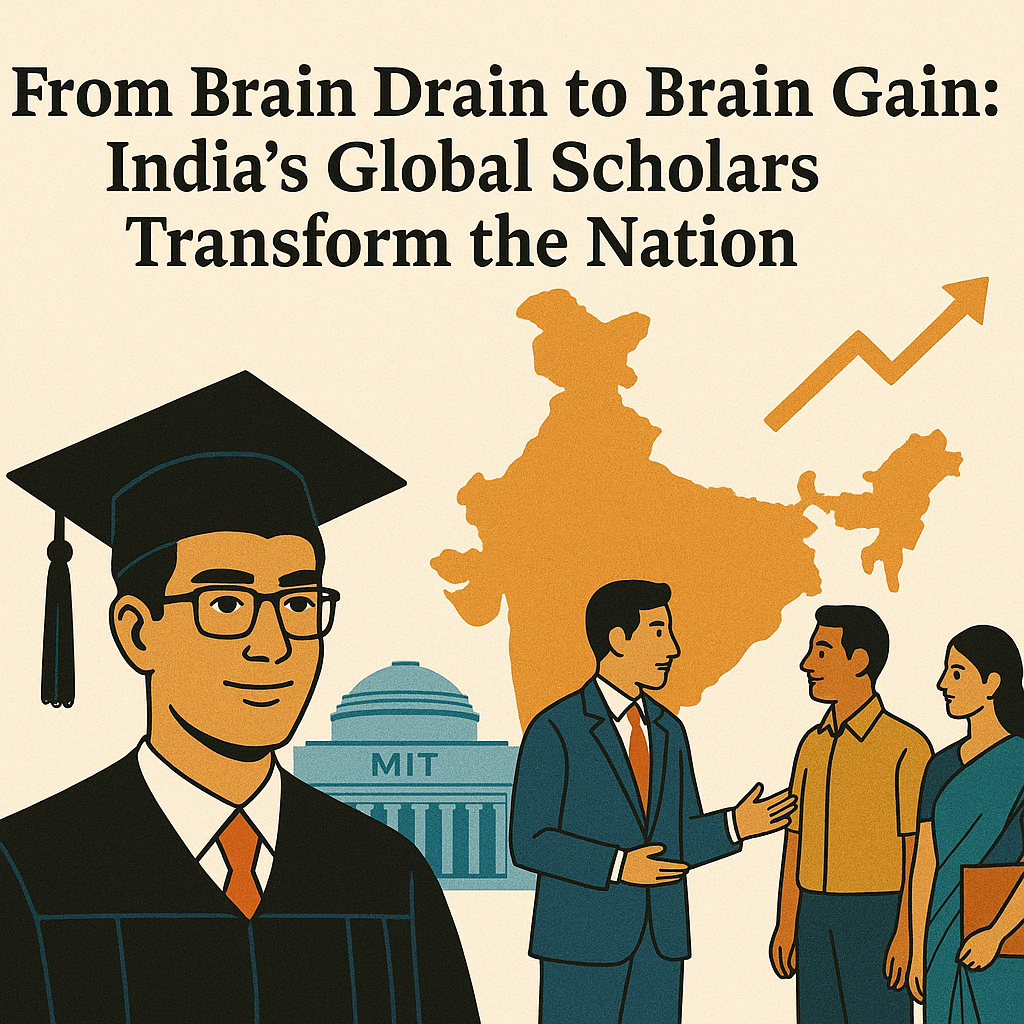
Yet amid the uncertainty, many Indian analysts and entrepreneurs are framing the move as potentially historic. Could this upheaval actually reverse India’s decades-long “brain drain”, turning it into a brain gain? India’s tech ecosystem today, with a booming startup scene, new R&D hubs, and expanding funding looks very different from the 1990s or early 2000s. As Zoho co-founder Sridhar Vembu (himself a returnee) told the media, this Visa crisis could be “an opportunity to return home and rebuild careers in India.” He urged affected IT professionals: “Do not live in fear. Make the bold move. You will do well”.
Zoho co-founder Sridhar Vembu called the H-1B fee hike a “turning point” and encouraged visa-holders to return to India and rebuild their careers.
Voices from India’s startup and finance world have echoed this optimism. Snapdeal co-founder Kunal Bahl reminded fellow entrepreneurs that his own 2007 H-1B rejection “was crushing and numbing” at the time, but ultimately led him back to India where he built his career. He told Twitter followers, “To those impacted today, be positive. There is something much bigger & better in store for you.”. Bahl predicted the visa fee hike will send “a tremendous number of talented individuals…back to India,” and that “the talent density in India is going to skyrocket.”
Similarly, Radhika Gupta, CEO of Edelweiss Mutual Fund, pointed out that India of 2025 is far more dynamic than it was 20 years ago. In a viral post she wrote: “India of 2025 is a far more exciting place than India of 2005 ever was, Chin up. Aao, ab laut chalen!”. Industry legend Vembu drew on Partition-era resilience. He noted how a community that had lost everything in 1947 eventually “flourished in independent India,” suggesting that adversity can spur new beginnings.
These reactions underscore a changing narrative. Instead of the United States being an “automatic” destination for India’s best and brightest, many in India now see opportunity at home. As one fintech founder put it, “when one door closes, many others open back home”. This shift in tone is mirrored by rapid action in India’s policymaking circles. The newly formed “Tamil Talents Plan” and other initiatives are racing to onboard returning scholars with cash grants, relocation support, and fast-tracked visas. Indian states like Tamil Nadu have also set aside special budgets (e.g. Rs.100 crore) for new research centers and university programs aimed at this demographic.
In short, the $100K H-1B fee has jolted the global tech ecosystem. It not only blocks thousands of new entrants to U.S. firms, but it incentivizes skilled Indians to stay in or return to India. In a very real sense, what looks like an American visa wall could become an open window for India; a chance to tap into a vast pool of talent right at home.
From Brain Drain to Brain Gain: Historical Context
To appreciate this moment, it helps to recall how we got here. The H-1B visa itself is not new. It was launched in 1990 to let U.S. companies hire “specialty occupation” workers. By the late 1990s and early 2000s, it became a pipeline for India’s brightest engineering and IT graduates to join Silicon Valley firms. Over time Indians came to dominate the program. By the 2010s, well over 70% of all new H-1B visas were going to Indian nationals. (Data for 2023 shows roughly 71% of approvals going to Indians, with another ~12% to Chinese.)
In practical terms, this meant hundreds of thousands of Indian techies living and working in the U.S., contributing to projects at Microsoft, Google, Amazon, JP Morgan, and beyond. For decades the H-1B was framed as a “brain drain” from India, good news for the individuals, perhaps, but bad for India’s domestic human capital. Certainly, many Indian IT professionals built lucrative careers abroad, and a sizable fraction eventually aimed for permanent residency (green cards). Yet academic research has challenged the simplistic “brain drain” view. A major study by Khanna and Morales (2017) found that H-1B immigration has actually boosted India’s tech ecosystem.
The promise of U.S. wages lured thousands of students into computer science and engineering, expanding the talent pool in India (even if many initially left). Meanwhile, those who did work in America acquired skills and networks, and many of them returned after their visas expired, bringing valuable know-how back to India. In fact, the authors concluded that the net effect was a “brain gain” for India.

This historical perspective is important. It means that even before the fee hike, the dynamics weren’t purely one-way. In the past, limitations on H-1B visas (the usual 65,000 annual cap plus 20,000 for U.S. master’s holders) had already forced many Indians to either stay home or go elsewhere. Those who remained helped grow India’s own IT services companies. When the visa-cap hit in the early 2000s, thousands of Indian engineers remained in India or elsewhere, prompting Infosys, TCS and others to invest in domestic training and services for global clients.
India’s diaspora returns have long sparked innovation. Founders of leading Indian startups (Flipkart, Ola, etc.) often spent a few years abroad before coming home. The migrants-turned-returnees have started companies, built research labs and raised venture capital in India, multiplying the impact of their foreign experience. For example, a 2024 Indiaspora report found that Indian-origin entrepreneurs founded or co-founded 72 of the 358 U.S. tech unicorns in the last five years, with a combined valuation over $195 billion and employing 55,000 people. These diaspora-led firms span AI, fintech, cloud, and many other fields. Importantly, many of those unicorn founders live partly in India today or maintain strong ties.
Likewise, Indian students in the U.S. create a large economic footprint even before they work. Pre-fee-hike data show roughly 270,000 Indian students enrolled in U.S. colleges (a quarter of all foreign students). They pump around $10 billion a year into U.S. universities and local economies through tuition and living expenses. They also contribute intellectually. About 13% of U.S. academic papers have an Indian American co-author and Indian immigrants’ share of U.S. patents rose from 1.9% in 1975 to over 10% by 2019. In short, the Indian tech diaspora built wealth and ideas both ways.
The recent visa changes now threaten to alter this long-standing exchange. If the U.S. “talent pipeline” narrows, some Indians may turn to other countries like Canada, Australia or the UAE, which have been rolling out more welcoming visas and startup schemes (the Indian government has even announced a limited program to repatriate Indian citizens illegally in the U.S. in 2025).
But equally important is the prospect that many of these highly trained people stay in India instead, enriching the local high-tech ecosystem. Experts say that the first generation to feel this pinch will include countless students, postdocs and junior professionals who would have applied for H-1B. Rather than seeking Silicon Valley, they may now launch careers in Bengaluru, Hyderabad, Pune or smaller startup hubs.
Sectoral Impacts: India’s Tech and Innovation Landscape
The H-1B policy shift touches almost every corner of India’s knowledge economy. Here we break down some key sectors:
IT Services and Software Giants: India’s big IT companies (TCS, Infosys, Wipro, HCLTech, etc.) have long deployed thousands of engineers to U.S. client sites. The new fees directly hit their cost models. Estimates suggest each top firm could end up paying $150–550 million more in visa fees based on their typical sponsorship levels. For example, TCS alone had about 5,500 H-1B workers in FY2025. If each needs a $100K fee on renewal, TCS’s operating profit (EBITDA) could shrink by 7–8% just from those cost increases. Industry analysts warn that a 7–15% cut in core profits is possible for these giants due to the fee hike.
In the short run, Indian IT firms are expected to respond by accelerating offshoring and remote work, moving more projects and jobs back to India and other countries where their employees already reside. Some roles requiring on-site U.S. presence will dwindle; others will become more expensive. Recruitment experts foresee a surge in gig-based and contract models, as U.S. companies shy away from full sponsorship costs. Over time, however, Indian IT companies may invest more in automation (AI-driven coding, low-code platforms) and domestic R&D to cut dependence on sheer manpower. The result could be a push toward higher-value work. Instead of shipping bodies to handle routine tasks, firms may double down on product development and global IP creation from India.
Importantly, Indian tech workers themselves stand to gain higher job prospects at home. Positions that might have opened in the U.S. can now be filled domestically or in hybrid teams. Many analysts note that this influx of talent could boost India’s own innovation output. India’s startup ecosystem is already the world’s third-largest, with over 100 unicorns. If even a fraction of returning engineers channel their skills into Indian startups or new ventures, the pace of new company formation and tech R&D could accelerate significantly. One VC founder told that “AI is the new gold rush” as returning engineers might start companies or join deep-tech teams, producing a “massive talent shift” that makes India’s companies more globally competitive.
AI, Deep Tech and Startups: Observers highlight artificial intelligence and related deep technologies as prime beneficiaries of this shift. Many leading U.S. AI startups and research labs were built with Indian engineers; now those engineers might build at home. “The proposed fee could accelerate a reverse brain drain into India,” “increasing the availability of skilled talent locally, particularly in AI, deeptech and SaaS”.
Investors say they are already seeing more U.S.-trained PhD graduates applying to Indian AI startups. Laina Emmanuel of BrainSight AI (a neuroscience startup) reported “a steady increase in applications from post-doctoral researchers and PhD graduates in the US looking to work in India.” She expects the H-1B order to further boost this trend, which “in the long term, will be good for Indian AI and deeptech”.
India’s government has signaled big ambitions in these fields . The INDIAai mission, new AI Centers of Excellence in Karnataka and Telangana, expanded supercomputing facilities (e.g. PARAM Siddhi), and draft frameworks for AI ethics and data sharing. These form a strong infrastructure foundation to absorb returning talent. Tech parks in Bengaluru, Hyderabad, Chennai and Delhi NCR are already home to R&D labs of Google, Microsoft, Amazon, IBM and other global giants, collectively employing tens of thousands of engineers. More U.S.-trained researchers could join these centers or start their own labs in collaboration with Indian institutes. The net effect could be a quicker maturation of India’s AI ecosystem, reducing the gap with Silicon Valley.
A big opportunity lies in product and deep-tech innovation. Historically, India’s IT workers often built products for U.S. companies. Now many commentators say the talent shift could finally help India produce its own big tech products. One software CEO warns, “If we don’t start moving from services to innovation, we risk being irrelevant. We need to invest in products. We all need to get into deep tech, building AI models.”.
Indeed, with more algorithm and ML experts staying home, India might launch more homegrown AI platforms, robotics projects, semiconductor design firms and biotech ventures. This could also diversify India’s startup scene beyond its current focus on consumer apps and services to harder tech problems (robotics, aerospace, clean energy, advanced manufacturing, etc.).
SaaS Industry: Software-as-a-Service has been a bright spot in India’s tech landscape. India is home to many SaaS startups (from enterprise software to new cloud platforms) that already serve global markets. This sector could see a surge of talent. Analysts note that the fee hike especially affects early-career techies, the very people who typically join or build SaaS companies. The H-1B changes “could accelerate a shift in the talent pool towards product-oriented companies”, including SaaS firms. Simply put, engineers who might have taken an H-1B job at a Western software firm might instead join a burgeoning Indian SaaS startup.
Academic Research and Higher Education: U.S. universities have for decades benefited from Indian graduate students and postdocs (many on H-1Bs or related visas). India and China combined account for a large majority of international STEM grad students in the U.S. The visa fee hike, and the broader anti-immigrant climate, may discourage many Indian students from staying after graduation. This could help fill positions (faculty, researchers, lab managers) in Indian universities and R&D labs. Already, about 70% of U.S. AI grad students are international; if Indian graduates return home instead of lingering on H-1Bs, India’s own universities could see a talent infusion.
The brain gain effect is already evident in research. A coalition of Indian states is planning to host returning scholars in areas like AI and basic science, with co-supervised PhDs and joint labs between returning academics and local institutions. In the last budget, India dedicated Rs.100 crore for two new R&D centers with IISc and TIFR, partly to attract such talent. Moreover, global funding cuts in U.S. science have made some fields (climate tech, AI safety, epidemiology) less secure, prompting early-career researchers (many Indian-origin) to look abroad. India’s response, building world-class labs and offering competitive fellowships could channel that expertise into domestic research ecosystems.
Of course, the transition won’t be frictionless. India’s universities still suffer from faculty shortages, bureaucratic hiring, and sometimes outdated labs (a recent IIM study noted PhD scholars often face limited resources and low stipends). If hundreds more experienced researchers return, India must ensure they have adequate facilities and incentives. But many of the conditions have begun to change. Schemes like the PM Research Fellowship (PMRF) now offer generous stipends (₹70,000/month plus ₹2 lakh contingency) to keep bright PhD candidates in India. The path is open for India to beef up its research funding, labs and industry linkages, and to value returning professors on par with hired international faculty.
Other Sectors: Beyond pure tech, the visa changes ripple into finance, healthcare, etc. Indian professionals in fields like quantitative finance, pharmaceuticals R&D, and even management consulting will find the U.S. a tougher market. Some may move to Canada, Singapore or the Middle East (already attracting talent). But many could turn to India’s own burgeoning high-skill economy. Financial engineering at Indian banks and fintechs, biotech research in Indian pharma giants, robotics and space at government labs, to name a few. In effect, any sector in India that relies on cutting-edge STEM skills stands to gain from the larger domestic talent pool.
In summary, the $100K H-1B fee is forcing a recalibration of global talent flows. American companies will try harder to hire Americans or outsource abroad, but India is uniquely positioned to capture the upside. With over 270 million youth (the world’s largest cohort under 25), booming digital infrastructure (5G, cloud, Internet initiatives), and a maturing capital market, India can indeed offer attractive opportunities. The question is whether India’s policies and ecosystem can absorb and capitalize on this surge of talent.

Each of these moves would help ensure that India’s engineers, scientists and entrepreneurs stay productive at home. As one commentator puts it, if restrictive U.S. policies are a “window” opening to India, India must simply build the house.
The $100,000 H-1B visa fee has dominated headlines as a blow to Indian techies. But beneath the alarm lies an unprecedented opportunity. India now has a chance to reverse its brain drain by keeping talented citizens at home and attracting its expatriates back. The ingredients are already in place. A deepening venture ecosystem, record startup counts, global R&D centers on Indian soil, and a young population hungry for opportunities.
If India rises to the moment with bold policies and investments, the country could see a surge of homegrown innovation in everything from AI and SaaS to semiconductors and pharmaceuticals. In the long run, this “H-1B moment” may well mark India’s transition from a provider of talent to a creator of global technology. The closed door of U.S. immigration might just prove to be an open invitation to reimagine India’s own ascendancy on the world tech stage.