Leak-Proof Or Proof Of Leaks? How Eduquity Managed To Stress Out An Entire Generation?
Eduquity’s trajectory from pioneering exam vendor to lightning rod for scandal reflects systemic weaknesses in India’s testing ecosystem. The firm continued to win contracts despite blacklisting and repeated malpractices because tenders prioritised low bids and no unified blacklist existed. Major controversies included the 2022 MP Teacher Eligibility Test leak and the 2023 Patwari exam irregularities, which exposed lax oversight and alleged political patronage. The 2025 SSC Phase‑13 fiasco, however, thrust Eduquity into national focus when software crashes, cancellations and protests affected over five lakh candidates. Official responses cited “teething problems” and promised reforms, yet students demanded the company’s removal amid allegations it was still blacklisted.


Silver Jubilee of Eduquity: How a Testing Firm Became the Centre of India’s Examination Controversies
Recently, we saw the press release update regarding SSC exams, CGLE 2025. Immediately the mind shifted to the SSC exam fraud that took place a couple of months ago.
The Indian public-examination landscape has undergone dramatic changes over the last decade. After a long period during which government recruitment and professional‐school entrance tests were mostly administered by state boards and universities, the late 2010s saw an explosion of third-party exam vendors offering computer‑based testing solutions. Among these vendors is Eduquity Career Technologies Pvt Ltd, a Bengaluru‑based company founded in 2000. The firm markets itself as a pioneer of online testing and boasts of having assessed over 100 million candidates.
However, within the last 10 years Eduquity has become synonymous with controversies ranging from paper leaks to technical failures and accusations of bid rigging. The piece traces all major stories about Eduquity between 2015 and 2025, reconstructing a timeline of key events, analysing the legal and ethical issues, and examining why the firm continues to win contracts despite a chequered past. The narrative is built on publicly available sources, and all factual claims are supported with citations.
Eduquity Career Technologies was established in June 2000 in Bengaluru by Ramachandra Dhirendra and Visweswar Akella. According to company filings and the firm’s own promotional material, it introduced computer‐based testing in India and claims to have proctored over 100 million candidates across government, education and corporate sectors. Eduquity operates as a service provider rather than a content creator. It designs exam schedules, provides computer infrastructure, manages logistics at exam centres and administers results. The company positions itself as offering “best‑in‑class assessment solutions,” emphasising scalability, security and accuracy. Its website showcases long‑term contracts with public bodies, universities and companies and boasts numerous industry certifications. By the mid‑2010s, Eduquity had become one of the largest private exam vendors in the country.
Between 2015 and 2019, there were few reports of major controversies involving Eduquity. The company appeared to operate quietly, handling recruitment tests for public‑sector units and professional bodies. Third‑party exam administration itself was relatively new in India, and most newspapers focused on the performance of more established vendors like Sify, MeritTrac or Tata Consultancy Services (TCS). As Eduquity’s profile grew, however, so did scrutiny of its operations.
2020: Blacklisting by the Directorate General of Training
The first major national story about Eduquity emerged in 2020. Investigative journalists reported that the Central Directorate General of Training (DGT), an agency under the Ministry of Skill Development and Entrepreneurship, had declared Eduquity “ineligible” to conduct examinations after finding irregularities in its operations. Eduquity was officially “made ineligible or blacklisted by the Central Directorate General of Training”. Contemporary reports suggest the DGT order stemmed from allegations that Eduquity had mismanaged a national apprenticeship examination. Though the details of the order were not widely publicised, the blacklisting became a key reference point in subsequent controversies.

The blacklisting should, in theory, have barred Eduquity from receiving government contracts. However, because India lacks a coordinated national blacklist and each state maintains its own tendering rules, the impact was limited: Eduquity could still bid for projects issued by departments that did not check the DGT’s sanctions list. This loophole would prove significant in later years.
2022: Madhya Pradesh Teacher Eligibility Test (MP‑TET) Leak
Eduquity returned to the headlines in March 2022 when the Madhya Pradesh Teacher Eligibility Test (MP‑TET) question paper surfaced on social media before the exam. Investigations revealed that Eduquity, despite the DGT blacklisting, had been contracted to conduct the MP‑TET. Eduquity subsequently subcontracted the work to a Rajasthan‑based firm, Sai Educare Pvt Ltd, allegedly after offering a commission. The outsourcing violated tender conditions and compromised security: soon after, the exam paper leaked widely. The scandal was compared to the notorious Vyapam scam of the previous decade, and local media dubbed it “Vyapam 2.0.”
Madhya Pradesh authorities were forced to cancel and reschedule the test. For thousands of teacher aspirants, many of whom had spent years preparing, the leak meant further delays and uncertainty. Yet, no serious penalties were imposed on Eduquity at this stage. The firm continued to operate in other states, and there was no nationwide decision to blacklist it.
2023: The Patwari Exam Scandal and Recurring Contracts
Judicial Inquiry into the Patwari Exam
The next major story unfolded in 2023 with the Madhya Pradesh Patwari recruitment exam. Eduquity again won the contract to administer this test, even though it had been embroiled in the MP‑TET leak. The Patwari exam witnessed “mass allegations of malpractice and foul play,” including false disability applications, age‑norm violations and suspiciously clustered high scores. It notes that seven of the top ten state toppers wrote the exam at the same centre, which happened to be owned by Bhind MLA Sanjeev Kumar Kushwaha, a member of the ruling Bharatiya Janata Party. Over 30 candidates allegedly faked disabilities to secure reserved seats; at least 217 candidates violated age norms; and experts flagged bogus high scores.
Facing public outrage, Madhya Pradesh chief minister Shivraj Singh Chouhan suspended the recruitment process and announced a judicial inquiry headed by a retired high court judge. The Patwari scandal was soon dubbed “Vyapam 2.0” or the new Vyapam scam, highlighting the perceived parallels with the earlier multi‑state exam frauds. Despite the controversies, the Madhya Pradesh Employees Selection Board again awarded Eduquity a contract in December 2023, an act widely criticised as evidence of regulatory failure.
National Testing Agency Contract and Other Deals
Around the same time, the National Testing Agency (NTA), established by the Ministry of Education to conduct entrance tests like NEET and JEE, issued a tender for computer‑based exams. It was reported that in March 2023 Eduquity was among the vendors selected to conduct NTA’s exams. The news sparked concerns given the firm’s recent track record, but NTA maintained that separate content agencies would set and deliver question papers, limiting any single vendor’s influence.
Eduquity also continued to secure other state contracts. In Maharashtra, the company administered the MBA Common Entrance Test (CET). The March 2023 exam was marred by technical issues like blank screens, crashes and server delays, leading some candidates to demand a re‑examination. Reports emphasised that Eduquity had already been declared ineligible by the DGT, yet state authorities kept awarding new tests, citing the company’s low bids and the absence of a unified blacklist. This pattern of controversies followed by new contracts became a leitmotif in Eduquity’s story.
2024: Growing Scrutiny and Fragmented Oversight
Although 2024 did not feature a single high‑profile exam leak like the MP‑TET, scrutiny of Eduquity continued. Journalists and activists highlighted the structural issues that allowed a firm with a troubled record to keep winning tenders.
- Low bids: Investigations noted that Eduquity often quoted significantly lower fees per candidate compared to larger competitors like TCS. For instance, during the 2025 SSC tender (discussed later), Eduquity bid ₹220 per candidate while TCS quoted ₹350, enabling the former to secure the contract. Cash‑strapped state boards were thus tempted to choose the cheapest option, even at the cost of quality.
- No central blacklist: States maintain their own lists of barred vendors. A company blacklisted by one department can still bid in another state because there is no unified database of sanctions. This regulatory gap allowed Eduquity to navigate around restrictions.
- Outsourcing and subcontracting: Eduquity’s business model involved subcontracting exam operations to smaller firms, as seen in the MP‑TET case. This practice made it difficult to ensure accountability and compliance.
These systemic issues set the stage for 2025’s explosive events.
2025: The SSC Phase‑13 Exam Fiasco
Switching from TCS to Eduquity
In early 2025, the Staff Selection Commission (SSC), the central agency responsible for recruiting Group B and Group C staff for ministries and departments decided not to renew its long‑standing contract with Tata Consultancy Services (TCS) and instead awarded the tender to Eduquity Career Technologies. The decision was significant: SSC examinations affect millions of candidates across India. TCS had built a reputation for stable exam administration, and the switch to a relatively smaller, controversial firm raised eyebrows. Around 5.5 lakh candidates sat for the first SSC Selection Post Phase 13 exam on 24 July 2025, the first test administered by Eduquity.
Technical Glitches and Cancellations
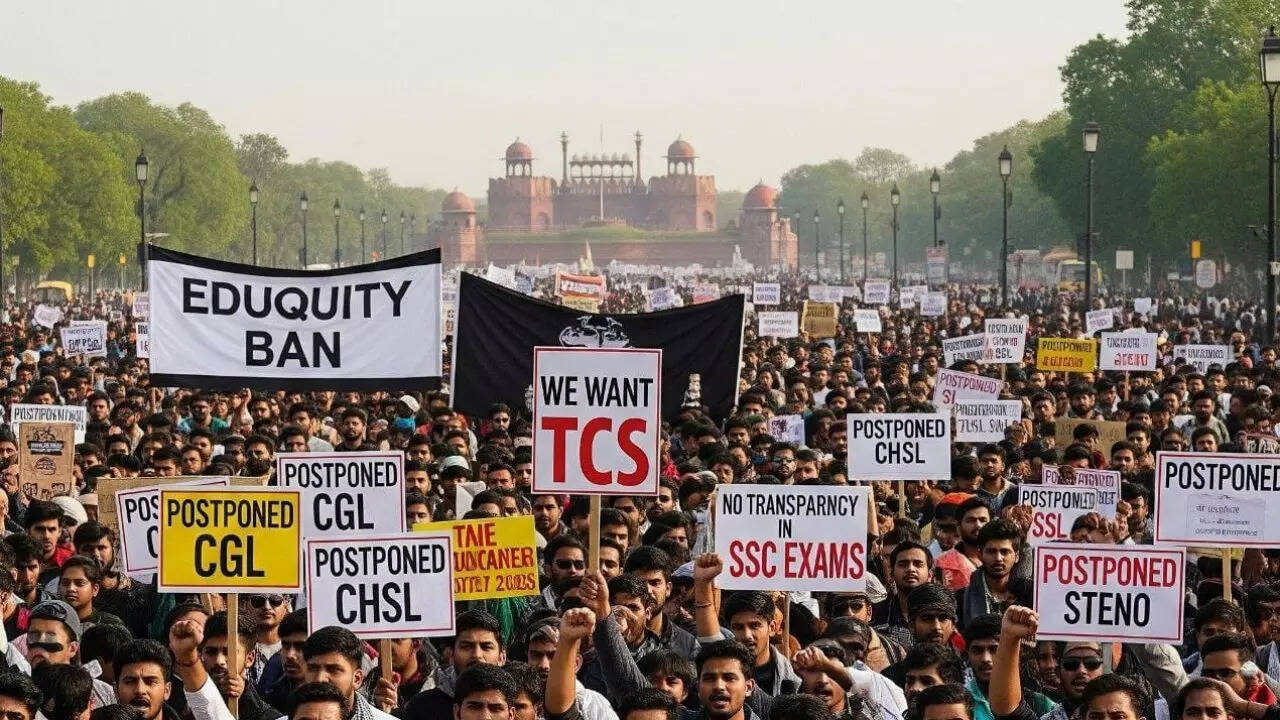
The Phase‑13 examination quickly descended into chaos. Candidates across multiple centres reported software crashes, duplication of questions and non‑functional computer mice. How aspirants were forced to sit in poorly ventilated rooms until late in the evening while invigilators ignored complaints or made social‑media reels? Some examinees lost up to 15 minutes because the system auto‑submitted their papers due to server errors. Others found that their biometric verification failed or that their exam centre was in a remote location hundreds of kilometres away. At one centre, cattle heads were reportedly stored on the ground floor while students attempted to take an exam on the upper floor?
The software glitches led to abrupt cancellations at several centres, like sudden cancellations, software crashes, biometric failures and misallocation of centres plagued the exam. Many students demanded that Eduquity be removed from future SSC examinations, arguing that a firm allegedly linked to the Vyapam scam should not be entrusted with high‑stakes tests. Social‑media hashtags like #SSCMismanagement and #SSCVendorFailure trended nationwide, and thousands of aspirants gathered in Delhi’s Jantar Mantar to protest.
Protests and Police Crackdown
As protests grew, aspirants and teachers reported heavy‑handed police action. It was noted that students and even teachers were detained and subjected to lathi charges (baton charges). Protesters alleged that bouncers were employed at exam centres to intimidate candidates and silence complaints. Videos circulated on social media showed aspirants being herded into buses, prompting demands for an inquiry into the use of force. Organisations such as the National Students Union of India (NSUI) joined the demonstrations and called for the cancellation of Eduquity’s contract.
Official Response and Explanations
The scale of the fiasco forced SSC officials to respond. In interviews with a media house, SSC chairman S. Gopalakrishnan admitted that there were “bugs” in the system but claimed that the problems affected only two of the 194 centres. A detailed analysis by the Centre for Development of Advanced Computing (C‑DAC) identified about 59,000 candidates impacted by system disruptions; these candidates were offered retests in late August 2025. SSC postponed other exams and promised improvements.
Gopalakrishnan also outlined reforms that the SSC had moved away from a single‑vendor model and now distributed responsibilities among four agencies, one for content creation, another for question delivery, a third for IT security and a fourth (Eduquity) for exam administration. The aim, he said, was to prevent any single company from “hijacking” an exam. He argued that protests were amplified by coaching institutes seeking to protect their business models and insisted that Eduquity had won a transparent tender in which TCS ranked third.
In a separate interview with another media house, Gopalakrishnan dismissed claims that Eduquity was blacklisted. He asserted that the agency selection followed an open tender process and that any blacklisted firm would have been automatically disqualified. He acknowledged disruptions, citing software crashes, unresponsive mouses and cancelled exams, but argued that the SSC was developing command control rooms, a real‑time log analysis system and Aadhaar‑based authentication to improve security. Gopalakrishnan also explained that centre allocations depended on the availability of computer labs and insisted that candidates were not forced to travel long distances.
Legal Challenge: MP High Court Notice
While the SSC saga unfolded, the Madhya Pradesh High Court delivered a blow to the firm. On 12 February 2025, a division bench issued notices in a petition alleging that the MP Staff Selection Board had chosen blacklisted companies, Eduquity and Mumbai‑based Aptech, to conduct online recruitment exams. The petitioner argued that both firms had been blacklisted by various state agencies and should not have been considered. The high court asked the companies, the MP selection board and the skill development ministry to respond. The case underscored the ongoing tension between state‐level tenders and existing blacklists.
Independent Reports and Analyses
Several organisations published deeper analyses of the Eduquity crisis.
- Legal Maestros released a detailed report titled “Eduquity Career Technologies’ Alleged Fraud, Political Donations, and Constitutional Rights Violations in the Wake of SSC Protests.” It traced Eduquity’s history and argued that the firm’s repeated contract wins, despite being blacklisted, point to state capture and “undue influence” in procurement. The report highlighted the Madhya Pradesh recruitment scams, the Phase 13 fiasco and the broader pattern of exam malpractices. It concluded that such failures infringe on students’ constitutional rights to equality and livelihood.
- Dynamite News published a story emphasising that Eduquity’s technical failures were not isolated and that the company had links to the Vyapam scam. The article detailed student grievances (cancellations, software crashes, biometric failures and remote centre allotments) and documented the protests demanding Eduquity’s removal.
- LawChakra chronicled aspirants’ experiences, including poor infrastructure, bouncers at centres and intimidation. It noted that many aspirants travelled hundreds of kilometres only to face cancellations. The article also quoted Delhi University Students’ Union (DUSU) president Ronak Khatri blaming the tender’s lowest‑bid criterion for the fiasco. These reports amplified calls for structural reforms—pre‑approved vendor audits, trial runs, live support systems and penalty‑linked contracts—to restore trust.
Aftermath and Continuing Discontent
By September 2025, SSC claimed that most technical issues had been resolved and that exams were running smoothly. Times of India reported that SSC suspected some protests were instigated by coaching institutes and emphasised that “no major disruptions” were expected in upcoming exams. Nevertheless, many aspirants remained sceptical, and social‑media campaigns calling for Eduquity’s removal continued. The experience of the Phase 13 exam had eroded public trust in the SSC and highlighted vulnerabilities in India’s outsourced exam infrastructure.
2025 – 2026: Ongoing Investigations and Legal Debates
Following the explosive events of mid‑2025, further legal and political developments occurred:
- Petitions and court cases: The MP High Court petition challenging the selection of blacklisted firms continued. The outcome could set a precedent for whether government bodies must check national blacklists before awarding contracts.
- Calls for a national blacklist: Activists, journalists and even some officials urged the central government to create a unified list of banned exam vendors. Without such a list, companies like Eduquity could remain eligible in some jurisdictions while banned in others.
- Legislative changes: The Parliament passed the Public Examinations (Prevention of Unfair Means) Act, 2024—a law aimed at preventing cheating and malpractices in public exams. Critics argued that implementation would be ineffective without strict enforcement against errant vendors.
- Media investigations: Outlets such as Newslaundry, Inventiva and TwoCircles.net continued to expose exam malpractices. They emphasised that the problem was not limited to Eduquity; other firms like Satvat Infosol, Aptech and NSEIT also faced allegations. However, Eduquity remained in the spotlight due to the scale of the SSC fiasco.
Impact on Students and the Examination Ecosystem
The consequences of repeated exam disruptions are profound. Millions of aspirants invest years preparing for competitive exams. When tests are leaked, cancelled or mismanaged, candidates must re‑schedule their lives, often losing age eligibility for other recruitment cycles. Frequent cancellations erode trust in public institutions and discourage talented candidates from pursuing public service careers.

Legal analyses emphasise constitutional dimensions: exam malpractices infringe on the right to equality (Article 14) and right to life and livelihood (Article 21). Students from rural or underprivileged backgrounds are disproportionately affected because they lack the resources to travel to faraway centres or retake exams. The repeated awarding of contracts to blacklisted vendors undermines the credibility of the procurement process and suggests that transparency and accountability are not priorities.
Firms like Eduquity have grown to be a deadly monster for Indian’s examination system in the first 25 years of the century. Will the Indian Examination System will be fool proof in the next 25 years of Indian democracy?
The period between 2015 and 2025 saw Eduquity Career Technologies evolve from a little‑known exam vendor into a lightning rod for debates about outsourcing, accountability and fairness in India’s public examinations. The company’s troubles trace a consistent pattern: after being declared ineligible by one government body, it continues to secure contracts elsewhere; after presiding over a paper leak or a technical fiasco, it still wins new tenders. This pattern is not solely a reflection of one company’s practices but a symptom of systemic weaknesses—fragmented regulation, opaque tender processes and a willingness to prioritise low cost over reliability.
The MP‑TET leak (2022) and Patwari exam scandal (2023) exposed serious security lapses and political anomalies. The NTA contract (2023) and Maharashtra MBA CET controversies underscored how quickly authorities move past failures. The SSC Phase‑13 fiasco (2025) brought the issue into the national spotlight: software crashes, cancelled exams and police crackdowns triggered protests across India and forced the SSC chairman to publicly defend the selection of Eduquity. Even as court cases and media reports question why blacklisted firms remain eligible, the underlying structures enabling such deals persist.
Ultimately, the Eduquity saga is a cautionary tale for policymakers. Public examinations are gateways to careers and higher education. They carry heavy expectations from millions of young people. Allowing a vendor with a chequered record to repeatedly compromise these exams harms not only individual aspirants but also the credibility of the state. The next decade must see systematic reform—centralised blacklisting, transparency, penalties and independent oversight—so that the promise of fair examinations is not undermined by the pursuit of low costs or political patronage. Only then can India’s examination system match its ambitions for equitable and efficient governance.