India’s IPO Boom and the Rise of MNC Listings
India’s capital markets have been on a tear. 2024 and 2025 together witnessed hundreds of initial public offerings (IPOs) as companies rushed to tap one of the world’s most liquid emerging‐market pools of capital. Investment bankers estimate India could raise US$25 billion in IPO proceeds in a single year, with an additional US$15–20 billion coming through qualified institutional placements and block deals.
These mammoth fund‐raises are not solely driven by Indian entrepreneurs; they also reflect a new willingness among multinational corporations (MNCs) to list their Indian subsidiaries. In 2024, Hyundai Motor India Ltd. became the first South Korean company to list on the Indian bourses, raising about Rs 27,860 crore (US$3.3 billion) in the country’s largest IPO at the time. Less than a year later, LG Electronics India Ltd. filed a draft red‑herring prospectus (DRHP) seeking to raise about Rs 15,000 crore, and analysts expect it to be one of the biggest IPOs of 2025.
While investors have generally viewed these deals as votes of confidence in India’s growth story, a closer look reveals a number of red flags, particularly in the case of LG Electronics India. LinkedIn influencer Mr Jayant Mundhra exposes the “big red flags” in LG’s DRHP, draws parallels with Hyundai Motor India’s IPO, and examines the broader pattern of Korean and other MNC IPOs in India. It asks whether these offerings create long‑term wealth for public investors or are primarily exit routes for promoters. To ensure objectivity, the report draws on verified news articles and other publicly available documents, citing sources throughout.
LG Electronics India: Background and IPO Structure
The Business and Its Market Position
LG Electronics India Ltd. (hereafter LG India) is a wholly owned subsidiary of South Korea’s LG Electronics Inc. The company operates in two major segments, home appliances and air solutions and home entertainment, and is among the market leaders in washing machines, refrigerators, televisions and air conditioners. The company’s DRHP notes that its value market share in the offline channel puts it at the top position in key categories including washing machines, refrigerators and panel TVs.
Structure of the IPO
LG India’s proposed IPO will be a pure offer for sale (OFS). The South Korean parent intends to sell about 101.8 million shares, representing 15 % of the post‑issue equity, while retaining approximately 85 %. Importantly, no new shares will be issued. Thus, the entire INR 15,000 crore raised will go directly to the Korean parent rather than to the Indian subsidiary for expansion or debt reduction. Financial analysts note that this structure is designed to cash in on the Indian market’s rich valuations, similar to Hyundai’s OFS the previous year.
Unpacking LG’s DRHP: The Red Flags
LG’s DRHP contains a number of risk disclosures that have largely escaped mainstream scrutiny. When studied closely, they reveal potential conflicts of interest and governance concerns that could undermine the long‑term prospects for Indian investors.
1. No Exclusivity Agreement With the Parent
The biggest shock in the DRHP is LG India’s admission that it does not have an exclusivity agreement with its parent. The prospectus states that the parent is “currently not engaged in businesses that compete with ours in India,” but emphasises that “the promoter may in the future engage in businesses that compete with ours because we do not have any exclusivity arrangement”.
In plain language, LG India’s controlling shareholder reserves the right to start a rival consumer‑electronics business in India at any time. This could not only erode market share but also give rise to conflicts of interest as the same group controls both entities. The DRHP further notes that such conflicts “may adversely affect our business, financial condition and results of operations”.
This disclosure is extraordinary because most MNC subsidiaries listed in India sign cross‑licensing or non‑compete agreements with their parents to protect the brand. For example, Hindustan Unilever, Nestlé India and Colgate‑Palmolive (India) operate under long‑term licensing agreements that prevent their global parents from introducing competing brands domestically. LG’s lack of an exclusivity clause therefore stands out and warrants intense scrutiny.
2. Potential Internal Competition via Hi‑M Solutek India
LG India also singles out Hi‑M Solutek India, an indirect wholly owned subsidiary of the Korean parent specialising in servicing LG’s air‑conditioning products. The DRHP notes that the Indian subsidiary currently relies on this sister company for maintenance services but has no exclusive contractual arrangement with it. Moreover, “there is no assurance that Hi‑M Solutek India will not expand their business in the future to compete with ours or to provide services for our competitors”. This wording implies that LG could, at its discretion, allow Hi‑M Solutek India to service rival brands or even start competing operations. Essentially, the parent is keeping the option open to cannibalise LG India’s service revenue or use its service arm to compete directly.
3. Conflicts of Interest and Corporate Governance
Taken together, the lack of exclusivity and the potential for internal competition suggest deeper governance challenges. LG India candidly notes that these circumstances “may give rise to conflicts of interest”. This is not just legal boilerplate. If the parent launches a competing brand or uses Hi‑M Solutek to service competitors, LG India’s management will effectively be answerable to a parent whose interests may no longer align with those of minority shareholders. Without structural safeguards such as independent majority boards or ring‑fenced service contracts, the parent could shift high‑margin products or distribution rights to its own unlisted entities.
4. Why Signal Such Risks?
One obvious question arises; Why would LG voluntarily disclose this possibility if it has no intention of pursuing it? The Times of India article covering the prospectus notes that Hyundai’s IPO documents did not contain any comparable clause. This suggests LG deliberately wants to preserve strategic flexibility, perhaps to restructure global operations or to leverage its Indian service network across multiple brands. Regardless of the rationale, the language signals that LG’s management is either unwilling or unable to give Indian investors the assurances typically provided by other multinational parents.
5. Value Extraction Without Capital Infusion
Because the IPO is entirely an OFS, the proceeds will not be used to build capacity or strengthen LG India’s balance sheet. The DRHP states that the company plans to build a new factory in Andhra Pradesh and expand its local sourcing from 45 % to 58.3 %, yet these initiatives will be funded from internal cash flows. With no new equity infusion, LG India’s capital base will remain unchanged while the parent receives INR 15,000 crore. Investors must ask whether the listing is primarily a wealth‑transfer exercise benefiting Korean shareholders rather than a catalyst for growth in India.
Hyundai Motor India: A Precedent for Korean IPOs
LG’s IPO is not happening in isolation; it follows Hyundai Motor India’s blockbuster listing in October 2024. Analysing Hyundai’s IPO provides a useful benchmark for assessing patterns in Korean companies’ listing strategies and the potential pitfalls for investors.
Hyundai’s Offer for Sale and Stake Sale
Hyundai Motor India Ltd. (HMI) floated the largest IPO in Indian history, raising US$3.3 billion by selling about 17.5 % of its shares via an offer for sale. Similar to LG, Hyundai issued no new shares; the entire sum went to its Korean parent. The Reuters report notes that the listing aimed to reduce Hyundai Motor India’s dependence on its parent and to provide financial muscle for expansion. However, because the Indian subsidiary received no new capital, the company’s ability to expand hinged on retained earnings and future borrowings. The parent still retained about 82.5 % of the post‑issue share capital, leaving limited floating stock and ensuring continued control.
Risk Factors and Royalty Payments
Hyundai’s prospectus did not include an explicit non‑compete risk. However, financial analysts flagged other risk factors. In an NDTV article summarising the IPO, investor Deepak Shenoy highlighted concerns about rising royalty payments to the Korean parent, the possibility of pre‑IPO dividends, and the challenge of competing in India’s crowded automobile market. He argued that investors should focus on substantive risks like royalties and competition rather than on secondary issues such as the OFS structure.
The Mint article emphasises that royalty payments to the parent were increasing and that competition from Kia, another brand owned by the Hyundai group, could affect sales. Reuters also reported that Hyundai’s risk disclosures included dependence on its Korean parent, related‑party transactions and the unavailability of government incentives for electric vehicles.
Listing‑Day Performance and Investor Losses
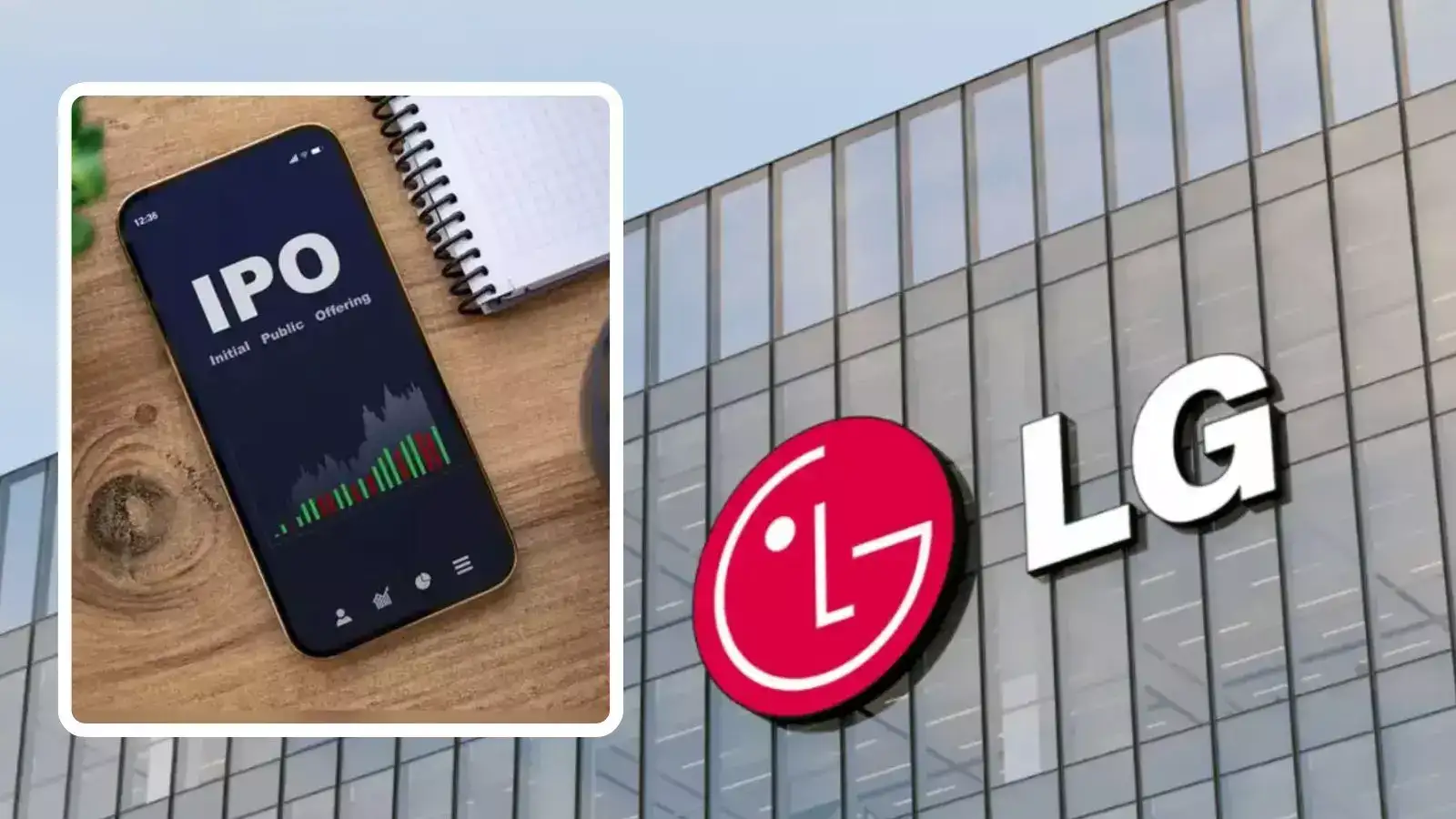
Despite being oversubscribed, Hyundai’s stock stumbled on debut. On its listing day, shares fell 7.2 % from the issue price of INR 1,960 to close at INR 1,819.60, valuing the company at about US$17.6 billion, below the targeted US$19 billion. Reuters noted that retail investors were deterred by the lofty valuation and that seven of India’s 10 largest IPOs had seen share price falls on their first day of trading. Analysts attributed the weak debut to the stiff price, near‑term weakness in car sales and the increase in the royalty rate paid to the South Korean parent from 2.5 % to 3.5 %. These factors underscore the risks inherent in investing in large OFS‑driven MNC listings.
Lessons for LG’s IPO
The Hyundai experience provides several cautionary lessons:
- Pricing risk: Even a popular brand can see its shares fall on debut if the valuation is stretched. Hyundai’s P/E multiple was only slightly lower than Maruti Suzuki’s, yet it commanded a smaller market share. LG investors should scrutinise valuation metrics carefully.
- Royalty and related‑party payments: Rising royalty payments to the parent can erode margins and reduce profits available to shareholders. If LG’s royalty structure mimics Hyundai’s, future profitability could decline.
- Dependence on parent: Like Hyundai, LG remains majority‑owned by its parent, so strategic decisions may prioritise the parent’s global interests over those of Indian minority shareholders.
- Listing‑day volatility: Large OFS issues can see volatile trading and even negative listing day performance. Investors drawn by hype should be prepared for near‑term losses.
Patterns in Korean MNC IPOs in India
With Hyundai and LG being the only South Korean companies to tap India’s public markets, the sample is small but telling. Some patterns stand out:
- Pure Offer for Sale: Both IPOs are structured entirely as OFS, with no new capital being raised. In Hyundai’s case, the sale raised up to US$3 billion; LG’s sale aims to raise about US$1.8 billion. The proceeds go straight to the Korean parent, leaving the Indian unit’s capitalisation unchanged.
- Majority Retention by Parent: After listing, both parents retain controlling stakes of more than 80 %. This means minority shareholders have little say in corporate decisions.
- High Valuation Expectations: Both offerings are priced aggressively, often drawing comparisons to domestic leaders (Maruti in automobiles and Havells/Voltas in appliances). Hyundai’s issue was valued at 26 times FY24 earnings; analysts worry LG will seek a valuation comparable to or even exceeding its global parent.
- Royalty and Related‑Party Transactions: In both cases, the subsidiaries pay royalties to the parent for brand and technology. Hyundai increased its royalty rate just before the IPO, while LG’s DRHP discloses its dependence on Hi‑M Solutek for services, hinting at potential future related‑party pricing issues.
- Potential for Parent‑Driven Competition: LG’s DRHP explicitly allows the parent to start competing businesses in India. Hyundai’s risk factors note potential competition from Kia, though Kia is part of the same group rather than an internal division. In both cases, the presence of other brands owned by the parent underscores the risk that future products may cannibalise the listed unit’s market share.
- Limited Historical Precedent: The NDTV article notes that LG will be only the second South Korean company to tap Indian markets after Hyundai. This paucity of examples makes it difficult for investors to draw comfort from precedent; each case must be evaluated on its own merits.
The Broader IPO Landscape: OFS Dominance and Exit Routes
The red flags in Korean IPOs mirror a wider issue in the Indian primary market. The dominance of offer for sale transactions. According to data cited by Fortune India, out of ₹52,213 crore mobilised through 28 IPOs in the first seven months of 2025, nearly two‑thirds (₹33,016 crore) came from OFS by existing shareholders. Fresh capital accounted for ₹19,197 crore.
Thus, the majority of recent IPO proceeds do not fund corporate expansion but enable promoters or early investors to cash out. Investment banker Rahul Saraf told The Times of India that equity transactions today are mostly OFS, a trend that investors have come to accept. He argues that high‑quality paper entering the market deepens liquidity, even if it doesn’t fund growth.
For investors, however, this shift raises concerns. OFS‑driven IPOs can serve as exit routes rather than means to build long‑term shareholder value. In many cases, private equity funds or global parents reduce their stakes when valuations are favourable. While there is nothing inherently wrong with owners taking money off the table, retail investors must recognise that they are buying into mature businesses that may not need capital but still face growth challenges.
The “80 %” Argument
Market commentators often claim that “80 % of IPOs serve as exits”. Although comprehensive data is hard to verify, the Prime Database figures cited by Fortune India, where two‑thirds of 2025 IPO proceeds were OFS, lend credibility to the assertion that exit‑driven issues dominate. Analysts caution that only a minority of IPOs, perhaps 20 %, raise significant new capital and focus on long‑term value creation. The rest simply recycle equity from one set of investors to another, often at the highest possible valuation.
The Impact on Indian Securities Markets and Investors
Wealth Creation vs. Wealth Transfer
The primary question for Indian investors is whether these mega‑IPOs create wealth or transfer it abroad. Since LG and Hyundai’s offerings are pure OFS, the proceeds flow back to South Korea. From an economics perspective, the Indian market benefits from liquidity and depth, but the capital raised does not translate into domestic investment. If the listed subsidiary continues to pay significant royalties and service fees to the parent, a portion of future profits will also flow outward.
Valuation Risk and Listing‑Day Volatility
Hyundai’s experience shows that aggressively priced IPOs can lead to immediate losses. Retail investors who bought into the IPO at the upper end of the price band saw their holdings drop 7 % on day one. By contrast, institutional investors often receive anchor allotments at discounted rates and may exit quickly to lock in profits. With LG expected to command a valuation nearly equal to its global parent, there is a real risk that the share price could correct after listing, especially if the broader market turns volatile or if quarterly results disappoint.
Long‑Term Growth Prospects
Despite the red flags, LG and Hyundai both operate in sectors with strong growth tailwinds. India’s consumer‑electronics market is expanding as per‑capita incomes rise. LG plans to build a third factory in Andhra Pradesh and increase local sourcing, suggesting ongoing investment. Hyundai is ramping up production of electric vehicles and SUVs. But without fresh capital infusion from the IPO proceeds, the subsidiaries will have to rely on internal accruals. If competitive pressures intensify, either from parent‑owned brands like Kia or from new entrants, profit margins could be squeezed.
Corporate Governance Concerns
The DRHP’s acknowledgement of potential internal competition raises questions about minority shareholder protections. In most developed markets, related‑party transactions and potential conflicts are tightly regulated. In India, securities laws require disclosure but do not necessarily prohibit such structures. The onus is on investors to assess whether management and independent directors have the will to enforce arms‑length dealings. Without a non‑compete clause, LG’s board could approve strategies that favour the parent’s interests. The absence of an exclusivity agreement is therefore not merely a legal technicality; it signals a governance philosophy that may prioritise global strategy over local minority interests.
Impact on Market Confidence
High‑profile listings with post‑listing price declines can dent retail investor confidence. Reuters notes that seven of the top ten IPOs in India saw their share prices fall on debut. If LG’s issue experiences a similar fate, especially after revelations about internal competition, investors may become wary of future MNC listings. This could raise the cost of capital for genuinely growth‑oriented companies.
Investigating Similarities and Differences With Other MNC Listings
Although the focus here is on Korean companies, it is instructive to compare LG and Hyundai’s strategies with those of other multinational firms operating in India.
Hindustan Unilever and Nestlé India: The Gold Standards
Hindustan Unilever (HUL) and Nestlé India are often cited as examples of successful MNC listings. Both are long‑established and enjoy dominant market shares. While their global parents (Unilever PLC and Nestlé SA) continue to own large stakes, the Indian units are responsible for a significant share of group profits. Importantly, these companies operate under long‑term licensing and non‑compete agreements that prevent the parent from introducing competing brands in India.
Their prospectuses did not highlight any risk of internal competition. Moreover, both have consistently invested in new capacity, product innovation and distribution. As a result, they have delivered steady dividends and market‑beating returns over decades. When investors buy HUL or Nestlé India, they are buying into growth rather than providing an exit to the parent.
Colgate‑Palmolive (India) and Gillette India
Colgate‑Palmolive (India) and Gillette India also operate under licensing agreements, paying royalties to their global parents. However, the royalty agreements are often capped as a percentage of sales and are subject to board approvals and regulatory scrutiny. Neither parent has signalled intent to start competing businesses in India. These companies therefore illustrate that royalty payments and parent control need not always be red flags, provided there is governance transparency and a clear alignment of interests.
New‐Age Tech IPOs: Paytm and Others
The Paytm IPO offers a cautionary tale on valuation and exit dynamics. The company raised Rs 18,300 crore through a mix of fresh issue and OFS in November 2021 but saw its share price plunge more than 25 % on listing day and continue to languish. Many early investors, including SoftBank and Alibaba, used the IPO to pare their stakes. Investors who subscribed at the issue price have yet to recover their money. While Paytm is not an MNC, the episode underscores that exit‑driven IPOs, whether domestic or foreign, can destroy shareholder value. Hyundai’s listing day slump and LG’s risk disclosures should be read in this broader context.
Possible Motives Behind LG’s Risky Structure
Why would a global giant like LG include such alarming clauses in its DRHP? Several hypotheses emerge:
- Strategic Flexibility: LG may wish to preserve the option of restructuring its Indian operations without being constrained by exclusivity clauses. For example, it could spin off premium product lines into a new entity or enter the growing services space through Hi‑M Solutek India.
- Leverage Over Minority Shareholders: By signalling the possibility of internal competition, LG may retain greater negotiating power with minority investors and regulators. It underscores that the parent can always shift resources if it feels constrained by the listed arm.
- Future M&A or Joint Ventures: LG might be planning joint ventures or partnerships that would conflict with exclusivity. Keeping the option open allows it to adapt to market conditions.
- Regulatory Requirements: Indian securities law mandates disclosure of all potential risks. LG may simply be over‑disclosing to avoid future litigation. However, the contrast with Hyundai’s DRHP and other MNC filings suggests that LG’s disclosure is more than a legal precaution; it reflects a deliberate strategic choice.
At the end, Proceed With Eyes Wide Open…
LG Electronics India’s impending IPO offers Indian investors exposure to a market leader in consumer appliances. At first glance, the company’s scale, brand strength and growth plans look promising. However, the lack of an exclusivity agreement, the potential for internal competition through Hi‑M Solutek India, and the absence of fresh capital infusion are serious red flags. These disclosures, buried in the DRHP, suggest that the Korean parent wants to maximise its options while cashing out a portion of its investment. No other major MNC listing in India has included such permissive language.
When viewed alongside Hyundai Motor India’s IPO, where shares fell on debut due to high valuations and rising royalties, a pattern emerges. South Korean conglomerates may see India’s buoyant markets as an opportunity to monetise assets without committing significant new capital. They retain majority control, extract value through royalties and remain free to compete against the listed subsidiary in the future. Retail investors must therefore decide whether they are comfortable funding an exit for the parent while assuming substantial strategic risks.
The broader IPO landscape compounds these concerns. With two‑thirds of IPO proceeds in 2025 going to OFS, most public issues serve as liquidity events rather than engines of growth. In such an environment, investors should approach mega‑IPOs with eyes wide open, balancing optimism about India’s growth with scepticism about promoters’ motives. Only by critically analysing offer documents and valuation metrics can they separate genuine investment opportunities from cleverly disguised exit strategies.