Never Ending Saga Of Eduquity, India’s Most Controversial Blacklisted Company Putting Millions Of Students’ Careers In Dark

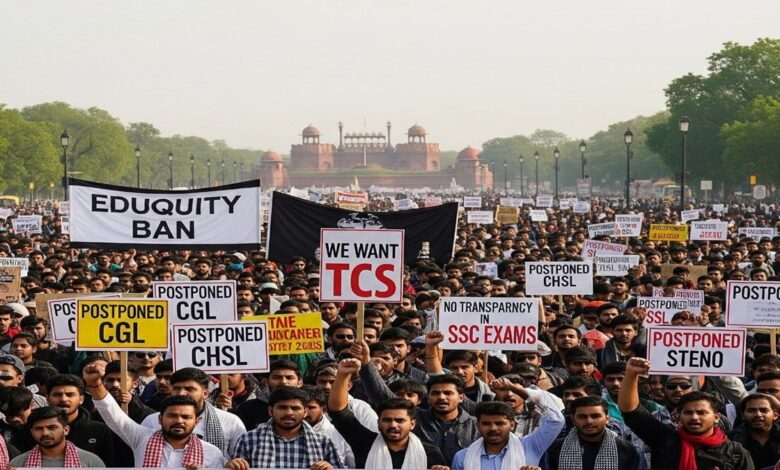
In the sweltering heat of July 2025, as lakhs of young Indians logged into computer-based terminals across the nation, hoping to secure a foothold in government jobs through the Staff Selection Commission (SSC) Selection Post Phase XIII exam, chaos erupted. Screens froze mid-question, servers crashed under invisible loads, biometric scanners failed to recognize fingerprints, and harried invigilators scrambled to manage irate crowds. What should have been a gateway to stable careers for millions turned into a nightmare, with candidates locked out of their sessions, traveling hundreds of kilometers in vain, and facing the prospect of lost opportunities. At the center of this storm stood Eduquity Career Technologies Pvt Ltd—a Bengaluru-based firm thrust into the national spotlight not for innovation, but for incompetence and a shadowy history of scandals.
Eduquity’s saga is more than a series of technical glitches; it is a damning indictment of systemic rot in India’s examination ecosystem. Founded in the early 2000s, this company has positioned itself as a pioneer in online assessments, yet its path is littered with allegations of paper leaks, mismanagement, fraud, and political favoritism. Blacklisted or deemed ineligible by central authorities as early as 2020, Eduquity has remarkably continued to clinch high-stakes contracts from bodies like the SSC, National Testing Agency (NTA), and state recruitment boards. Protests have raged from the streets of Delhi to the digital forums of X (formerly Twitter), with aspirants accusing the firm of jeopardizing the futures of an entire generation. As of October 2025, the outrage shows no signs of abating, with Supreme Court notices issued and student hunger strikes making headlines.
This article delves deep into Eduquity‘s labyrinthine controversies, tracing a chronology of deceit that spans nearly a decade. From its role in exam conduction to allegations of leaks and mismanagement, blacklisting, electoral donations, and the baffling persistence of government contracts, we uncover why this “blacklisted” entity continues to hold the careers of millions hostage. In a country where competitive exams are the great equalizer—or so the narrative goes—Eduquity’s unchecked reign paints a bleak picture: the future of India’s youth hangs in precarious balance, dimmed by governmental inaction and a procurement system that prioritizes cost over competence.
1. The Role of Eduquity in Conducting Exams: From Pioneer to Pariah
Eduquity Career Technologies Pvt Ltd, established in 2000 in Bengaluru, markets itself as a trailblazer in India’s digital assessment landscape. According to its official website, the company introduced the concept of online examinations and assessments to India, offering end-to-end solutions for high-stakes testing. With an authorized share capital of Rs. 100 crore and paid-up capital of over Rs. 20 crore, Eduquity specializes in computer-based tests (CBT), center management, biometric verification, and result processing for government and educational institutions. Its services extend to question paper delivery, invigilation oversight, and post-exam analytics, positioning it as a one-stop vendor for recruitment drives that shape the destinies of millions.
At its core, Eduquity’s role is logistical: it sets up exam centers, deploys hardware and software, ensures secure logins, and handles real-time monitoring. In SSC contracts, for instance, the firm is responsible for conducting the examinations but not for setting question papers—a distinction SSC Chairman S. Gopalakrishnan emphasized in August 2025 to deflect leak allegations. Eduquity has secured deals with prestigious bodies: in March 2022, the NTA engaged it for CBT exams despite its murky record. State-level engagements include the Madhya Pradesh Employee Selection Board (MPESB) for Patwari and Teacher Eligibility Test (TET) recruitments, and Maharashtra’s Common Entrance Test (CET) Cell for MBA admissions in 2023.
The firm’s footprint is vast, touching over 10 million candidates annually through contracts worth hundreds of crores. For SSC’s Selection Post Phase XIII in 2025, Eduquity replaced Tata Consultancy Services (TCS) after bidding Rs. 273 crore—far below TCS’s Rs. 497 crore quote—winning on the government’s lowest-bid criterion. This cost-saving approach, proponents argue, democratizes access to tech-driven exams. Critics, however, see it as a Faustian bargain: Eduquity’s under-resourced infrastructure has repeatedly buckled, turning exams into ordeals.
In subcontracting models, Eduquity often delegates printing, local center ops, and logistics to smaller firms like Sai Educare Pvt Ltd, pocketing commissions while diluting oversight—a practice flagged in multiple probes. This fragmented chain has been blamed for vulnerabilities, from hardware failures to unauthorized access. As one insider from Eduquity revealed on Reddit in July 2025, the company was “heavily under-equipped” for SSC CGL, scrambling for postponements amid internal panic.
Eduquity’s evolution from a modest IT firm to a Rs. 100-crore powerhouse underscores India’s digital exam boom. Yet, its operational model—prioritizing scale over security—has sown seeds of distrust. In a nation where 25 million students appear for competitive exams yearly, Eduquity’s pivotal role amplifies every failure into a national crisis.
2. Allegations of Mismanagement: A Trail of Technical Nightmares and Administrative Apathy
Eduquity’s mismanagement allegations paint a picture of chronic incompetence, where cost-cutting trumps candidate welfare. The SSC Selection Post Phase XIII in July-August 2025 epitomized this: over 59,500 candidates faced glitches like frozen screens, login failures, biometric mismatches, and server crashes, forcing re-exams and sparking nationwide protests. Candidates in Indore reported mice “interfering” with inputs, while Delhi centers saw power backups fail during peak hours. Untrained staff exacerbated the chaos, with no escalation protocols for distressed aspirants who waited hours without resolution.
This wasn’t isolated. In Madhya Pradesh’s 2023 Patwari recruitment, Eduquity’s oversight lapsed led to score normalization anomalies—students screenshotting 157/200 marks but receiving 86.1 post-processing—prompting demands for nullification. The 2022 MP TET saw similar woes: subcontracted centers lacked redundancy, resulting in incomplete sessions and candidate disqualifications. Maharashtra’s 2023 MBA exam under Eduquity drew over 150 petitions to the Bombay High Court, citing cheating enablers like poor surveillance.
Administrative lapses compound these: indifferent staff, misallocated seats, and delayed communications. During SSC 2025, aspirants alleged “heavy-handed policing” at protests, with FIRs filed against demonstrators rather than vendors. RTI revelations show Eduquity’s contracts often bypass rigorous pre-qualification, with “teething problems” acknowledged by SSC yet unpunished.
Analysts trace this to Eduquity’s low-bid strategy: Rs. 220 per candidate versus TCS’s higher rates, sacrificing quality for savings. The result? A pattern of “operational failings” that SSC’s Gopalakrishnan admitted in August 2025, promising penalties but delivering none by October. As protests rage on X, with hashtags like #SSCScam trending into October 2025, mismanagement isn’t just inefficiency—it’s a betrayal of trust.
3. Allegations of Paper Leaks: Whispers of Systemic Sabotage
Paper leak allegations against Eduquity strike at the heart of exam integrity, evoking the ghost of the Vyapam scandal. While SSC denies direct involvement, candidates and probes link the firm to a “longer pattern” of compromises.
The 2022 MP TET leak was explosive: papers surfaced online mid-exam after Eduquity subcontracted to local firms, breaching chain-of-custody. Aspirants alleged insider facilitation, with political heat demanding probes. In 2023’s MP Patwari exam, irregularities like suspicious toppers and leaked questions led to arrests, with media tying Eduquity’s role to procedural gaps. FIRs named individuals and YouTube channels, but petitions scrutinized Eduquity’s subcontracting as the weak link.
Links to Vyapam—a 2013-2015 Madhya Pradesh scam involving bribery and impersonation—are rhetorical but persistent. Protests in 2025 branded Eduquity a “Vyapam legacy” player, alleging seat manipulation networks. During SSC unrest, social media juxtaposed glitches with leak histories, though Gopalakrishnan insisted no SSC paper leaked since 2018.
Remote access vulnerabilities in 2025 SSC exams fueled fresh claims: X posts in September-October alleged “solver gangs” exploiting Eduquity’s servers for real-time cheating. LegalMaestros’ August 2025 analysis called these “criminalized” acts infringing constitutional rights. While FIRs target peripherals, the firm’s opacity invites suspicion—why does a “blacklisted” vendor handle sensitive logistics?
Detailed Chronology: A Decade of Notorious Entanglements
Eduquity’s timeline is a chronicle of ascent amid infamy, blending legitimate growth with escalating scandals. Here’s a comprehensive recounting:
2016-2018: Foundations and Early Expansion Eduquity enters the public procurement fray, securing niche contracts for institutional assessments. No major red flags yet, but the firm builds a network in state education boards. This era marks its pivot to online delivery, handling small-scale CBTs amid India’s digital push.
2019-2020: Procurement Scrutiny and the Blacklisting Bombshell In 2020, the Central Directorate General of Training (DGT) declares Eduquity “ineligible” for tenders in a comparative EOI statement, citing irregularities in prior exam conduct. Media dubs it “blacklisted,” a term later corrected by Newslaundry to “ineligible”—a nuanced but critical distinction, as it barred specific contracts without a blanket ban. Protests brew on social media, questioning the firm’s eligibility.
2021: Tender Resilience Amid Flags Despite the DGT tag, Eduquity snags state contracts, raising pre-qualification enforcement queries. Procurement watchers note “murky records” ignored in evaluations.
2022: MP TET Leak and Subcontracting Scandals March 2022: NTA contracts Eduquity for CBTs. But MP TET implodes—papers leak online post-subcontracting to Sai Educare. Aspirants protest, alleging commission-driven oversight lapses. Political debates erupt; courts issue notices on procurement transparency. A J&K-like tender (e-NIT 2022) is canceled for “tailored conditions” favoring Eduquity and peers.
2023: Patwari Fury and Arrests Mid-2023: MP Patwari exam under MPESB/Eduquity sees score mismatches, suspicious toppers, and leak whispers. Arrests follow for malpractice; media links to vendor gaps, evoking Vyapam echoes. Maharashtra CET awards Eduquity an MBA contract; 150+ students petition Bombay HC for re-exam over cheating. MP HC notices petitions alleging “blacklisted” vendors like Eduquity.
2024: Murky Momentum Eduquity secures Maharashtra and other state deals despite 2020 flags. Newslaundry spotlights “repeat contracts for tainted firms,” including NTA ties. RTI probes reveal subcontracting commissions fueling risks.
Early-Mid 2025: SSC Pivot and Brewing Storm SSC shifts from TCS to Eduquity for Phase XIII and CGL, citing transparent tenders. Aspirants decry the choice, citing history. Protests foreshadowed.
July-August 2025: SSC Catastrophe and Mass Uprising Phase XIII: Glitches galore—59,500 re-exams ordered. Delhi sit-ins, hunger strikes; demands: Vendor removal, Chairman resignation. Gopalakrishnan rejects leaks but admits “teething issues.” Supreme Court issues notice on irregularities.
September-October 2025: Escalating Protests and Remote Access Alarms CGL 2025 derailed; X erupts with #ssc_chairman_jwab_do, alleging solver gangs via Eduquity servers. Durga Puja pandals host aggrieved students; Rahul Gandhi slams “blacklisted” favoritism. FIRs against YouTubers, but vendor scrutiny lags. As of October 5, demands for cancellations persist.
This chronology reveals a vicious cycle: scandals beget probes, yet contracts flow unabated.
4. Blacklisting of Eduquity: A Label That Lingers, But Doesn’t Stick
Eduquity’s blacklisting saga began in 2020 with DGT’s “ineligible” verdict in a tender PDF, barring it from central training exams over “irregularities.” Media amplified it as “blacklisted,” fueling protests. Newslaundry’s 2024 correction clarified: not a full blacklist, but administrative ineligibility for specific bids—legally narrower, yet damning.
Claims escalate: “Blacklisted in four states,” per LinkedIn and X, tying to MP, Maharashtra, and others via court petitions. MP HC notices in 2023-2025 questioned awards to “debarred” firms like Eduquity. SATHEE profiles it as “murky,” involved in leaks post-2020 ban.
The tag’s persistence—despite nuances—stems from procurement opacity. No unified national blacklist exists, allowing state-level comebacks. By 2025, it’s a protest rallying cry, symbolizing unchecked recidivism.
5. Why Eduquity Is Still Being Given Contracts for Paper Management
Eduquity’s contract continuity baffles: low bids win tenders under General Financial Rules, prioritizing L1 (lowest) over experience. SSC’s 2025 switch from TCS saved crores, but at what cost?
Loopholes abound: Ineligibility is tender-specific, not perpetual; subcontracting evades direct liability. No severe penalties enforce accountability, per Inventiva’s July 2025 analysis. Political inertia—amid allegations—keeps the faucet open.
6. Electoral Donations of Eduquity: The Quid Pro Quo Whispers
Allegations of political funding taint Eduquity’s rise. LegalMaestros’ August 2025 exposé claims donations to parties secure contracts, linking to MP scams. Reddit threads allege “chanda dhanda” with BJP, tender favors via Amit Shah connections. No disclosed figures, but The Hindu’s 2024 EB data shows loss-making firms donating Rs. 582 crore, 75% to BJP—Eduquity fits the pattern.
X posts in 2025 echo: “Eduquity does chanda with BJP.” These claims, unproven but pervasive, suggest influence peddling.
7. Why Is the Government Still Awarding Contracts to Eduquity?
Government defenses ring hollow: SSC cites “transparent” tenders, no broad debarment. Cost savings justify risks, per rules. Yet, critics like Deepanshu Rathi decry favoritism: barred in 2020, yet MP/SSC wins.
Alleged donations and bureaucratic silos explain persistence: No centralized blacklist, state autonomy. Protests demand probes, but inaction prevails.
8. The Future of Youth in This Country Is Dark Due to Inaction of the Government
India’s youth—25 million exam-takers yearly—face a dystopia where merit yields to mafia. SSC 2025’s fallout: derailed CGL, shattered dreams, suicides whispered. October 2025 X storms demand justice: “Cancel exams, remove Eduquity.”
Governmental torpor—ignoring HC notices, SC pleas—breeds despair. Reforms needed: Unified blacklists, quality bids, independent audits. Until then, Eduquity’s saga darkens horizons, turning aspirations to ashes. The youth’s roar must force change—or the equalizer becomes the oppressor.