Concrete Corruption: The Unending Story Of Bihar’s Incomplete Bridges!
Built (But, Cannot Be Used), And Forgotten: Inside Bihar’s Broken Bridge Bureaucracy- How poor planning and powerful contractors have turned Bihar’s development map into a field of abandoned structures.

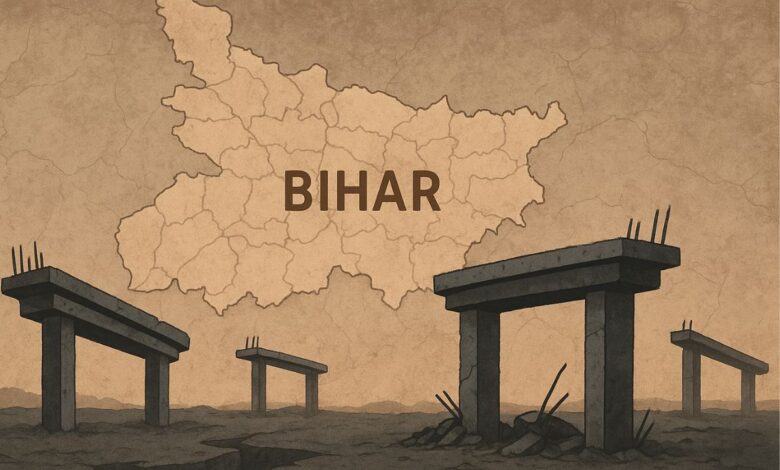
In Bihar’s flood-plain villages, the dream of connectivity often turns to dismay. Grand new bridges are built, but the roads leading to them are missing. The result is costly structures “dangling in the air” and ignored by bureaucracy and contractors alike. The problem surfaced most recently in Araria’s Parmanandpur village, where a 35-foot “box culvert” (bridge) was completed under a rural roads scheme, but lies stranded in a field with no approach road. This is just one example of a state-wide pattern. In Katihar, a ₹6‑crore PMGSY bridge completed in 2021 cannot be used because its access road was never built.
Across Bihar, scores of bridges have been left unusable due to faulty planning, land issues and contractor negligence.
Our investigation finds no published sources identifying the contractor responsible for these projects, which is a troubling secrecy. Official reports admit that detailed project reports (DPRs) were approved without securing land, and that contractors simply walked away or ignored major portions of the work. Local officials and villagers paint a damning picture where bridges were built “on paper only” without real approach roads, letting hundreds of crores of public funds yield nothing but concrete eyesores. The Bihar government has reacted with after-the-fact orders (vowing no new bridge without roads), but the unfinished bridges of Katihar, Araria, Begusarai, Muzaffarpur, Jehanabad, Motihari and elsewhere continue to symbolize years of neglect.
Araria’s Bridge to Nowhere
In Parmanandpur village (Raniganj block, Araria district), a ₹3‑crore bridge was built under the Chief Minister’s Gramin Sadak Yojana. Completed around early 2024, it has no road on either side. Locals say land acquisition was only partially done as the site and pillars were acquired, but about 200 metres of approach road lie on private land. The outcome is a concrete structure in the middle of a field, which can be termed as “just an object of beauty,” in villagers’ words. As Hindustan Times reported, the Araria DM Inayat Khan ordered a probe by expert engineers and warned that “action will be taken against officials, including engineers, if they are found guilty”.
Local officials explain the fiasco bluntly. An assistant engineer described the structure as merely a “box culvert” built under CM Gramin Sadak Yojana, intended as part of a 3.2‑km roadway from Parmanandpur to the Kopari border. He admitted about 200 metres of needed road are private land, and said they are “working on” resolving that issue. He also said villagers reportedly demanded bribes from the contractor, prompting the contractor to post a fabricated photo on social media. Whether true or not, the explanation shifts blame onto villagers rather than tackle the reality: no road has been built, four years after the bridge was “completed”.
Villagers are furious. “We were very happy that this bridge was being built. Our village does not have a road, so we thought they would build roads too,” said local youth Krityanand Mandal. Instead he found only a 40‑foot culvert on flat land with no future planning. Likewise, DM Khan’s team found nothing at the site except unfinished work. The DM’s orders (in mid-2024) came after news reports, underscoring how authorities react only under media pressure. Araria’s case echoes a statewide pattern of bridges opened without connectivity and villagers “left to fend for themselves”.
Katihar’s ₹6 Crore Folly
A similar story unfolded in Katihar district’s Dandkhoda block. In 2020 the Rural Works Department (RWD) tendered a ₹2.49‑crore PMGSY contract (tender MR-N/19-20 Katihar/06) for Pasanta bridge. In September 2020 work began, with an original deadline of Sept 2, 2021. Yet four years later the bridge cannot be used. News reports describe a “beautifully built” bridge with no road connecting it to surrounding villages. Villagers say one pillar was placed on private land, which was a mistake the DPR itself apparently overlooked. The RWD District Officer (Katihar) Manish Kumar Meena acknowledged the issue and said he had ordered an investigation, but nothing has been fixed.
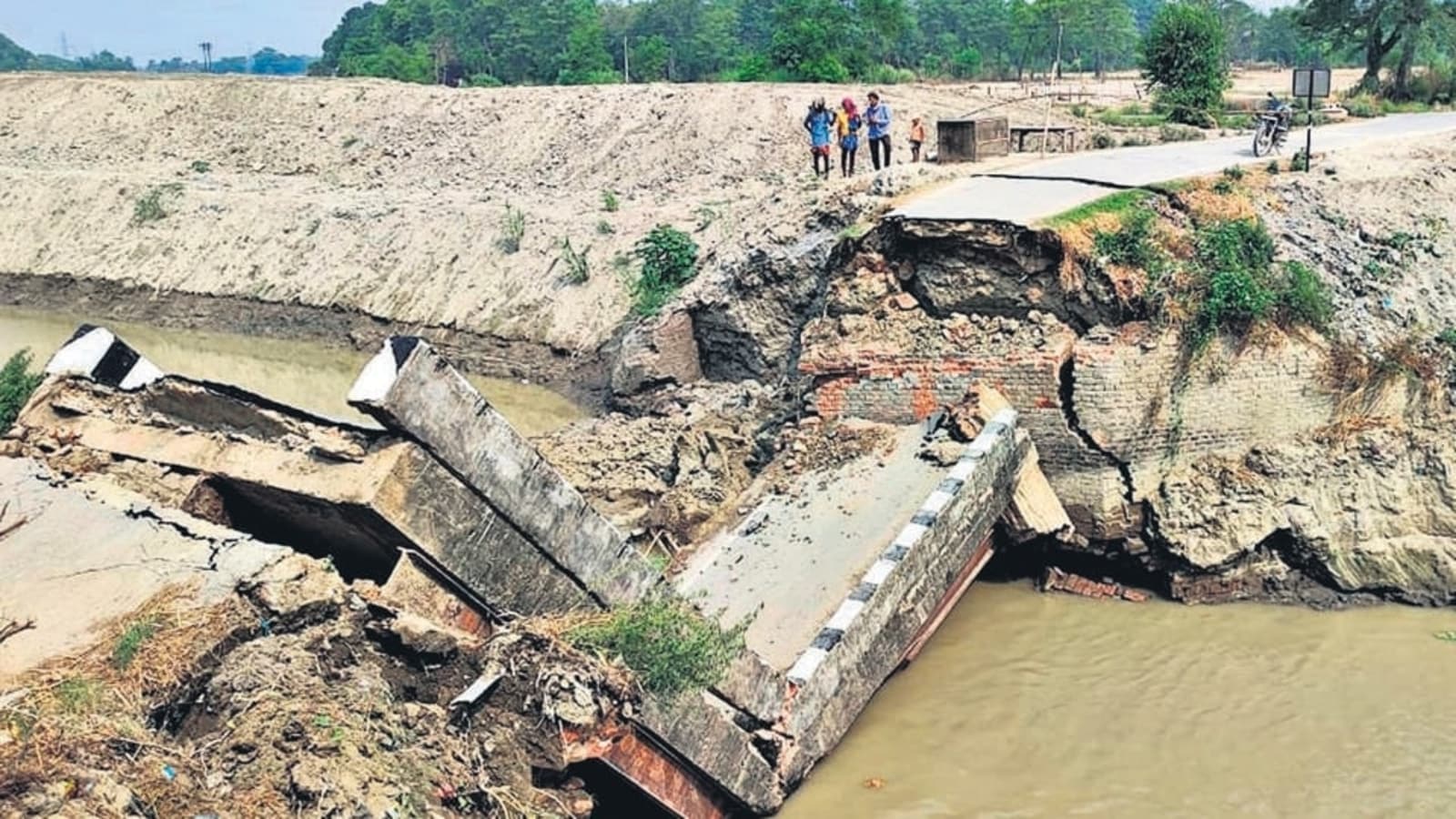
Local media have scathingly criticized the tender’s implementation. NDTV reported that the government approved the DPR “even without proper land acquisitions” and that the magistrate would probe the matter. The Daily Dainik Jagran (recycling the NDTV story) noted “improper land acquisition” stalled the approach road. An official even admitted that the DPR was made without securing the private land it needed.
In short, the contractor was asked to build a bridge on a road that didn’t exist. Even as four years passed, the RWD did nothing to retry land purchase or complete the road. Villagers now reach the bridge only by boat when rivers flood, calling the project “a joke on us.” The DO’s promise to investigate has so far yielded no results.
Katihar’s case invites obvious criticism of the contractor, who should have spotted and refused such a flawed scheme, and of the officials who approved the DPR without land. Yet in media accounts neither contractor nor RWD engineers were named or punished, only demurrals about “studying feasibility” or “adhering to rules”. In fact, no mainstream report gives the contractor’s name for the Pasanta project. (Even the RWD website lists contractors by registration ID but without linking them to specific projects.) The cover-up is obvious: the public only hears that “the problems remain unsolvable” due to administration’s mistakes, while those responsible skate by.
Accountability Lapses: Magistrates and Ministers
In both Katihar and Araria, administrative teams were dispatched only after media outrage. District Magistrate Inayat Khan of Araria said experts were examining the site and promised action if wrongdoing was found. Katihar’s DO also acknowledged the error and “will personally investigate”. But years pass with villagers waiting. Only under pressure did the state government move. In September 2024, RWD Minister Ashok Chaudhary and Chief Secretary Amrit Lal Meena announced that no new small bridge will be sanctioned without an access road. They also vowed punitive action against contractors who neglect rural roads. While welcome in principle, these directives come years too late for thousands already affected.
The pattern of inaction goes beyond individual cases. A recent NDTV investigation found nearly identical failures in multiple districts. In Begusarai (Vishnupur Ahok), a ₹13-crore bridge built in 2016 on the Gandak River still has no approach road eight years later. Locals and media explicitly blamed “the contractor’s negligence and indifference” for the five-year stall.
In Muzaffarpur’s Adarsh Gram (Jajuaar Paschim), a ₹3.63-crore bridge finished in 2020 has never been connected to its ₹0.88‑crore road, and villagers note even their BJP MP or MLA did nothing to press for completion. In Jehanabad’s Nadiyawa village, a ₹7‑crore bridge built in 2015 is now eight years old and only bicycles can cross it as its approach road was never finished. In each case, even after villagers pleaded for help, officials merely promised inquiries.
Motihari (East Champaran) has its own tale. At Kalyanpur near the Sumauti River, a bridge project has dragged for three years with constant diversions collapsing under the rain. A Hindustan report from Oct 2025 describes how the under-construction diversion repeatedly failed and the “company” hired by RWD still hadn’t finished the job. Locals say trucks even fell into the river crossing. Yet again, no end is in sight; the contractor and JE merely promise repairs when the water level falls.
Even within Araria district, another decade-old fiasco awaits completion. Near Kushiyar village on NH-27, a 58.6m bridge over the Kosi was to be finished by June 2016 (tendered at ₹2.5 crore under PMGSY). But the contractor quit and disappeared mid-project. A SudamaNews report in March 2025 details how villagers on a major highway have endured ten years of delays for “tens of crores” spent. The executive engineer only now mentions plans to “increase the span” of the unfinished bridge – ten years late. Remarkably, even in this case the JE refused to name the contractor on record. In effect, Bihar’s Rural Works Department has consistently treated contractors as untouchable and allowed them take advances and vanish, while feigning surprise.
Finally, some failures stem from nature and planning. In Pararia Ghat (Araria), villagers have suffered both a shifting river and a failed bridge. In 2012 a six-pillar span was started, but the Bakra River “changed course” as construction progressed, rendering the bridge obsolete. A 2021 attempt to rebuild it again found the river had moved – the main cause was “soil obstruction caused by the negligence of the contractor,” Main Media reported. In short, two separate bridge efforts in one location were wiped out, partly due to contractor errors. Villagers, some losing homes to erosion, seethe that elected leaders ignored repeated pleas. The bridges stand as monuments to bureaucratic hubris: hundreds of houses lost while bridges to nowhere pile up.

A Culture of Unfinished Projects
These stories share the same DNA where ambitious projects approved without due diligence, contractors obliged to start work, and administrative oversight that evaporated once the money changed hands. At each site, neither the firm contracted nor the local engineer is ever publicly held to account in press reports. Officials simply issue bland statements about “taking action if found guilty” or reforming SOPs. Citizens are left to wonder who exactly was paid (and what cut officials took) for dozens of useless bridges. The Bihar government’s belated decree that “no bridge will be built without an approach road” underscores how long bridges have been built backwards.
There are no signs yet that real accountability will follow. In Katihar and Araria, district magistrates express outrage under media scrutiny, but the primary victims, rural villagers, remain in limbo. The official probe team in Araria may report, but villagers note that not even land acquisition orders have been revisited after four years. In Katihar, a deputy commissioner claimed the mistake arose from election code delays, yet even a year after polls, nothing changed on the ground. Critics charge this is mere damage control.
Meanwhile, Bihar continues approving new bridge schemes at a rapid pace, where 703 new bridges were announced for FY2025-26 at a cost of ₹3,688 crore, even as legacy bridges rot. Without systemic reform, those bridges are at risk of joining the incomplete list. The government must ensure quality assurance, strict contractor vetting, land acquisition before breaking ground, and genuine follow-through by engineers. As of now, Bihar’s bridge projects are betraying the very people they were meant to serve.
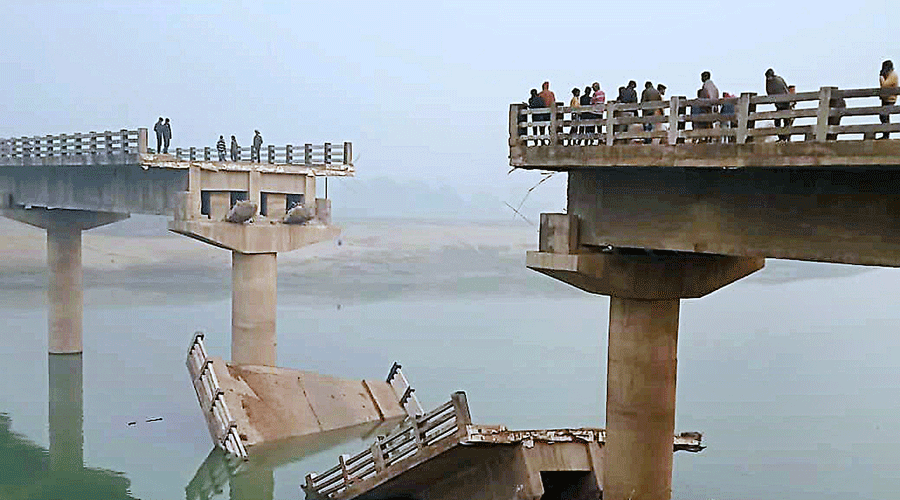
Other Incomplete Bridge Projects in Bihar
- Begusarai (Vishnupur Ahok) – A 13-crore bridge across the Gandak in 2016 was meant to connect a flood-prone belt to Sahibganj block. Eight years later, it has still no usable approach road. Audit of the case blames contractor “negligence and indifference” for a five-year stall, and officials simply let the project languish.
- Muzaffarpur (Jajuaar Paschim) – A 2020 bridge (₹3.63 crore) was to include an 880‑lakh approach. After five years, the access road is incomplete and villagers say even their BJP MP and local MLA have not intervened. The bridge sits idle as an emblem of broken promises.
- Jehanabad (Nadiyawa, Ghosi block) – A 7‑crore Daradha River bridge finished around 2015 has no proper road. Locals report that only cycles can navigate it, turning it into a “burden” rather than relief. The district administration simply assured villagers an investigation, but no fixes have occurred.
- Motihari (Kalyanpur, East Champaran) – For three years (since 2022), a bridge over the Somauti River has remained under construction. Each monsoon, the makeshift diversion route collapses, and villagers suffer daily hardship. A Hindustan news piece notes the RWD’s contractor has still not completed the work, even after trucks repeatedly plunge into the river. The JE promises to repair the diversion only after rains recede.
- Araria (Kushiyar, NH-27) – On the Kosi River near NH-27, a 58.6m bridge (₹2.5 crore) started in 2015 was to finish in 2016. The contractor “left work midway and ran away,” per SudamaNews. Ten years on, neither the span extension nor approach has been done; villagers on this national highway still detour dozens of kilometers for a usable crossing.
- Araria (Pararia Ghat) – Repeated attempts to build a bridge on the shifting Bakra River have failed. A Main Media report found that both the 2012 and 2021 bridge projects were rendered useless after the river changed course – failures blamed on contractor negligence that altered river flow. Dozens of Pararia households have been swept away by erosion while officials debate embankments. Locals hold politicians responsible for this cycle of futile construction.
Each bullet above highlights a Bihar bridge intended for rural connectivity that remains unusable after years. In every case, official accounts cite land problems or contractor lapses, while the public hears only inquiries and promises. Yet the broken infrastructure continues to isolate villagers and waste state funds. Bihar’s record on bridges in recent years shows a litany of abandoned projects, where contractors left unpaid or unpunished, bureaucrats shrugging off delays, and magistrates offering hollow “probes”. Without rigorous transparency (for example, publishing awarded contract details) and enforcement of penalties, these failures will continue unchecked.