Work Hard, Die Tired: India’s Deadly Overtime Mantra
“Just one more hour” of work; from corporate cubicles to airplane cockpits, can cost lives, arguing for urgent labor reform.

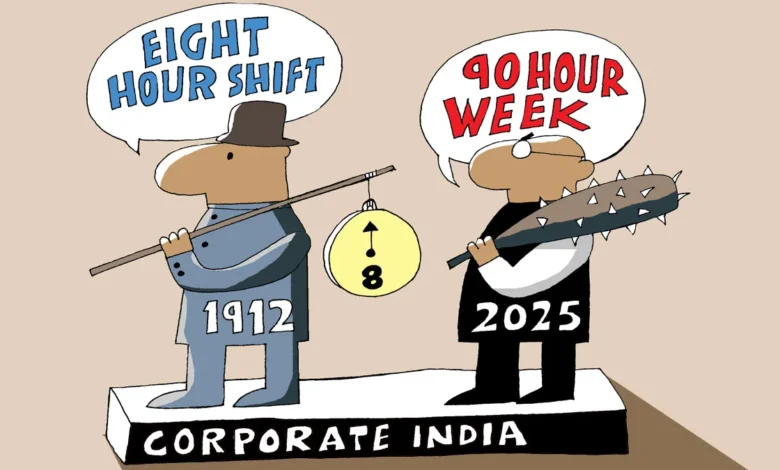
India’s glorification of “just one more hour” of work is proving fatal. From the cockpits of jumbo jets to the cubicles of Big Four offices, authorities and executives are squeezing extra shifts out of the same tired bodies. A recent DGCA rule quietly extended pilot duty-time by 30 minutes, a change pilots say is a recipe for disaster. And in corporate India, young professionals collapse under impossible deadlines. This culture of unending work is deeply entrenched as Indians now log an average of 47–49 hours per week, among the highest in the world.
Experts warn that each additional hour beyond the norm carries dire health and safety risks. When a 26-year-old auditor at EY died after months of 14-hour workdays, and now pilots protest a one-hour extension in their shifts, the public is forced to confront a brutal question:
If even an extra hour of work can kill an individual, what happens when it affects dozens on a flight?
Pilots Sound the Alarm: A Half-Hour Could Be Deadly
It began with a seemingly minor bureaucratic tweak: in late 2025 India’s civil aviation regulator (DGCA) raised the maximum flight-duty period (FDP) for a Boeing 787 Dreamliner crew from 13 hours to 14 hours. For passengers, an extra hour on board sounds minor, but the pilots cried foul. The Airline Pilots’ Association of India (ALPA) warned this was “a matter of grave operational and safety concern”.
In blunt terms, veteran pilot Sam Thomas told that “even 10 hours was already a lot… by the time you approach London your eyes are burning. The last 30 minutes come at the most critical phase of flight – approach and landing – and you need to be most alert. Three extra minutes can be too many,” he said. Pilots compare fatigue to intoxication; half an hour of extra duty could turn a careful landing into catastrophe.
This alarm is hardly theoretical. Just months before the rule change, India’s flag carrier saw disaster when on June 2025 a Boeing 787 Dreamliner crashed after takeoff from Ahmedabad, killing 260 people. ALPA acutely noted that extending duty hours instead of using an extra pilot crew, “raises serious questions about the prioritisation of flight safety over operational costs and convenience”.
Taken together, the pilots’ warnings are chilling: in an industry where one error can doom hundreds, India’s regulators and companies are treating an “extra hour” as a mere commercial convenience. The pilots’ union points out that in most of the world, airlines would add a crew member to cover long routes – but instead here they stretch a single crew even longer. As ALPA summarised, the DGCA decision “gives the impression that greater consideration is being placed on operator convenience and commercials rather than prioritising the core objective of flight safety”.
In other words, in India today the only “threat” they see to flights is the price of adding more pilots – while they ignore the far larger threat of pilot exhaustion. If a fatigued crew makes a mistake, who will answer for the lives lost? The airline? The regulator? For now, the surviving relatives may be the only ones seeking justice.
It’s more than just Cockpits; It’s also seen in Corporate Cubicles…
On the ground, the same story of “just one more push” has played out over and over in offices and worksites. The grim symbol of this trend was Anna Sebastian Perayil, a 26-year-old chartered accountant at EY India. Four months after joining EY’s Pune office, she collapsed and died. Her distraught mother revealed that Anna’s schedule was “overwhelming,” with 14-hour workdays and no weekends off. At one moment, Anna took a few hours off for family, only to be “rebuked” by a manager who told her, “You can work at night – that’s what we all do”.

For Anna, this was deadly earnest: “She worked late into the night, even on weekends, with no opportunity to catch her breath,” her mother later wrote. Those “relentless demands” and “impossible deadlines” were tragically not just a cliché – they cost us the life of a young woman with so much potential. Nobody from EY even attended her funeral, a final indignity that underscored how disposable her life seemed to her employer.
In the wake of Anna’s death, a nationwide #JusticeForAnna campaign and a federal investigation have exposed how pervasive this is. One ex-EY auditor (speaking anonymously) confirmed that such brutality is “standard practice” in the big firms. He described it as “pretty brutal,” with “12- or 13-hour days, finishing up around 10pm, and regularly working both days of the weekend.” Worse, he said “belittling and degradation” of junior staff was common – shouting, thrown files, people reduced to tears – all in service of meeting targets.
Behind this cruelty is cold calculation: India produces millions of qualified graduates, but corporate jobs are scarce. It is found that only about 40% of new graduates get hired, and “often there are tens of thousands of applicants for a single position”. With that supply of labor, managers know there’s no pressure to ease up. “If one person won’t do it or quits, there are thousands of other people who will take their place.” The sole focus becomes “productivity and long hours, with no thought for the wellbeing of employees”.
The EY tragedy has resonated beyond accounting. In manufacturing and tech, too, young employees report unsustainable demands. A former Deloitte auditor went public about pulling 20-hour shifts and waking up just 15 hours after a previous shift. Analysts have pointed out that India’s average working week is now nearly 47 hours, longer than in China, Singapore or even Japan – countries not exactly known for lenient schedules.
The ILO recently noted that “South Asia as a region had the longest working hours in the world – 49 hours per week on average”. Meanwhile, influential figures keep fanning the flames. Infosys co-founder N.R. Narayana Murthy asserted that Indian millennials should be prepared to work “70-hour weeks” to fuel the economy. (Even Infosys itself quietly warns employees against that level of overtime, sending emails reminding them to cap the day at ~9.15 hours – a dissonance that underscores how extreme the rhetoric has become.)
Behind the headlines are millions of voices. Countless Indians have stories of “bring-your-laptop-to-a-dentist-appointment” messages and of answering emails at 3AM because “someone’s waiting”. In event management or media, working a 16-hour day then immediately taking a late-night assignment has become the norm. One event planner told “It was completely normalised to work 16-hour days and be given tasks at 11pm Sunday night to have done by Monday morning”. Each story ends the same way: a staffer reduced to a hollow shell, working “until they collapse” – until they literally do, like Anna.
Beyond the Cockpit: Hospitals, Factories, IT and More
It isn’t only offices that pay this human price. In India’s overcrowded hospitals, burnout is endemic. In Chennai, Dr. Gradlin Roy, a 39-year-old cardiac surgeon, suddenly collapsed and died on the job in August 2025. Colleagues later described that Roy had been on punishing 24-hour rotations and almost never rested. This is no aberration. An analysis by The Economic Times points out that Indian doctors routinely endure “12–18 hour days, sometimes exceeding 24-hour shifts, leaving little time for rest or self-care”.
The stress is amplified by the life-or-death decisions they make and the sheer volume of patients. As Dr. Sneha Sharma, a Delhi psychiatrist, warns, chronic overwork leads not only to burnout but to heart disease, stroke and other “cardiac issues… it can really be deadly”. Globally, similar patterns hold: Japanese studies of karoshi (death by overwork) found many victims were logging extreme hours and suffering fatal cardiovascular events. In India’s transport and manufacturing sectors, overwork-related fatigue has also contributed to accidents, though it is rarely officially acknowledged. (For instance, an overloaded trucker falling asleep has tragic potential.) The point is that excessive hours don’t “only” hit the tired worker – they can endanger everyone around them.
Even in IT and finance, sectors stereotyped as high-status, staffers are running ragged. Serving overseas clients means Indians routinely work 24/7 in shifts. One Mumbai tech accountant described: “Shift hours are not usually followed… We start on Indian time, then continue on the offshore team’s time as well. This means you’re working all the time.”. Companies publicly tout wellness initiatives, but workers complain these are window-dressing. A common refrain: “We have a ‘no work beyond 10 pm’ policy, but it’s never followed… something urgent always comes up,” said a data analyst at a pharma startup. Large corporate campuses may offer gyms or nap pods, but if leaders still demand nightly reports, those perks mean little.
In construction or manufacturing, the angle is more subtle but no less real. If a laborer is forced to double-shift in searing heat or a machine operator is left on-site through the night, the risk of fatal mishaps rises. India’s federal labor laws offer protections only to factory workers: the Factories Act limits factory work to 48 hours/week with overtime pay, but this legally excludes office or managerial staff. In practice, that means a white-collar coder or analyst has no legal cap on hours; they exist in a kind of gray zone.
As one former EY consultant (preparing to sue) was told by a labor official, “I am not like a construction or road worker” – implying he had no statutory rights to rest or pay. Even unions have begun demanding change. Maharashtra and Karnataka labor ministries are drafting new rules and cracking down on office overtime after a string of complaints, spurred by Anna’s case. Union activists, employers, and even lawmakers now concede that white-collar workers need basic safeguards, just like factory hands.
The ILO’s Elena Gerasimova put it bluntly: under international labor standards, “rights shall be given to all those who work, both blue and white collar”. But in India today, far too many in management assume they can keep squeezing the same workers because the law doesn’t force them otherwise.
Data Speaks: India Among the World’s Most Overworked
The anecdotes above are sobering; the data are shocking. Multiple surveys and studies paint a consistent picture of overwork in India. According to the International Labour Organization (ILO), 51% of employed Indians now work 49 hours or more per week, making India the second-most-overworked country on earth. To put that in context, the ILO formally recommends a 48-hour maximum week with 8-hour days – thresholds Indians routinely exceed.
Comparisons illustrate the gap: Indians work about 13 hours more per week than a typical German worker. As of 2019, nearly 57.1% of South Asian workers (including India) labored over 48 hours a week, more than any region globally. In short, the average Indian who is employed is already racing the clock far longer than peers worldwide.
This constant grind has measurable health consequences. A landmark WHO/ILO study found that people working 55 or more hours per week have a 35% higher risk of stroke and a 17% higher risk of dying from heart disease than those keeping to 35–40 hours. In parallel, recent corporate surveys paint India as a burnout hot spot: one McKinsey poll found 59% of Indian respondents reported significant burnout symptoms in 2023 – the highest rate globally.
Medical data bear this out. Emergency rooms and cardiac wards across India report younger patients presenting with hypertension, diabetes, and heart attacks, linked to chronic work stress. Even Dr. Roy’s story is said to be part of a “growing trend of young doctors in their 30s and 40s suffering sudden cardiac events,” according to neurologists. In one study of Indian professionals, psychiatrists warned: if overwork becomes the rule rather than the exception, “the body can adapt… but only up to a point, or it can lead to burnout, chronic stress… and it can really be deadly”.
Clearly, the problem is systemic. For every high-profile death, there are thousands more quietly suffering insomnia, anxiety, depression or quietly dying of so-called “natural causes” after years of punishing schedules. Indeed, in a society that often worships self-sacrifice, the data on stress, strokes and suicides suggest that the very thing praised as virtuous – working “24×7 for growth” – may be killing the workforce it depends on.
Corporate Logic vs. Common Sense: Why Not Hire More?
A baffling aspect of this crisis is that hiring shortages are blamed for the grind, yet India has a young workforce. If more labor is needed, why not recruit more people instead of overworking the same staff? The answer lies in corporate incentives and job-market dynamics. As noted, tens of thousands compete for each coveted job. This oversupply of applicants empowers employers to demand long hours and compliance, knowing that if one junior quits, dozens more will step up. Labor remains relatively cheap, and union power is weak in white-collar sectors. For management, it’s cheaper to squeeze extra hours out of current employees than to raise salaries for new hires or expand headcounts.
Top executives often tacitly endorse or ignore this culture. Some publicly advocate endless work. Indian Prime Minister Modi’s persona as a tireless leader who “works 24×7” is frequently cited as inspiration. Tech entrepreneurs and financiers have argued that India’s growth demands a unique “work week” – last year, more CEOs endorsed 6- or 7-day workweeks for development.
Elon Musk-style zeal for hustle has even become a point of pride in some start-up circles (especially given the global “hustle culture” trend). Yet ironically, many of those same leaders and companies privately preach balance to their own employees. Infosys, for example, launched an internal campaign warning staff to cap working time at 9–10 hours a day, precisely because of health worries – a policy contradicted only by its founder’s public 70-hour exhortation.
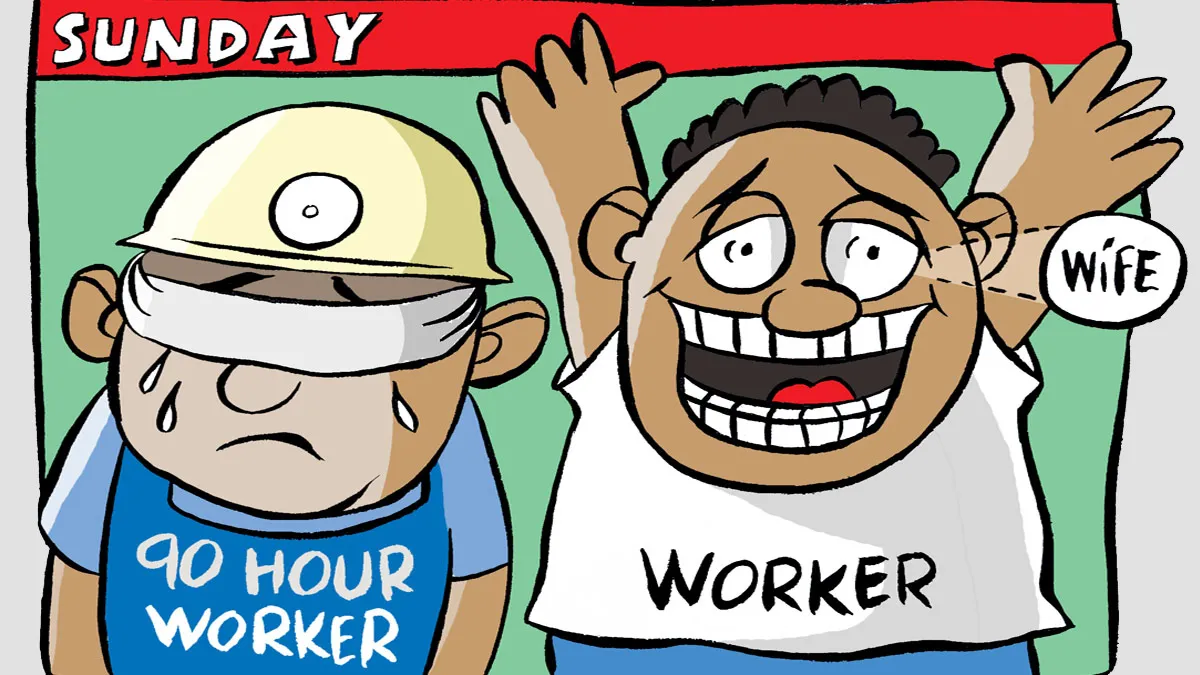
On the legal side, India still lacks a clear policy for private-sector hours. The Factories Act of 1948 – the country’s main working-hours law – explicitly exempts most white-collar and service jobs. In practice, this loophole allows a corporate boss to demand unlimited hours from a manager or accountant. Only recently have state governments even begun to audit corporate worklogs, spurred by Anna’s case. Federal ministers have publicly weighed in: for example, Labour Minister Shobha Karandlaje tweeted that an “unsafe and exploitative work environment” was under investigation. But until robust limits and enforcement exist for all workers, the pressure to do “just one more hour” will remain.
At a cultural level, Indians are often socially conditioned not to refuse extra work. Subordinates are taught to comply unquestioningly with seniors – so many will pick up a late-night call rather than risk offending their boss. A book on Indian corporate culture highlights this “power distance”: with a high emphasis on hierarchy, employees can rarely say no to after-hours demands. Thus “grateful obedience” blends with fear of losing a hard-won job. The result is a vicious cycle: companies pile on overtime, young people endure it out of insecurity, and the next generation learns to expect no mercy.
All the while, top management and policymakers often shrug or even justify these norms. When questioned about Anna Sebastian’s death, Finance Minister Nirmala Sitharaman implied that young professionals needed to develop “inner strength” to handle pressure – a remark widely criticized as victim-blaming. Even outside India, business figures sometimes praise overwork: Jack Ma infamously said during the pandemic that 12am meetings were “a blessing”, a comment that could equally describe some Indian offices’ midnight grind. In short, the social narrative still valorizes the martyrdom of labor, even as the tragedy mounts.
Global Echoes: India in the World of Overwork
India’s overtime mania, while extreme, is part of a global pattern. Across Asia, countries have long histories of punishing work cultures. Japan’s “karoshi” crisis first came to light in the 1980s when office workers began dying of strokes after months of 100+ hour weeks. In recent years China’s tech firms institutionalized a “996” schedule (9am–9pm, six days a week), prompting worker protests under the slogan “996.ICU” (implying ICU or death). South Korea had similar issues until some reforms were passed. Even in the West, white-collar burnout is rising: many Americans now work beyond the traditional 40 hours, and professions like law and medicine face calls to limit shifts after student tragedies.
But hard data suggest South Asia is uniquely arduous. The ILO found nearly half of South Asian workers put in over 48 hours weekly. By contrast, Europe’s strong labor protections cap normal workdays (the EU Working Time Directive limits most workers to 48h/week, and countries like France and Germany often enforce 35–40h standards). The U.S. has no federal limit (the 40h standard applies only to overtime pay), but cultural work-life balance movements and tech-sector waves of remote work have somewhat curbed the extremes of past decades.
In a wide Asia-Pacific survey, India respondents reported among the highest stress and burnout globally: a 2023 poll showed 59% of Indians experienced work-related burnout symptoms, far above the global average. A South China Morning Post editorial argued that Asia must abandon its “toxic myth” of long work hours, pointing to cases like Anna’s as a wake-up call. International labor experts now emphasize that healthy economies do not require breaking their people. Organizations like the WHO and OECD are calling excessive overtime a public-health crisis. Still, India’s intensity stands out: as one observer put it, “work and India have a colonial relationship… tireless work is associated with nation-building” – a mindset that clashes sharply with modern evidence on well-being.
The Human Toll: Lives and Laws
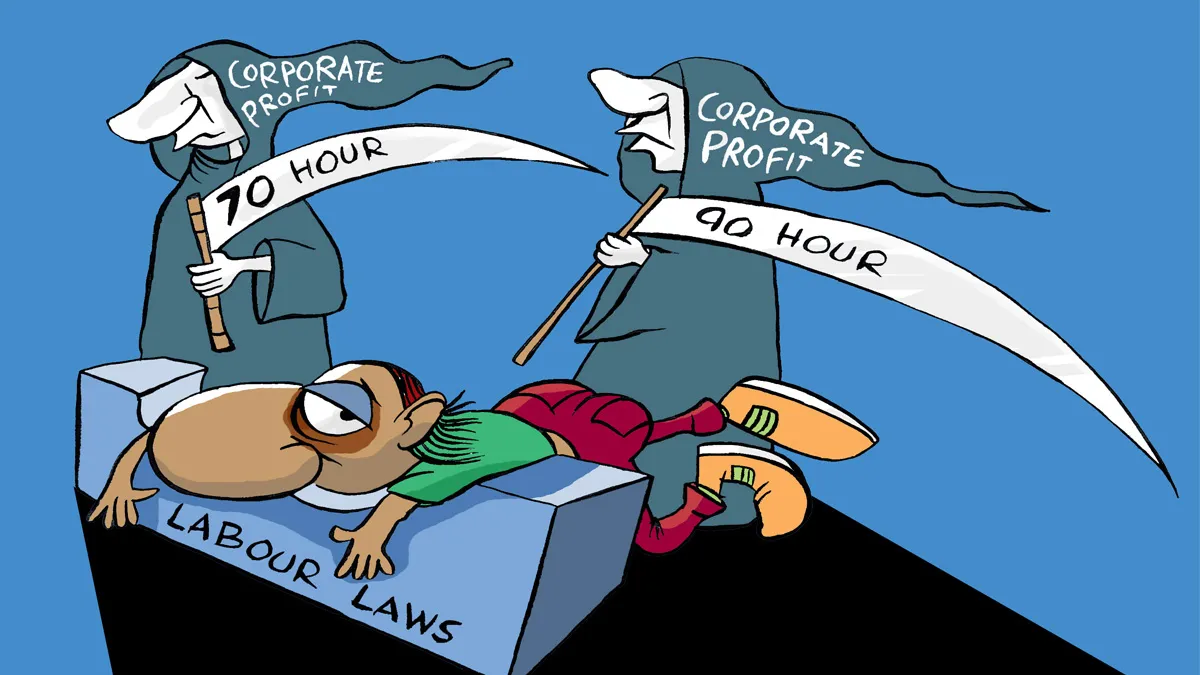
Every statistic above represents real human suffering. The loss of even one young life to overwork – a heart attack at 26, a stroke at 30 – should be intolerable. In the aviation example, one can multiply that loss by the number of people on a flight. Yet corporate boards often treat such tragedies as abstract risks rather than moral crises. That calculus must change.
Workers and experts have begun speaking out. Pilots say bluntly, “It’s sleep I’m asking for, not sacrifices”, highlighting how profit motives compromise safety. Dr. Sharma warns that every extra shift without rest “can really be deadly”. Labor specialists insist that employees must have an enforced right to refuse unsafe overtime – a right white-collar India still lacks. Even tech companies are being pressured: Infosys’ internal memos telling staff to “take regular breaks” and “disconnect when off hours” are part of a recognition that mental and physical health cannot wait for voluntary compliance. Each of these voices underscores the same truth: pushing Indians to work longer hours is not just unfair – it is lethal.
Conclusion: Enough Is Never Enough, But It Must Be
India’s economic story often highlights the potential of its vast youth and talent. But that promise is undercut by an attitude that treats the young as disposable resources. The data and cases above leave one stark conclusion: adding “just one more hour” to any shift carries the risk of losing a life. A nation cannot develop on a foundation of broken bodies and burnt-out brains. The question “why not hire more people instead of extending hours?” is not naïve – it’s a plea for common sense. If there is indeed work to be done, spreading it among more hands is the only humane answer.
India may celebrate hard work – but no visionary mission demands its citizens die for a project deadline. After the EY and Air India tragedies, authorities have a choice: acknowledge that employees are humans, not machines, or continue pretending that endless work-hour growth is a sustainable strategy. As pilots, doctors, unionists and parents have warned: we stand to lose far more than we gain by this cult of overwork. It’s time for regulations, corporate ethics and national pride to catch up with basic human decency. Because in this race, the final hour might very well be the last.