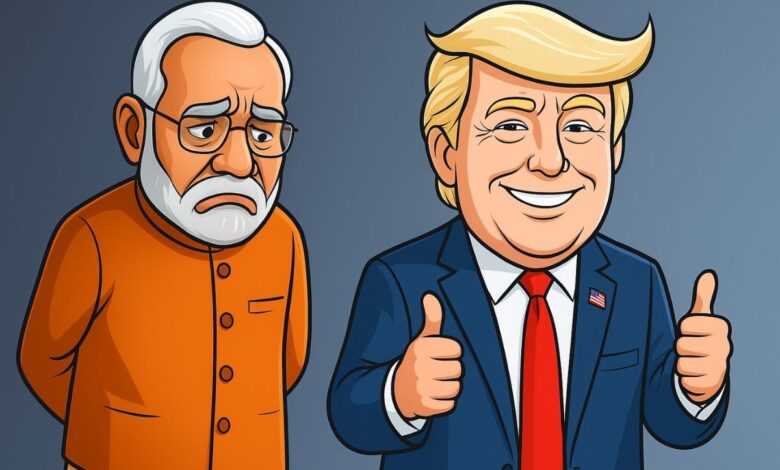
When Prime Minister Narendra Modi walked into the White House Rose Garden in mid-February 2025, he did so with a flourish worthy of a Bollywood finale. Behind him fluttered the flags of the world’s leading democracy, and before him sat an ebullient President Trump, another character accustomed to theatrical gestures. With characteristic bravado, Modi seized the moment. Drawing a grin, he announced India’s own catchphrase, “MIGA,” or “Make India Great Again”, explicitly casting it as India’s mirror-image to Trump’s “MAGA.”
“When the United States and India work together, i.e. ‘MAGA’ plus ‘MIGA’, the ‘MEGA’ Partnership for prosperity is formed,” he declared. In that instant, Indian media outlets and cheerleaders of the ruling party went into overdrive. Headlines crowed that, finally, India was rising to its destiny as a Vishwaguru, a world leader, walking arm-in-arm with the preeminent superpower. At last, 2025 would be the year India became “MEGA.”
This narrative of mutual admiration and grand ambition; let us call it MAGA+MIGA=MEGA optimism set India’s expectations soaring. And yet, as Warren Buffett famously quipped, “you only find out who’s been swimming naked when the tide goes out.” By December 2025, the tide of good fortune had indeed receded for India. The delusions of indispensability were washed away, leaving the naked truth: India’s grand partnership with the U.S. was more limping than lit up, and the country’s touted strategic autonomy proved to have brittle underpinnings. The year 2025 turned out to be India’s Año horrible, not because India failed on every front, but precisely because it failed spectacularly on the front it had been flaunting as its biggest achievement.
In retrospect, 2025 exposed a bitter lesson: alliances and slogans alone do not make a nation great. Diplomacy, like swimming, relies on solid footing beneath the waves like economic strength, geopolitical flexibility, and strategic self-reliance. The Modi government’s response to these revelations, regrettably, was to fall back on pageantry and propaganda rather than concrete reforms. It paraded victory in photo-ops and Twitter storms, while the fundamentals quietly eroded.
By the end of the year, things had gone so far south that India’s vaunted “special relationship” with the U.S. was limping, its economy reeling under surprise tariffs, and its global influence in retreat. Meanwhile, the world’s three biggest powers, America, China, and a revanchist Russia, marched on their own agendas, often indifferent or even antagonistic to Indian interests. India’s 2025 arc was a long fall from the rose-tinted expectations of February, a comedic tragedy of rising hopes grounded in harsh reality.
“MAGA + MIGA = MEGA”? The February Hype
Early 2025 was a season of triumphalist rhetoric in Delhi. The Modi administration, basking in a second term with large parliamentary majorities, was determined to showcase India’s clout. Modi’s February trip to Washington, only the second such state visit since the pandemic was stage-managed as a crowning achievement. Just as Trump patted himself on the back for the U.S.-Mexico trade deal and championed “MAGA”, Modi sought his own soundbite.
In reality Modi coined “MIGA” on the fly. On 14 February 2025, at a joint press conference with Trump, Modi even playfully adopted American vernacular. “If I say in the language of America, developed India means Make India Great Again, i.e. ‘MIGA’,” he announced, then zipped the letters together: “MAGA plus MIGA creates a MEGA partnership for prosperity”.
Indian media outlets framed the moment as evidence that the MAGA-MIGA syzygy was real. They gushed that “MAGA + MIGA = MEGA” had “injected renewed fervour into the bilateral ties between these two world giants,” noting how Indians were celebrating cheaper bourbon and Harleys under Trump’s trade umbrella. Even seasoned US analysts praised Modi’s catchy branding. CNN’s Will Ripley called it “very clever branding that resonates with Trump,” and advised other leaders to take note.
Behind the curtain, bureaucrats hammered out token deals: a target to double India-US trade to $500 billion by 2030; talk of faster visas for the Indian tech diaspora; joint high-tech initiatives; and an energy partnership focusing on liquefied natural gas and nuclear reactors. Official communiqués were awash in visionary talk of “Transforming Relationship Utilizing Strategic Technology” (TRUST) in semiconductors, defense, and even semiconductor supply chains. Modi spoke of building an “Autonomous Systems Industry Alliance” and launching a new Defence Cooperation Framework for the next decade, as if India were confidently dictating terms to the U.S., rather than remaining hostage to its own weaknesses.
In India, commentators took these signals at face value. Many hailed the Rose Garden press conference as proof India was finally the global power it deserved to be. After all, “Narendra and Donlad (pun intended), beyond being a bit lost in translation, were now bromancing again, and that must mean India’s star had truly risen”. On the ground in Delhi, spirit was high.
Analysts recalled the MAGA era of 2016-19, when U.S.-India ties strengthened; now they forecast a MIGA whirlwind. There was talk of India finally shedding “slavery” to Chinese imports and of an overdue export boom once the trade deal kicked in. For the first half of 2025, the narrative was clear: India was ascending to vishwaguru (world teacher) status with Washington’s blessing, and all that was needed was a starry slogan and a live president to celebrate it.
But at this euphoric peak, signs of trouble were already brewing beneath the surface. A hint came just weeks after Modi’s return: President Trump quietly announced new tariffs. These were no ordinary duties, however. In an unexpected twist, the U.S. slapped 10% duties on certain Indian goods on April 2, 2025, under its “Liberation Day” approach (echoing tariffs he also imposed on European allies). The pretext was that India’s oil trade with Russia was inadvertently supporting Moscow’s war effort.

Two months later, on August 7, Trump doubled those rates from 10% to 25%. Then, shockingly, by late August he cranked Indian tariffs up to a staggering 50%. In one fell swoop, American trade policy made Indian products among the most heavily taxed in the U.S. market: Indian exports to the U.S. fell 28.5% from May to October 2025, a collapse on par with that of American or European rivals during worst-case recessions.
These moves blindsided New Delhi. After all the bravado about an equal partnership, India discovered it was being slapped with even higher duties than China’s. By October, the rupee was slipping through silk gloves – sliding past ₹90 to the dollar for the first time as global capital fled – while Indian entrepreneurs scrambled to reroute shipments. The scenario was anything but MEGA. Modi’s MIGA moment had turned into a crisis of vulnerability.
The Tide Goes Out: India’s 2025 Año horrible
By late 2025, pessimists in New Delhi quietly felt the year an Año horrible, not merely a bad year, but one that blasted to pieces decades of complacent illusions. What emerged was a trio of structural weaknesses, exposed all at once: an economy still deeply dependent on China, a growing misalignment with American priorities, and a military arsenal still tethered to Russia. To India’s own horror, every grand claim of strategic autonomy was undercut by these systemic blind spots. Most alarming, the modus operandi of the government was to treat every setback as a photo-op. Ministers responded with talking points and patriotism flapping, rather than concrete fixes. Meanwhile, the practical levers of power slipped further from India’s grasp.

Economic Dependence on China: First, there was the glaring reality of India’s trade with China. In April 2025 it was reported that India’s trade deficit with China had exploded to a record $99.2 billion for the fiscal year, propelled by a surge in imports, especially electronics, batteries and solar equipment. Trade analysts called the imbalance a “wake-up call”, noting India’s export successes in electronics and pharma simultaneously “fuel imports from China, due to their heavy dependence on imported components”.
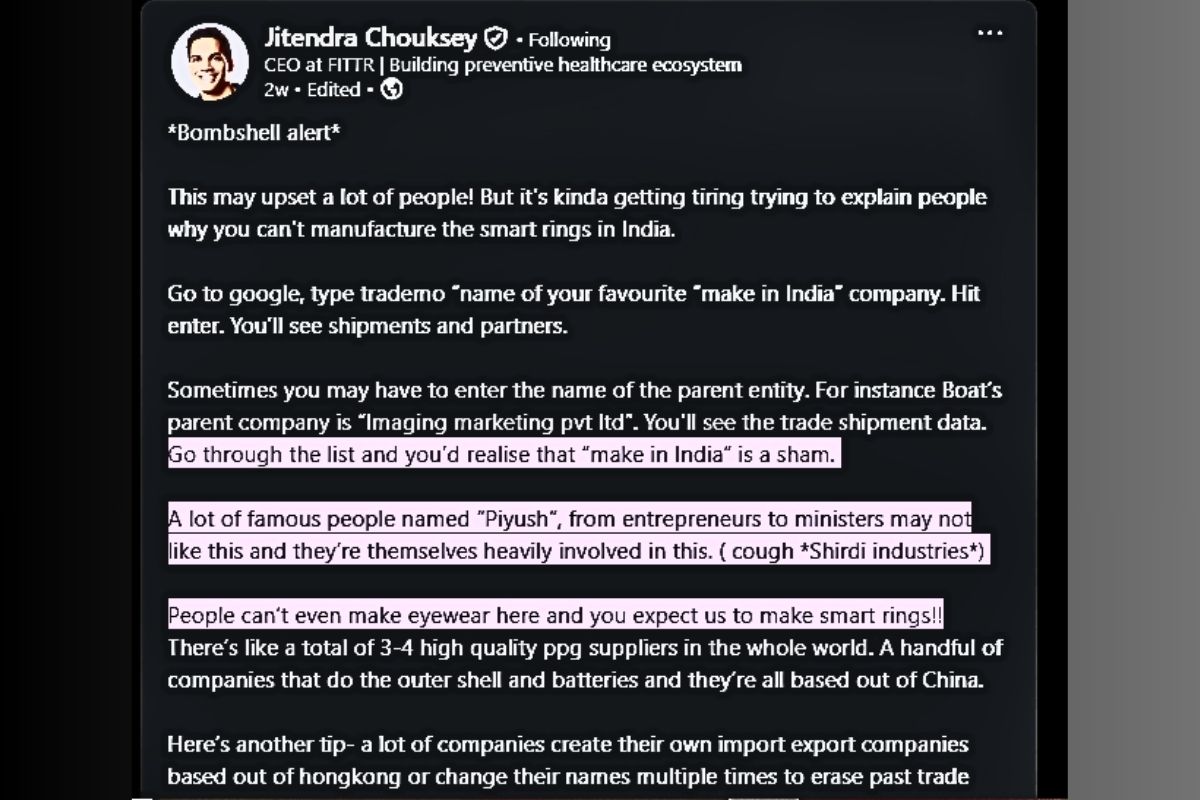
To put it plainly, Modi’s heralded “Make in India” programs were still built on Chinese bricks: nearly half of India’s electronics components, pharmaceuticals ingredients, and high-tech parts were imported from across the Himalayas. Not only we are saying that, a seasoned entrepreneur Jitendra Chouksey, the founder of Fittr, openly mentioned on one of his linkedin posts that ‘Make in India is a sham‘, and many of Indian companies, who flaunts them to be really ‘Made in India’ is actually ‘Not Made in India’; which means ‘if’ world markets snapped or new tariffs hit, Indian factories couldn’t suddenly rewire their supply chains overnight.
According to industry trackers, India’s imports from China had nearly doubled in eight years, rising from roughly $72 billion in 2017 to $129 billion in 2024. By mid-2025, they were still surging: one report noted H1 imports up 18.5% year-on-year. Yet this growth was narrow: three hundred product categories accounted for over three-quarters of the entire China-India trade. In other words, India’s reliance was highly concentrated in a few sectors.
Take electronics. By mid-2025, integrated circuits (computer chips) from China alone were worth $5.5 billion, 88% of all such chips India imported. India even imported almost all of its semiconductor manufacturing equipment (99.5% sourced from China). Batteries were similarly perilous: lithium-ion battery parts, vital for India’s budding green energy plans, were $1.85 billion worth in H1 2025, 94% coming from China.
In pharmaceuticals (India’s so-called pharmacy of the world), key precursors and antibiotics overwhelmingly came from Chinese factories. Fertilizer chemicals, steel products, solar panels, and even silver (for electronics) were heavily sourced from China. The litany goes on: Chinese combine-harvesters, safety glass for construction, and even aluminium structures for buildings saw dramatic import jumps. Each category became a single point of failure if Beijing chose to turn off the tap.
This deep entanglement means India can neither ditch Chinese trade easily nor fundamentally transform its economy fast. Amid global supply shocks (like COVID or semiconductor shortages) and now the unexpected rerouting of commerce under Trump, those old dependencies came back to bite. Worse, as reports ominously warned, “the rising imports reflect deeper structural dependencies of the Indian economy.” The Make in India narrative was half-built on shaky scaffolding: yes, domestic output had risen, but behind every “Made in India” gadget were layers of Made in China guts.
Misaligned Interests with the U.S.: The second structural fault line was the widening gap between what India hoped from Washington and what the U.S. actually demanded. Before Trump’s second term, New Delhi had counted on Washington’s desire to check China to guarantee special treatment for India. That was the entire foundation of the “alliance of democracies” storyline: India as the natural counterweight to Beijing in Asia.
India entered 2025 brimming with optimism that Trump’s return would cement this vision. Surveys even showed 75% of Indians welcomed Trump back in office, far higher than in many allied countries. Our politicians and pundits believed Trump’s instincts to cultivate India (so long as Modi cajoled him at White House photo-ops) would continue regardless of administration change.
Those hopes crashed hard. There was an abrupt reversal showcasing that, “Instead, the United States dramatically increased tariffs on India during the spring and summer of 2025,” targeting New Delhi specifically to punish it for buying Russian oil. The fact was obvious and deeply ironic given that India was Washington’s intended Indo-Pacific partner: in practice, Trump governed on transactional whims. He slapped higher trade barriers on India than on China itself. By August, India was paying 50% duties on most exports to the U.S. (versus roughly 30% on Chinese goods).
In one graphic comparison, an Indian smartphone or textile faced a tariff wall far steeper than the same product from Beijing. “With these duties, Indian products have now become some of the most heavily taxed in the American market. In contrast, Chinese goods face about 30% tariffs”. In effect, Trump made India’s goods 50% heavier to carry than China’s when trying to enter the U.S., a slap in the face to India’s global ambitions.
But the misalignment went beyond money. Trump (and the American establishment around him) began to see India through a very different lens than Delhi expected. Instead of a counterweight, India became a bargaining chip. For example, U.S. pressure to stop India’s Russian oil imports spilled into harsher policy: White House statements explicitly linked India’s Russia trade to the tariff hikes. Diplomatic signals also turned contradictory. While India tried to underscore common values (democracy, freedom, rule of law), Washington under Trump treated India more like a nuisance to be managed.
The telegraph piece on Modi’s avoidance strategy bluntly summarized the new reality. Trump “pursued a rapprochement with Indian arch-rival Pakistan” and even cut Pakistan’s tariffs to 19-29% while India was paying 50%. (In other words, the U.S. was rewarding Islamabad for cooperation while punishing Delhi. The irony was lost on no one: Modi’s implacable stand on Pakistan backfired as the U.S. cozy relationship with Pakistan resumed.)
Even on issues where Indians expected support, Washington’s messages turned hollow. In May 2025, when a brief India-Pakistan border crisis flared in Kashmir, Trump brazenly claimed credit for brokering an “India-Pakistan ceasefire”, a claim outright denied by Indian officials.
Washington’s vocal eagerness to send arms to Pakistan and build its ties underlined a cold truth that India was no longer Washington’s sole focus. Secretary of State Marco Rubio’s trip to Doha in October was a symbol, celebrating Pakistan while barely mentioning India, even as Washington talked up a Pakistan alignment for Afghan stability. In short, the world’s superpower was no longer putting India at the center of the regional order. And India’s government found itself scrambling to catch up to this unwelcome pivot.
The mismatch of expectations hit home economically too. As Indian exporters were stunned by skyrocketing duties, the rupee and markets bore the brunt. Within months, it was reported, Indian companies were “operating at reduced capacity” in Surat’s diamond belt, Tiruppur’s textile mills, and elsewhere. Diamonds fell out of U.S. retail orders, garments rerouted to Vietnam and Bangladesh.
Across the spectrum, software workers, auto parts makers, vegetable exporters, the pain was registered. For Indians, the result was sticker shock as the rupee plummeted, making every imported good costlier and pushing up prices at home. By December, the rupee had slid to around ₹90 to the dollar, an all-time low, largely because U.S. tariffs and capital flight had piled pressure. In plain English, the U.S. had driven the money spent on every American smartphone (even the tariff-free ones) up in rupee terms.
Meanwhile India’s diplomatic voice lost traction. A telling indicator came just days before a Putin visit in December as the ambassadors of France, Germany, and Britain penned a sharp op-ed in a national daily criticizing Russia’s war in Ukraine. Normally, India might have stayed neutral or even allowed Russian talking points a space, given its own ties.
But this collective publication by European envoys, and India’s own Media obscenely reacting, underscored Delhi’s isolation. The Indian foreign ministry publicly bristled, calling the move “very unusual”, but it was almost a confession that India couldn’t set the terms in its own capital, but foreign diplomats did. In the midst of all this, our PM was skipping crucial multilateral summits to avoid being in the same room as Trump. The message from the world’s stage was unambiguous: India was no indispensable partner, but rather a liability to juggle.
Defense Reliance on Russia: The third big failure could be the one of identity: India’s armed forces remained astonishingly tied to Moscow, even as world politics shifted. Decades of buying Russian weapons for everything from fighter jets to frigates seemed to be paying dividends when Putin’s army once helped kill terrorists in Kashmir, but now the bill was coming due. Under Trump 2.0, New Delhi’s defense portfolio proved its Russian habit was a strategic millstone.
Even before 2025, observers had warned India’s defense imports were unsustainably concentrated. The latest figures from the Stockholm International Peace Research Institute (SIPRI) confirmed that two thirds of Russia’s arms exports in 2020–24 went to just three states, led by India at 38% of all Russian arms deliveries. SIPRI noted “Russia delivered major arms to 33 states in 2020–24. Two thirds of Russian arms exports went to three states: India (38 per cent), China (17 per cent) and Kazakhstan (11 per cent).”
In practical terms, India accounted for nearly 40% of what Russia sold abroad. This single partner status meant Russia was in no position to bend to Indian requests. Indian generals might want technology transfer or production rights, but Russian suppliers didn’t need India’s business badly enough to comply. In truth, even by 2024 India’s share of Russian imports had started to slip, as other suppliers (American, French, Israeli) sold more, but India remained Russia’s largest customer by far.
Come 2025, this entitlement to Russian arms became a liability on at least two fronts. First, on the battlefield. India’s Western-system allies (the U.S., France, Israel) were hesitant to fully plug gaps in Indian air defenses and missiles, in part because of the ongoing India-Russia friendship. New Delhi’s vow to stay “neutral” in the Ukraine war and keep importing Russian oil led Western capitals to withhold some high-end tech transfers (even the much-discussed F-35 was off-limits). Second, Putin’s visit in December was overshadowed by these very arms ties. Modi could not publicly chastise Putin for Ukraine without undermining India’s own supply lines; nor could he abandon decades of Russian equipment without leaving holes in readiness.
The op-ed by European envoys exposed this conundrum. They tactfully ignored India’s policy balancing act and simply assumed India would criticize Russia for the war, forgetting New Delhi’s reluctance. India’s lack of a strong response (even negative) to the envoys was seen abroad as helplessness. The bolbala of diplomatic norms was breached, and India had little ground to protest. In its refusal to alienate its most dependable arms supplier, India had instead undermined its claim to strategic autonomy. A foreign minister pointed to this: Modi’s answer was to argue that friendship with “a very friendly third country” (Russia) shouldn’t be questioned, but global capitals saw that as India choosing Moscow over Washington and Brussels.
In the year’s latter half, India’s self-view of being indispensable to great powers was shattered. The country scrambled not from anything technical misstep, but from the very worldview it had been peddling, that India, by virtue of its democracy or big military, could demand concessions when push came to shove. Instead the lesson was: size alone is not influence, and friendship alone is not loyalty.
In short, all three “failure points” boiled down to one thing: India had been coasting on illusions of strength. Its economy felt big because of population and growth rate, but in depth was fragile. Its diplomatic posture looked confident thanks to big summits, but in substance was flimsy. Its military sounded powerful at 1.4 million personnel and nuclear warheads, but it still needed the U.S. to give tech and Russia to supply guns. With the tide gone, the naked truth was embarrassing that “India wasn’t yet indispensable, it wasn’t a superpower, and it had very little leverage when great powers called the shots”.
Pageantry Over Policy: Modi’s Reaction
When faced with this unravelling, the Modi government’s instinct was to keep the camera rolling. Narendra Modi, ever the showman, doubled down on slogans and social media. Instead of quietly reworking strategies, the official playbook was all about optics. Every setback was countered with a photo-op or a hot mic moment.
Take, for example, trade. In February he’d proclaimed a $500 billion trade target with the U.S., a figure no trade ministry analyst expected even as a far-off dream. By late summer, when exports were collapsing, the Union Minister for Commerce instead tweeted confidence that “INDIA WILL RISE”!, choosing hashtags like #GlobalVishwaguru. In October, news reports noted that India was belatedly extending export incentive schemes and asking for a tariff rollback, but ministers talked instead about “strengthening lobbying” in Washington.
The answer to trade complaints was more cheerleading, not negotiation. For example, it was seen that the Indian firms hurting, the government’s official reply was a tweeted denial that “no targeted sanctions” existed on India. Meanwhile insiders told press the finance minister was musing about “bringing back diaspora patriots” to pressure Trump on social media. The Modi administration’s default solution to any problem turned out to be a spin cycle: slogans and hashtags, not substantive remedies.
The foreign ministry’s public posture also turned theatrical. For months, whenever a setback hit, it released statements reaffirming commitment to “strategic autonomy” and telling India’s friends that India would not be swayed. The reality, however, was more desperate. Close aides say Modi’s visits to smaller neighbours and forums increased, as if to paint the picture of a “rising India” anyway (recall how our PM went to another nation’s visit just days after a serial blast in national capital) He invited world leaders to tea even as India skipped theirs.
It is not wrong to note how Modi’s ministers insisted on projecting “leadership” simply by saying it: India would chair more committees in UN agencies, hold more Defense Dialogue Bilaterals, etc., even as it lost actual clout on the big stage.
Perhaps the most cynical example of all was the reaction to the EU ambassadors’ op-ed. Instead of seizing the moment to clarify India’s Ukraine policy, the MEA spokesperson grumbled about diplomatic faux pas and the “unacceptable” breach of norms. The foreign office blamed “vicious” commentary by an ex-official (Kanwal Sibal) for stirring media outrage, emphasizing wounded national pride over any policy point. Then, insisting Putin was a “very friendly third country,” India’s government gave him a warm handshake during the state visit, because it couldn’t risk alienating its weapons supplier. It was proof of the theatre that there is no real shift in policy, just some chest-thumping.
Even in domestic politics, the spin was obvious. On Diwali (late October), Modi declared that India’s spiritual and strategic glow would never be dimmed by any foreign policy challenge, likening the country to a demon-slaying warrior. Critics, however, saw the timing of his ASEAN summit absence (touted as observing celebrations) as part of the same spin: he would rather hold a candle at home than face Trump abroad. Satirists pointed out that the only new mantra from Delhi that year was a cynical one: “Never let truth ruin good PR.”
Throughout it all, the government seemed tone-deaf to how it was being perceived overseas. The Telegraph columnist concluded with a damning line: “Every summit Modi skips is another opportunity lost, another relationship weakened, another signal sent that India is irrelevant.” India’s establishment may claim great power status, but real power isn’t conferred by speeches – it’s earned by respect and results, which 2025 painfully revealed India lacked.
The Final Scorecard
By year-end, putting aside the spin and slogans, the facts were stark. Economically, India’s promise as a $5 trillion economy (it crossed that GDP mark in 2025 on paper) meant little if growth was imported from elsewhere, and if ordinary businesses were under siege. Tens of thousands of jobs in textiles, jewels, machinery, and engineering hung by a thread thanks to tariffs and cheap foreign competition. The Times warned of factories “operating at reduced capacity” with hundreds of thousands facing layoffs. Stock analysts forecast the worst year for the rupee in over a decade.
Diplomatically, India’s leverage had crumbled. A year after Modi declared a “mega” partnership, the U.S. had basically told him: “Nah, we’ll do things our way”. The Paris-Delhi-Berlin op-ed was a symptom, but so was the silence from India when the world discussed Ukraine and Middle East crises. India had no seat at the table on any decisive peace plan, just a rider’s seat on symbolic exercises. Even in the newly hyped Indo-Pacific, the Quad summit India was to host never got a date as partners waited to see if Trump’d bother.
Militarily, the gap to China was more apparent than ever. China continued to field modern jets and ships (indigenously built), while India’s latest fighter jets were still abroad for tech transfer. India had touted its military modernization under “Make in India”, but in 2025 the actual deliveries lagged and old Russian platforms (Su-30, T-90) were stretched thin. That year’s Army Day speech bragged about new missile deals and drones, but analysts noted they were small steps compared to China’s sweeping upgrades.
One bitter image captured it: while Modi and Trump exchanged pleasantries, thousands of Indian factory workers were being laid off because orders for their garments and gems had evaporated. The shops that had sponsored the New Year fireworks and budget cuts ironically found themselves counting on government bailouts by Christmas. India’s foreign policy stewardship had been more of a fancy brochure than a real engine – and 2025 was precisely that moment when the tide ran out on such illusions.
At the end, what ‘WE, THE PEOPLE OF INDIA’ demand in 2026 is “No More Magic, Just Work”…
By the dawn of 2026, the dust is still settling. The time for slogans is over. India’s task is to transform hard lessons into hard policies. There is no shame in admitting vulnerability; after all, “weakness” under Modi was long avoided even uttering. Our PM himself said, that ‘he wants criticisms’ to rectify him governance. In 2018, Prime Minister Narendra Modi said at an event in London that “Criticism is the ‘beauty’ of democracy, but added that it has to be based on facts and research. We think there is enough facts and research now available.
Yet acknowledging that dependency on Chinese inputs is unhealthy, that India must diversify its supply chains, is step one. Admitting that India may have to work harder diplomatically to reassure traditional friends, and sit down for a sober recalibration of interests with the U.S., is step two. Cutting back reliance on any single arms supplier and fostering indigenous defense industry are steps three and beyond. Above all, re-focusing on domestic competitiveness, manufacturing, digital, green energy, education, is the real route to being great, rather than magical shortcut formulas.
The flip side of the Año horrible experience is that it cleared illusions. If early 2025 was a high-stakes magic show, the finale exposed the magician’s secrets. No cables under that table, just empty space. India’s global aspirations have not died, but are far from it. The West once saw India’s rise as inevitable (if distant); now, if India wants to reclaim that story, it will have to earn it from scratch. Instead of relying on big men, it will have to strengthen institutions and industries. Instead of slogans, it will need strategy.
For Indian readers, the moral is simple, if uncomfortable: expect help from allies, but don’t count on it. India should prepare for “friendships of interest, not of sentiment.” That means building resilience for when tides go out. Economically, it means wooing multiple partners, upgrading in-house tech. Diplomatically, it means avoiding false binaries (you can’t stay neutral to please both sides). Militarily, it means making tough choices and no more buying toys that don’t help you.
These are hard truths, and our PM’s penchants for pageantry won’t change them. But if the country’s self-confidence was naïve, the cure must be action. A truly MEGA future for India will come not from fusing two slogans at a press podium, but by methodically strengthening the foundations of national power: technology, trade, and trust built on deeds, not just words.
If 2025 was the year the tide ran out on blind faith, let it also be the year India started rebuilding its suit before the next swim. The skeptics will have plenty to say about 2026’s outcome; but one hopes that next year’s story will be about substantive steps, not just another catchy slogan.