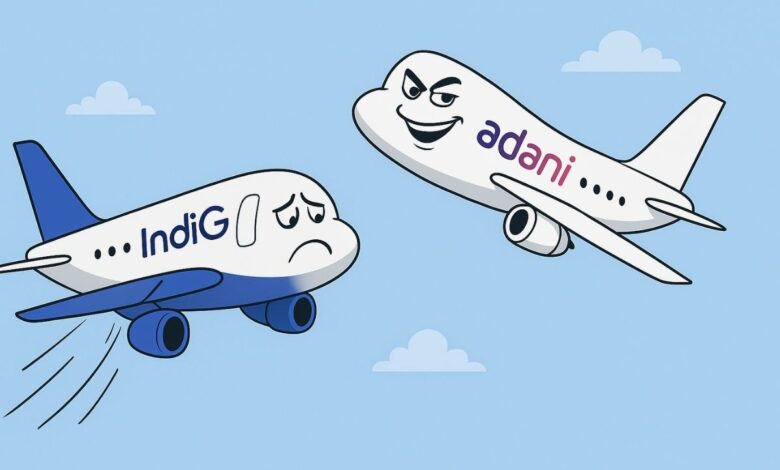
Who is gaining from IndiGo’s fall?
In the great IndiGo meltdown of 2025, angry passengers and trending hashtags have blasted India’s largest airline left, right and centre. Flights were delayed or cancelled en masse, vacation plans and weddings upended, and terminals overflowed with luggage-piled-up scenes that “had never been witnessed in India’s aviation history”. Social media lit up with blame on IndiGo memes, tweets and rants, all pointing at the blue airline for missing the mark.
But is the outrage masking a deeper story? Sometimes the real story isn’t what’s on the ticket; it’s what’s in the boardroom. Behind the scenes, the pieces of a very different power play may have fallen into place, and one group seems to be smiling. Could it be that while we were blaming IndiGo, another giant was quietly gaining?
Let’s be clear: this isn’t conspiracy for its own sake. Everything we discuss here is grounded in hard facts of government filings, news reports and market data. The timeline is striking. Late in 2025, as IndiGo scrambled to adjust to new crew-rest rules, an unrelated deal was announced: the Adani group’s aerospace arm would pay ₹820 crore to buy roughly 72.8% of FSTC, India’s largest pilot-training and simulation company.
At first glance, training pilots might sound as dull as a safety video. But think of it this way, in aviation, the one who controls the pilots controls the sky. India’s airlines are ordering more than a thousand new jets, meaning tens of thousands of new pilots will be needed. By snapping up FSTC, with its 11 full-flight simulators and 17 training planes, Adani essentially hoists a giant sign on India’s cockpit, saying “Welcome aboard Adani Aviation.” So let’s dissect the data and plot: Who’s really flying this story?
Maybe: #IndiGoDown, #AdaniUp: Outrage vs. Opportunity
Consider the public narrative where everyday travellers vent their spleen at IndiGo’s failure. Flight after flight cancelled. Newlyweds stranded at airports. An outraged bride wrote on X that her honeymoon was ruined. On Instagram, passengers shared photos of sleeping toddlers in terminals. Indeed, hundreds of cancellations in a single week turned IndiGo from a punctuality champion (91% on-time as of mid-2025) into a cautionary tale overnight. The immediate cause was crew shortages triggered by new DGCA rules on pilot duty times. But while the court of public opinion roasted IndiGo, maybe, a subtler drama was unfolding far above the runway.
Instead of flights and fares, the real action was in regulatory circles and boardrooms. Funny timing, yes? IndiGo was under the gun for failing to plan for the January 2024 fatigue rules. Passengers and the press saw chaos at airports. Meanwhile, a little-noticed stock exchange filing revealed that Adani Defence Systems & Technologies (through its subsidiaries) was set to buy the dominant pilot-training outfit. The timing begs the question: was someone in Adani’s corner playing 4D chess? Or is it just coincidence that as IndiGo faltered in the skies, Adani ascended on the ground?
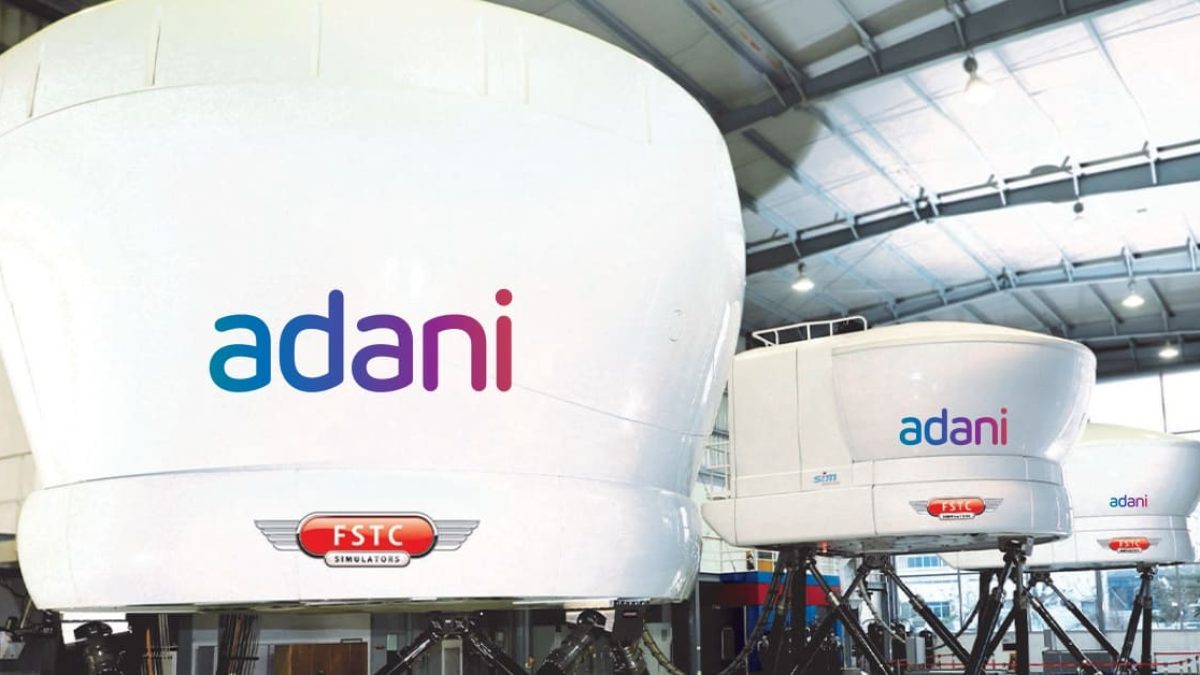
By Nov 27, 2025 – the very week flight disruptions peaked and Adani’s group announced it would acquire a 72.8% stake in FSTC for ₹820 crore. FSTC (Flight Simulation Technique Centre) is no fly-by-night shop. It’s India’s largest independent pilot training and simulator provider. It operates 11 full-flight simulators and a fleet of training aircraft. Pilots from fresh cadets earning their Commercial Pilot License (CPL) up to seasoned captains needing a type-rating on a new aircraft all pass through FSTC’s courses. In other words, as India’s aviation market booms, Adani just took control of the pilot pipeline.
Let’s peek at the financials. The deal price of ₹820 crore is bigger than it looks because Adani bought most of the company (a 72.8% controlling stake). This transaction was engineered by Adani Defence Systems & Technologies Ltd (ADSTL), backed by Adani Enterprises (AEL), and its JV Horizon Aero Solutions (HASL). In fact, ADSTL and HASL (an AEL subsidiary) signed share-purchase agreements on Nov 27 to acquire effective 72.8% of FSTC. Post-acquisition, FSTC folds into Adani’s aviation ecosystem, with Air Works and Indamer Technics, two Adani-owned MRO (maintenance) players, creating what the CEO calls a “fully integrated aviation services platform”.
Adani Enterprises had a market capitalization of roughly ₹3 lakh crore at that time. So this FSTC deal used under 0.3% of the parent’s capital. Adani’s stock actually jumped ~3.4% on the day of the announcement, implying investors cheered the move. In contrast, IndiGo’s parent (InterGlobe Aviation) saw its share price plunge in early December, losing about 16% of its value in a few days, roughly a $4 billion hit. Even more telling, AEL’s stock, despite being down earlier in the week, recovered on the FSTC news, while IndiGo’s imploded as the crisis escalated. To say the market picked sides is an understatement.
So on the balance sheet says Adani invested ₹820 cr, got the crown jewel of pilot training, and (minimally) boosted its stock. IndiGo, meanwhile, lost reputation and stock market cap. And what did the flyers get? A mountain of delays and an apology from CEO Pieter Elbers, plus DGCA interference. It’s hard to call that a happy ending for passengers.
Timeline of Fatigue Rules: Delays and “Convenience”
To untangle how IndiGo got here, we need to look at the DGCA’s rulebook on pilot duty, the so-called Flight Duty Time Limitations (FDTL). In January 2024, the regulator overhauled pilot duty rules to improve safety. The changes tightened rest requirements: minimum weekly rest increased to 48 hours (from 36), “night” was redefined as 00:00–06:00 (up from 00:00–05:00), and strict new caps were placed on consecutive overnight shifts and night landings.
In practice, that meant an 8-hour limit for flights touching the new night window, a max of two night landings (down from six), and no more than two night duties in a row. All designed to keep pilots from becoming zombie-like. Sounds sensible, but also meant airlines would need more pilots and rejig schedules.
Originally, these norms were set to kick in mid-2024. Business Standard reports that after notifying the rules in May 2024, compliance was due June 1, 2024. However, airlines lobbied hard, pleading for more time to hire crew. DGCA eventually relented: implementation was phased and delayed. The first phase finally took effect on July 1, 2025, extending weekly rest to 48 hours. The second phase of slashing night landings from six to two came into force on November 1, 2025. In sum, a deadline that was “slated for June 2024” got quietly pushed to late 2025.
Why does this matter? Because each postponement bought India’s airlines more time to delay hiring and training pilots; the very output that FDTL aimed to force up. In effect, regulators made fatigue rules far gentler than planned, right when pilot demand was surging (India needs some 25,000–30,000 new pilots for the 1,700 jets on order). When enforcement finally tightened, it hit at the worst possible moment: the December holiday/wedding rush. IndiGo and a few others had essentially ignored the extra planning window and suffered the consequences.
By the first week of December 2025, the impact was painfully clear. IndiGo cancelled hundreds of flights over just a few days, with on-time performance dropping from 84% in October to barely 19.7% on Dec 3. The airline blamed “unforeseen operational challenges,” but citizens pointed to chronic under-planning. Pilot unions had a field day calling IndiGo’s plight a “strategic mistake” or even a deliberate pressure tactic.
“Whenever a rule comes out in favour of pilots, airlines cause public inconvenience to build up pressure on the regulator,” implying IndiGo may have flexed its market muscle. For purposes, the salient fact is that just days before IndiGo’s network unraveled, the rules finally locked in, and just days after Adani’s FSTC deal was inked.
These shifting timelines look, to put it bluntly, awfully convenient. The DGCA initially told airlines they had more time, then suddenly said “carry on” under a court mandate. Crucially, when the final strictures arrived on Nov 1, IndiGo’s crewing was barely adequate. Banks of flights departed with empty seats. Suddenly, there was a dire need for pilots. And who runs the biggest pilot source? Adani, by then.
Interestingly, as crises mounted, the DGCA backtracked on one final detail. The new FDTL had included a rule that pilots could not substitute any leave for their mandatory 48-hour weekly break. But on December 5, amid IndiGo’s apocalypse, the regulator announced it was withdrawing that instruction, allowing airlines to count some leave days as rest. Practically overnight, IndiGo got a reprieve from one tough rule. Adani’s supporters claim it was just a pragmatic fudge to ease disruption. Critics sniff at it as the regulator suddenly making a rare concession after one airline’s trouble; a classic sign of regulatory pushback. Pilot associations were furious, calling the relief “selective” and dangerous, but that’s a political other-flies-in-the-ointment issue.
In sum, the FDTL saga was a roller-coaster of deadlines. Airlines won delays; regulators were forced to enforce; airlines cried foul; regulators gently eased. The end result: IndiGo’s training shortfall became legend and fear. Meanwhile, a new player had quietly moved in to supply the solutions.
Adani Acquires the Flight School: A Financial Breakdown
Now let’s zero in on that Nov 2025 deal. Adani Defence Systems & Technologies Ltd (ADSTL) and its affiliate Horizon Aero Solutions (HASL) agreed to buy roughly 72.8% of Flight Simulation Technique Centre (FSTC) for an enterprise value of ₹820 crore. To be precise, regulatory filings say the share purchase agreements were signed on Nov 27, 2025 with FSTC’s shareholders. The remaining ~27% stays with the original founders. In short: Adani is now the controlling owner of FSTC.
What is FSTC worth? The announced price implies a 100% valuation of about ₹1,126 crore (since 72.8% was ₹820cr). That’s a hefty sum for a pilot school; but remember, this is India’s largest independent pilot-training company. It’s not flying on a wing and a prayer. According to news reports, FSTC “operates 11 advanced full-flight simulators and 17 training aircraft” across campuses in Gurugram and Hyderabad. It’s certified by the DGCA and even Europe’s EASA, so it can train pilots to international standards. It also runs big flying schools in Haryana (Bhiwani and Narnaul). All told, it’s a one-stop shop: you can earn your CPL, get recurrent training or type-rating, and practice on the sim, all under one roof.
For context, consider Adani’s financial size. The flagship Adani Enterprises Limited (AEL), parent of the airport and defence units had a market capitalization around ₹3 lakh crore in late Nov 2025. So the ₹820cr purchase is about 0.27% of its equity value. A relative rounding error, really, small change on Adani’s balance sheet. By contrast, ₹820cr is enormous to a pilot academy or to a small company. It’s the sort of price that underwriters of bank loans and stock market investors stand up and notice.
So far, how’s it looking on the books? Upstox reports that Adani Enterprises stock jumped over 3% on Nov 28, 2025, hitting ₹2,331 on the NSE after the FSTC news. Markets clearly cheered this expansion of Adani’s aviation franchise. Meanwhile, FSTC itself promises “robust growth” plans, it sees itself scaling up as India’s pilot hunger grows.
What about monopoly gains or strategic payoff? It’s easier to see opportunity than to quantify it. But consider that India will need roughly 25,000–30,000 new pilots to staff the ~1,700 jets already on order. If those pilots train at, say, ₹30 lakh each (typical CPL course costs), that’s ₹75,000–90,000 crore of training revenue at stake. Even a 1% slice of that is ₹750 crore, nearly the cost of FSTC itself! And remember, FSTC isn’t the only flight school in India, but it’s by far the largest private one. In effect, Adani’s suit now has monopoly-ish leverage over a big chunk of the pilot pipeline. It can scale up classes, attract foreign cadets, or even price strategically if supply tightens.
Plus, vertical integration multiplies the edge. Adani already runs 8 major airports across India, from Mumbai to Ahmedabad to Lucknow to Jaipur and more. If it also controls where pilots are trained, it owns both ends of airline operations. Airlines wanting to fly out of Adani airports or needing pilots might have to knock on Adani’s door. The news portal quoted Adani’s CEO as saying this acquisition is the next step to a “fully integrated aviation services platform”. Integrated indeed as pilots trained at FSTC, then flown by airlines operating from Adani terminals, maintained by Adani’s MROs (Air Works, Indamer); all these a neat funnel. Seems like “Control the supply chain and you control the market.”
Of course, India still has dozens of flight schools and a few government academies, so FSTC isn’t a legal monopoly. But being the biggest player in a capacity-constrained market is powerful. In any case, Adani’s shareholders and managers have positioned themselves to profit from every incremental demand for pilots. Meanwhile, IndiGo faces a double whammy of more competition for pilots (since airlines now chase trainers) and blame from regulators and customers for not having enough.
Doppler Radar on IndiGo’s Woes
While Adani was scooping up simulation gear, IndiGo itself was plotting recovery. How is the airline’s market standing after the storm? Before December, IndiGo was flying high. It commanded about 60–65% of domestic air travel, making it the dominant low-cost carrier. Its punchline was cheap tickets and on-time arrivals – a rare combo that had CEO Pieter Elbers crowing about being “too big to fail.”
Then it all stalled. The cancellations turned into the biggest crisis in IndiGo’s 20-year history. International agencies noted the market was near duopoly: IndiGo plus Air India (including AI Express) together held about 92% of seats. On many thin routes, IndiGo was the only carrier. That “too-big” status meant its fall was felt industry-wide. (One aviation analyst sniffed that if either IndiGo or Air India faltered, “there will be mayhem in Indian aviation” – echoes of the GoFirst or Jet blunders past.)
By numbers: IndiGo cancelled over 2,000 flights in one week. On Dec 3, only 19.7% of its flights departed on time (down from 35% the day before). In early December, its OTP was hit with rock-bottom 8.5% one day. Lost revenue soared, as customers were already due \$68 million in refunds from the disruptions. On a P&L scale, IndiGo last year made about \$807 million profit on \$9 billion revenue. Even a few percentage hit could wipe out a quarter’s earnings.
The stock market jigsaw fell quickly. IndiGo’s share price tumbled, shedding about 16% of its value in a week. That wiped roughly \$4 billion off the airline’s valuation. By contrast, smaller rivals (Air India, SpiceJet, Akasa) saw modest bumps as passengers scrambled to rebook, but none could realistically scale up given their own problems.
The fear was if IndiGo’s network was crippled during peak season, a lot of leisure and business demand would spill over into others’ lap; at least temporarily driving yields on alternate carriers. SpiceJet took out ads for new flights in Delhi/Mumbai, Air India added trains to relieve stranded flyers, and the government even imposed price caps on domestic fares to prevent gouging. In effect, the crisis became a national air-travel emergency, not just an airline PR nightmare.
Nor did regulators stand idle. On Dec 5, the DGCA fired off a stern show-cause notice to CEO Elbers, giving him 24 hours to explain why action (fines or worse) shouldn’t be taken. The DGCA’s exact words accused the CEO of failing in his duty to ensure “reliable operations”. Local media headlines ran “DGCA Investigates IndiGo” and “Regulator Warns Indigo,” underscoring the political heat. Meanwhile, the Union Aviation Ministry even set up a 24×7 consumer helpline. All of which says: IndiGo is now squarely in the hot seat, and the fallout may shadow it for years.
For customers, the brand damage is the scar. IndiGo’s mantra was always “we land on time.” Now there are viral videos of sleeping families and stranded pilgrims. Even Prime Minister Modi’s dream of “flying in slippers” (his old slogan) got a rude awakening. Several experts and industry veterans pointed out that IndiGo’s own lean staffing and hiring freeze left it fragile. But others noted the irony. Few passengers care about IPL or DGCA or simulators when they’re stuck at the airport. They see only one airline and in their mind, that’s the problem.
In terms of market share, it’s too early to say if IndiGo permanently loses ground. The huge pent-up demand and limited competition might actually swell its bookings for weeks to come. But this episode gave competitors (especially Air India’s LCC arm, Air India Express, and Akasa) a taste of opportunity: any improvement in those airlines’ services now will attract business lost by IndiGo. On Dec 8, some analysts trimmed IndiGo’s profit forecasts and target price, anticipating higher costs (overtime, wet leases) and brand damage. The long-term outcome hinges on trust: one exec told Reuters that this looks like “the lowest point in the company’s history” for its reputation.
Monopoly, Regulatory Capture and the New Political Economy
So what’s the big picture? On one side we have IndiGo, a 65% domestic market-share monopoly on wheels, dragged into crisis by sudden fatigue rules. On the other, Adani – an industrial behemoth snapping up every piece of the aviation supply chain: airports, cargo terminals, MROs, and now pilot schools. If you step back, it begins to look like more than a coincidence.
In an ideal world, regulators push the industry toward safety and efficiency, and companies compete on open fields. But here, reality had some odd twists:
- Regulatory Delay: DGCA’s multiple deferments of the FDTL rules effectively gave airlines an extra year of business-as-usual. That timing, scholars say, smells of “regulatory capture” – when industry insiders influence the hands that should protect the public. Now we can’t prove a smoking gun, but the fact is enforcement got gentler precisely during Adani’s run-up.
- Selective Enforcement: After IndiGo’s crisis peaked, DGCA excused just that airline from two strict norms (night flying limits and leave-for-rest). All other carriers still must comply. Why make one airline an exception in December? Possibly to stop the crisis from deepening. But pilot unions denounced it as compromising safety to bail out management. It’s a vivid example of policy bending under pressure.
- Market Structure: India’s aviation market is essentially a duopoly (IndiGo + Air India ~92% combined share), and now one of those players (IndiGo) is in peril. Adani isn’t an airline, but it’s a “shadow airline” architect: it profits from anyone who flies. It’s not allowed to own an airline (that would breach foreign investment rules for airports), but controlling airports and pilots is the next best thing.
- Political Influence: Gautam Adani’s conglomerate is famously intertwined with India’s infrastructure plans. He’s building 8 airports in India (plus the upcoming Navi Mumbai mega-hub). Throw in FSTC and you have him touching passengers from runway to crew training. Critics of such concentration warn of crony capitalism, a term for when business and politics collide to shut out others. We lack any public evidence of backroom deals, but one can’t ignore that rules suddenly paused just as Adani bought FSTC. Observers will be watching whether policy reshuffles ultimately benefit his empire.
The broader theme is this: India’s aviation growth is tied up with its political economy. Ministers talk up airports and manufacturing, but the players benefiting most are a few giants. IndiGo’s chaos exposed how fragile the “model” is – and handed Adani a golden opportunity to consolidate. After all, who makes money when there are more pilots per plane? The pilot-training industry does. And who now runs that industry? Adani does.
We should note: none of the above is illegal or even unusual for big business. Companies always seek regulatory grace and strategic assets. But it underscores how safety rules, business strategy and politics can intersect unexpectedly. While passengers took selfies next to cancellation boards, Adani’s board was likely calculating how many courses to offer next year. In the end, the victims of IndiGo’s fall are mainly travellers and small competitors. The beneficiary – Adani – made a measured bet that the math was on its side.
At the end: Beyond the Headline
This saga is more than just an airline’s PR disaster; it’s a microcosm of “how India flies now.” IndiGo’s fault, or misfortune, remains at the centre of media attention, but all evidence suggests the gains are landing elsewhere. Adani’s share price jump and strategic positioning tell a clear story: the rules changes, and especially the collapse of IndiGo’s roster, have handed them a near-monopoly tailwind in aviation services. Meanwhile, IndiGo pays the price in lost trust, regulatory scrutiny and financial loss.
In the next few months, we’ll learn a lot. Will IndiGo recover its on-time crown? Will competitors step up? Will the pilots Adani now trains fill IndiGo cockpits – or others? And perhaps most pointedly: Did any of us connecting the dots see this coming? Even the DGCA seems sheepish now, granting special leeway and scolding IndiGo in the same breath. Passengers and politicians have to consider whether their outrage is misdirected. Because when the dust settles, it’s possible the airlines and regulators will have shifted, but Adani will still be flying high.

Sometimes, the biggest stories are the ones no one tweets about. This one might just be unfolding on cloud nine, out of sight. And if it does turn out that one family ended up with the keys to India’s aviation, then to quote an industry watcher: “It’s not just business. It’s power consolidation.”