Supreme Court Bans NCERT Textbook On Judiciary Corruption: When The Accused Becomes The Judge

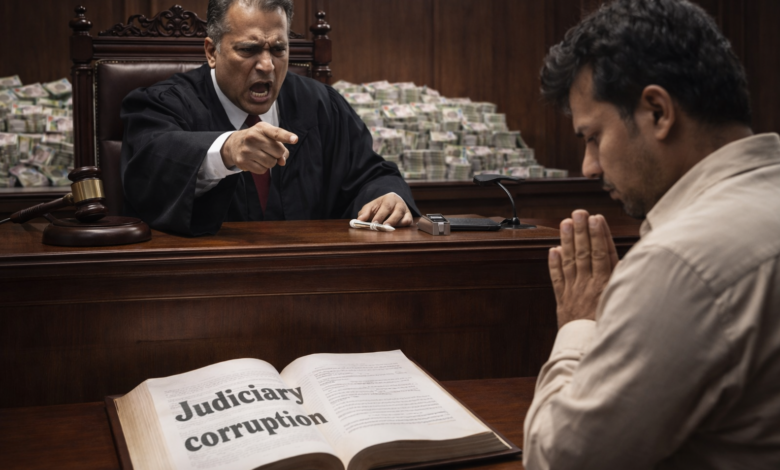
India’s Supreme Court Bans a Textbook for Telling the Truth About Itself!
There is a thought experiment that every first-year law student encounters somewhere in their jurisprudence classes — usually in a musty classroom that smells of chai and anxiety — and it goes something like this: can a person be a fair judge in their own case? The Latin maxim nemo iudex in causa sua answers it with the bluntness of a gavel. No. Never. Not in a democracy. Not in any system that claims to believe in justice rather than just power dressed in justice’s robes.
India’s Supreme Court, on February 26, 2025, took that maxim, looked at it carefully, and apparently decided it was merely a suggestion.
On that day, a bench headed by Chief Justice Surya Kant took suo motu cognisance of a chapter in a new Class 8 NCERT Social Science textbook — a chapter written for 13-year-old children — that listed “corruption at various levels of the judiciary” among the challenges faced by India’s judicial system. The court did not merely order a review. It did not merely ask for a clarification.
It issued show-cause notices to the Secretary of School Education and the NCERT Director, asking why criminal contempt of court proceedings should not be initiated against them. It banned the book entirely. It ordered that every printed copy be seized and that every digital version be removed from public access. It declared that any attempt to distribute the book — physically or digitally — would be treated as wilful breach of court orders. And for good measure, the Solicitor General assured the bench that the individuals who had defended the chapter’s inclusion would not be associated with NCERT or any government ministry in future.
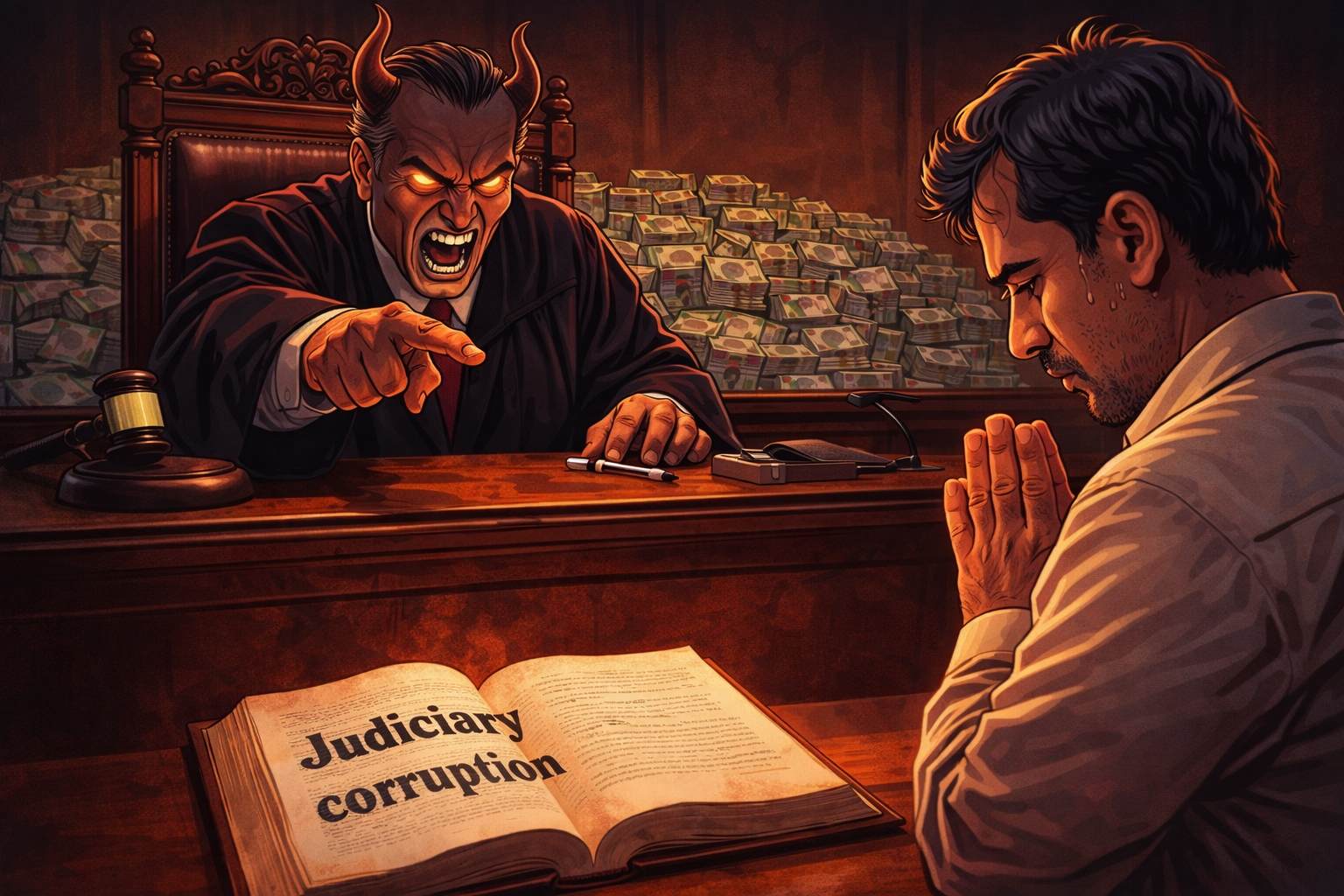
The institution that was being discussed in the textbook had, in a single hearing, appointed itself the plaintiff, the investigator, the judge, and the sentencing authority in a case against a school syllabus. And it did all of this using a law — the Contempt of Courts Act, 1971 — that it alone administers, interprets, and enforces.
If a student had submitted this as a case study in institutional conflict of interest, their professor would have given it full marks and quietly wondered whether the student had been reading the news.
Are These Numbers That Were Too Dangerous for Thirteen-Year-Olds?
Let us begin with the data — because what makes this case uniquely extraordinary is not that someone published opinions about the judiciary. Opinions about the judiciary have been published since the day there was a judiciary to have opinions about. What makes this case extraordinary is that the court banned a textbook for teaching children numbers. Government numbers. Parliament’s numbers. Numbers spoken aloud in the Lok Sabha by a sitting Union Minister.
Law Minister Arjun Ram Meghwal informed the Lok Sabha that between 2016 and 2025, a total of 8,639 complaints were received against sitting judges of Indian courts. In 2024 alone — the highest in any single year during that period — 1,170 complaints were registered. The textbook cited these figures. The Supreme Court banned the textbook.
To understand the scale of what is being hidden from children under the generous banner of “protecting institutional dignity,” consider the following. India has, as of 2025, approximately 25 million cases pending across all levels of its court system — though the textbook’s own figures, which cited the National Judicial Data Grid, put the number at 4.70 crore (47 million) cases pending in district and subordinate courts alone, with an additional 62.40 lakh (6.24 million) in high courts and 81,000 in the Supreme Court itself. That is, by any reasonable measure, not a system operating at the frontier of functional justice.

That is a system in which a citizen filing a civil case today may reasonably expect to die before the matter is resolved — and statistical evidence supports that grim assessment. Studies by the DAKSH Centre for Public Interest Law have found that at the current rate of disposal, it would take some high courts between 30 and 50 years to clear their existing backlogs even if not a single new case were filed.
And the children of India — the future litigants, the future lawyers, the future voters who will one day stand in those queues — were being taught, in a balanced, officially published textbook, that this is a problem worth understanding. The Supreme Court’s response was to ensure they would not be taught this at all.
The Colonial Tool That Judges Cannot Bear to Put Down
The mechanism the court used to achieve this suppression is the Contempt of Courts Act, 1971 — and the specific provision invoked is what legal scholars have long called its most dangerous clause: criminal contempt for “scandalising the court.” The court noted on record that the publication “can come within the purview of criminal contempt of court, if proved to be a deliberate act to scandalise the judiciary.”
It is worth sitting with the circularity of this for a moment, because it is breathtaking in its audacity. The court determines what constitutes “scandalising” the court. The court decides what is a “deliberate act” to defame itself. The court prosecutes the alleged scandaliser. The court sentences them. There is no external check on any stage of this process. No independent ombudsman reviews whether the court’s hurt feelings are constitutionally proportionate. No parliamentary oversight scrutinises whether the contempt power is being exercised in the public interest or the judicial interest. The provision is, structurally, a mechanism by which powerful people in black robes can punish anyone who makes them uncomfortable — and call it justice.
The Law Commission of India, in its 274th Report (April 2018), was specifically asked by the government to examine whether ‘scandalising the court’ should be removed from the Contempt of Courts Act. Its answer was no — retain it. The Commission, headed by a former Supreme Court judge, looked at the UK’s 2013 abolition of the same provision and decided India was different. The institution being protected by the law was asked whether the law protecting it was necessary. It said yes.
Compare this to the United Kingdom, which abolished criminal contempt by way of “scandalising the court” through the Crime and Courts Act 2013 — doing so with the explicit support of the UK Supreme Court, which concluded that a mature, confident judiciary in a democratic society should be able to withstand criticism without reaching for criminal law. The UK’s senior judges endorsed the removal of their own shield. India’s senior judges, in 2025, used that shield against a Class 8 textbook. The direction of travel in these two common law systems — both heirs to the same legal tradition — could not be more starkly opposite.
Suo Motu for a School Book: A Question of Prioritisation
The suo motu power — the court’s ability to take up cases on its own initiative without waiting for an aggrieved party to approach it — is among the most powerful tools in any apex court’s arsenal. In India, it has been used magnificently: to address prison conditions, to respond to environmental disasters, to intervene in cases of custodial torture where victims had no voice. At its best, it is the conscience of the Constitution speaking when no one else will. On February 26, 2025, it was used to ban a children’s textbook.
NCRB data for police custody deaths reported between 2001–2013 recorded about 1,275 deaths in police custody during that period (not including judicial custody) and roughly 12,727 deaths in judicial custody between 2001–2010 per NHRC-related figures. Later summaries based on News reports note that 1,888 custodial deaths (including police and judicial custody) were reported across India from 2001 to 2020. One rights analysis reported that between 2001 and 2018, data compiled from NCRB and other official disclosures show 1,727 persons died in police custody (judicial remand + police custody) across India in that 18-year period — averaging about 96 deaths per year. Has the Supreme Court taken suo motu jurisdiction to address every one of those custodial deaths?
As of 2025, the electoral bonds scheme — which the Supreme Court itself struck down as unconstitutional in February 2024 — had already generated documented evidence of what critics called systemic corruption in the relationship between corporate donors and state power. The suo motu docket could accommodate an inquiry, but does the apex court of the nation did so?
As of 2025, India’s prisons held 5.73 lakh inmates against a sanctioned capacity of 4.25 lakh — a 135% occupancy rate — with 76% of those prisoners being undertrials, people who have not been convicted of anything, waiting in overcrowded cells for a system too backlogged to hear their cases. The suo motu power could reach them, but does it really reached the roads of justice?
Instead, the court reached for a Class 8 Social Science textbook. Chief Justice Surya Kant described its contents as a “deep-rooted, well-planned conspiracy to defame the judiciary.” Let the record show that the conspiracy was authored by curriculum designers employed by the Indian government, its weapon of choice was publicly available parliamentary data, and its intended victims were 13-year-olds learning civics.
The Quote That Broke the Bench — And What It Actually Said
Perhaps the most exquisite irony in this entire episode — and in a case this rich with irony, competition is fierce — is the identity of the person being quoted in the offending chapter. The textbook cited former Chief Justice of India BR Gavai, who stated publicly that “instances of corruption and misconduct within the judiciary had a negative impact on public confidence” and that “transparency and accountability are democratic virtues.”
The current Supreme Court bench observed that this quote had been taken out of context to give the impression that the CJI himself had acknowledged corruption. One must pause to absorb the intellectual content of this objection. The former Chief Justice of India said, in a public address, that corruption and misconduct within the judiciary damage public confidence. A textbook quoted him saying this. The current bench’s position is that quoting him accurately, in a chapter about challenges facing the judiciary, creates a false impression that he was acknowledging corruption.
What impression was CJI Gavai creating when he gave the speech? Was he discussing corruption in some other institution? Was the word “judiciary” in his sentence a typographical error? The bench offers no clarification on what the correct context of “corruption and misconduct within the judiciary” might be — only the assurance that in a textbook, it becomes contempt.
What this episode reveals, with uncomfortable clarity, is not merely a disagreement about educational content. It reveals a judiciary that has decided its public narrative must be managed, not merely protected — that even the words of its own former Chief Justice are too dangerous to allow into a classroom if they come without sufficient accompanying praise.
The Standard That Only India’s Judiciary Claims
There is a simple test for whether a legal position is reasonable in a democracy: does any comparable democracy hold the same position? On the question of whether judicial corruption and institutional accountability should be taught in schools, the answer is unambiguous and unanimous.
In the United States, the Federal Judicial Center — the research and education agency of the federal courts — publishes studies on judicial misconduct that are freely available and regularly incorporated into high school civics curricula. Between 2008 and 2022, the US Judicial Council received and processed over 4,000 misconduct complaints. None of this is hidden from students. None of it has resulted in a textbook ban.
In Germany, the Federal Ministry of Justice publishes annual judicial statistics including data on disciplinary proceedings against judges, and this data is cited in school-level political education materials as part of the Rechtsstaat (rule of law) curriculum. German schoolchildren learn that judges are accountable to the law. It has not caused the German judiciary to collapse.
In France, the Conseil Supérieur de la Magistrature — the body responsible for judicial discipline — publishes an annual public report of its proceedings. It is accessible to anyone, including students, including journalists, including people who wish to form opinions about whether the judiciary is functioning well. No French court has ever declared an educational ministry in contempt for citing it.
India’s Supreme Court, in February 2025, issued criminal contempt notices to education officials for citing the Law Minister’s own Lok Sabha statement in a Class 8 textbook. By the comparative standard of every major democracy with a functioning judiciary, this is not the behaviour of a confident institution defending its legitimacy. It is the behaviour of an insecure institution defending its image — and using the most powerful legal tool at its disposal to ensure the defence holds.
What Is Actually Being Protected
The court’s stated concern is institutional dignity. The protection of public confidence in the judiciary. The shielding of impressionable young minds from content that might erode their faith in the justice system.
But consider what actually erodes public confidence in a justice system. Is it a textbook chapter that acknowledges 4.70 crore pending cases while also explaining the redressal mechanisms available? Or is it the 4.70 crore pending cases themselves? Is it a civic education chapter that notes 8,639 complaints against judges? Or is it the 8,639 complaints, and the in-house mechanism that has never once published a public account of what happened to any of them?
A judiciary that commands public confidence through the suppression of accurate information about itself is not commanding confidence at all. Isn’t it’s manufacturing ignorance and calling it reverence? And a generation of children educated in that manufactured ignorance will not grow into citizens who trust their institutions — they will grow into adults who, when they finally encounter the reality of those 47 million pending cases, will feel not just frustrated but betrayed. Betrayed by a system that hid itself from them. Betrayed by an education that chose comfort over truth.
Nemo iudex in causa sua. No one shall be a judge in their own cause.
The principle is 800 years old. It took India’s Supreme Court 78 years of independence to openly defy it — and all it required was a Class 8 textbook, some government statistics, and a bench that decided, on the record, that the children of tomorrow do not need to know what the temples of justice actually look like from the inside.
The children will find out anyway. They always do. The only question is whether they find out from a textbook that also tells them how to fix it — or from experience, when it is already too late.
Views are personal and evidence-based. All data cited in this article is sourced from official government statements, parliamentary records, and publicly available judicial statistics.