The Boat on the Road: What Cars24’s Stunt Revealed About Gurugram’s Annual Failure
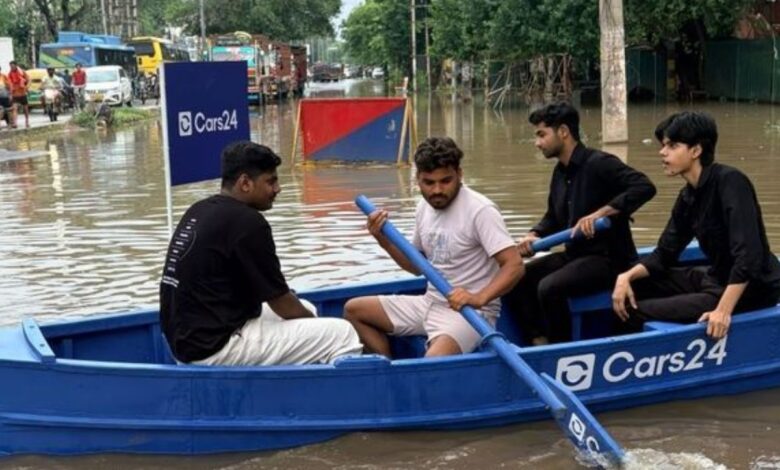
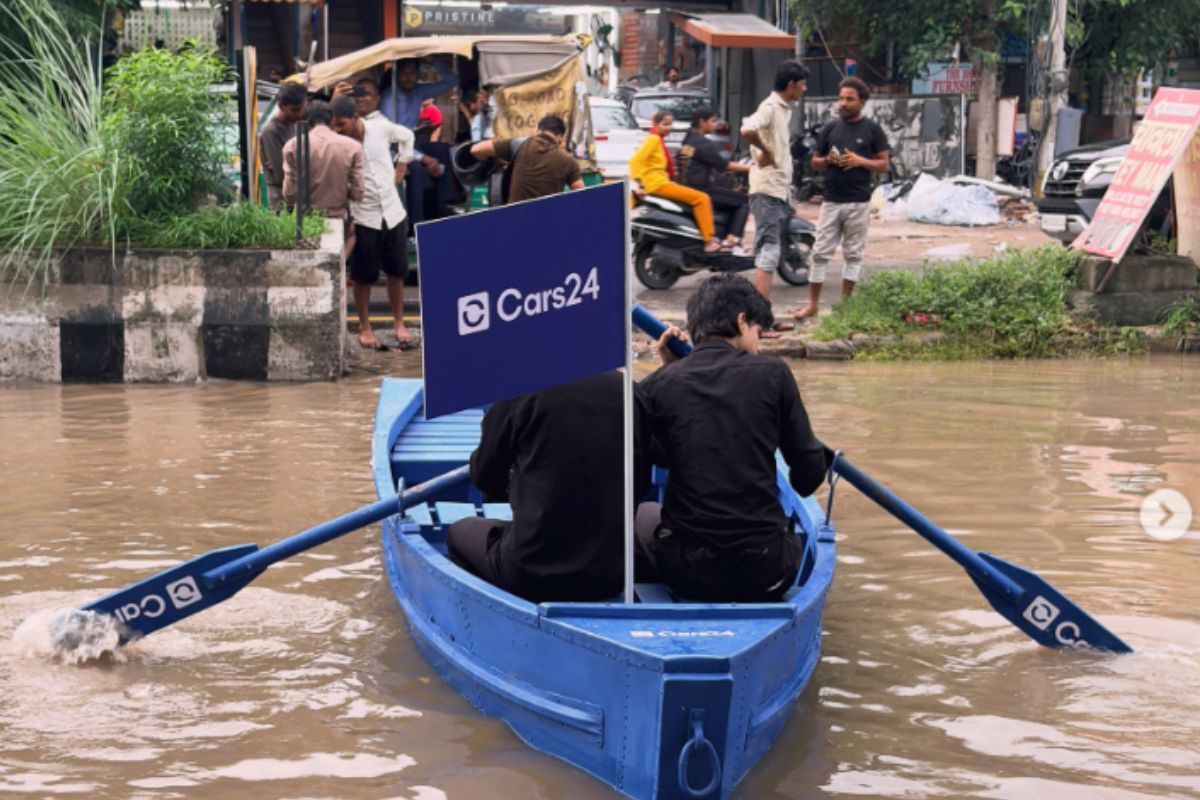
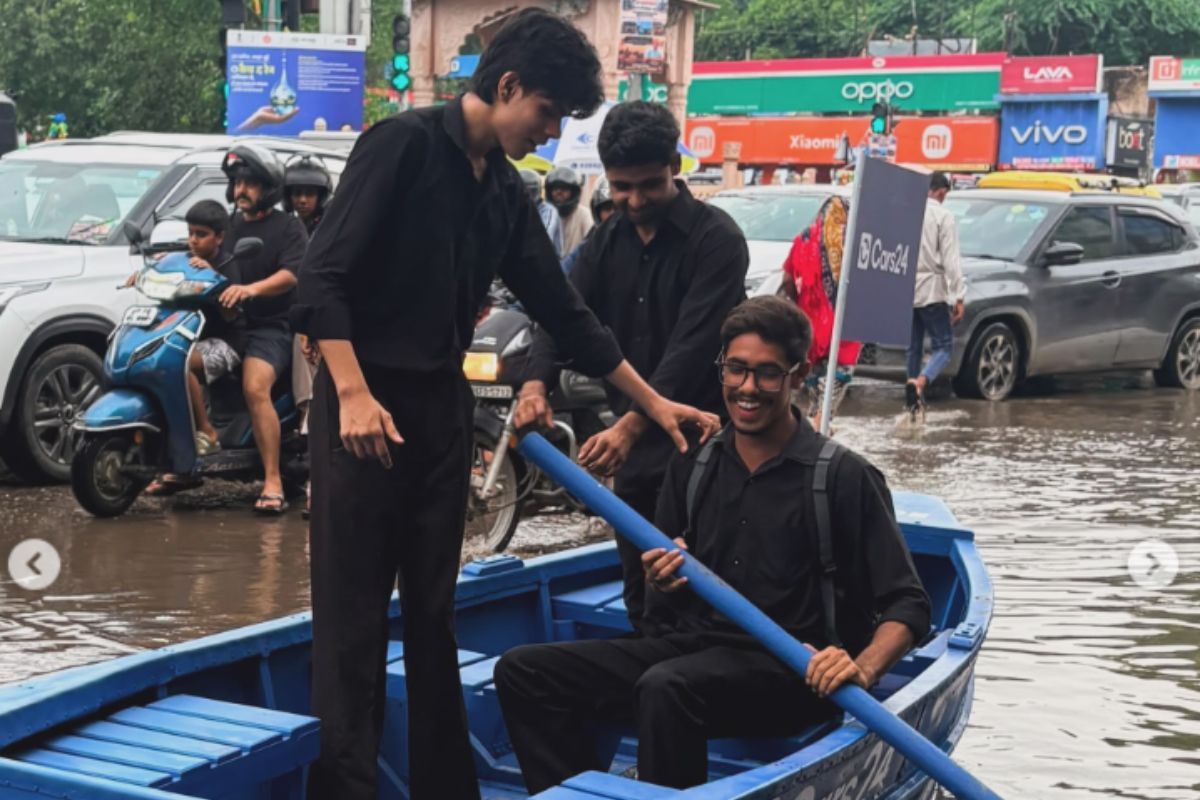
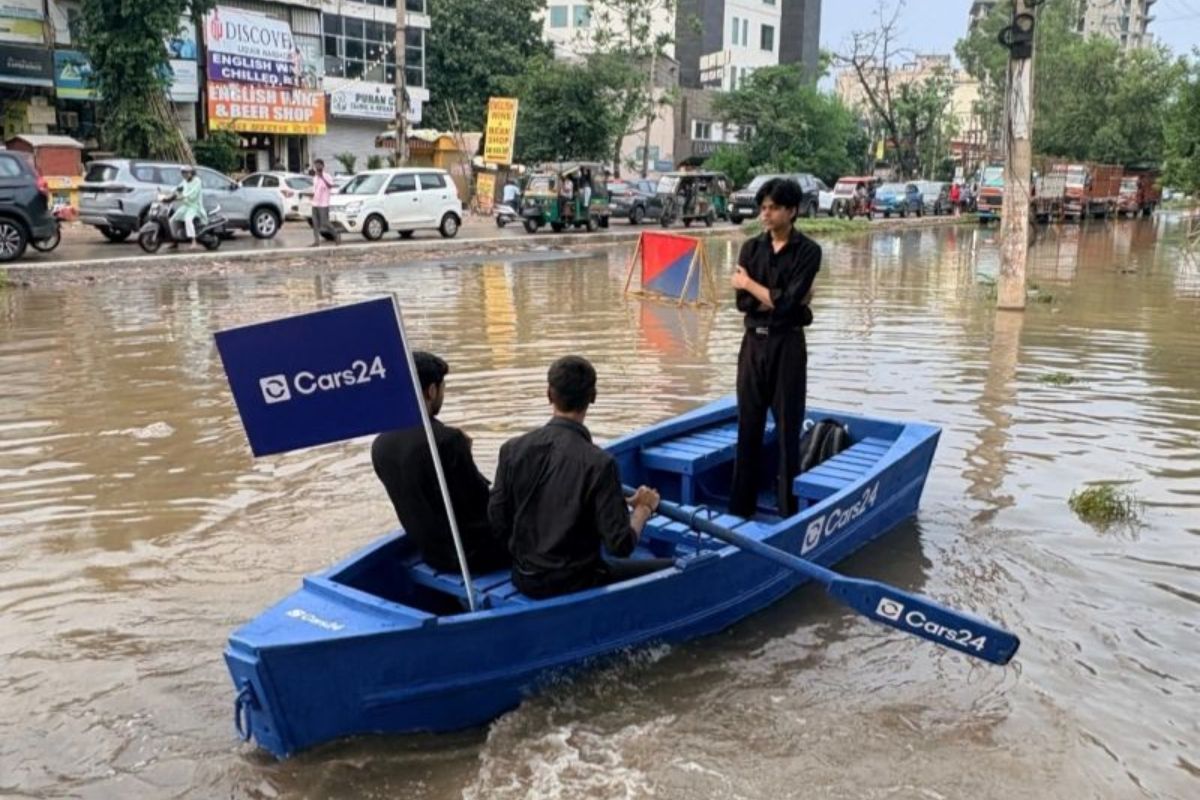
Last week, a bright blue boat carrying the Cars24 logo appeared on a flooded road in Gurugram. Four men sat inside it with oars, moving through what was supposed to be a city street. The image was shared by Prachi Sharma, the company’s Head of Brand and Communications, on LinkedIn. It was intended as satire. It quickly became something more revealing.
In her post, Sharma wrote that the company had put the boat in the water as a joke about the rain. She claimed a challan of ₹50,000 arrived within seconds. “The crime: a boat. The location: a road. The road: a river,” she said. She added that flooding had been arriving in Gurugram for years and had never cost anyone anything. When people began climbing into the boat because rowing had become the fastest way home, the joke, she noted, stopped being funny.
The claim travelled quickly. Within days, however, the facts shifted. Gurugram Traffic Police publicly denied issuing any challan or seizing any boat. ACP Traffic Satyapal Yadav stated that no complaint had been received and no fine had been imposed. He even questioned whether the circulating photograph was from the current season. Cars24 then issued a clarification: the ₹50,000 figure referred to the cost of the marketing activation itself, not a traffic penalty. The company apologised to the Gurugram administration and police, acknowledging that the way the campaign was framed had created confusion by wrongly attributing an enforcement action that never occurred.
The correction is important. No challan was issued. The boat was a planned marketing exercise that used the city’s flooding as its backdrop. Placing a vessel on a public road during waterlogging raises legitimate questions of safety and authorisation. Yet the episode still matters—not because of the disputed fine, but because of what it made visible.
A Failure That Repeats Every Monsoon
Gurugram’s waterlogging is not an occasional inconvenience. It is a chronic, documented, and expensive failure. Year after year, significant rainfall turns major roads, underpasses and residential stretches into temporary waterways. Cars stall. Commuters wade. Office corridors flood. Luxury societies find their basements and approach roads submerged.
Civic agencies have spent large sums trying to address the problem. Reporting in 2026 has cited cumulative expenditure on drainage upgrades, cleaning, pumps and related works running into hundreds of crores over the past decade, with one widely quoted figure placing the total near ₹1,400 crore. The Municipal Corporation of Gurugram has spent substantial amounts on sewer repairs and desilting. Temporary pumps are deployed. Action plans are announced. Identified waterlogging points are mapped—more than fifty chronic locations have been listed in recent assessments, including stretches on the Southern Peripheral Road, Iffco Chowk, Golf Course Road and service lanes of the Delhi-Gurugram Expressway.
Despite this spending, the outcome remains largely the same. The city’s drainage network was never expanded to match the scale of construction that followed the real-estate boom. Natural water channels and ponds were built over. Master drains remain poorly connected in places. Contractors leave works incomplete. Dewatering equipment often arrives late. The result is predictable: even moderate to heavy rain produces the familiar scenes of stranded vehicles and impassable roads.
The Disparity the Boat Exposed
The Cars24 episode is useful precisely because it is minor. A private company executed a visible, branded stunt on a flooded street. The claim of a fine travelled nationally within hours. Police felt compelled to issue a public denial. The company was forced to clarify and apologise. Attention and response moved quickly.
Contrast this with the underlying condition that made the stunt possible. The systemic failure of drainage has persisted for years. Hundreds of crores have been spent. Multiple agencies—GMDA, the Municipal Corporation, HSVP, NHAI and others—share overlapping responsibility. Master plans and promises of check dams, recharge wells and comprehensive overhauls have been announced repeatedly. Yet accountability for the continued failure remains diffuse and slow. Residents experience the consequences directly in lost time, damaged vehicles, health risks from stagnant water, and a degraded quality of life in a city marketed as a modern corporate hub.
This disparity is the real substance of the episode. Enforcement or public scrutiny against a corporate publicity stunt is relatively straightforward. Identifying and holding accountable the chain of decisions that produced the flooding—planning permissions granted without adequate drainage capacity, contracts poorly supervised, natural systems obliterated, desilting budgets spent without lasting effect—is far more difficult. Complexity of multi-agency governance often becomes a shield rather than a mechanism for responsibility.
Beyond the Image
It would be easy to treat the boat as just another social-media moment that will fade. That would miss the point. The underlying data is stubborn. Drainage capacity has not kept pace with population growth and construction. Large public sums have been spent. Outcomes remain inconsistent. Identified waterlogging points remain numerous. Natural systems that once absorbed monsoon water have been systematically reduced.
Cars24’s stunt was not a solution to urban flooding. It was not responsible public infrastructure. It was a marketing activation that used a genuine civic failure as its stage. The company’s later clarification and apology correctly recognised the problems with how the campaign was presented.
But the image of a branded boat floating on a Gurugram road still performs a useful function. It makes the absurdity concrete. A road that can float a boat has failed its primary purpose. When that failure repeats year after year despite significant public expenditure, the question is no longer whether a private company should have put a boat on it. The question is why the public system continues to produce conditions in which a boat becomes a plausible visual response.
Until the institutions responsible for drainage, planning and enforcement face consequences comparable in visibility and speed to those applied to a marketing activation, Gurugram will keep generating the same scenes every rainy season. The boat may have been a joke. The flooding is not. And the real cost continues to be paid by the people who live and work on those submerged streets.