Gurugram: From Failed Drainage Systems To Failed Firefighters, How the Millennium City Is Choking?

Gurugram- A City Eating Itself Alive
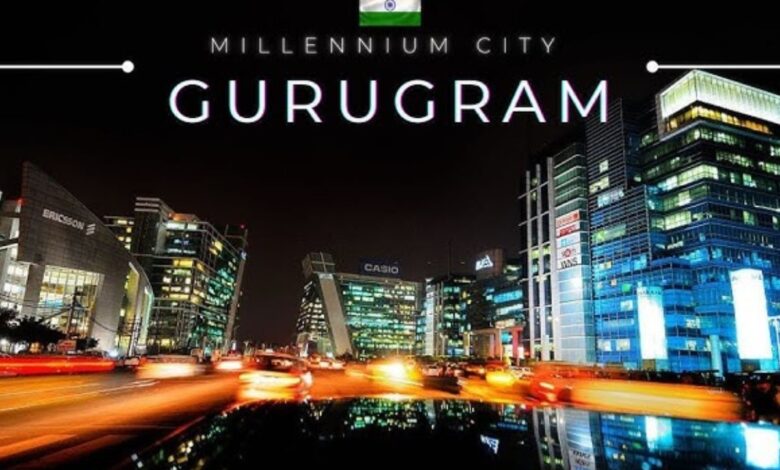
There is a particularly cruel irony at the heart of Gurugram. Nowhere in India does the gap between aspiration and actuality cut quite so deep. This is a city whose skyline could pass for Singapore on a good day — a forest of glass towers housing the Indian headquarters of nearly a third of the Fortune 500 companies, a city that boasts more luxury automobiles per square kilometre than almost any other place in the subcontinent, a city whose real estate developers sold not apartments but a philosophy: ‘world-class living.’
And yet, every monsoon, those world-class apartments flood. The air that the city’s Pilates-doing, kombucha-drinking residents breathe is, without exaggeration, without hyperbole, the most toxic in the world. The fire trucks cannot reach the upper floors of the buildings those residents live in. The garbage is not collected. The groundwater is drying up while the streets are submerged. The roads are parking lots dressed up as expressways.
What follows is not a collection of isolated complaints. This write-up is an attempt to hold up a mirror to the full and total collapse of governance in Gurgaon — a collapse that is comprehensive, interconnected, and above all, avoidable. Eight infrastructure crises, each damning enough on its own, are in fact a single, unified failure: the failure of a city that was planned for revenue, not for living.
I. The City That Drowns on Schedule
Annual Flooding: A Man-Made Catastrophe Disguised as a Weather Event
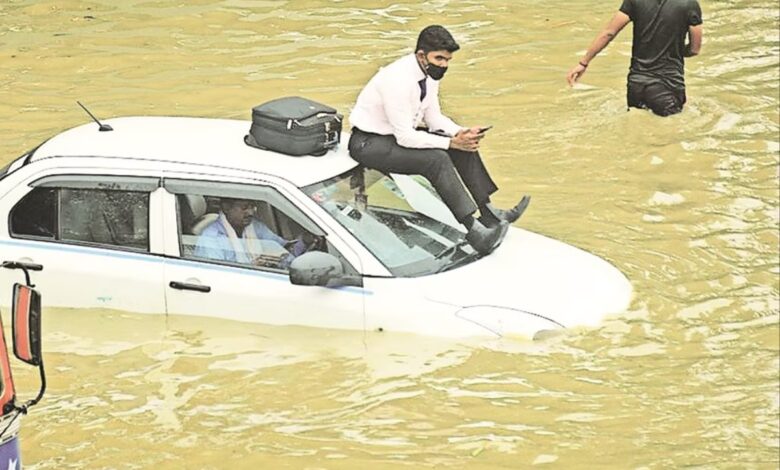
Every year, without fail, the same images emerge from Gurugram. Cars submerged to their bonnets on NH-48. Office workers wading through waist-deep water on Sohna Road. Ambulances stranded on the Iffco Chowk underpass as the rain barely slows to a drizzle. The event is reported breathlessly as breaking news, and then, as reliably as the flooding itself, forgotten within a week.
The numbers make this inexcusable. A spell of 100 mm of rain in just four hours; not an unprecedented deluge, not a hundred-year storm, but a perfectly routine monsoon downpour is enough to bring the ‘Millennium City’ to a complete standstill, causing massive traffic jams along NH-48 and flooding streets across entire sectors. This is not weather. This is engineering failure.
To understand why, one must go back. During the British colonial era, Gurugram was managed by a sophisticated hydrological system of 63 check dams, locally known as ‘bunds’, designed to slow water flow, allow percolation, and protect low-lying areas from flash flooding. According to researchers and INTACH documentation, today only four of those 63 check dams survive. The other 59 have been encroached upon, buried under concrete, converted into building plots, or simply rendered non-functional by the construction that has swamped every drainage channel around them.
The mathematics of impermeability is pitiless. A 2018 district administration study found that more than half of Gurugram’s natural blue cover, its lakes, wetlands, and drainage channels has vanished over the past four decades. Today, over 80% of the city’s surface area consists of impervious concrete and tarmac, creating what hydrologists call ‘zero permeability zones’, essentially, areas where rainwater has nowhere to go except horizontally, across roads and into basements.
The Badshahpur drain, the city’s primary stormwater channel, has been steadily narrowed and concretised, reducing its carrying capacity even as the volume of runoff it is expected to handle has multiplied exponentially with urbanisation. During particularly severe spells, an estimated 70% of the city has experienced extensive flooding, with average water depths of approximately three feet in the worst-affected sectors.
What is most damning is the gap between diagnosis and action. The causes of Gurgaon’s flooding have been documented by government studies, academic researchers, environmental organisations, and journalists for well over a decade. Every report reaches the same conclusions. Every monsoon, the same areas flood. Every winter, the reports are forgotten. And every summer, the approvals for new construction — new concrete, new impermeable surfaces, new encroachments on what little drainage remains — are signed, sealed, and delivered.
II. Drowning on the Surface, Dying of Thirst Underground
The Groundwater Crisis: A City Extracting Itself into the Earth
The supreme irony of Gurgaon’s flooding is that the water washing over its roads is not replenishing anything beneath them. The city is, simultaneously and paradoxically, drowning above ground and running dry below it. The reason is that concrete — which creates the floods — also prevents water from percolating into the aquifers that the city increasingly depends upon for its survival.
The depletion data is frightening. Gurgaon’s groundwater levels are falling at a rate of approximately 1.5 metres every single year, and average groundwater depth in many parts of the city has now exceeded 38 metres; meaning residents and industry must drill ever deeper and spend ever more to access the resource they are consuming faster than nature can replenish it. The supply-demand gap has become structural, which says the city currently receives only 570 million litres per day (MLD) of surface water supply, while peak summer demand has reached 675 MLD — a shortfall of over 100 MLD that is made up almost entirely by groundwater extraction. This unsustainable dependency is not a secret. It is official government data.
The problem extends across all of Haryana. The state’s overall groundwater extraction rate has reached 136% of the annual recharge rate, meaning Haryana as a whole is extracting roughly 36% more water from the ground each year than rains and rivers can put back. Gurugram, as the state’s most densely built and fastest-growing city, sits at the sharp end of this crisis.
What makes this more than just a resource management problem is a physical consequence that most residents have never been told about. Scientists at Indian and international institutions, using satellite-based Interferometric Synthetic Aperture Radar (InSAR) data from Sentinel-1 and ALOS-1 satellites, have documented that parts of Gurgaon, Kapashera, and Faridabad are literally sinking into the ground as the aquifers beneath them empty and compact.
Subsidence rates exceeding 11 centimetres per year have been recorded near the IGI airport boundary — not a figure that oscillates seasonally, but a continuous, accelerating, inelastic trend. Research published in Scientific Reports (Nature, 2022) found that approximately 100 square kilometres of the NCR are at ‘high risk’ of ground displacement, with areas including Sector 22A and Block C in Gurgaon specifically classified as high-risk subsidence zones. The city is, in a very literal sense, collapsing under the weight of its own ambition.
III. Fifty-Six Floors, One Broken Ladder
The Fire Safety Catastrophe: A City of Towers With No Way Down
If the flooding and groundwater crises feel like problems of nature being abused, the fire safety crisis is something more nakedly disturbing: it is a crisis created entirely by human decision-making, in full view, with no excuse of ignorance or surprise.
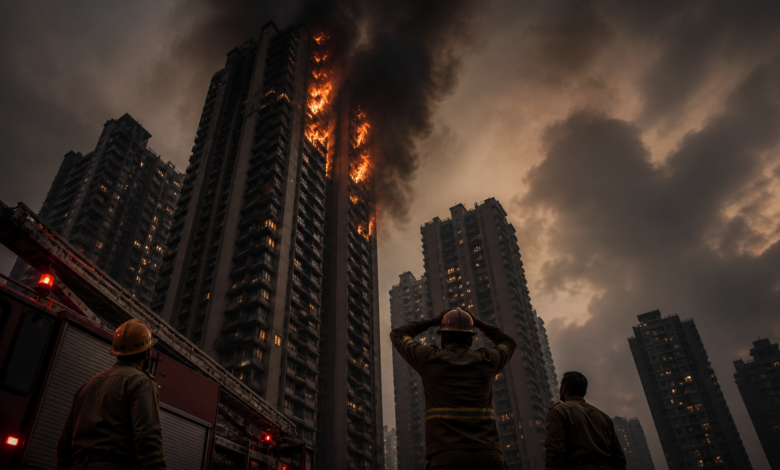
Gurugram is home to some of the tallest residential towers in northern India. Trump Tower, at approximately 200 metres, and Raheja Revanta, at 56 floors, are among the most prominent. The city’s skyline adds new floors every year as developers win approvals for ever-taller structures. What the approvals do not come with, apparently, is any corresponding investment in the equipment needed to fight fires in those buildings.
The Haryana Fire Services maintains exactly one hydraulic platform vehicle in its entire Gurugram fleet. That vehicle — a 42-metre aerial platform, incapable of reaching even the fifteenth floor of many buildings in the city — has been out of service since 2022.
As of the time of writing this write-up, it has been broken for three full years. Senior fire officials have confirmed that the problem has been raised in ‘meetings after meetings with government officials.’ Nothing has moved. No replacement has been procured. No interim arrangement has been made. A city that collects property taxes, development charges, and real estate transaction revenues running into thousands of crores every year cannot find the budget — or the political will — to replace a single broken fire truck.
The implications are not theoretical. When a high-rise fire breaks out above the 42-metre mark — which is roughly the 12th floor in a building with standard floor heights — Gurugram’s fire department has no external rescue capability whatsoever. The residents of the upper 40-odd floors of a 56-storey building are, in the event of a serious fire, on their own. This is not a gap in preparedness. It is a total, documented absence of the most basic fire-fighting infrastructure, in a city that has continued — through this entire three-year period — to approve new high-rise construction.
IV. ₹45 Crore a Year, Spent Moving Garbage Around
The Solid Waste Catastrophe: Bandhwari and the Mountains We Made
Gurgaon generates between 1,200 and 1,500 tonnes of solid waste every single day. That figure grows at approximately 5% annually, driven by increasing population, commercial activity, and the consumption patterns of a city that has been sold on the idea that prosperity means disposability. Somewhere along the way — and the audit trail is not difficult to follow — the city’s institutions decided that the answer to this waste was not management but geography: move it far enough away, and it becomes someone else’s problem.
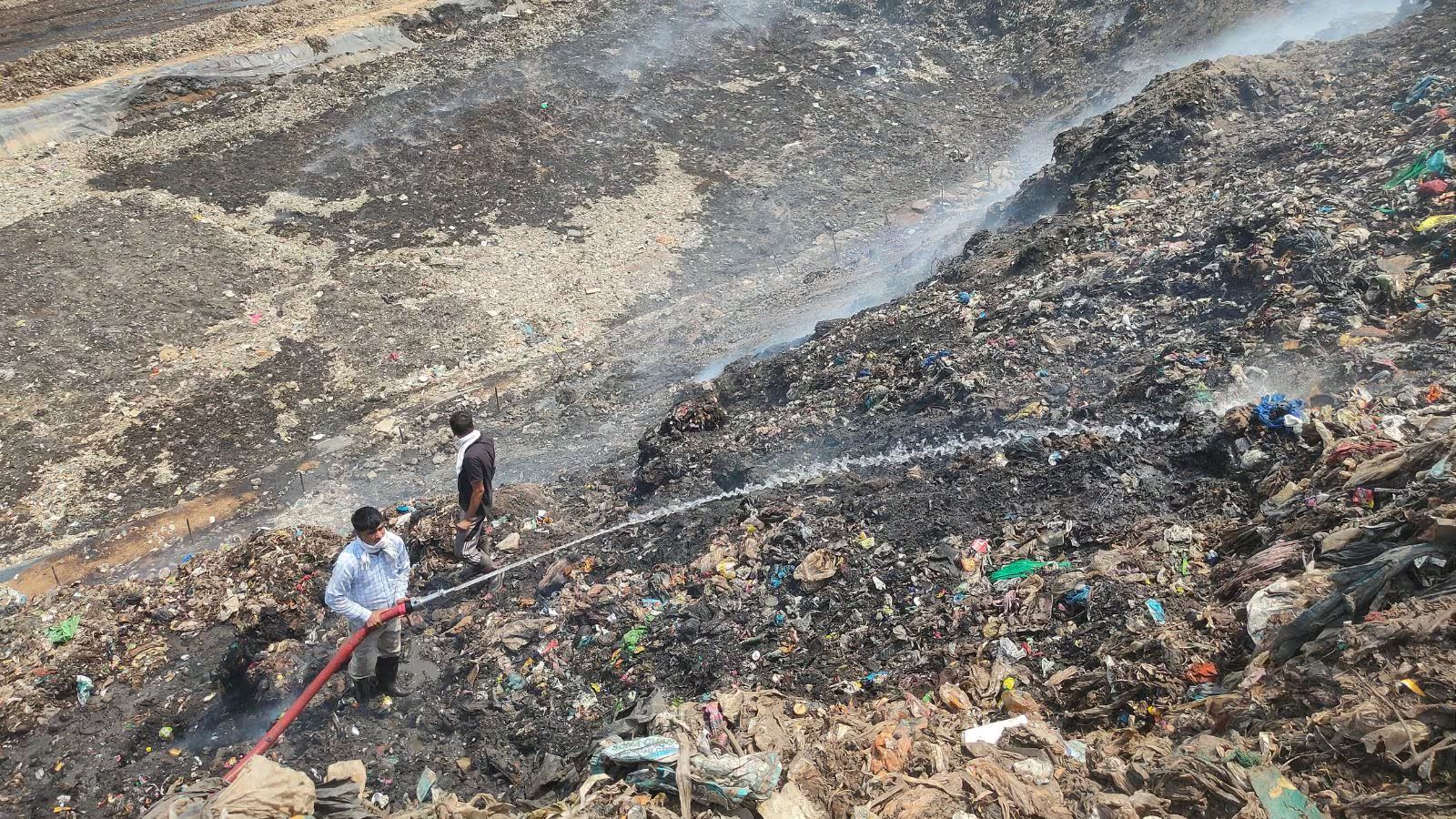
The consequence is the Bandhwari landfill. Situated on the edge of the ecologically protected Aravalli forest — a zone that, under the Environment Ministry’s 1992 Notification, enjoys legal protection from construction and industrial use — Bandhwari is now a mountain range of unsegregated, untreated garbage. It is not a landfill in any engineering sense of the term. It is a dump. And the dump is burning, leaching into groundwater, and poisoning the air of surrounding villages and the Aravalli ecosystem simultaneously.
The statistics, examined closely, reveal a governance failure of almost spectacular completeness. The Municipal Corporation of Gurugram’s door-to-door waste collection coverage, which is the most basic metric of municipal service delivery, fell from 98% in 2022-23 to just 59% in 2024-25. Waste segregation at source, the foundation of any functional waste processing system, collapsed from 97% to a barely-there 10% over the same period. Yet, simultaneously, the city’s official processing rate supposedly surged to 98% — a statistical impossibility that independent researchers have described as ‘deeply misleading,’ given that processing rates of 98% cannot coexist with collection rates of 59% and segregation rates of 10%.
Since June 2024, when the contract of the municipal waste collection agency was terminated, the MCG has been operating through emergency, temporary arrangements. This temporary state has produced at least 186 identified ‘garbage vulnerable points’ — locations across the city where waste is regularly dumped and rarely collected.
The city’s construction and demolition waste problem is no better: the Basai processing plant, located 25 kilometres from most construction sites, has a capacity of 300 tonnes per day, against a city-wide C&D waste generation of over 1,000 tonnes daily. The gap is filled by illegal dumping on roads, empty plots, and Aravalli forest land. The city spends ₹45 crore annually on waste management. For this expenditure, it has achieved not waste management but waste relocation — the transfer of the problem from affluent sectors to forests, roads, and the lungs of the poor.
In June 2024, the Haryana government declared a ‘solid waste exigency’ and constituted the SWEEP committee, headed by the Chief Secretary, promising that Gurugram would be cleaned by 31 December 2024. As of mid-2025, the same problems persist.
V. The Air That Kills Slowly and Invisibly
Air Pollution: Fifteen Times the Safe Limit, Year-Round
Gurugram’s air quality crisis is the one failure in this catalogue that has occasionally broken through to national and international attention, and then been absorbed and normalised in the way that only Indian cities have learned to normalise the intolerable. In 2018, IQAir ranked Gurugram the single most polluted city on earth. In 2019, it came seventh. Today it consistently ranks among the top three globally — a distinction so horrifying that it barely registers as news anymore.
The numbers are worth sitting with, because they have a way of sliding off the mind if not stated clearly. Gurugram’s PM2.5 levels — the concentration of fine particulate matter, particles less than 2.5 micrometres in diameter that penetrate deep into the lungs and bloodstream — averaged nearly 75 micrograms per cubic metre for the first half of 2025. The World Health Organisation’s safe annual average guideline is 5 µg/m³. Gurugram’s air is, therefore, fifteen times more polluted than the level the WHO considers safe for human health.
A UNDP Air Pollution Investment Case report (2024) recorded Gurugram’s annual average PM2.5 at 100 µg/m³ in 2021, twenty times the WHO guideline — and found that simply meeting India’s own National Ambient Air Quality Standards (which are themselves far weaker than the WHO’s) could have prevented 340 deaths and 19,447 incident cases of illness in that single year alone. Meeting WHO standards could have averted 1,013 deaths and 42,885 cases.
Airveda’s five-year air quality analysis (2025) found that both 2023 and 2024 fell squarely in the ‘Very Poor’ AQI category — confirming that the measures currently in place, including GRAP restrictions and mechanised road-cleaning, are producing no meaningful long-term improvement. The year 2023 recorded the highest number of days when the AQI crossed 400, a level classified as ‘Severe’ and dangerous even for healthy individuals with no pre-existing conditions. The misconception that pollution is a winter problem is a dangerous myth: only the monsoon offers Gurugram’s residents any temporary relief from the PM2.5 assault.
What makes this crisis structurally inseparable from every other failure on this list is that its primary causes are all local governance failures: construction dust from unregulated building activity, waste burning at Bandhwari, diesel generators running during power cuts, and traffic gridlock that keeps millions of vehicles idling for hours on city roads. Fix any three of the other crises in this report, and the air quality improves. Fix none of them, and no amount of smog towers or water-sprinkling trucks will make any measurable difference.
VI. The Expressway That Became a Parking Lot
Traffic and Roads: An Infrastructure That Cannot Support the City It Serves
There is a joke that circulates among Gurugram’s residents with the weary familiarity of a folk saying: ‘It takes longer to get to the airport from Golf Course Road Extension than to fly to Mumbai.’ This is not hyperbole. During peak hours, the Delhi-Gurgaon Expressway, the arterial highway that was, at the time of its construction, hailed as a symbol of seamless, world-class connectivity, sees average speeds of barely 30 kilometres per hour. On bad days, those speeds drop to single digits.
The root cause is elementary: Gurugram’s population has more than doubled, from approximately 1.5 million in 2011 to over 3 million today. In that same period, the road network has not kept anything close to pace. New residential sectors have been approved in waves, each adding tens of thousands of residents and their vehicles to a network designed for a fraction of the load.
Flyovers have been built, but without synchronising traffic signals, storm drains, or pedestrian infrastructure so that each flyover fixes one chokepoint while creating a new one 500 metres further along. The signal system has not been modernised. The pedestrian infrastructure is so dangerous that walking is not a realistic option for most residents, forcing greater car dependency in a city already drowning in cars.
The economic cost is becoming existential. A Fortune 500 CEO, speaking anonymously to a Delhi-based publication, revealed plans to relocate operations from Gurugram to Aero City in Delhi, citing the commute as ‘a big pain point for staff.’ If even a fraction of Gurugram’s corporate tenants reach the same conclusion, the economic premise on which the entire city was built — that proximity to Delhi, with better infrastructure, was a business advantage — collapses. The infrastructure failure is on the verge of becoming an economic one.
VII. Blackouts in India’s Corporate Capital
Power Infrastructure: A City That Runs on Diesel Generators
In early 2025, a fire at a Gurugram power substation caused a 36-hour blackout that left approximately 10,000 families without electricity — in January, in north India, which is not the most comfortable season to be without power. The incident made news for a day and was then set aside as an aberration. It was not an aberration. It was a symptom.
Gurugram’s electricity demand has touched 9,000 megawatts. The city’s distribution infrastructure of ageing substations, overloaded transmission lines, inadequate last-mile connectivity cannot reliably meet peak demand, leaving a shortfall of approximately 1,500 MW during summer months and resulting in at least six hours of daily power cuts during the peak season. The burden of these cuts falls on residents and businesses who are forced to run diesel generator sets — an expense that is simultaneously financial, acoustic, and environmental.
This last point completes a particularly vicious loop in Gurugram’s infrastructure dysfunction. The power cuts force diesel generators to run. The diesel generators produce particulate matter and nitrogen dioxide. The particulate matter enters the air. The air quality worsens. The city’s pollution crisis is being fed, in part, by the city’s power crisis. Every breakdown in one system cascades into every other. This is not bad luck. This is what happens when a city is built for aesthetics rather than function, for approvals rather than for actual human use.
VIII. The Hills That Were Supposed to Save the City
Aravalli Encroachment: Destroying the Foundation of Everything
All seven crises described above have immediate, visible causes. But beneath all of them lies a deeper, slower catastrophe — the systematic destruction of the Aravalli hills, the ancient mountain range that forms Gurugram’s natural ecological spine.
The Aravallis are not merely scenic. They are functional infrastructure of the most fundamental kind. Their fractured quartzite rock formations act as natural groundwater recharge conduits, absorbing monsoon rainfall and feeding the very aquifers whose depletion is sinking the city. Their forested slopes are Gurugram’s only natural windbreak, filtering the dust and pollutants that blow in from the west. Their watershed function — capturing rain and releasing it slowly — is precisely what Gurugram’s 63 check dams were designed to supplement.
Despite Supreme Court orders, National Green Tribunal rulings, and the Union Environment Ministry’s 1992 Aravalli Notification — which explicitly protects gair-mumkin pahad (uncultivable hill land) from mining and construction — the Aravallis on Gurugram’s periphery have been carved up for real estate. Illegal construction, mining, and encroachment have proceeded for decades with the knowledge, and sometimes the complicity, of local authorities. Every hectare of Aravalli that is concretised removes groundwater recharge capacity, increases dust generation, reduces windbreak effect, and accelerates runoff during the monsoon. The destruction of the Aravallis is not one crisis on this list. It is the root system from which every other crisis grows.
The Single, Unified Failure
What Ties Eight Crises Into One Indictment
It would be comforting if these were eight separate problems, each with its own distinct cause and its own distinct bureaucratic owner. They are not. Every crisis documented in this report flows from the same governance philosophy: the prioritisation of real estate revenue, construction approvals, and the outward aesthetics of a ‘world-class city’ over the unglamorous, invisible, essential work of building infrastructure that actually functions.
The MCG, HRERA, HSVP, Haryana Fire Services, the state Irrigation Department, and the state government itself have all presided over this catalogue of failures. In every case, the diagnosis was available. In every case, the resources — from a city generating billions in real estate transactions, stamp duties, development charges, and corporate tax revenues — were theoretically available. What was unavailable was the political will to spend those resources on drainage instead of decorative fountains, on fire trucks instead of golf courses, on groundwater recharge instead of more approvals for more towers above depleted aquifers.
The bill for this governance model is now being presented — not to the officials who signed the approvals, not to the developers who built the towers, not to the consultants who drew the master plans. It is being presented to the millions of ordinary residents who were sold the dream of a world-class city and got, in its place, flooded basements, unbreathable air, unresponsive garbage trucks, and fire departments with broken ladders.
Gurugram is not choking despite its success. It is choking because of how that success was pursued — recklessly, short-sightedly, and at the expense of the very ecological and infrastructural foundations that any city, however ambitious, must rest upon. The Millennium City label was always more marketing than reality. The reality is a city-sized experiment in what happens when you build upward without looking downward, outward without looking inward, and forward without looking at what you are leaving behind.
There is, somewhere inside this accounting of failure, a possibility of reversal. The check dams could, in theory, be restored. The groundwater extraction could be regulated. The fire trucks could be replaced. The waste could be managed. The Aravallis could be protected, if the Supreme Court’s orders were actually enforced. But none of this will happen until the institutions that created this crisis are held accountable for it — not in a press release, not in a committee report, and not in a monsoon-season promise that evaporates by October. Until then, the city will flood on schedule, choke on schedule, and burn — if it burns — without a ladder tall enough to reach the flames.