What India Must Learn From Evergrande — And Why Our Courts Keep Teaching Criminals the Opposite Lesson
On 20 August 2026 a Shenzhen court ended a tycoon’s life as a free man. In India, the equivalent man would still be arguing maintainability.

Shenzhen did not write a sermon. It wrote a sentence.
On 20 August 2026, the Shenzhen Intermediate People’s Court sent Hui Ka Yan — Xu Jiayin to the Party files — to prison for the rest of his natural life. All personal property confiscated. Political rights extinguished for life. The group fined 15.82 billion yuan, about US$2.4 billion. Fifty-six others, including his two sons, drew terms from twenty-two months to eighteen years. The court called the fraud “particularly egregious,” the social harm “particularly serious,” the disruption of economic order complete. He had already pleaded guilty in April after three years in detention. The period of the crimes: 2016 to 2021. The overstatement of revenue in two years alone: roughly US$80 billion. The wreckage he left: about US$300 billion in liabilities, a default in 2021, a Hong Kong liquidation order in 2024, a delisting on 25 August 2025, and a housing slump that has taken Chinese home prices down by about 20 per cent or more.
That is not a romance about Chinese law. China’s courts are not independent, the detention was not a Westminster trial, and a life sentence after a guilty plea in a Party-supervised courtroom is not a template for a constitutional republic. Say that first, so the rest of this cannot be dismissed as a hymn to authoritarianism.
Now say the other thing, which Indian courts, Indian prosecutors and Indian insolvency theatres have earned the hard way: when a financial crime is large enough to wreck households, the system that cannot confiscate, cannot conclude, and cannot lock the promoter away has chosen a side. It has chosen the accused.
India’s judiciary did not choose that side in a single corrupt hour. It chose it by habit. By adjournment. By the sacred chant that bail is the rule and jail is the exception — a principle meant to protect the poor man from colonial lock-up, now worn like a silk robe by men who moved public money into private islands. By treating a decree as a certificate and execution as optional homework. By letting a raid, an FIR, an attachment and a press conference stand in for a verdict.
The numbers are not mood. They are the National Judicial Data Grid and Parliament.
A republic of pending files
As of July 2026, Indian courts are sitting on more than 5.6 crore cases — about 56 million. District and taluka courts hold the bulk: roughly 4.97 crore, of which about 1.12 crore are civil and 3.85 crore criminal. The High Courts hold about 64.7 lakh. The Supreme Court itself has crossed 95,000, the highest it has ever carried, even while disposing of record volumes.
Age is the insult inside the pile. In the district courts, about 48.6 lakh cases are more than ten years old. In the High Courts, about 15.22 lakh — nearly a quarter of the High Court docket — are older than a decade. Parliament’s own annexure, drawn from NJDG as on 16 July 2026, records 80,660 High Court cases pending more than thirty years, and 81,275 such fossils in the district system. The Supreme Court’s oldest pending civil matter dates to 1986. A child born the year that file opened could now have a child of his own, still waiting for the same listing.
Uttar Pradesh’s district criminal docket alone was about 95 lakh as of December 2025. That is not a backlog. That is a parallel country of unfinished accusations.
This is the machine that is supposed to teach a lesson to the next Hui Ka Yan.
It cannot even clear its own waiting room.
“Bail is the rule” was written for the innocent. The market rented it.
The Supreme Court did not invent softness. It inherited a civilised rule: a man is not a convict until a court says so, and pre-trial prison is not the sentence. State of Rajasthan v. Balchand (1977) and the line that followed said jail is the exception.
Watch what the exception became in the white-collar docket.
The raid happens. Television vans arrive. The ED or CBI or a state EOW seals a floor, photographs a vault, attaches a farmhouse, freezes an account that still has enough left in a cousin’s name to keep the club membership alive. Then the real Indian trial begins — not of guilt, but of custody. Anticipatory bail. Regular bail. Medical bail. The “twin conditions” of PMLA are argued into vapour. The accused walks. The victim takes a local train back to a half-built tower.
That walk is not a rumour. It is the design of delay. Every month outside is a month in which documents age, witnesses tire, companies are stripped, and the “proceeds of crime” become school fees in London and legal fees in Delhi. Hui Ka Yan was detained for three years and then buried under a life term and a total confiscation. India’s equivalent promoter learns a different arithmetic: three years of hearings can be cheaper than three years of a cell, and thirty years of a civil file is cheaper still.
Do not hide behind the Enforcement Directorate’s favourite statistic. When a PMLA case actually reaches a judgment on merits, conviction rates look ferocious — the government has cited figures above 90 per cent of decided cases. That is the small door at the end of a long corridor. The corridor is the story. Parliament has also been told that between 2014 and late 2025 the ED registered thousands of money-laundering cases and produced convictions that, counted against the stock of registrations and arrests, collapse into single digits or low double digits. About 123 accused convicted against 1,135 arrested from April 2014 to December 2025 — roughly 11 per cent of those arrested. Convictions measured against the mountain of ECIRs are thinner still. In May 2025 the ED Director himself admitted that PMLA investigations had been “pending for a very long time” and that delay “may fail to create deterrence.” When the policeman says the file is the problem, stop pretending the robe is the solution.
A 94 per cent conviction rate on the handful of cases that survive the decade is not deterrence. It is a souvenir.
The civil decree: India’s most expensive piece of stationery
If the criminal side is slow, the civil side is a practical joke told to the winner.
A civil suit in the district system takes, on NJDG-derived averages cited before the Supreme Court, about 4.91 years. Winning is not the end. The winner must file an execution petition — a second case to make the first case real. That petition takes, on the same data, another 3.97 years. Call it nine years from injury to cash, if the file is lucky and the judgment debtor is not imaginative.
In October 2025 the Supreme Court looked at the execution docket and used words courts usually reserve for other people’s failures: “highly disappointing,” “alarming,” “nothing short of a travesty of justice.” The count then: 8,82,578 execution petitions pending in the district courts. Maharashtra alone was a civilisation of unenforced paper — on later figures, close to 4 lakh pending execution matters, tens of thousands stayed by superior courts. By April 2026, even after a disposal drive that cleared lakhs of files, 7,95,981 execution petitions older than six months were still sitting there. Fresh filings replaced the dead. The Court had already ordered a six-month outer limit. The limit joined the decree in the drawer.
Counsel unavailable: 38.9 per cent of the delay reasons. Stay by a higher court: 17 per cent. Awaiting documents: 12 per cent. Section 47 of the Civil Procedure Code, meant to keep execution summary, has been turned into a trial inside a trial inside a stay. The man who lost on facts gets a second life on procedure. The woman who won on facts gets a third life in the nazir’s office.
In China, Hui’s personal estate was confiscated in the same breath as the sentence. In India, you can hold a certified decree and still watch the judgment debtor sell the same land under a different khata, then dare you to file another suit.
That is not delay. That is a subsidy.
The homebuyer is India’s Evergrande victim — without Evergrande’s ending
If you want the comparison that does not need a map, do not start with diamonds. Start with a flat.
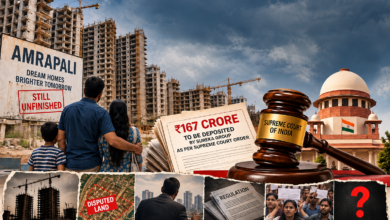
Evergrande sold dreams across 1,300 projects in 280 cities, booked revenue before delivery, and left a country staring at unfinished concrete. India’s version has names the Supreme Court already knows: Amrapali, Unitech, Supertech.
Amrapali’s buyers reached the Court in the same season as Unitech’s, around 2016–17. In 2019 the Court cancelled Amrapali’s RERA registration, cancelled leases, put a receiver in charge, and sent NBCC to build. That was the rare Indian hour that looked like a decision. Even then, years later the Court was still clearing additional FAR and funding gaps so that tens of thousands of units begun in another decade might actually get keys. Unitech, on the same calendar, remained a museum of mentions and deferred hope — projects unbuilt, refunds unpaid, the file listed and not heard. Supertech’s towers in Noida were launched mostly between 2010 and 2012. Insolvency arrived in 2022. Homebuyers’ counsel told the Court the wait had already stretched over two decades. The management counted about 40,000 residential units; buyers said more than 51,000. The twin towers came down in August 2022. In July 2026 the Supreme Court was still deferring a refund plea, after a lawyer said the last payment to those buyers was in 2024.
Read that sequence again. A demolition in 2022. A refund still being “explored” in 2026. The building is dust. The money is a mention.
Hui Ka Yan does not get to attend a creditors’ cocktail and call the haircut a “resolution.” His sons are not case-managing the next listing. The Chinese state, for its own reasons — stability, face, Party discipline — treated unfinished homes as a political emergency. India’s courts treated them as a list.
RERA was the statute that would end this. IBC was the code that would end this. The Supreme Court’s Article 142 compassion was the last parachute. The parachute opened. The ground is still ten years down.
Insolvency as a washing machine
When the criminal trial is too slow and the civil decree is too shy, India congratulates itself for the Insolvency and Bankruptcy Code.
Look at what the Code actually pays.
In FY 2025–26, reporting based on Ministry of Corporate Affairs numbers put bank recovery through IBC at about 20 per cent of what was owed — the lowest in five years. ICRA, using resolution-plan data, put recovery around 23 per cent of admitted claims and the average haircut around 68 per cent. Resolution time: about 744 days as of 31 March 2026, against a statutory ambition of 330 days and an older 270-day hymn. Ind-Ra clocked CIRP timelines for financial creditors at 751 days in FY26. Liquidations still outrun clean resolutions. Personal-guarantor recoveries, the supposed clawback from the man who signed the papers, were about 1 per cent of admitted claims as of June 2026 — ₹234.56 crore from a Himalaya of claims.
Then the cartoon that should have ended the sermon: Zee Group founder Subhash Chandra’s personal insolvency plan, cleared in August 2026, offered about ₹6.5 crore against admitted claims of ₹22,006.57 crore. Three paise on a hundred rupees. LIC Housing Finance, owed more than ₹1,300 crore, was shown about ₹38 lakh and called the plan unviable. The tribunal still had a document to stamp.
Evergrande’s offshore creditors are also staring at single-digit recoveries. The difference is not the haircut. The difference is that China did not pretend the haircut was justice for the founder. It separated the corporate carcass from the man’s freedom. India often gives the promoter both: the haircut and the sunlight.
A code that takes two years to hand the bank twenty paise, while the guarantor’s overseas life continues, is not a bankruptcy law. It is a scheduling tool.
The men who left, and the years that followed them
Vijay Mallya flew. Nirav Modi flew. Mehul Choksi flew. The PNB fraud — LoUs, dummy firms, a public sector bank used like an ATM — is still measured in the language of ₹13,000 crore and US$2 billion, with Nirav’s alleged slice alone put by Indian agencies at about ₹6,498 crore.
Nirav Modi has been in a British prison since 19 March 2019. Seven winters. UK courts approved extradition years ago. In 2026 he was still finding corridors — a failed attempt to reopen the case, a turn toward the European Court of Human Rights, administrative “steps” that are always about to begin. A London court can order him to pay Bank of India more than US$11 million on a guarantee. What it has not yet done, after seven years, is put him on a plane that ends in a Tihar van. Choksi’s Belgian file moves, then appeals. Mallya writes letters about how much has been recovered from him and asks for a retired judge to audit the government’s arithmetic — from a country that will not send him home.
The government will say, correctly, that extradition is not an Indian trial, that 274 fugitives were brought back between 2019 and July 2026 against an older trickle of four a year, that FEOA attachments exist, that some assets have been seized. Fine. Count the trophies. Then count the calendar on the names the country actually knows. A Shenzhen court finished Hui in a morning. India’s most famous bank fraud is still an international procedural novel.
If bail inside India is a gift, flight is the upgraded package. The judiciary’s contribution is the knowledge, shared by every competent counsel, that time is a defence exhibit.
What, exactly, is the lesson — and what it is not
It is not that India should import a Party court, a televised confession, or a definition of “socialist market economic order” written by the same state that created the boom.
It is this.
One: Finish. A financial crime file that is alive after ten years is not under trial. It is under protection. Special courts for PMLA and CBI cases were supposed to be special because they were fast. Make the listing special or stop the branding.
Two: Separate liberty from luxury. “Bail is the rule” can survive for the pickpocket and still die for the man who emptied a bank. The Supreme Court already carved harder tests under PMLA. Those tests are useless if every other statute, every medical certificate and every “trip to the Supreme Court on a question of law” restores the old weather.
Three: Confiscate so that the lifestyle ends before the appeal begins. Attachment that can be rented, leased, and litigated for a decade is a press release. Hui lost the estate in the operative sentence. India’s victims lose years watching attached assets generate another interlocutory application.
Four: Make the decree a weapon, not a PDF. Six months for execution was already the Supreme Court’s command. Command without contempt is stationery. Dedicated execution courts, staff, and an end to Section 47 as a second innings are not radical. They are the minimum required to stop calling this a civilised system.
Five: Stop using insolvency as the moral ending. IBC can save a project. It cannot be the only punishment of the person who sold the project twice. Personal-guarantor recoveries at one per cent are a confession. Homebuyer completion must be a clock, not a committee.
Six: Stop confusing process with innocence. Process is how a republic avoids becoming Shenzhen. Process that never ends is how a republic becomes a sanctuary. The Indian accused of a ₹10,000-crore fraud should not be able to outlive the judge, the IO, the first set of witnesses and the original complainant’s heart.
The taunt that is also the record
China will not teach India how to be free. It can still teach India how not to be a fool.
A 67-year-old man who was worth US$45.3 billion in 2017 is now a convict without a house in his name. That fact will be used in Beijing as a morality play about the Party’s grip. It should be used in Delhi as a mirror.
Here is the reflection. Fifty-six million cases. Nearly a million unenforced decrees. Civil justice that needs nine years to pay a winner. Insolvency that returns twenty paise and calls it reform. A money-laundering empire of registrations and a village of convictions. Homebuyers who have aged inside a “project.” Fugitives who have aged inside a foreign appeal. Promoters who have not aged inside a cell.
The Indian legal system is not “soft” in the abstract. Toward the poor man caught with a stolen phone it can be savage. Toward the man who stole a skyline it is patient, courteous, and inexhaustible. That patience has a beneficiary. It is not the homebuyer in Noida. It is not the depositor in a collapsed bank. It is not the financial creditor eating a 68 per cent haircut. It is the accused who learned the only Indian precedent that still has teeth:
File. Adjourn. Bail. Appeal. Repeat. Die of old age on the right side of the gate.
Shenzhen closed the gate. Until Indian courts learn to close one — on time, on assets, on the person who signed the fraud — every new FIR in a financial scandal is just another invitation to the same party. The raided office will be on television tonight. The victim will be in the corridor in 2036. And the man with the crime money will be, as usual, asking for a short date after Diwali.