Is The Master Plan for Delhi 2047 A Genuine Path To Homeownership Or Merely An Ambitious Numerical Target That Ignores Real Household Budgets and Infrastructure Gaps?
Delhi’s Master Plan for 2047 promises around 40 lakh additional affordable housing units through transit oriented development, redevelopment and land pooling yet the plan raises profound questions about whether these homes will ever become financially accessible to ordinary salaried employees young professionals lower income households and migrant workers. The distinction between constructing units and enabling genuine ownership remains stark. Historical mismatches between supply and demand combined with high land costs limited borrowing capacity and delayed infrastructure threaten to leave families trapped in unaffordable markets or distant poorly connected locations while the city grows vertically without inclusivity.

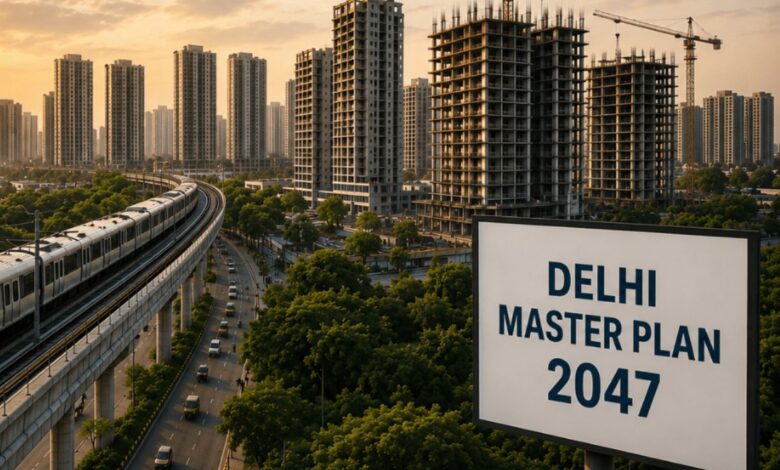
The announcement of the Master Plan for Delhi 2047 on August 20 2026 by the Union Ministry of Housing and Urban Affairs has been presented as a transformative framework for the capital’s future. Official statements claim the plan will guide development to accommodate projected population growth reaching approximately 3.2 crore by 2047 and deliver around 40 lakh additional affordable housing units.
Yet one must ask what these numbers truly mean for a family earning between 3 lakh and 9 lakh annually struggling to accumulate a down payment or service a monthly instalment while covering food, transport, healthcare and education. The plan combines around 18 lakh affordable homes in transit oriented development zones, approximately 7 lakh additional dwelling units through redevelopment of existing residential areas and around 12 lakh homes through planned urban expansion under the land pooling policy covering nearly 200 square kilometres with an envisaged 600 kilometre road network.
These figures come directly from the Press Information Bureau announcement and related government disclosures. But does announcing a total of 40 lakh units guarantee that any meaningful share will fall within the borrowing capacity of the households the plan claims to serve? A housing unit priced beyond a family’s ability to finance remains unaffordable no matter how close it sits to a Metro station or how many floors rise above the ground.
The arithmetic of the target itself demands scrutiny. Taking 2026 as the base year and 2047 as the endpoint produces a span of roughly 21 years. Dividing 40,00,000 by 21 yields an average annual requirement of approximately 1,90,476 homes. That translates to about 15,873 units every month or 3,663 every week. Actual delivery will almost certainly fluctuate with land assembly approvals financing conditions and redevelopment negotiations. Years of slow progress could easily be followed by bursts of activity that still fail to match the needs of growing households.
Without published annual targets broken down by ownership rental redevelopment and rehabilitation categories the 2047 deadline risks remaining a distant aspiration rather than a binding programme. How will the public know whether the city is on track in 2031 when the illustrative midpoint would require roughly 9.5 lakh additional homes or in 2036 when the figure would reach about 19 lakh? The absence of such milestones leaves the entire ambition open to the charge that quantity on paper matters more than measurable progress on the ground.
Even more troubling is the lack of clarity about what counts as an additional home. A unit proposed in a planning document differs sharply from one for which land has been assembled plans approved construction begun occupancy certificates issued and families actually moved in. A completed flat that lacks reliable water sewerage or electricity cannot be treated as habitable. A habitable flat priced beyond the reach of its intended occupants does not solve the ownership problem.
Rehabilitation units allocated to eligible residents of informal settlements serve an important social purpose but they are not market accessible ownership opportunities for first time buyers. The government has not yet published a transparent housing delivery dashboard that distinguishes these stages. Without it the 40 lakh figure remains an undifferentiated total that invites overstatement of real progress.
The very definition of affordable housing requires interrogation. Regulatory affordability means a dwelling meets a policy threshold based on carpet area or price band. Market affordability means the property costs less than comparable units nearby. Household affordability means the buyer can pay the deposit meet the monthly instalments cover recurring costs and still afford food transport healthcare and education without unsustainable debt. Only the third definition determines whether ownership becomes genuinely accessible.
Consider a household earning 6 lakh annually or 50,000 per month before deductions. A flat priced at 35 lakh would require a 20 percent down payment of 7 lakh leaving a loan of 28 lakh. Yet the Interest Subsidy Scheme under PMAY U 2.0 limits the eligible loan value to 25 lakh and the property value to 35 lakh for households with annual income up to 9 lakh. The scheme provides a maximum subsidy of 1.80 lakh at 4 percent on the first 8 lakh of the loan for a tenure up to 12 years.
These parameters are set out in official scheme guidelines. A property that sits at the official price ceiling may still leave the household outside the subsidy’s full benefit if the required loan exceeds 25 lakh. How many families in the 3 lakh to 9 lakh income band can realistically accumulate the initial savings while paying rent and supporting dependants? The plan’s reliance on the term affordable without linking it to actual household budgets and borrowing capacity raises serious concern that official classification will substitute for real access.
Historical data underscore the depth of the challenge. The Delhi Economic Survey 2022-23 drawing on Census 2011 figures reported 46,05,555 total census houses of which 5,12,691 were vacant and 40,92,864 occupied. Of the occupied houses 31,76,329 were used as residences while the population stood at approximately 1.68 crore with around 1.64 crore in urban areas. These numbers are more than 15 years old as of 2026 yet they remain the most comprehensive official baseline available in public documents.
Vacant houses cannot automatically be treated as available affordable stock. They may be held for investment undergoing renovation located in price segments mismatched to demand or simply unsuitable. The same survey noted that the earlier Master Plan for Delhi 2021 had projected a requirement of approximately 24 lakh new housing units by 2021 of which 54 percent were needed for economically weaker sections and lower income groups.
That projection was never fully realised in a form that closed the affordability gap. Why should the public accept that a larger target two decades later will succeed where previous efforts fell short without clearer evidence of changed implementation capacity?
The 18 lakh homes proposed in transit oriented development zones form the largest single component. Official announcements describe planned high density mixed use development within a 500 metre radius of Metro and Regional Rapid Transit System corridors covering approximately 207 square kilometres primarily to facilitate affordable housing. Proximity to public transport can reduce commuting costs and time.
A household that relies on the Metro rather than private vehicles may spend less on fuel maintenance and parking while gaining hours previously lost to long journeys. Yet land values near stations tend to rise. Developers may concentrate on higher priced units attractive to investors. Without explicit and enforceable affordability safeguards the very locations intended to improve access could become the most expensive. The government has not published corridor by corridor breakdowns of expected unit numbers price bands carpet areas or shares reserved for different income groups.
Nor has it detailed the infrastructure expenditure required before occupation or the measures to prevent displacement of existing residents. How can the 18 lakh figure be treated as a credible contribution to ownership when so many operational questions remain unanswered?
Redevelopment of existing residential areas is expected to yield around 7 lakh additional dwelling units. The plan reduces the minimum area requirement for redevelopment of group housing DDA housing and government housing from 40,000 square metres to 3,000 square metres. Smaller sites may become eligible and ageing buildings may be replaced with higher density structures. Yet redevelopment is not merely a construction exercise. It involves existing owners residents developers financing and the distribution of value created by additional development rights.
An old building containing 100 occupied homes replaced by a building containing 180 homes produces only 80 net additional homes. The remaining units replace existing housing. The official target does not clarify whether the 7 lakh figure refers to gross units created or net additional supply. Existing residents may face disputes over compensation temporary accommodation replacement housing and timelines. Without clear safeguards covering informed consent transparent entitlements protection against coercive displacement and independent dispute resolution higher development potential could come at the expense of housing security for those already living in the city.
Who will ensure that the additional units are priced for lower and middle income buyers rather than higher income purchasers seeking better located properties?
Land pooling aims to deliver around 12 lakh new homes across nearly 200 square kilometres supported by a 600 kilometre road network. The government has announced an infrastructure first approach under which the Delhi Development Authority would develop roads of 30 metres and wider before residential occupation. A minimum planning scheme area of 20 hectares has been identified. Coordinated development can in principle provide roads utilities schools and parks together rather than as afterthoughts.
Yet landowners need clarity on the treatment of their parcels the allocation of development rights the timeline and the risks of delay. Future residents need assurance that homes will be connected to drinking water sewerage electricity public transport and emergency services. Road construction alone does not establish that an area is fully serviced.
A cheaper flat in a poorly connected location can become more expensive once daily commuting childcare and other costs are included. The plan has not published expected price bands for these homes or the intended income groups. If the majority of the 12 lakh units are priced beyond the reach of lower and middle income households land pooling will expand supply without resolving the ownership problem.
Residents of informal settlements cannot be overlooked. The plan is intended to benefit more than 17 lakh residents of Jhuggi Jhopri clusters and provides for regularisation of residential buildings in 1511 unauthorised colonies with the stated objective of improving ownership security for approximately 45 lakh residents. These are distinct interventions. Regularisation may improve legal status under the applicable framework.
Rehabilitation concerns the provision of secure housing to eligible residents. Neither automatically means every resident qualifies for a newly constructed flat. Eligibility documentation cut off dates and scheme specific rules will determine outcomes. In situ rehabilitation where feasible can preserve access to workplaces schools and support networks. Relocation can impose additional commuting expenses and disrupt informal employment.
The government should publish settlement wise data on households identified found eligible homes approved completed allocated and occupied along with pending disputes and average time from identification to possession. Without such transparency the 17 lakh figure remains a statement of intent rather than a record of delivery.
Rental housing receives a 50 percent floor area ratio incentive intended to encourage accommodation for students working professionals migrant workers and low income groups. Not every household can or should purchase immediately. Secure reasonably priced rental options can allow families to build savings before buying and reduce dependence on overcrowded informal accommodation. Yet additional development potential is an incentive not a guarantee of affordable rents.
Construction costs financing land costs and operating expenses remain. The policy must specify what rental affordability means which households qualify how rents will be monitored and how long conditions will remain in force. Without these provisions the incentive may produce additional rental stock that is still beyond the means of the intended occupants.
Government subsidies under PMAY U 2.0 offer one demand side instrument. The Interest Subsidy Scheme applies to households with annual income up to 9 lakh loan value up to 25 lakh and property value up to 35 lakh. The maximum subsidy is 1.80 lakh at 4 percent on the first 8 lakh of the loan for a tenure up to 12 years released in five yearly instalments.
These limits are confirmed in official guidelines. A property costing 50 lakh falls outside the property value ceiling regardless of the buyer’s income category. If most homes near employment centres exceed 35 lakh eligible households will find the subsidy of limited use. Supply side policy and demand side assistance must therefore operate together. Subsidies cannot bridge an unlimited gap between household incomes and market prices.
Illustrative loan calculations reveal the pressure. Assuming a 20 percent down payment 8.5 percent annual interest and 20 year tenure a 15 lakh property requires a 3 lakh down payment and roughly 10400 monthly instalment. A 20 lakh property requires 4 lakh down and about 13900 monthly. A 25 lakh property requires 5 lakh down and about 17400 monthly. A 30 lakh property requires 6 lakh down and about 20800 monthly.
A 35 lakh property requires 7 lakh down and about 24300 monthly. A 50 lakh property requires 10 lakh down and about 34700 monthly. These are rounded estimates using the standard fixed rate formula and exclude registration stamp duty maintenance insurance and taxes. For a household earning 30000 per month an instalment of 20800 represents 69 percent of income. For a household earning 50000 the same instalment is 42 percent.
For a household earning 75000 it is 28 percent. These ratios are illustrative not official lender assessments yet they demonstrate how the same property can be manageable for one family and crushing for another. The down payment barrier compounds the difficulty. Saving 6 lakh while paying rent and supporting dependants can take years for a household earning 50000 monthly.
Location adds a further layer of cost. A home priced at 25 lakh but poorly connected may impose 4000 extra monthly commuting expenses compared with a 30 lakh home near the Metro. Over 20 years the undiscounted difference reaches 9.6 lakh. Time spent commuting reduces hours available for childcare education and rest. Affordability assessments that ignore total recurring costs of living in a location mislead both planners and families.
The government should measure travel time to major employment centres access to public transport cost of a typical daily commute and availability of schools and healthcare before declaring a project successful.
Vertical growth and smaller format housing with carpet areas of approximately 25 to 60 square metres are presented as solutions. Higher density can use land more efficiently and support mixed use areas. Smaller homes can reduce total purchase price. Yet construction costs for taller buildings include structural requirements lifts fire safety water systems and common facilities.
A compact apartment priced at 30 lakh may still exceed the borrowing capacity of many households. Affordable housing must not mean inadequate ventilation poor sanitation or unsafe structures. Cost reduction cannot come at the expense of safety habitability and durability.
Recent schemes illustrate the gap between announcement and scale. In October 2026 the Delhi Development Authority launched the Awaas Nivesh Yojana offering 2516 low income group flats in Narela at a 25 percent discount with starting prices around 15 lakh after the rebate. Registration opened on October 14 and booking on October 20. The number is tiny relative to a 40 lakh long term target. Location connectivity employment access and the number of completed transactions will determine whether the scheme improves access or merely moves existing inventory.
Separately the authority has begun processes for rehabilitating residents of 45 Jhuggi Jhopri clusters covering approximately 21,229 households across 135.74 acres by issuing requests for proposals for transaction advisers to prepare feasibility reports. A feasibility study is a preliminary step not completed construction or possession. These examples show that individual initiatives exist yet their collective contribution to the scale price location and quality required remains unproven.
Multiple risks threaten the plan. Housing prices may rise faster than household incomes leaving new supply concentrated in higher income segments. Infrastructure may lag behind construction leaving residents with incomplete services. Homes may be built in locations with limited employment access imposing high recurring costs. Completed units may remain vacant because of price location or eligibility barriers.
Private developers may prefer higher return projects unless incentives make affordable development commercially viable. Redevelopment may generate disputes or displacement. Performance data may lack independent verification. Each of these risks is inherent in the structure of the plan as currently announced.
Priorities for making ownership accessible must include an income linked definition of affordability reviewed periodically against incomes interest rates and living costs an annual public dashboard distinguishing planned approved under construction completed occupied and affordable units measurable affordability conditions attached to development incentives operational transport connectivity at the time of possession expanded secure rental options targeted assistance with upfront costs clear protections for existing residents during redevelopment coordination of housing with employment geography and transparent reporting on every major scheme.
Housing quality must be measured alongside quantity. Structural safety water sanitation electricity and ventilation cannot be compromised.
A monitoring framework should track annual homes completed net additional homes after replacement affordable homes completed median price to income ratios typical instalment to income ratios upfront purchase costs affordable homes occupied rehabilitation completion rates average commute costs project delays infrastructure readiness at possession rental affordability and beneficiary satisfaction. Baselines and methodologies must be published. Independent reviews should allow course correction when evidence shows a policy is failing.
Before strong claims can be made the government must clarify how the 40 lakh target was calculated the relationship between the 18 lakh 7 lakh and 12 lakh components the proportion intended for each income group the share available for purchase versus rehabilitation or rental the annual delivery targets the definition of affordability used the public expenditure required and the accountability mechanisms. These are not arguments against the plan. They are the minimum conditions for evaluating whether it can achieve its stated objectives.
More homes are necessary but not sufficient. Transit oriented development can improve connectivity yet its benefits depend on prices and distribution. Redevelopment can create additional units yet outcomes depend on existing residents rights and final prices. Land pooling can support expansion yet success depends on infrastructure and economics.
Subsidies can reduce financing costs yet cannot make every property affordable. Rental housing can improve security yet requires appropriate rents and standards. The central challenge is ensuring that additional supply translates into improved access for the households that need it most.
By 2047 Delhi’s success should be measured not by the height of its buildings or the number of units announced but by whether a young professional can purchase a first home without an unsustainable share of income committed to the instalment whether a family can move into an affordable home without an unreasonable daily commute whether existing residents benefit from redevelopment without losing security whether lower income households access safe serviced accommodation rather than distant poorly connected locations and whether transparent data demonstrate measurable improvement.
The capital does not have to choose between a modern skyline and inclusive ownership. The two can complement each other only if planning incentives prices infrastructure and financing are designed around the actual needs of residents rather than the numerical ambitions of a master plan. The evidence so far establishes ambition and mechanisms. It does not yet establish delivery of homes that ordinary families can afford to own occupy and maintain. That remains the unanswered question at the heart of Delhi’s housing future.