One Year of Strike, Zero Delivery: How BPTP’s Greater Faridabad Colonies Remain a Monument to Unfinished Promises

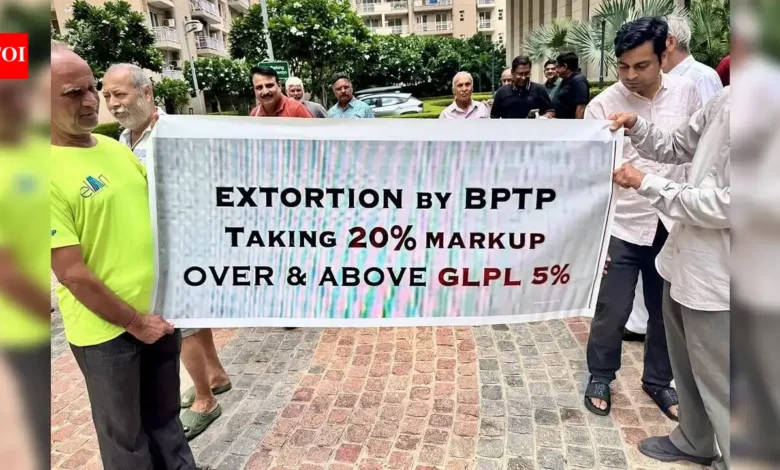
A year after residents of BPTP’s sprawling plotted colonies in Greater Faridabad walked out in protest, the streets still flood with sewage, taps still run dry for 15 to 40 hours at a stretch, and the colony they paid for still has not been handed over to the Municipal Corporation of Faridabad. The assurances given when the agitation began have evaporated. The incomplete works remain incomplete. The builder continues to collect charges. The administration continues to hold meetings. And the residents continue to live inside a licensed township that behaves like an unfinished construction site.
That is not rhetoric. That is the public record as of 5–6 September 2026.
A township sold as a city, delivered as a construction site
BPTP, through Countrywide Promoters Private Limited and related entities, launched its flagship Parklands and plotted developments across Sectors 75 to 89 around 2004. Possession began trickling in from about 2012. Two decades after launch, these sectors form one of Greater Faridabad’s largest private residential belts: Sectors 82–89 alone cover 571.30 acres; Sectors 75, 76 and 80 add 350.79 acres; Sector 77 another 97.82 acres. Thousands of families live in blocks A, C, E, F, G, J, M, P and T. In some of those blocks alone, more than 10,000 residents have been counted in protest reports.
They bought plots and floors on the promise of planned roads, sewerage, water, parks, street lighting and eventual civic handover. What they got is a dual tax: they pay house tax to the Municipal Corporation of Faridabad and, simultaneously, Common Area Maintenance and assorted “repair” charges to the builder who still controls the internal infrastructure. The corporation collects tax. The builder collects CAM. Neither completes the work.
The strike that became a calendar
In September 2025, after years of petitions, the official line suddenly sounded hopeful. Reports spoke of 15 plotted colonies in Sectors 75–89 being prepared for takeover by the Municipal Corporation. A letter had gone to the Director of Town Planning. Ministers had directed that unfinished works be completed and the colonies transferred. Residents were told the file was moving.
They struck. They marched. They sat outside the builder’s Next Door office in Sector 76. They delivered memorandums to Food and Supplies Minister Rajesh Nagar. They raised the issue in the district grievance committee. A year later, Amar Ujala recorded the obvious: the strike is one year old, the handover demand has received neither action nor a proper hearing, and the unfinished works have not been finished.
That is the story in one sentence. Everything else is the evidence of how systematically that sentence was allowed to become true.
What “incomplete work” actually looks like on the ground
Residents have not been vague. Across 2025 and 2026 they have listed the same failures, protest after protest:
- Internal roads laid years ago — in F Block, Sector 88, as far back as 2011 — never rebuilt, now broken.
- Sewer lines that overflow onto streets; dirty water through which people walk. Sector 85 C-Block residents said in May 2026 they were wading through it.
- Water supply at 25–42 hour intervals in multiple blocks; in late May 2026, sectors 80, 83, 84, 85 and 88 saw stretches of 15–40 hours without supply. Thousands of families bought tanker water while living in houses that cost crores.
- No individual electricity connections in several blocks, so residents cannot even access state solar schemes. Unscheduled power cuts continue. In Parkland Pride, Sector 77, families reported 5–6 hour daily cuts even after paying generator charges collected at booking.
- Parks that exist on layout plans and vanish on the ground; F Block residents said there is no public space for children or the elderly.
- Street lighting, drainage and cleaning that remain the builder’s responsibility only on paper.
These are not “teething problems” in a new project. Possession started more than a decade ago. The Completion Certificate that should have followed within five years of the licence, according to residents and later Union Ministry correspondence, has been a running farce. Applications in 2011 and 2014 did not produce the certificate. The infrastructure that the certificate is supposed to certify was never finished.
The collection machine that never stops
While pipes stay dry, the billing does not.
In October 2025, RWAs from Sectors 75–89 marched to the builder’s office after maintenance charges were doubled over four years and new water, sewer and road-repair bills appeared — including charges for water in colonies where meters do not exist.
By May 2026 the same residents were back. CAM had been hiked again — 30 per cent on top of a November increase. Builder demands of ₹290 per square yard for “road repair” were called arbitrary. In Sector 85 Parklands, residents alleged they were being asked for ₹50,000 to ₹2 lakh per household for external road work. They took the complaint to Minister Rajesh Nagar; he summoned the builder to Chandigarh. The charges did not disappear. The roads did not appear.
Residents pay the Municipal Corporation house tax and get no corresponding civic service inside the colony. They pay the builder CAM and get overflow sewers. That is not a service model. It is a rent-extraction model dressed up as township management.
Consumer forums have already punctured pieces of this model. In May 2026 the Faridabad District Consumer Disputes Redressal Commission ordered BPTP to refund club membership fees collected in 2010 for a facility that never materialised for 15 years, and to pay ₹3 lakh compensation. One case does not prove a pattern. A decade of similar complaints, delayed possessions and unpaid amenities does.
Meetings, files, and the art of looking busy
The administration is not unaware. It is over-documented.
September 2025: “Good news” stories that 15 sectors would come under the corporation.
January–February periods referenced in later coverage: ULB Minister-level meetings in Chandigarh; a Union Ministry of Housing and Urban Affairs letter forwarding residents’ grievance to Haryana Town and Country Planning, asking for remedial action and a response.
4 August (grievance committee): facility shortages and builder recoveries placed on record.
July 23, 2026: Joint Commissioner Amit Maan chairs a meeting at Municipal Corporation headquarters with RWA representatives and builders, on instructions of Commissioner Dhirendra Khargata. The decision: colonies will be taken over after technical inspection, after development works meet standards, after documents are in order, and after developers first rectify deficiencies.
Read that last condition again. The same developer whose unfinished works caused the strike is now the party that must finish them before the corporation will accept the colony. The incentive to delay is obvious. Every extra year of “deficiency” is another year of CAM.
Files have moved from the District Town Planner to the Municipal Commissioner and back. Savita Jindal, then District Town Planner, spoke of faster development once sectors came under the corporation. A year after the strike, the corporation still does not have them. The builder still does.
Who is being asked to wait — and who is not
BPTP is not a collapsed company sitting on a dead project. In August 2026 it launched WA VANA, a wellness-themed enclave inside its Sector 80 township, RERA-registered, marketed with Japanese forest-bathing language and international landscape architects. New inventory is being sold in the same geography where old inventory still lacks water for 40 hours.
That contrast is the scandal. Capital is available for the next brochure. It is mysteriously unavailable for the sewer that was promised to the last brochure’s buyers.
RWA office-bearers who have been on the record for years — Prafull Sharma (A Block), Bhupendra Dagar (C Block), Sumer Khatri (G Block), Ravindra Chaudhary (F Block), Vinod Nagar (Sector 75/76), Advocate Gyanendra Khatana (D Block), Surajbhan Sharma (B Block) — have repeated the same demand: finish the licensed works, stop the double charging, hand the internal civic network to the Municipal Corporation and the power network to the discom. They have not been answered with a timeline. They have been answered with another committee.
The legal and civic hole no one wants to close
Haryana’s municipal law and licence conditions are not ambiguous on internal services. The Haryana Human Rights Commission, dealing with a different Faridabad colony that had gone 20 years without a municipal water network, cited Section 267 of the Haryana Municipal Corporation Act, 1994 — the duty to provide adequate water within five years of a scheme being sanctioned — and called two decades of tanker dependence a “grave issue.” The principle is the same even when the colony has a different name on the gate.
RERA registrations exist. Layouts were approved. External Development Charges were collected, then enhanced, then collected again. What was not collected was the political will to enforce the licence against a large developer and to force a municipal body to accept a colony that will immediately become a liability of potholes and overflowing manholes.
Faridabad’s civic record outside these gates is not inspiring either — CAG findings on municipal contracting, Smart City projects that spent most of the budget and still left works unfinished, regularisation drives that move slower than the slums they are meant to absorb. Handing BPTP’s sectors to the corporation is not a magic wand. Leaving them with the builder is a proven failure. The residents are being offered a choice between two institutions that have both already failed them.
A year is not a delay. It is a decision.
A strike that lasts twelve months is not a misunderstanding. It is what happens when every official lever — minister’s assurance, grievance committee, joint commissioner’s meeting, Town Planning letter, Union Ministry forwarding note — produces the same product: a sentence that begins with “process is underway.”
Process is underway. Works remain incomplete. Handover has not happened. Charges continue.
The residents of BPTP’s Greater Faridabad colonies did not buy a process. They bought plots in a licensed development that was required to deliver roads, water, sewerage, parks and, in time, a civic body that would maintain them. Twenty years after launch and one year after they stopped pretending the next meeting would save them, they still have the process. They still do not have the colony they paid for.
That is not an administrative lag. That is the system working exactly as designed — for everyone except the people who live there.