Denmark Sends Conscripts To Greenland As Trump’s Ambitions Turn The Arctic Into NATO’s Newest Security Flashpoint
Denmark is sending young conscripts into Greenland as the Arctic becomes a new front in global power politics. With Donald Trump repeatedly demanding the island, Russia expanding its military footprint and China pushing deeper into the region, Greenland has become far more than frozen territory - it is now a strategic prize.

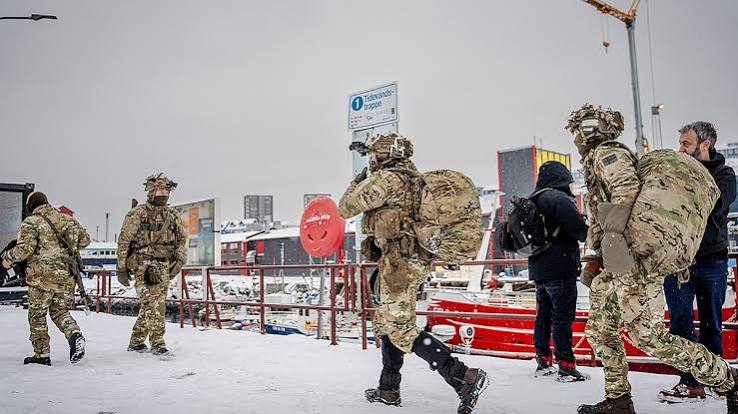
Denmark has sent conscripts to Greenland for the first time in recent history, putting young soldiers through Arctic training as tensions grow over the strategically vital island.
For the first time in recent history, Danish conscripts have been deployed to Greenland, putting some of the country’s newest soldiers in one of the most remote and challenging parts of the Danish kingdom. Their mission is not to occupy territory or prepare for an imminent battle. It is to learn how to operate in Arctic terrain where the weather, landscape and isolation can be as demanding as any adversary.
The timing, however, is impossible to ignore.
The soldiers are training in Greenland as the strategic importance of the Arctic grows and as U.S. President Donald Trump repeatedly presses Denmark to give up control of the island.
The exercise, Arctic Endurance, is designed to train soldiers to survive and operate in extreme cold. They move across a landscape where temperatures, terrain and distance can quickly turn small mistakes into serious problems.
But the training carries a significance beyond military preparedness.
For decades, Greenland was a distant concern for most of the outside world. Now it has become one of the most closely watched pieces of territory in the Arctic and Denmark is making sure its soldiers are physically there to show that the island remains part of its strategic horizon.
The conscripts may be learning how to fight and survive in the Arctic. But their presence is also saying something else: Denmark intends to be there.
Trump Changed the Equation
For years, Greenland could remain largely outside the daily calculations of most European governments, a vast and sparsely populated Arctic territory whose strategic importance was understood by military planners but rarely became the subject of mainstream political debate, until Donald Trump repeatedly turned the question of who controls the island into an issue that Denmark could no longer afford to treat as distant or theoretical.
Trump has repeatedly argued that the United States needs Greenland for national security, portraying control of the island as essential to protecting North America from potential threats posed by Russia and China and, at various points, refusing to rule out the use of military force to secure what he described as America’s strategic interests there.
The demands have placed Denmark in an extraordinary position: a longstanding U.S. ally is now being pressed by Washington to surrender control of a territory within the Danish realm, even as Copenhagen is being forced to confront its own years of underinvestment in Arctic defence and the growing military importance of the region surrounding Greenland.
Denmark and Greenland have rejected Trump’s ambitions, with Greenland’s government making clear that the island’s future belongs to its people, while Copenhagen has insisted that Greenland is not for sale and that questions over its future cannot simply be settled by another country declaring that it needs the territory.
Yet Trump’s campaign has already changed the political calculation.
Denmark has pledged billions of dollars to strengthen its Arctic defences after the country’s defence minister acknowledged that the region had been neglected for years, while the decision to train and deploy conscripts in Greenland provides a highly visible demonstration that Copenhagen is now treating the Arctic as a central part of its defence responsibilities rather than a remote corner of the kingdom.
That distinction matters because Denmark is trying to do two things at once: strengthen its military ability to operate in a region where it has historically been underprepared, while also making clear to allies, rivals and Greenland itself that Copenhagen intends to remain an active presence in the Arctic.
And beneath all of this sits the question that has transformed Greenland from a remote territory into one of the most coveted strategic pieces of land in the world: what is it about this enormous island that makes Washington, Moscow, Beijing and European capitals suddenly care so much about what happens there?
Why Greenland Matters
Greenland’s importance begins with geography, because its enormous size can be misleading: much of the world’s largest island is covered by ice, its population is only around 56,000 and vast stretches of its territory remain almost completely uninhabited, yet its position between North America, the Arctic Ocean and the North Atlantic places it directly across some of the most important military and maritime routes connecting the United States and Europe.
Roughly 80% of Greenland lies above the Arctic Circle, putting the island at the centre of a region that is becoming increasingly accessible as climate change reduces Arctic sea ice and opens the possibility of new shipping routes, while at the same time exposing previously difficult-to-reach areas to greater competition over energy, minerals, trade and military access.
That strategic value is hardly new.
During the Second World War, the United States occupied Greenland after Denmark was invaded by Nazi Germany, seeking to prevent the island from falling under German control and to protect the North Atlantic approaches that were vital to the Allied war effort.
What was once primarily a question of protecting shipping lanes has since evolved into something much larger, with Greenland occupying a position that allows the United States and its allies to monitor activity across the Arctic and North Atlantic while providing a crucial link between North America and Europe.
For much of the period after the Cold War, however, the Arctic was less a battlefield than a zone where competing countries could pursue cooperation, scientific research and economic interests without the same level of military confrontation seen elsewhere.
That calculation has changed dramatically as Russia has rebuilt its military infrastructure across the Arctic, China has sought a greater economic and strategic role in the region and NATO has begun paying far closer attention to its northern flank.
Climate change is accelerating that shift by making the Arctic less isolated than it once was, with thinning sea ice creating new possibilities for shipping and resource extraction while simultaneously making the region more accessible to military forces and strategic competition.
Greenland therefore sits at the intersection of several interests at once: it is a geographical gateway between the Arctic and North Atlantic, a crucial position for monitoring military movements, a potential source of strategically important minerals and a territory whose location gives whoever has meaningful access to it an advantage in one of the world’s fastest-changing strategic environments.
That is why the question surrounding Greenland is no longer simply whether Denmark can defend a remote Arctic possession. It is about who gets access to the routes, resources and military geography of the Arctic as the region itself becomes increasingly important to global power.
America Is Already in Greenland
The irony at the heart of Trump’s argument is that the United States does not need to own Greenland to maintain a powerful military presence there, because Washington already operates one of the most strategically important installations on the island, giving the U.S. access to a location that has been central to the defence of North America for decades.
The U.S. Department of Defense operates Pituffik Space Base in northwestern Greenland, a remote facility built after Washington and Copenhagen signed the Defense of Greenland Treaty in 1951, and today it supports missile warning, missile defence and space surveillance operations for the United States and NATO.
The base is part of a much larger strategic picture.
Greenland also sits across the approaches to what military planners call the GIUK Gap – the stretch of North Atlantic running between Greenland, Iceland and the United Kingdom – which has long been regarded as a critical passage for monitoring Russian naval activity and tracking movements between the Arctic and the Atlantic.
In other words, the United States already has precisely the kind of strategic access that Trump says makes Greenland indispensable.
Thomas Crosbie, an associate professor of military operations at the Royal Danish Defence College, has argued that an American takeover would therefore offer Washington little meaningful security advantage over the arrangements it already enjoys as a close Danish and NATO ally.
“The United States will gain no advantage if its flag is flying in Nuuk versus the Greenlandic flag,” Crosbie told The Associated Press, arguing that Washington already has access to the security advantages it wants and would be able to seek additional access through its existing alliance with Denmark.
That existing relationship has also been expanding.
Denmark’s parliament approved legislation allowing greater U.S. military access to Danish territory, widening an earlier agreement reached with the Biden administration that gave American forces broad access to Danish air bases, while Danish Foreign Minister Lars Løkke Rasmussen later indicated that Copenhagen could terminate the arrangement if Washington attempted to annex all or part of Greenland.
The message from Denmark is therefore complicated but increasingly clear: Copenhagen is willing to deepen military cooperation with Washington, and recognises the importance of American forces to the defence of the Arctic and North Atlantic, but that cooperation does not mean Denmark is prepared to hand over sovereignty.
That distinction goes to the heart of the Greenland dispute. America already has access. Trump wants ownership. And Denmark is now having to explain why those two things are not the same.
Russia Is Watching the North
If Greenland has become more valuable to Washington, it is partly because the Arctic itself is becoming a much more contested strategic space, with Russia maintaining the region’s largest military footprint and increasingly treating its northern territories as a core component of its national defence strategy.
Moscow has spent years restoring Soviet-era infrastructure across the Arctic and building new military facilities, including bases and upgraded airfields that extend Russia’s ability to operate across an enormous stretch of territory, while the region is also home to the Northern Fleet and remains closely connected to Russia’s nuclear deterrent.
The scale of that presence has become more significant since Russia’s full-scale invasion of Ukraine in February 2022, which dramatically altered European security calculations and pushed NATO countries to reconsider areas that had previously been treated as relatively stable or peripheral.
The Arctic was one of them.
Russia has increasingly portrayed NATO’s expanding activity in the region as a direct security challenge, while Russian President Vladimir Putin has warned that Moscow would respond to what it sees as a growing military presence by strengthening its own armed forces in the Arctic, even as he has continued to leave the door open to international cooperation.
The concern in European capitals is that the same geography that makes Greenland valuable to NATO also makes the wider Arctic valuable to Russia, particularly because the region provides access to the North Atlantic, contains important military infrastructure and offers Russia a strategic environment in which its naval and nuclear capabilities can operate close to the approaches to North America and Europe.
That has created a cycle of competing military preparations.
NATO strengthens its northern defences because Russia has expanded its Arctic capabilities; Russia views NATO’s movements as evidence that the alliance is becoming more threatening; and countries such as Denmark, Norway, Canada and the United States respond by placing greater emphasis on surveillance, readiness and military cooperation across the region.
Greenland sits directly inside that equation.
Its location gives NATO an important position from which to watch the northern approaches, while Denmark’s responsibility for the island means that a weakness in Greenland’s defences is not simply a Danish problem but potentially a vulnerability within the alliance’s wider Arctic and North Atlantic security architecture.
And Russia is not the only power looking north.
China has its own ambitions for the Arctic – and its growing relationship with Moscow adds another layer to an already complicated strategic contest.
China Wants a Place in the Arctic
China does not border the Arctic Ocean, but Beijing has spent years making the case that geography should not prevent it from having a role in the region, declaring itself a “near-Arctic state” in 2018 and pursuing economic, scientific and strategic interests that have increasingly brought it into the calculations of the United States, Denmark and other Arctic powers.
Beijing has promoted the idea of a “Polar Silk Road” as part of its wider Belt and Road Initiative, seeking greater involvement in Arctic shipping, infrastructure, research and natural resources, while Chinese companies have also explored opportunities linked to Greenland’s mineral wealth, an interest that has inevitably attracted scrutiny from Western governments concerned about China’s dominance of critical mineral supply chains.
The concern is not simply about Chinese investment.
The Arctic is becoming more strategically accessible at precisely the moment when relations between China and the West are deteriorating, while Beijing’s increasingly close partnership with Moscow has added another dimension to Western concerns about what greater Chinese involvement in the region could eventually mean.
When China declared itself a near-Arctic state, the move drew an unusually blunt response from Washington.
Then-U.S. Secretary of State Mike Pompeo warned that the Arctic should not become another heavily militarised arena marked by competing territorial claims, explicitly invoking the South China Sea as a warning of what could happen if Beijing’s ambitions were allowed to expand unchecked.
The comparison reflected a broader American concern: control of the Arctic is no longer simply about the countries whose coastlines touch the polar region, because the opening of new shipping routes, the discovery and development of valuable resources and the changing military geography of the north are creating incentives for outside powers to establish a presence.
Greenland is particularly important in that calculation because it combines strategic geography with enormous potential mineral wealth, while its small population and difficult terrain make large-scale development extraordinarily complicated.
For Denmark, that creates a difficult balancing act.
Copenhagen must defend Greenland against a changing security environment while managing its relationship with the United States, keeping NATO’s interests in mind and remaining sensitive to Greenland’s own political aspirations, all while watching China and Russia deepen their involvement in a region where the rules of strategic competition are being rewritten.
The ice may be melting, but the competition is only getting harder.
The Minerals Beneath the Ice
The military argument is only one reason Greenland has become so valuable, because beneath the island’s vast frozen landscape lie deposits of minerals that have become increasingly important to the global economy and to the geopolitical struggle over who will control the supply chains of the future.
Greenland is believed to have significant deposits of rare earth elements and other critical minerals used in everything from smartphones and computers to batteries, electric vehicles and advanced defence technologies, making the island particularly attractive at a time when the United States and its allies are trying to reduce their dependence on China, which currently dominates much of the global processing and supply chain for rare earths.
That makes Greenland’s mineral wealth strategically important even if extracting it remains extremely difficult.
The island’s harsh climate, enormous distances and limited infrastructure make mining projects expensive and technically challenging, while environmental protections and Greenland’s own political debate over how—and whether—its natural resources should be developed have created additional hurdles for investors.
Yet the potential is difficult for major powers to ignore.
For Washington, gaining greater influence over Greenland could provide another source of critical minerals at a time when supply-chain security has become a national-security issue; for European countries, developing alternative sources could reduce exposure to Chinese-controlled supply chains; and for Greenland itself, resource development offers the possibility of generating the economic strength needed to support greater autonomy from Denmark.
That last point is particularly important.
Greenland’s mineral resources are not simply another prize in a contest between powerful countries. They are also tied to the island’s long-running political ambitions, because greater economic independence could give Greenland more room to determine its own future and potentially reduce its reliance on financial support from Copenhagen.
This is where the strategic and political interests begin to overlap.
The same resources that make Greenland attractive to Washington, Europe and other outside powers could also strengthen Greenland’s ability to pursue greater self-government, meaning that the island’s mineral wealth could ultimately become a tool not for another country to control Greenland, but for Greenlanders to gain more control over themselves.
For all the attention on military bases, Arctic shipping routes and great-power rivalry, however, there is a practical obstacle that no geopolitical speech can erase: Greenland is an exceptionally difficult place to build, mine and operate.
And that is precisely why the contest over the island is increasingly being fought not only through resources and military access, but through physical presence.
What Denmark Is Really Signalling
For Denmark, the deployment of conscripts is part of a much broader attempt to rebuild a military presence in a region where Copenhagen has acknowledged that it spent years doing too little, with the Arctic now moving from the margins of Danish defence planning to the centre of a security debate that involves the United States, Russia, China and NATO.
The soldiers taking part in Arctic Endurance are part of Denmark’s first cohort under an extended conscription programme intended to produce troops capable of operating in difficult environments, and their training in Greenland is designed to give them experience with the extreme cold, rugged terrain and isolation that would define any military operation in the region.
The exercise also forms part of Arctic Sentry, a NATO mission launched this year to strengthen the alliance’s presence in the Arctic and reinforce surveillance and readiness across a region that has become increasingly important to NATO’s northern defences.
For Denmark, however, there is a message beyond military readiness.
Putting Danish conscripts on the ground in Greenland demonstrates that Copenhagen is willing to invest people, money and military resources in a territory that has suddenly become the subject of intense international pressure, while also reminding its allies that the defence of Greenland cannot simply be discussed from Washington, Brussels or Copenhagen without considering the people who actually live there.
That bigger picture is becoming harder to ignore.
Denmark has pledged billions of dollars to strengthen Arctic defences, while NATO is increasing its activity and the United States continues to regard Greenland as a critical part of the defence of North America; meanwhile, Russia sees NATO’s expanding presence as a threat and China continues to build its economic and strategic position in the wider Arctic.
The result is a remarkable transformation for Denmark, which now finds itself having to demonstrate military credibility in a territory that was for decades treated as strategically important but insufficiently defended.
The conscripts therefore represent something larger than a new generation of Danish soldiers learning how to survive in extreme cold.
They are part of Copenhagen’s attempt to answer a much bigger challenge: how do you defend a territory that a powerful ally wants, a strategic rival is watching and an increasingly assertive local population insists belongs to its own future?
The Sovereignty Question
That final question cannot be answered by military strategy alone, because Greenland is not simply a piece of Arctic real estate sitting on a map between North America and Europe; it is a self-governing territory within the Kingdom of Denmark, home to roughly 56,000 people, most of them Inuit, whose own political ambitions have become increasingly important to any discussion about the island’s future.
Greenland’s government has rejected Trump’s designs on the territory and has maintained that Greenlanders themselves must determine what happens to their island, while Denmark has likewise rejected the idea that Greenland can simply be bought or transferred to another country because Washington considers it strategically useful.
That creates an uncomfortable reality for every major power interested in Greenland.
The United States can argue that the island is essential to its national security, Russia can regard the surrounding Arctic as a critical military theatre, China can pursue economic opportunities and Denmark can strengthen its defences, but none of those calculations erase the political question at the centre of the dispute: what do Greenlanders want?
Greenland has spent decades acquiring greater control over its own domestic affairs, and the question of eventual independence from Denmark remains an important part of its political future, meaning that American pressure could have consequences that go well beyond the current dispute between Washington and Copenhagen.
There is also a striking contradiction in Trump’s argument.
The United States already operates Pituffik Space Base, already has access to Greenland for missile warning, missile defence and space surveillance, and already works with Denmark as a NATO ally, which raises the question of what ownership would actually add to American security that cannot be achieved through agreements with Copenhagen and Nuuk.
For Denmark, meanwhile, the challenge is not simply resisting American pressure, but proving that it can actually fulfil its responsibilities in the Arctic after years of underinvestment.
And for Greenland, the stakes are even greater, because the island risks becoming the object of a struggle between larger powers at precisely the moment when its people are seeking greater control over their own political and economic destiny.
The danger is that Greenland could be discussed primarily as a strategic location, a military platform or a mineral deposit, while the people who live there become an afterthought.
That is the tension at the heart of the Arctic’s new geopolitics. Everyone wants access to Greenland. Greenlanders want a say in what happens to Greenland.
The Fight for Greenland
Trump has argued that Denmark should not control Greenland simply because a ship landed there hundreds of years ago, dismissing historical claims as inadequate justification for determining who owns territory in the modern world.
The argument quickly produced its own response in Canada, where a joke circulated online using the same logic against America’s territorial ambitions: if an old landing by one country’s ship cannot establish ownership, then neither can an American ship arriving centuries later suddenly create a claim over someone else’s land.
The joke travelled because the underlying contradiction was difficult to miss.
Trump has repeatedly spoken about Greenland in terms of American security and strategic necessity, while also making comments about territorial expansion elsewhere in North America, including Canada, even though both Denmark and Greenland have rejected the idea that the island is available for acquisition and Canada has rejected the notion of becoming a U.S. state.
Behind the jokes, however, lies a serious question about how the next era of Arctic competition will work.
The region is opening up, military activity is increasing, critical minerals are becoming more valuable and the United States, Russia, China, Denmark and NATO all have reasons to pay closer attention to the far north. Greenland’s location places it directly in the middle of that competition, which means the pressure surrounding the island is unlikely to disappear simply because one diplomatic dispute ends.
For now, Denmark is responding with soldiers, exercises and new defence spending, while the United States already maintains a major military installation on the island and Russia and China continue to build their own Arctic capabilities.
But the most important presence on Greenland may not be a military one at all. It is the presence of the people who live there.
The Arctic may be becoming a new arena for great-power competition, but Greenland is not an empty strategic prize waiting to be claimed. It is a homeland and whatever happens next, Greenlanders will have to live with the consequences.