
Sugar Mocked Recode on Shark Tank, Today Its Valuation Lies in Ruins
In the brightly lit studio of Shark Tank India Season 2, a cosmetics brand called Recode Studios walked in with an ask of 1 crore rupees for 1 percent equity, implying a 100 crore rupee valuation. The founders presented revenue of roughly 15 crore rupees in the preceding financial year and a model built around affordable products and community-driven customer acquisition. What followed was not a rigorous debate on unit economics or scalable distribution.
Instead, several sharks stepped back, citing conflict of interest with an existing player on the panel. Vineeta Singh of Sugar Cosmetics was that player. Reports of the episode quote her describing herself, in substance, as the gunda of the industry. Other sharks referenced friendship and competitive overlap. Flying kisses were exchanged among the panel. Recode left without a deal.
Fast forward to 2026. Sugar Cosmetics, once valued at approximately 3000 crore rupees at its 2022 peak, has raised fresh capital at a post-money valuation of 550 to 600 crore rupees, an implied cut of 75 to 80 percent from that peak and a sharp reduction even from the 2600 to 2700 crore rupee range reported in late 2024.
Recode Studios, the brand that was turned away, completed an SME IPO in May 2026 at a price band of 150 to 158 rupees per share, raising about 44.6 crore rupees. Post-listing, the stock traded at a significant premium. Market capitalisation figures around 350 crore rupees and above have been reported depending on the trading price. The numerical contrast is stark. The cultural contrast is sharper still.
The Data of Bittery Sugar and Rebounding Recode: Which One Has Financially ‘Beautiful’ Trajectory?
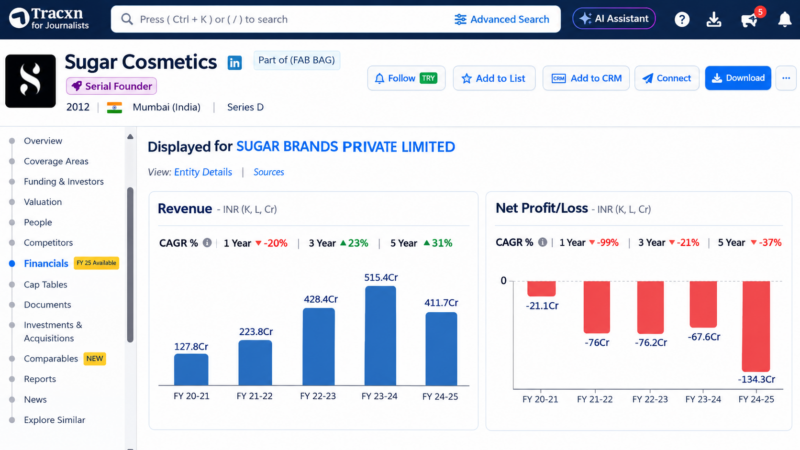
Sugar Cosmetics was founded in 2015 by Vineeta Singh and Kaushik Mukherjee. It rode the post-pandemic D2C wave, raising substantial capital from institutional investors including Elevation Capital, A91 Partners, L Catterton and others. At its 2022 peak it commanded a valuation near 3000 crore rupees. By FY25, operating revenue had declined to approximately 404 crore rupees from 505 crore rupees the prior year, a drop of about 20 percent. Net losses nearly doubled to around 135 crore rupees. In September 2026 the company raised roughly 144 to 145 crore rupees from A91 Partners at a valuation of 550 to 600 crore rupees. That is not a modest correction. It is a collapse in the private-market price of the equity.
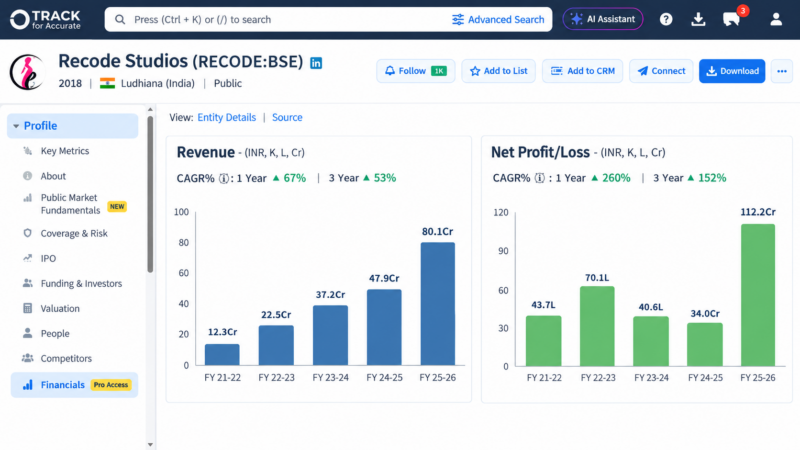
Recode Studios followed a different path. After the Shark Tank rejection it continued building offline distribution, retail presence and a profitable model. By the time of its 2026 IPO it reported revenue of 80 crore rupees in the year ended March 2026 with a profit after tax of 11.21 crore rupees, up from lower bases in prior years. The public listing gave it a market price discovered by actual buyers and sellers rather than negotiated between founders and venture funds. The resulting capitalisation, while still modest by large-brand standards, sits in the same order of magnitude as Sugar’s latest private valuation, and Recode achieved it without the hundreds of crores of venture capital that Sugar absorbed.
If you had bought a slice of Sugar at its peak valuation, that slice is now worth roughly one-fifth of what it once commanded. If you had been able to buy into Recode at the 100 crore rupee valuation it sought on television, and held through the IPO and subsequent trading, the market has assigned it a higher absolute value than the private price Sugar currently carries. Sugar Cosmetics burned large amounts of investor capital and saw its paper value evaporate. The other grew more modestly, stayed closer to profitability, and received a public price that did not require the same scale of external funding.
The Gunda of the Industry: The Rejection Dynamics and the Language of Dominance
The Shark Tank episode is not merely colour. It is evidence of an attitude. When a founder of an established brand describes herself as the gunda of the industry while rejecting a smaller competitor, the signal is clear, that the category power is being asserted, and capital is being withheld on relational rather than purely commercial grounds. Other sharks’ explicit references to not funding a friend’s competitor reinforce the point. In ordinary markets, competition is supposed to benefit consumers and discipline incumbents. In this televised moment, competition became a reason to close the chequebook and exchange affectionate gestures among the powerful.
Investors are free to decline any deal for any reason, including personal relationships. But it is revealing. It shows how social capital and category dominance can substitute for dispassionate evaluation of a business plan. Recode’s subsequent performance suggests the business was not inherently unviable. The rejection therefore looks less like rigorous diligence and more like an incumbent protecting turf, or at least declining to fund a potential rival while signalling strength.
Vineeta Singh: What the Numbers Teach About Capital and Attitude?
Venture valuations are not the same as public market prices. Private rounds are negotiated between a small number of parties and can detach from underlying cash generation for long periods. When growth slows, losses widen and the funding environment tightens, those valuations often reset violently. Sugar’s journey from 3000 crore rupees to 550 to 600 crore rupees is a textbook illustration. The company took large amounts of capital, expanded aggressively, and then faced declining revenue and deepening losses. The latest round simply made the market’s revised opinion visible.
Recode’s path is the opposite lesson. It sought a relatively modest valuation on television, was refused largely for non-financial reasons, continued to execute, and eventually obtained a public listing where thousands of investors, not a handful of funds, set the price. Profitability, even at modest absolute levels, proved more durable than narrative-driven private valuations.
Paper wealth created by venture rounds can disappear when the music stops. Real businesses that generate cash and list on an exchange receive a daily reality check. An incumbent that uses its platform to dismiss a competitor as beneath consideration, or to frame itself as the industry’s enforcer, does not thereby become more valuable. Markets ultimately price cash flows, margins and risk, not the volume of flying kisses or the self-description of toughness.
When successful founders treat smaller players as threats to be frozen out rather than as evidence of a healthy category, they signal fragility rather than strength. Sugar’s subsequent valuation collapse did not occur because Recode existed. It occurred because revenue fell, losses rose, and investors recalibrated their expectations. Yet the optics remain uncomfortable: the brand that once projected dominance now trades, in private-market terms, at a fraction of its former glory, while the brand it declined to fund has a public market capitalisation in the same neighbourhood.
The episode and the subsequent numbers do not prove that every rejection of a competitor is commercially wrong. They do illustrate the cost of confusing industry power with lasting economic value. Capital that is withheld for relational reasons does not magically protect the incumbent’s valuation. Capital that is raised at peak optimism must eventually be justified by results. When the results disappoint, the correction is indifferent to who once called themselves the gunde of the industry.
Recode’s public listing and Sugar’s down round are two data points in a larger story about the maturation of India’s consumer brands. One path prioritised narrative scale and venture funding. The other prioritised steady execution and eventual public price discovery. The market, at least for now, has assigned them roughly comparable capitalisations after one of them lost four-fifths of its peak private value. That arithmetic is the most eloquent critique of the earlier posture of dominance.