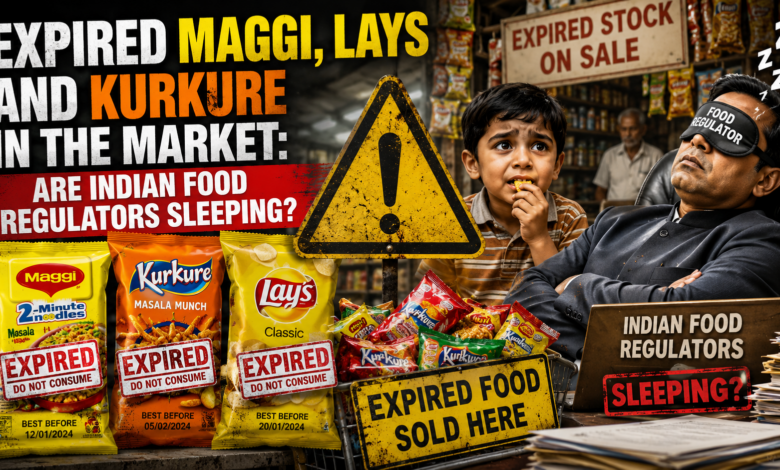
Every time Indian regulators bust a food-relabeling racket, the story is written as a one-off scandal. It is not. Navi Mumbai’s Turbhe TTC Industrial Area has now produced near-identical busts in 2024 and 2026, with the seizure value roughly tripling in under three years. That trajectory is not a success metric for enforcement. It is proof that India’s food-safety regime does not shrink the black market for expired or mislabeled branded food. Instead it prices the occasional raid in as a manageable cost of doing business.
In February 2024 the Maharashtra Food and Drug Administration raided a firm in the Turbhe industrial belt for tampering with manufacture and expiry dates and swapping nutrition and ingredient labels on branded goods. The seized stock was valued at 24.52 lakh rupees. An FIR followed under sections dealing with adulteration of food and sale of noxious food or drink. Roughly 30 months later, between 24 and 29 August 2026, the same FDA under Commissioner Tukaram Mundhe joined forces with the Navi Mumbai Police Crime Branch and raided Sadhana Enterprises in the identical Turbhe TTC belt.
Officials seized 8442 cartons linked to 10 exporter companies, valued at 75,21,269 rupees, plus roughly 30600 rupees of unlabelled or expired stock, for a total of about 75.52 lakh rupees. The firm’s licence was suspended. An FIR was registered under the Food Safety and Standards Act 2006 and the Bharatiya Nyaya Sanhita. Same geography, same method of erasing or overwriting dates and replacing labels, seizure value up after 30 months.
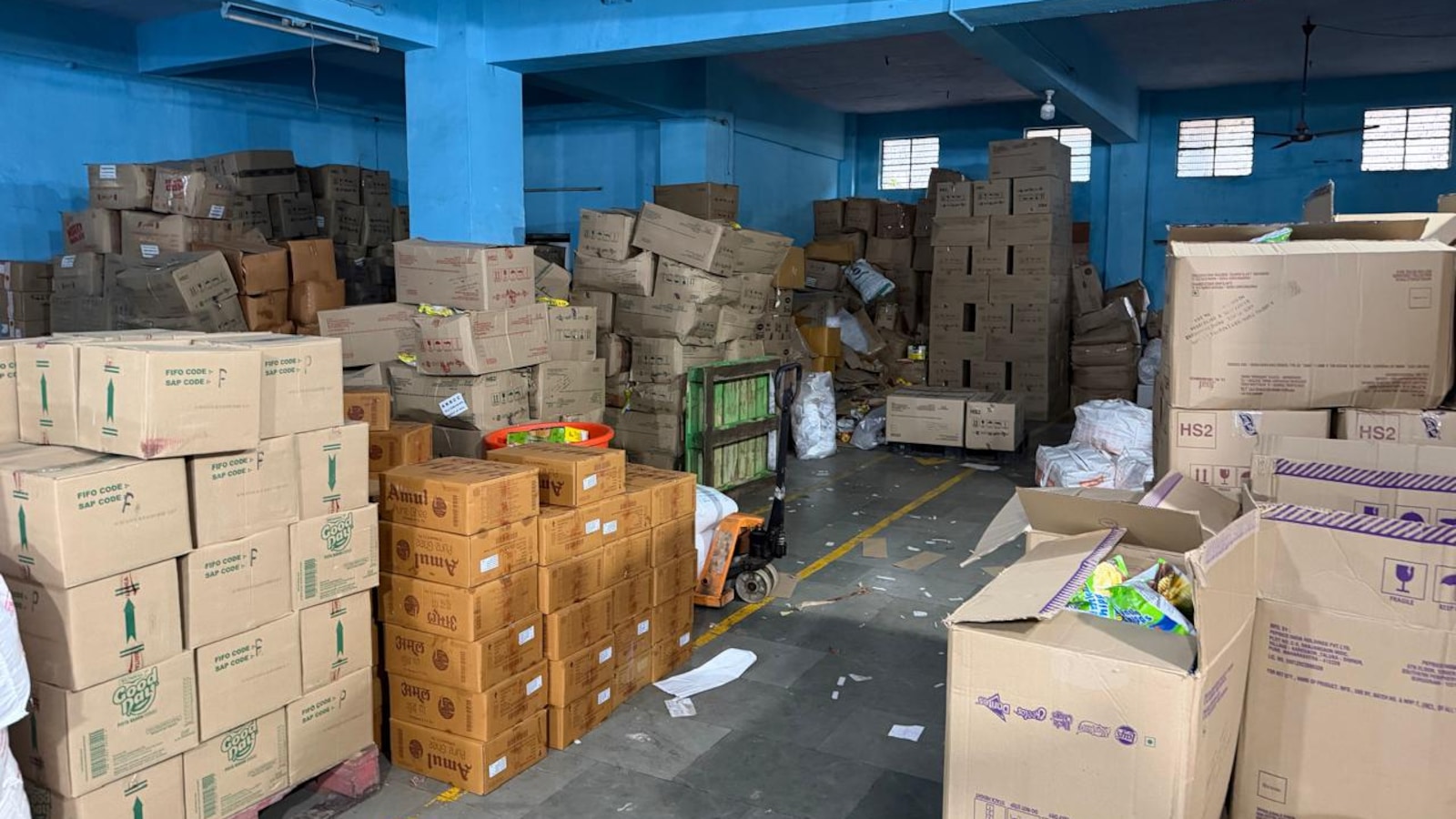
What investigators found inside the premises shows this was never a crude backroom operation. Officials recovered inkjet printers, thinners and specially prepared stickers used to erase, conceal or replace original manufacturing and expiry information printed on packaging. Original labels carrying ingredient lists and nutritional information were removed or covered and replaced with new stickers. The entire stock was then ready for recirculation inside India or for export.
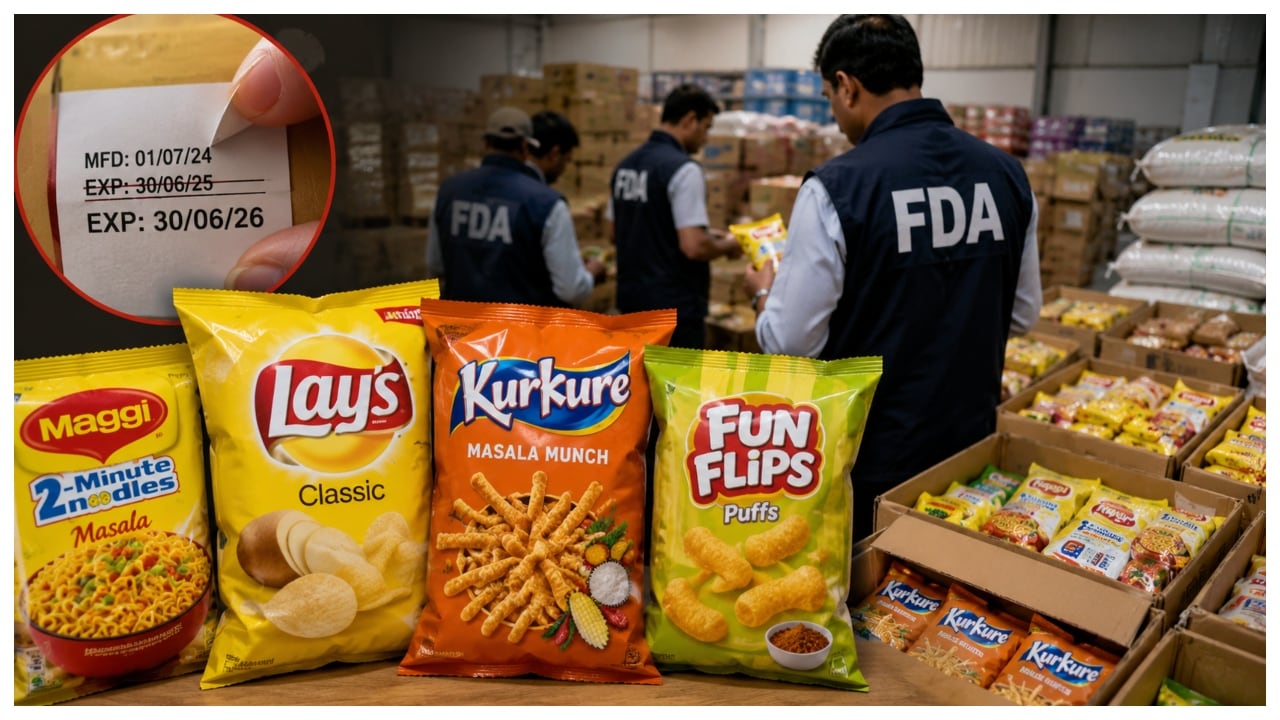
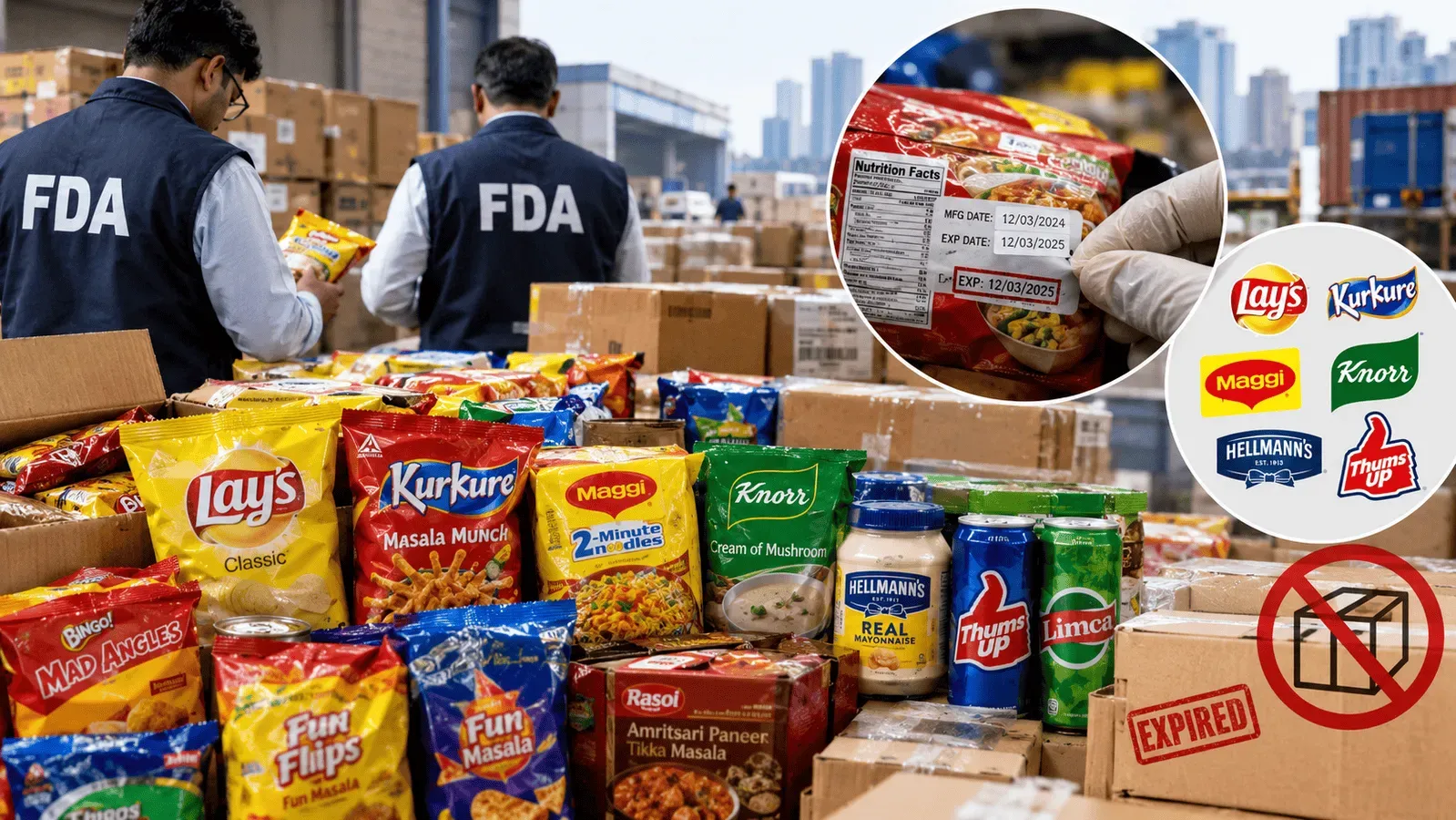
The products spanned multiple major brands at once: Lay’s Classic Salted, Magic Masala, Spanish Tangy Tomato, Sizzling Hot and Lemon Chilli; several Kurkure variants including Masala Munch, Red Chilli Chataka, Naughty Tomato, Solid Masti, Green Chutney and Schezwan Chutney; Fun Flips and related snacks; Maggi Masala Noodles and Maggi Atta Noodles; ready-to-eat and ready-to-cook items under the Rasoi label; Knorr mushroom soup; Hellmann’s mayonnaise; and canned soft drinks including Thums Up and Limca. In other words, products belonging to PepsiCo, Nestlé, Hindustan Unilever and Coca-Cola sat together in the same facility under the same racket.
The network was equally revealing. The 8442 cartons were not the inventory of a single shady godown operator. They were linked to ten exporter companies with addresses across Mumbai localities such as Mulund, Ghatkopar, Malad, Fort, Andheri and Chembur, as well as Delhi and Noida. Named entities included Aarnika Export, Novas Export, Joshi Brothers, Beyond Export, Jamnadas Ruttonsy and Company, Span Impex, Kasturi, Angad Export, Bharat International and Anika Export.
This was a distributed, multi-city supply chain that treated expired or near-expired branded stock as inventory to be refreshed and moved onward. Some early media headlines floated multi-crore figures for the seizure. The scale that matters is not the precise lakh or crore figure of one raid. It is the recurrence in the same industrial pocket with larger volumes, industrial-grade tooling and an intact buyer network.
Big brands are structurally exposed to this problem. PepsiCo, Nestlé, Hindustan Unilever and Coca-Cola invest heavily in manufacturing standards, primary packaging integrity and authorised distribution. Once product leaves the primary channel and moves through layers of distributors, stockists, exporters, cold storages and informal warehouses, visibility collapses.
Expired or near-expired stock that should be destroyed or diverted under controlled conditions can instead enter secondary markets where the economic incentive to extend shelf life is high and the probability of detection is low. Export channels add further opacity. Goods destined for overseas markets, or returned and unsold stock, can be diverted, relabelled and recirculated domestically or re-exported under altered dates. No single company can police every downstream and export node in India’s fragmented system. The simultaneous presence of four major portfolios in one Turbhe facility is therefore less a collective boardroom failure and more evidence of a systemic gap in the secondary and export ecosystems.
Maggi’s reappearance carries particular resonance. The brand’s last major crisis in India was the 2015 episode involving alleged excess lead and the presence of monosodium glutamate despite “no added MSG” labelling. Tests in Uttar Pradesh triggered a nationwide ban, a massive recall and destruction of stock, and a government class-action suit seeking roughly 640 crore rupees, then about 100 million dollars, for alleged unfair trade practices and misleading labelling.
Nestlé disputed the findings, multiple retests followed in India and abroad, and the product eventually returned to shelves after court interventions. Labelling integrity, specifically claims around composition and safety, has been Maggi’s known soft underbelly in the Indian market. Finding Maggi again inside a 2026 date-and-label tampering operation is therefore almost thematically inevitable. The earlier crisis demonstrated both the commercial damage that labelling failures can inflict and the difficulty of permanently eliminating the underlying vulnerabilities in the wider system. The deeper problem is enforcement.
India’s food-safety architecture under the Food Safety and Standards Act 2006 looks robust on paper. In practice it is chronically under-powered and structurally tilted toward monetary penalties and administrative action rather than certainty of serious consequence.
Parliamentary data over recent years show the pattern clearly. Across 5 years ending in 2025-26, authorities analysed roughly 8.86 lakh food samples. About 20 % were found non-conforming, meaning adulterated, substandard, misbranded or otherwise non-compliant. Of the roughly 1.85 lakh non-conforming cases, about 75 percent were settled with monetary penalties. The conviction rate hovered between 3 and 5 percent, rising modestly to about 4.8 percent in 2025-26 but remaining extremely low relative to the volume of violations detected. Staffing shortages compound the problem. Large numbers of sanctioned Food Safety Officer and Designated Officer posts remain vacant in multiple states, limiting inspection frequency and follow-through. Laboratory capacity is uneven and turnaround times can undermine prosecutions.
Licence suspension, the administrative tool used in the Turbhe cases, does not prevent promoters from re-registering elsewhere in the same industrial belt or shifting operations a few kilometres away. FIRs under the Food Safety and Standards Act and the Bharatiya Nyaya Sanhita create a paper trail, but the combination of often bailable offences, slow judicial processes and fines that are modest relative to the profits of large-scale relabeling means the expected cost of being caught remains manageable.
Raids generate a news cycle, a suspended licence and seized stock. The underlying economics of low detection probability, limited personal criminal exposure for organisers and an intact buyer network allow the business model to survive and grow. This is not unique to packaged snacks. Milk, spices, edible oils, sweets and paneer routinely feature in adulteration statistics. The unorganised and semi-organised segments of the food economy are vast. Formal licensed channels sit alongside informal networks that are hard to map and harder to police continuously. Enforcement is frequently reactive, driven by festival-season drives, tip-offs or high-profile commissioner-led actions, rather than continuous risk-based surveillance backed by real-time traceability.
Why is rule-breaking so common and why are food products not taken more seriously? Thin margins in many parts of the supply chain create constant pressure to cut costs or extract extra value from existing inventory. Extending the commercial life of branded stock by a few months through date and label alteration can be highly profitable when detection is infrequent. Enforcement capacity has not kept pace with the growth and complexity of India’s food economy.
Officers are stretched thin. Testing infrastructure is uneven. Prosecutions move slowly. Penalties often fail to outweigh the gains. Consumers, especially in price-sensitive segments, may prioritise affordability and brand familiarity over rigorous scrutiny of dates and labels. Buyers further down the chain, whether exporters, stockists or retailers, may look the other way when margins are attractive. The result is a system in which adulteration and mislabelling are treated as chronic rather than exceptional, and in which the occasional high-visibility raid functions more as public theatre than as genuine deterrence.
Real deterrence would require structural changes. Traceable batch systems, whether through secure QR codes linked to central databases or more advanced distributed-ledger approaches, would make date and label substitution far harder to hide and far easier to audit across the chain. Criminal liability thresholds need recalibration so that organised, industrial-scale relabeling of branded food attracts non-bailable exposure and meaningful prison risk for the organisers, not merely fines and licence suspensions that can be worked around.
Until these structural shifts take hold, Turbhe-style operations will keep recurring. The 2024 raid did not deter. The 2026 raid, roughly larger in value and spanning the same brands and the same industrial geography, is the predictable outcome of a system that has already priced the next raid into its cost structure. India’s food-safety enforcement remains largely reactive theatre, visible and newsworthy yet insufficient to alter the underlying business model of refreshing expired branded food and feeding it back into domestic and export markets.
The real story is not the latest carton count or the latest suspended licence. It is that the same industrial pocket has demonstrated, with hard numbers, that the black market for relabelled food is resilient, adaptive and still growing.