Sugar Cosmetics’ 80% Valuation Crash Exposes The Brutal Truth About Indian Beauty Unit Economics


Sugar Cosmetics’ recent funding round at a sharply reduced valuation offers a clear window into the structural pressures facing India’s beauty and personal care D2C sector. In September 2026 the company raised approximately ₹144–145 crore from A91 Partners at a post-money valuation of ₹550–600 crore. That figure represents a 75–80 percent cut from the ₹2,600–2,700 crore valuation at which it raised capital in November 2024 and an even steeper drop from its peak near ₹3,000 crore in 2022.
The financial numbers that accompanied the round were equally stark. Operating revenue fell roughly 20 percent to about ₹404–415 crore in FY25 from ₹505 crore in FY24, while net losses nearly doubled to ₹134–135 crore from ₹67–68 crore the previous year. EBITDA losses of Sugar Cosmetics widened further, moving from roughly ₹48–58 crore to ₹108–116 crore. These figures are not merely a temporary setback. They illustrate a deeper problem that has plagued many Indian beauty brands: unit economics that struggle to support profitable scale.
Unit economics measure the profitability of each individual order or customer after accounting for every variable cost. In beauty, those costs are especially punishing. Gross margins in beauty world often appear healthy on paper, yet contribution margins after marketing, logistics, returns and payment fees frequently turn thin or negative.
One analysis of beauty and personal care startups notes that many brands operate with gross margins around 38 percent when the sector typically needs closer to 65 percent to absorb high customer-acquisition costs and still leave room for contribution.

The arithmetic becomes clearer once average order values and acquisition costs are examined side by side. Industry observations place the average order value for many D2C beauty brands in the ₹600–1,500 range, with established players such as Mamaearth frequently cited around ₹800. At the same time, paid customer-acquisition costs in the category commonly run ₹800–1,500 or higher once competition intensifies. When CAC approaches or exceeds AOV, the first order is almost always loss-making.
A simplified illustration drawn from typical Indian D2C modelling shows the pressure. Assume an AOV of ₹800, cost of goods sold at 35 percent (₹280), marketing cost per order of ₹300, blended shipping and RTO of ₹100, and payment and miscellaneous fees of ₹40. Contribution margin after these costs collapses to roughly ₹80 before any fixed overheads. If the customer never returns, the brand has spent far more to acquire the order than it retains. Even with moderate repeat rates, payback periods stretch, locking up cash in inventory and receivables while marketing bills continue to rise.
After a brand crosses ₹10 crore in annual recurring revenue the problem intensifies. Early growth can mask inefficient spending; at higher volumes the same decisions compound. Meta CPMs and Google CPCs rise, creative fatigue sets in faster, and CAC that once sat near ₹350 can climb toward ₹700 or more in competitive beauty segments. Logistics and reverse logistics consume another 10–15 percent of revenue if returns and RTO are not tightly controlled. Cash conversion cycles lengthen because inventory and ad spend are paid upfront while marketplace settlements arrive weeks later. A brand generating ₹1 crore in monthly revenue can easily find ₹1.5 crore tied in receivables and another ₹2–3 crore locked in stock.
Retention is the only reliable escape hatch, yet beauty brands often fall short. A repeat purchase rate of 30 percent or higher is widely regarded as the threshold that separates sustainable models from those dependent on continuous paid acquisition. Many beauty and personal care brands struggle to clear that bar consistently. When customers treat purchases as one-off or discount-driven events rather than routines, lifetime value fails to cover the elevated CAC.
The result is a sector that can generate impressive top-line growth while remaining structurally unprofitable at the unit level. Sugar’s experience is instructive precisely because the company had already achieved meaningful scale. Revenue crossed ₹500 crore, brand awareness was strong, and offline expansion was attempted. Yet the combination of high marketing intensity, ambitious store roll-outs that later required partial retreat, and insufficient contribution margin per order produced contracting revenue and widening losses.
Mamaearth provides a useful contrast. By emphasising bundles, routines and category cross-sell, the brand improved repeat behaviour and thereby lowered effective CAC over time. Higher lifetime value protected contribution margins even as absolute acquisition costs rose. That discipline helped the parent company reach profitability at a much larger revenue base. The difference is not brand strength alone; it is the deliberate management of the metrics that determine whether each incremental customer improves or erodes the economics.
Other structural features of the Indian market amplify the difficulty. High COD penetration increases RTO risk. Payment gateway and marketplace commissions further compress margins. Discounting, once used to accelerate growth, conditions customers to wait for offers and permanently lowers full-price realisation. Inventory turns below four times annually signal working-capital strain regardless of revenue growth.
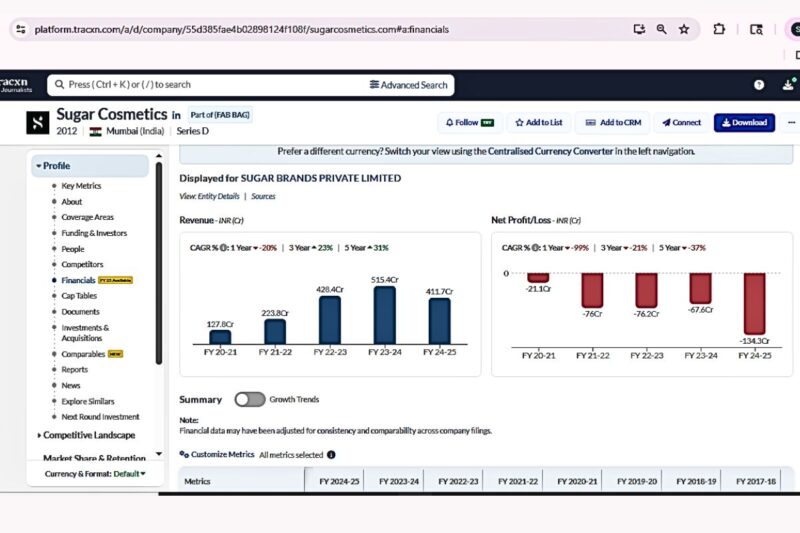
For years the Indian beauty D2C narrative celebrated growth rates, influencer reach and category expansion while treating unit economics as a secondary concern that would improve with scale. The data now show that scale without contribution-margin discipline simply multiplies losses. Brands that continue to spend 30–40 percent of revenue on advertising while AOV remains below ₹1,000 and repeat rates stay modest are not building durable businesses; they are converting investor capital into temporary order volume.
A healthier path requires several simultaneous shifts. First, AOV must be lifted through genuine value—routines, kits and higher-ticket hero products—rather than pure discounting. Second, contribution margin after all variable costs must become the primary decision metric, not gross margin or ROAS in isolation. Third, repeat purchase behaviour has to be engineered into the product and communication strategy from the outset, because first-order losses are only tolerable when recovery is rapid and reliable. Fourth, logistics and RTO must be treated as controllable levers rather than fixed costs of doing business.

Sugar Cosmetics’ valuation reset and revenue contraction are not an isolated failure. They are a public demonstration of what happens when unit economics remain weak after the easy growth phase ends. The broader Indian beauty sector faces the same arithmetic. Until more brands treat contribution margin, CAC payback and repeat rates as non-negotiable constraints rather than optimisable afterthoughts, the pattern of impressive top-line stories followed by painful corrections is likely to continue. The numbers, not the narrative, will decide which companies survive.