Krishan Rattan And His Spider Web Of Shady Connections — Ankiti Bose, Shailesh Haribhakti, Ajoy Veer Kapoor, Geoff Pollard, Rajiv And Rahul Lulla
Does A Person With Such Dark & Shady History Deserve To Be Called An Investment Banker & Financial Services Entrepreneur?

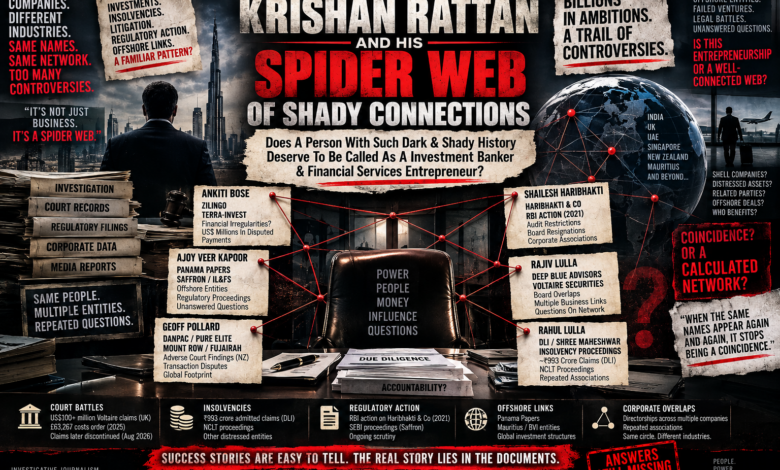
There is a remarkably polished vocabulary surrounding Krishan Rattan.
Terra-Invest describes him as a banker and financial-services entrepreneur who has “raised, deployed and overseen” transactions worth more than US$12 billion. Its website describes him as a founding partner and says that, before Terra-Invest, he established Mount Row, an alternative asset manager with more than US$1.2 billion in assets under management.
It is an impressive biography.
But financial journalism begins where the biography ends.
Because behind the polished description sits an unusually dense web of corporate associations, distressed companies, litigation, regulatory histories, disputed transactions and professional relationships involving a remarkably wide circle of financiers, entrepreneurs, advisers and corporate directors.
That does not prove that Rattan, or anyone around him, committed a criminal offence.
But it does raise a legitimate investigative question:
How much scrutiny should a man receive when the corporate and litigation trail surrounding his businesses repeatedly intersects with people and entities carrying their own serious controversies, regulatory proceedings, insolvency disputes or contested allegations?
That question becomes harder to dismiss when the relationships are not merely social photographs or conference appearances, but are visible in company directorships, investment platforms and formal corporate records.
And this is where the “spider web” metaphor becomes useful.
Not because every person in the web is guilty.
But because the threads are real.
THE FIRST PROBLEM: THE MAN MARKETED AS A GLOBAL FINANCIER IS ALSO A MAN WHOSE CORPORATE TRAIL LEADS THROUGH MULTIPLE DISTRESSED OR LITIGATED ENTITIES
Public corporate databases identify Krishan Rattan, DIN 07998639, as having served as a director of Voltaire Securities Private Limited, Voltaire Advisory Services Private Limited, Distribution Logistics Infrastructure Private Limited and Deep Blue Advisors Private Limited, among other entities.
This matters because these are not four interchangeable names on four harmless letterheads.
They represent distinct chapters of a financial and corporate network.
Voltaire became the centre of substantial litigation in England.
DLI ultimately entered insolvency proceedings in India.
Deep Blue creates a direct corporate overlap with Rajiv Ramesh Lulla.
And the broader network reaches into Mount Row, KairosWealth and Terra-Invest.
The point is not that every failed or disputed company proves wrongdoing by a director.
The point is much simpler:
A person who repeatedly markets himself as an institutional financial-services entrepreneur cannot reasonably expect journalists, investors and counterparties to examine only the glossy side of the balance sheet.
VOLTAIRE: THE LITIGATION THAT PUT THE BRAND UNDER A MICROSCOPE
The most serious chapter is the Voltaire litigation in the English Commercial Court.
In Voltaire Capital Holdings Ltd & Ors v Eric Watson & Ors, CL-2022-000699, Rattan was identified as the second defendant. In an April 2026 judgment, Mr Justice Bryan recorded that the proceedings concerned roughly US$100 million civil-fraud claims, arising from investments connected with the Voltaire group. The judgment recorded the claimants’ case that the Gemini Group had invested approximately US$101 million between 2014 and 2019, while their broader pleaded account put the investment at roughly US$132 million including further capital injections, with approximately US$101 million lost.
The claimants alleged, among other things, fraudulent misrepresentation, breaches of fiduciary duties and duties of good faith, conspiracy and accessory liability. Their case, as summarised by the judge, was that they had been led to believe that Voltaire was a legitimate business principally controlled by Rattan and intended to develop and operate a legitimate foreign-exchange business. The claimants alleged a different ownership-and-control reality and alleged that trading arrangements, further investments, forecasts and payments to associates formed part of the disputed picture.
Those are allegations, not findings of fraud against Rattan.
That distinction matters.
But so does another distinction:
A civil-fraud claim involving approximately US$100 million is not a trivial reputational footnote simply because it has not produced a final merits judgment.
The court record is real.
The defendants were real.
The disputed investment was real.
The money figures were real as pleaded.
And Rattan was not an anonymous peripheral witness.
He was defendant number two.
AND THEN CAME A VERY DIFFERENT COURT RECORD: £63,267 IN COSTS
There was, however, a verified adverse procedural order against Rattan personally.
In [2025] EWHC 1948 (Comm), dated 28 July 2025, the Commercial Court dealt with a disclosure-related application in the same litigation and ordered Rattan to pay £63,267 in costs.
That is not a fraud judgment.
It is not a criminal sentence.
It is not proof that the underlying allegations were true.
But it is an actual court order against Rattan personally.
And investigative journalism should not play games with language in either direction.
Calling the order a “fraud penalty” would be dishonest.
Calling it nothing would be equally dishonest.
It was an adverse costs order arising from litigation in which Rattan was personally a defendant.
THE VOLTAIRE CASE THEN CHANGED — AND THAT CHANGE MUST NOT BE HIDDEN
Here is where journalism becomes more difficult than propaganda.
The earlier Voltaire litigation ultimately did not proceed to the October 2026 trial against Rattan.
A 5 August 2026 Commercial Court consent order, before Mr Justice Jacobs, recorded that the claimants and Rattan had compromised their claims and permitted discontinuance. The order provided for discontinuance upon filing and service of the appropriate notice, and for Rattan’s removal from the relevant notification injunction.
Reporting at the time likewise identified the 5 August 2026 order as recording discontinuance of the claims against Rattan.
That is not a trial exoneration.
But it is also not a judgment finding that Rattan committed fraud.
It is a compromise and discontinuance.
And that distinction is essential.
Anyone portraying Rattan today as though a 10-week fraud trial against him is still scheduled is relying on an outdated procedural position. Conversely, anyone claiming that the court found the allegations false would also be inventing an outcome that did not occur.
The uncomfortable fact lies between those two exaggerations:
Rattan was sued over extremely serious, nine-figure civil allegations; he was personally hit with a costs order in the proceedings; and the substantive claims against him were later compromised and discontinued without a merits determination.
That is a far more interesting story than either a public-relations brochure or a social-media accusation.
DLI: ANOTHER THREAD, THIS TIME RUNNING THROUGH INDIA’S INSOLVENCY SYSTEM
Now consider Distribution Logistics Infrastructure Private Limited (DLI).
Corporate records identify both Rahul Lulla and Krishan Rattan as directors. Rattan’s appointment is recorded from 19 April 2019.
The company subsequently entered the Corporate Insolvency Resolution Process.
The Insolvency and Bankruptcy Board of India records an NCLT Mumbai admission order dated 14 May 2026 in the matter of Distribution Logistics Infrastructure Private Limited.
The scale is not cosmetic.
The evidence register records approximately ₹993.26 crore of provisionally admitted secured financial-creditor claims against DLI, with major claims reported from Bank of Baroda, Punjab National Bank, Union Bank of India, Bank of India, ARCIL, PNB and SBI.
Bank of Baroda alone accounted for more than ₹408 crore of provisionally admitted claims.
That is nearly ₹1,000 crore of secured-creditor exposure sitting inside an insolvency process.
Yet here again precision matters.
These are claims against DLI, not a ₹993 crore personal judgment against Krishan Rattan.
And Rattan has publicly stated, through the position reported by Terra-Invest, that he resigned as a director on 20 June 2025, almost eleven months before CIRP commenced.
That chronology matters.
But it does not answer the more important investigative question:
What decisions were taken while he was actually a director, what liabilities arose during that period, and what do the board records, lender documents and restructuring history show?
A resignation before insolvency is not evidence that somebody “escaped”.
Nor is insolvency evidence that a former director personally caused the failure.
The documents have to answer that question.
AND HERE THE SPIDER WEB GETS INTERESTING
Because Rahul Lulla is not an unrelated name appearing randomly in a DLI filing.
He appears in the same broader corporate network.
The evidence register identifies relationships connecting Rattan and Rahul Lulla through DLI, while Rajiv Ramesh Lulla appears in a separate set of companies overlapping directly with Rattan, including Deep Blue Advisors, Voltaire Securities and Voltaire Advisory Services.
Corporate records identify Rajiv Ramesh Lulla and Krishan Rattan as directors of Deep Blue Advisors. They also place Rajiv Lulla and Rattan together on the board of Voltaire Securities.
That is not gossip.
That is corporate data.
And it raises a very straightforward journalistic question:
How many supposedly unrelated business relationships can be dismissed as coincidence when the same names repeatedly emerge in the same companies and investment structures?
The answer is not “therefore fraud.”
The answer is:
These relationships deserve mapping.
RAHUL AND RAJIV LULLA: ONE NAME, TWO PEOPLE, AND A WARNING FOR EVERY JOURNALIST
There is a particularly dangerous trap here.
The public record distinguishes Rahul “Sonny” Lulla from Rajiv Ramesh Lulla.
They are not the same individual.
The evidence register specifically warns that material under review had incorrectly shifted between “Rahul Sonny Lulla” and “Rajiv Sonny Lulla”.
That distinction becomes important when allegations or proceedings are attributed to either individual.
Rahul Lulla appears in DLI records and in the wider Infrastructure India/Shree Maheshwar branch of the network.
Rajiv Lulla appears in Deep Blue Advisors, Voltaire Securities and Voltaire Advisory Services and has a historical board relationship with Blue Star.
A careless investigative article can turn two brothers into one composite villain.
That would not be investigative journalism.
It would be bad journalism.
The proper conclusion is more uncomfortable:
The corporate overlaps are strong enough that they need to be examined — but the people must remain correctly identified.
RAHUL LULLA AND THE INSOLVENCY TRAIL
Rahul Lulla is also named in an NCLT proceeding involving Shree Maheshwar Hydel Power Corporation Ltd.
The evidence register records an 8 January 2026 NCLT Indore order in which Rahul Lulla was named as Respondent No. 8 and the tribunal directed relevant former directors and other respondents to provide information and cooperate with the resolution professional, with the order warning of coercive consequences in case of non-compliance.
Again, this must not be inflated into a criminal conviction.
It was an insolvency-cooperation proceeding.
But it was also not merely a photograph from a business conference.
It was a judicial order naming the individual.
There are additional company-level insolvency disputes surrounding Shree Maheshwar, including substantial financing claims reported in the judicial record. Those company-level proceedings cannot simply be re-labelled as personal criminal liability for Rahul Lulla.
The investigative lesson is obvious:
When sophisticated financial professionals repeatedly appear around distressed investment structures, the correct question is not “Who is guilty?” before the evidence answers it. The correct question is “Who controlled what, when, under which documents, and for whose economic benefit?”
ANKITI BOSE: FROM ZILINGO’S COLLAPSE TO TERRA-INVEST
Now comes another remarkable thread.
Krishan Rattan and Ankiti Bose are not simply people who attended the same event.
They are public-facing founding partners of Terra-Invest. Terra-Invest currently describes Rattan and Bose as founding partners.
That relationship is commercially real.
But Bose arrives at Terra-Invest carrying her own turbulent corporate history.
In March 2022, Zilingo suspended Bose. In May 2022, the company terminated her employment following an investigation commissioned to examine what Zilingo described as serious financial irregularities. Bose disputed the basis for her termination and publicly denied wrongdoing.
Contemporaneous reporting later detailed questions about payments to various service providers. Inc42 reported approximately:
US$944,000 to EbixCash;
more than US$2.3 million to OneDelta Technology Solutions; and
approximately US$7 million to Algo Legal.
These were investigative allegations and disputed transactions, not judicial findings that Bose committed fraud.
That distinction should be printed in bold.
Because the point is not to declare Bose guilty.
The point is to ask a more uncomfortable question:
Why is a founder whose previous company descended into a major governance and financial controversy now part of the leadership of a new investment platform alongside Krishan Rattan?
The answer may be completely legitimate.
But a serious investment journalist is allowed to ask the question.
And should.
THE BOSE LITIGATION TRAIL DID NOT END WITH ZILINGO
Bose subsequently initiated litigation and criminal proceedings of her own.
In April 2024, Mumbai police registered an FIR following a complaint by Bose against Zilingo co-founder Dhruv Kapoor and former COO Aadi Vaidya, involving allegations including cheating, criminal intimidation, conspiracy and harassment.
She has also been involved in civil litigation relating to publications about her, including a Bombay High Court proceeding in Suit 242 of 2023, where the December 2023 order recorded continuation of earlier interim relief.
Again, those proceedings do not make her guilty of anything.
But they illustrate why the Terra-Invest association matters.
The business platform brings together people whose prior professional lives have generated unusually high levels of public scrutiny.
That is not criminality.
It is reputational risk.
And reputational risk is a perfectly legitimate subject for investigative journalism when the individuals involved are selling themselves as financial-services professionals.
SHAILesh HARIBHAKTI: THE AUDITOR WHO WAS NEVER SIMPLY “THE AUDITOR”
Shailesh Haribhakti adds another layer.
In October 2021, the Reserve Bank of India barred Haribhakti & Co LLP from undertaking audit assignments for RBI-regulated entities for two years beginning 1 April 2022.
The RBI action concerned the firm’s failure to comply with a specific direction relating to the statutory audit of a systemically important NBFC. Contemporaneous reporting described the step as unprecedented under the provision being used.
Haribhakti responded that he had ceased to be a partner of Haribhakti & Co LLP with effect from 31 March 2018 and said he was not responsible for the firm’s subsequent activities.
This creates a chronology worth investigating, not a personal conviction.
The important question is:
Which audit engagement, which financial year, which direction and which individuals were actually responsible for the conduct that resulted in the RBI action?
The evidence register also notes Haribhakti’s resignation as chairman and independent director of Future Lifestyle Fashions in April 2022, amid his stated concerns about “volatile, complex and unpredictable legal and financial circumstances” and insufficient implementation of board recommendations.
That was his stated explanation.
It is not proof of wrongdoing.
But again, it is part of the public record.
AND THEN HARIBHAKTI APPEARS AROUND THE SAME INVESTMENT NETWORK
The evidence register records Shailesh Haribhakti as Mentor-in-Chief at Terra, while Rattan and Bose are founding partners. It also records his historical relationship with the Lulla family through Blue Star’s board.
Blue Star’s corporate disclosures historically identified Shailesh Haribhakti and Rajiv Lulla among its non-executive directors. Haribhakti later retired from the Blue Star board effective 31 March 2024.
Again:
A board relationship does not prove a hidden financial scheme.
An adviser role does not prove an investment.
A common corporate association does not prove conspiracy.
But when the same people recur across finance, investment advisory, boards and distressed businesses, network analysis becomes legitimate journalism.
AJOY VEER KAPOOR: THE OFFSHORE QUESTION THAT SHOULD NOT BE TURNED INTO A CRIME
Ajoy Veer Kapoor brings the offshore dimension.
The ICIJ Offshore Leaks database identifies Ajoy Veer Kapoor as a beneficiary of Yasu Management Limited, a British Virgin Islands entity, within the Panama Papers dataset. The data is historical and stated by ICIJ to be current through 2015.
That fact does not prove tax evasion.
It does not prove money laundering.
It does not prove hawala.
It does not prove an illegal transaction.
An offshore entity is not automatically an illegal entity.
But the existence of an offshore beneficial-interest record is a legitimate reason to ask:
What was the economic purpose of Yasu Management Limited? What assets did it hold? Who controlled it? What beneficial interests existed? Were the arrangements disclosed where disclosure was required?
Those are reasonable questions.
THE SAFFRON–IL&FS CONNECTION AND THE DANGER OF MIXING CORPORATE IDENTITIES
Kapoor’s historical relationship with the Saffron investment-management structure and the 2010 integration with the IL&FS investment-management environment is documented in contemporaneous reporting.
But here again journalism must resist the easy shortcut.
There is a distinction between Saffron Capital Advisors Limited in Mauritius, historically associated with Kapoor’s investment-management business, and Saffron Capital Advisors Private Limited in India, whose present website identifies Kanakagiri Srinivas as founder and managing director and describes the business as founded in 2007.
The same name does not prove the same company.
That distinction is not a technicality.
It can determine whether a regulatory history belongs to the person being discussed.
And nowhere is that more important than the historical SEBI proceedings.
THE SAFFRON SEBI CASE: A STORY OF WHAT HAPPENED — AND WHAT DID NOT
An earlier SEBI adjudication imposed a ₹5 lakh penalty in December 2020 concerning due-diligence allegations relating to an Acropetal IPO.
But that is not the end of the story.
The subsequent procedural history included a parallel exoneration in June 2021, a SAT order setting aside and remanding the adjudication order in December 2021, and a fresh SEBI adjudication order dated 30 May 2022 finding the alleged violations unestablished and disposing of the matter without imposing a penalty.
Therefore, anyone using the ₹5 lakh figure as though it were a final regulatory finding of established misconduct is publishing an incomplete record.
And investigative journalism should be harder than that.
GEOFF POLLARD: AN ENTIRELY DIFFERENT KIND OF ISSUE
Geoff Pollard introduces one of the strongest person-specific judicial records in the wider network.
In Pure Elite Holdings Ltd v Bodco Ltd [2019] NZHC 2191, the New Zealand High Court addressed Pollard personally as one of the defendants in litigation concerning ownership and funding arrangements associated with Danpac.
The judgment made substantive findings concerning representations about funding and recorded Pollard’s acceptance that numerous emails were untrue. It also addressed failures concerning the company’s share register.
That is not merely an allegation imported from somebody else’s controversy.
It is a judicial record concerning Pollard’s own conduct.
But even there, precision matters.
The case was civil.
It should not be described as a criminal conviction.
A later costs decision, [2019] NZHC 2982, also affected how the outcome should be characterised, including the decision not to impose personal costs on Pollard and the absence of a damages inquiry on the Fair Trading Act issue. The appellate position was not established in the material reviewed.
FUJAIRAH: ANOTHER TRANSACTION THAT DEMANDS DOCUMENTS, NOT DRAMA
Pollard’s professional orbit also intersects with the Mount Row business.
Reporting describes Mount Row’s acquisition of the GP Global Fujairah terminal for approximately US$124 million in May 2022 and subsequent litigation brought by Gulf Petrochem concerning the transaction.
That dispute involved allegations regarding the sale process and valuation and claimed damages of approximately AED100 million. A subsequent appellate development returned the matter for consideration on its merits. There was no finding located in the material reviewed establishing fraud by Pollard personally.
So again:
transaction dispute — yes;
Pollard’s connection to the operating ecosystem — yes;
personal judicial finding of fraud over that acquisition — not established by the reviewed record.
That distinction protects the article from becoming propaganda.
THE NETWORK IS STRONGER THAN A COLLECTION OF PHOTOGRAPHS
The most interesting thing about the Rattan network is therefore not that its members have appeared at the same dinners.
It is that the relationships appear in corporate records.
Rattan and Rajiv Lulla appear in Voltaire Securities.
Rattan and Rajiv Lulla appear in Deep Blue Advisors.
Rattan and Rahul Lulla appear in DLI.
Rattan, Bose and Wagar built Terra-Invest together.
Rattan and Wagar are associated with KairosWealth, where Rattan is described as chairman and founder.
A contemporary industry account describes a US$25 million Series A investment into KairosWealth from Mount Row, which Rattan co-founded.
Haribhakti appears in the wider Terra/Kairoswealth relationship network described in the supplied evidence.
And Pollard is separately identified with Mount Row and Telok, while Rahul Lulla appears under capital advisory at Telok according to the researched record.
That is a network.
The unanswered question is what all of those relationships actually meant economically.
THIS IS WHERE “INVESTMENT BANKER” BECOMES A QUESTION OF SUBSTANCE
There is nothing improper about calling someone an entrepreneur.
There is nothing improper about building another company after a previous company struggles.
There is nothing inherently improper about working with people who have themselves faced litigation or controversy.
Business is full of failed ventures.
Capital markets are full of disputes.
Corporate boards contain imperfect humans.
But the term “investment banker” carries an implicit expectation of stewardship, due diligence, disclosure and professional judgement.
So when the same professional biography sits beside:
- a major historical civil-fraud action in which the person was a named defendant;
- a personal adverse costs order;
- directorships across multiple financial and investment companies;
- an Indian company subsequently admitted into insolvency proceedings involving approximately ₹993 crore of provisionally admitted secured claims;
- corporate overlaps with people involved in their own major litigation or regulatory controversies;
- and a new investment platform prominently marketed around the credibility of that same individual,
the obvious question is not whether the person is legally guilty.
The obvious question is:
Has the market been given the complete picture?
That is a legitimate question.
And it deserves an answer backed by documents.
THE DARKNESS IS NOT PROVEN CRIMINALITY — IT IS THE DENSITY OF UNANSWERED QUESTIONS
This is the critical distinction.
The public record reviewed does not establish that Krishan Rattan is a money launderer.
It does not establish that he operated a hawala network.
It does not establish that he committed GST fraud.
It does not establish that he was criminally convicted of fraud.
It does not establish that he orchestrated DLI’s insolvency.
It does not establish that Terra-Invest is implicated in Voltaire’s old disputes.
It does not establish that Bose, Haribhakti, Kapoor, Pollard or either Lulla brother participated in one common criminal enterprise.
Those conclusions would go beyond the evidence.
But the opposite conclusion — that there is therefore nothing worth investigating — would be equally indefensible.
Because there is plenty to investigate.
WHAT SHOULD JOURNALISTS, INVESTORS AND REGULATORS ASK?
They should ask who owned what.
Who controlled what.
Who signed what.
Who approved what.
Who received money.
Who benefited economically.
Who sat on which board during which period.
When did directors resign?
When did creditors first complain?
When did defaults begin?
What related-party transactions were undertaken?
What was disclosed to investors?
What was disclosed to lenders?
What did due diligence reports say?
What did auditors say?
What did board minutes record?
What did investment agreements require?
And when allegations were made, what happened afterwards?
That is how a financial-network investigation should be done.
Not through hashtags.
Not through photographs.
Not through guilt by friendship.
Through documents.
THE MOST UNCOMFORTABLE QUESTION FOR RATTAN
The question is not whether Krishan Rattan has impressive credentials.
He plainly has an impressive résumé.
He has worked at major financial institutions, built investment businesses and now occupies a prominent role at Terra-Invest. Terra itself publicly presents him as a financier who has overseen transactions worth more than US$12 billion.
The question is whether the complete corporate and litigation history behind that résumé receives the same prominence as the achievements.
Because investors do not invest in résumés.
They invest in judgement.
They invest in governance.
They invest in controls.
They invest in trust.
And trust requires transparency.
THE BOTTOM LINE
The public record paints neither a saint nor a convicted criminal.
It paints something far more journalistically interesting:
a powerful financial professional surrounded by an unusually interconnected ecosystem of investment companies, corporate directorships, financial ventures, distressed businesses and people who themselves have appeared in high-profile disputes, regulatory proceedings or controversial corporate episodes.
Some allegations remain allegations.
Some proceedings ended without findings.
Some sanctions were against companies rather than individuals.
Some associations are simply professional relationships.
Some proceedings have been settled.
Some companies have entered insolvency.
And some of the darkest claims cannot yet be proved from the accessible record.
But that does not make the questions disappear.
It makes them sharper.
Because when a person repeatedly presents himself to the market as a sophisticated investment banker and financial-services entrepreneur, the appropriate standard is not merely:
“Was he convicted?”
The appropriate standard is:
“What does the complete record show, what remains unexplained, and what should investors know before trusting the next billion-dollar story?”
That is the question hanging over Krishan Rattan.
And the answer cannot be found on a glossy biography page.
It is buried in company filings, court dockets, insolvency records, board minutes, investment agreements, regulatory orders and money trails.
That is where the real story is.
And that is precisely where the next investigation should go.
Editor’s Note on Legal Accuracy
This article distinguishes between verified corporate relationships, judicial findings, regulatory orders, pleaded allegations, reported allegations and unresolved investigative leads. It does not state that any of the individuals named committed a criminal offence unless such an offence has been independently established by the cited record.
In particular, the Voltaire allegations against Krishan Rattan were compromised and discontinued by consent order dated 5 August 2026, without a merits judgment establishing fraud against him. The earlier £63,267 costs order remains a distinct procedural outcome.
Likewise, DLI’s approximately ₹993 crore of provisionally admitted secured-creditor claims are claims against the company, not a personal ₹993 crore liability against Rattan.