₹200 Crore Routed, ₹21 Lakh Seized: The Fake Doctor Who Turned CSR into a Cash Machine

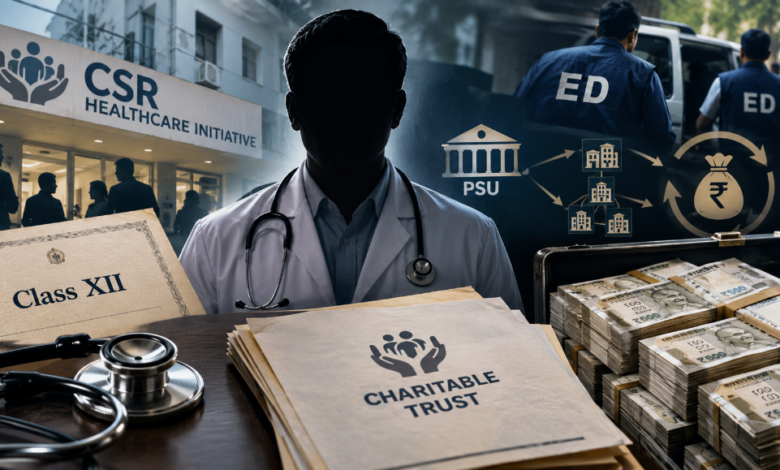
A Class XII pass allegedly wore a doctor’s coat for three decades. Forty public-sector balance sheets allegedly paid him for the privilege. The Enforcement Directorate has so far walked away with ₹21 lakh.
That is not a recovery. That is a receipt for how cheaply this country still prices a fraud dressed up as charity.
The coat, the title, the till
On 5 October 2026, the Directorate of Enforcement, Mumbai Zonal Office-I, put out a press release that should have embarrassed every CSR committee, every PSU board, and every public representative who has ever signed a “recommendation” on a hospital letterhead. The agency said it had searched eight locations on 1 October across Maharashtra, West Bengal, Gujarat and Delhi-NCR in the case of Dharmendra Kumar Chandradev Singh and others, an alleged bogus CSR donation racket. Cash of about ₹21 lakh was seized. Documents and digital devices were seized. And about ₹200 crore in CSR funds, the agency said, had been routed through the mechanism under investigation.
Read that sentence again. Two hundred crore routed. Twenty-one lakh in the bag. The rest is still a story the agency has not finished, and a story the institutions that wrote the cheques have not begun to tell.
The man at the centre of the ED’s account is not, on the agency’s own papers, a doctor. The release says he possesses no recognised medical qualification, holds no Medical Council registration, and studied only up to Class XII. It says he allegedly used the title “Doctor” for nearly three decades. It says he capitalised on that title to build a network of charitable trusts presented as healthcare CSR vehicles, and through them mobilised money from public sector undertakings and private companies.
A stethoscope was not required. A letterhead was.
July already had a man in custody. October still has no names.
This file did not begin with the October raids. On 13 July 2026, Times Now reported that Mumbai Crime Branch Unit-1 had arrested a man in his fifties accused of posing as “Dr. Dharmendra Kumar” for nearly 28 years. Police, the report said, recovered an identity card in that name, a PAN card, visiting cards, certificates purporting to come from institutions, medical equipment, and project papers linked to people and companies in Maharashtra and other states. He was produced in court and remanded to police custody until 16 July. The preliminary police figure then was about ₹10 crore in CSR funds over three years.
Hindustan Times later dated the Juhu cheating case to 12 July. Moneycontrol Hindi reported the predicate FIR as 1044/2026, registered that day at Juhu police station, Greater Mumbai, under the Maharashtra Medical Practitioners Act, 1961, the National Medical Commission Act, 2019, and the Bharatiya Nyaya Sanhita, 2023, including offences corresponding to the old IPC sections 420, 467, 471 and 475. Those are scheduled offences. That is what opened the door for a PMLA case.
So the sequence on the public record is blunt. A city police station books a man in July for allegedly impersonating a doctor and dipping into CSR money, then talked about in the region of ₹10 crore. Three months later a central agency searches four states and says the pipe carried about ₹200 crore, fed by at least 40 PSUs and public sector banks. Either the July figure was a keyhole, or the October figure is an early estimate that still has to survive a charge-sheet. Both can be true. Neither excuses the silence on names.
The October press release does not record an arrest, a provisional attachment, or a charge-sheet. It ends with the sentence agencies use when the hard work has not started: further investigation is under progress.
How the alleged machine was built
The ED’s account, read without the softening of a government handout, describes a toll booth erected on a legal obligation.
Under Section 135 of the Companies Act, 2013, a company meeting the thresholds — net worth of ₹500 crore or more, turnover of ₹1,000 crore or more, or net profit of ₹5 crore or more — must spend at least 2 per cent of its average net profit of the three preceding years on CSR. Unspent money has a clock on it. Miss the transfer deadlines and the company can be penalised up to twice the amount required to be transferred, capped at ₹1 crore, and officers in default up to ₹2 lakh. The law, in other words, punishes the company that fails to spend faster than it punishes the company that spends badly. That is the crack this alleged racket is accused of living in.
The cover, the agency says, was medical equipment. Trusts were projected as vehicles to buy high-end machinery for hospitals that claimed they could not pay. Those hospitals, the release says, were then connected to public representatives of the area. The representatives, or their staff, issued recommendations that the funding go specifically through the trusts operated by Singh. Enquiries, the ED says, showed that PSUs donated “primarily on the strength of such recommendations”.
Sit with that. Not on a tender. Not on a utilisation certificate that an auditor had kicked. On a recommendation.
From there the release describes the usual Indian layer cake. Trustees. CSR agents. Middlemen. Equipment suppliers. Vendor bills allegedly inflated. Projects only partly executed, or not executed in proportion to the money received. Excess routed through bogus or shell entities. Kickbacks and commissions allegedly paid to the intermediaries who brought the cheque. Most of those shell entities, the agency adds, have already been flagged in GST fraud cases. The same pipes, different labels.
Two doors, one till
The release is more careful than the headlines that followed it, and the difference matters.
On private companies, the ED is explicit. CSR contributions were returned substantially in cash to the contributors after a small commission was cut. Accounted money in. Unaccounted cash out. A donation entry left behind for the board report and the tax file. The agency’s own closing line is the indictment: “the CSR mechanism was utilised as a conduit for conversion of accounted funds into unaccounted cash.”
On PSUs and public sector banks, the release does not say the money was handed back to the company. It says at least 40 of them donated to these trusts, that delivery did not match the funds, that bills were inflated, and that intermediaries were paid. The lever it names is the public representative’s recommendation.
Some newspapers went further. The Times of India, and outlets rewriting it, reported that top executives of PSUs and government banks were bribed to release the funds. That sentence is not in the ED press release. It may yet be proved. It has not been proved by the document the agency actually signed. A serious investigation does not need a reporter to invent a bribe the agency has not yet alleged in its own note. The recommendation chain, the under-delivery, and the shell companies are already ugly enough.
The arithmetic of a system that does not look
India’s CSR pool is no longer petty cash. A Fulcrum report cited by BW Businessworld put FY 2023–24 spending at ₹34,909 crore, of which healthcare took ₹7,151 crore. A later Fulcrum-based account put FY 2024–25 CSR expenditure at ₹40,794 crore, with healthcare at ₹8,531 crore. Central public sector enterprises alone spent a record ₹6,437 crore on CSR in FY25, Business Standard reported from the Public Enterprises Survey, and nearly half of that went to hunger, healthcare and sanitation.
Set the ED’s ₹200 crore against that pool and a defender will call it small. That defence is the scandal. Two hundred crore is the price of equipment wards, diagnostic lines, and district hospitals that were allegedly promised and, on the agency’s account, only partly delivered. It is also, if the private-side allegation holds, a laundering fee dressed as philanthropy: companies meeting a statutory 2 per cent by buying their own cash back.
And the public recovery, six days after the searches, stands at about ₹21 lakh. Roughly one rupee seized for every thousand rupees the agency says moved. No trust named. No PSU named. No bank named. No public representative named. No hospital named. No supplier named. A racket that allegedly needed recommendations from elected offices is still being described as if the offices had no faces.
What a tightened case would actually do
Searches are not a result. A press release is not a charge-sheet. If this file is what the ED’s own language says it is, the next steps are not optional.
Name the trusts and freeze them. Name the 40 PSUs and public sector banks and haul their CSR committees, not their spokesmen. Match every recommendation letter to a utilisation certificate, a delivery challan, and a machine that either exists in a ward or does not. Call the public representatives whose staff allegedly steered the money, and the hospital administrators who allegedly asked to be steered. Trace the cash-back the agency says private donors received, and treat that not as a CSR lapse but as what it is alleged to be: accounted funds washed into unaccounted cash, with shell entities already flagged in GST cases sitting on the route. Attach property in proportion to the alleged proceeds, not in proportion to the cash found in a drawer. File the complaint. Seek custody where the law allows it. Put a clock on the trial.
Section 135 already threatens a company that fails to spend. It is much quieter about a company that spends into a fiction. That gap is now alleged to have been worth ₹200 crore in one network. Boards that signed these cheques should not be allowed to hide behind “we donated to a trust”. Donation is not due diligence. A recommendation is not an audit.
The man the agency describes studied to Class XII and allegedly practised a profession for thirty years on a title. The institutions that allegedly funded him have chartered accountants, vigilance officers, and independent directors. If the ED is right, the dropout was not the most culpable person in the room. He was only the one who noticed that nobody in the room was looking.
Disclaimer
Everything above that concerns Dharmendra Kumar Chandradev Singh, the trusts, the donors, the intermediaries and the public representatives is drawn from the ED’s press release of 5 October 2026, from the agency’s description of the Juhu FIR, and from contemporaneous reporting of that FIR and the July Crime Branch arrest. These remain allegations. A search is not a conviction. A press release is not a judgment. As of 7 October 2026, no court of law has convicted Singh or any other person named in this reporting of these offences. He and every other person and institution referred to are presumed innocent until proved guilty. The ₹10 crore figure is a July police estimate reported by Times Now. The ₹200 crore figure is the ED’s approximate estimate of funds routed, not money seized or judicially determined. Media claims that PSU executives were bribed go beyond the signed ED release and are treated here as unverified reporting, not as established fact. What is demanded is not a verdict by headline. It is a faster, tighter, named investigation, attachment where the law permits, a charge-sheet on a short clock, and a trial that does not outlive the equipment the money was supposed to buy.